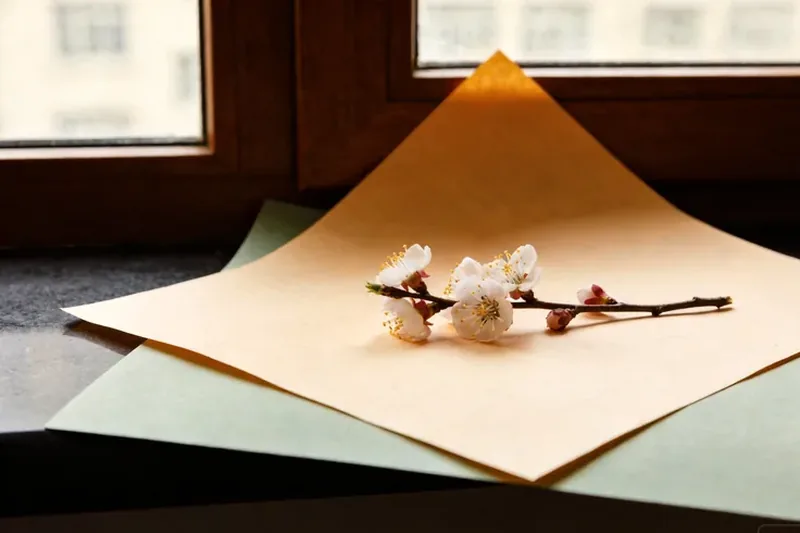
Technical answer: Plum blossom — méihuā (梅花) in Chinese — is the flower of Prunus mume, the East Asian “plum” (actually a close relative of the apricot) that blooms in late winter. It is one of the great floral motifs of Chinese incense and poetry, and the flower is used dried in floral incense blends and in the classical “plum incense” (梅花香) recipes.
Key facts
| Chinese | 梅花 (méihuā); dried flower also 白梅花 / 绿萼梅 |
| Botanical source | Prunus mume (syn. Armeniaca mume) — the flower |
| What it is | A dried flower, not a wood or resin |
| Aroma | Delicate, sweet, almondy, green-floral |
| Traditional role | Floral incense (梅花香), tea, poetry and seasonal culture |
Aroma profile
Direct answer: The fresh plum blossom has a delicate, cool, almond-sweet, green-floral scent that arrives while most plants are still dormant — a “winter” floral note. The dried flower is far subtler, used for a gentle floral lift in blends.
The fresh plum blossom has a delicate, cool, almond-sweet scent that arrives while most plants are still dormant — a “winter” floral note. The dried flower is far subtler, used for a gentle floral lift in blends. The blossom’s cultural weight — first flower of the year, a symbol of resilience — has always mattered as much as its scent. Where wintersweet reads spicy-sweet and osmanthus apricot-fruity, plum blossom is cool and quiet — the floral equivalent of the late-winter air in which it opens.
Botanical identity
Direct answer: Plum blossom is the flower of Prunus mume (syn. Armeniaca mume), a Rosaceae tree recorded by Flora of China at 4–10 m tall that blooms in late winter. It is a flower material — and the same tree yields a separate fruit material, 乌梅 (wūméi), the smoked dried fruit.
Prunus mume is a tree of the rose family, Rosaceae. Flora of China records it as a tree, rarely a shrub, 4–10 m tall, with smooth grayish-green bark and winter buds; it blooms in late winter, before most plants leaf out. The same tree yields two distinct materials:
- 梅花 (méihuā) — the blossom, used dried in incense and tea.
- 乌梅 (wūméi) — the smoked, dried fruit, a materia-medica and culinary item.
Note that “plum blossom” in English is a translation of convenience: Prunus mume is botanically closer to the apricot than to the European plum, and its Chinese name 梅 is its own thing. See Armeniaca mume (= Prunus mume) in Flora of China and Prunus mume on GBIF.
Chinese name and terminology
Direct answer: 梅花 (méihuā) is the blossom of Prunus mume, but the word 梅花 also names a grade of borneol — 梅花脑 / 梅花片, the top ice-like crystal. The two meanings point to completely different materials, so an incense label’s 梅花 must be read in context.
The name 梅花 carries two meanings that a buyer must separate:
- 梅花 (méihuā) — the plum blossom, the flower this page describes. The dried flower is also recorded as 白梅花 / 绿萼梅.
- 梅花脑 / 梅花片 — a grade of borneol (龙脑), the top ice-like borneol crystal, named for resembling plum-blossom ice.
The word 梅花 in an incense label can mean either the flower or the borneol grade — two completely different materials. See borneol.
Where does plum blossom come from?
Direct answer: Prunus mume is native to China and has been cultivated for millennia for its flowers and fruit, across East Asia and into Japan and Korea. It is an ancient horticultural plant rather than a wild-harvested aromatic.
Prunus mume is native to China and has been cultivated for millennia for its flowers and fruit, spreading across East Asia and into Japan and Korea. As a cultivated flowering tree, its supply follows horticulture — centuries of selected blossom varieties — rather than the wild-harvest or plantation patterns of the woods and resins of the incense canon.
Why is it used in incense?
Direct answer: Plum blossom is used in incense in two senses: the dried flower adds a delicate floral lift, and — far more famously — the plum-blossom theme anchors the classical “plum incense” (梅花香) recipes, including Princess Shouyang’s plum incense. Its incense role is as much cultural as aromatic.
Plum blossom’s incense role is inseparable from its cultural weight:
- 梅花香 (plum incense): classical incense recipes built around the plum-blossom theme are among the most famous in the tradition, including the storied 寿阳公主梅花香 (Princess Shouyang’s plum incense). The Song-dynasty Xiangpu (香譜) includes a 梅花香 method. See the Shouyang princess plum recipe.
- The flower itself: dried plum blossom is used for a gentle floral lift, though it is too delicate to carry a formula alone.
The blossom’s status as the “first of the four gentlemen” (梅兰竹菊) and the emblem of early spring matters as much as its scent.
How is it processed?
Direct answer: Plum blossom is harvested and dried; the whole dried flower is the commercial form. The drying method and the resulting moisture and color depend on the producer and grade, and for powder the particle size and moisture affect how the material behaves in a formula.
The essential step is simple: the opened blossoms are harvested and dried to a stable, storable form. From there it branches by end use — whole dried flowers for tea and display, or ground powder for blending into incense. For powder buyers, the same practical variables as any floral powder apply: particle size and moisture affect how the material packs, burns, and releases aroma, and the right target depends on the formula (see Our Industry View below). The drying and grinding mechanics sit within the wider how incense is made process.
What determines plum blossom quality?
Direct answer: Quality turns on cleanliness and an intact, gentle floral character — a clean, whole, delicately fragrant blossom beats a crumbled or stale one. There is no standardized numerical grading system; the buyer evaluates the physical condition of the lot.
The practical quality factors:
- Cleanliness — freedom from leaves, stems, and debris.
- Completeness — intact, well-formed blossoms over crushed material.
- Aroma — a gentle, clean floral character, not musty or stale.
- For powder — consistent particle size and moisture, judged against the specific formula.
Dried plum blossom is subtle, so its quality is judged by cleanliness and a gentle, intact floral character rather than by intensity.
Common forms
Direct answer: Plum blossom is sold as whole dried flowers (for tea and display) and as ground powder (for incense blending). The two are the same flower in different physical forms, not a quality distinction.
| Form | Typical use |
|---|---|
| Whole dried flowers | Tea, display, classical recipes |
| Powder | Blended into incense sticks and cones |
The distinction is functional, not a quality statement. See incense powder & resin for how floral powder behaves in practice.
In Chinese tradition
- 梅花香 (plum incense): classical incense recipes built around the plum-blossom theme are among the most famous in the tradition, including the storied 寿阳公主梅花香 (Princess Shouyang’s plum incense). The Song-dynasty Xiangpu (香譜) includes a 梅花香 method. Historical Record — documented classical recipes.
- Seasonal culture: plum blossom is the emblem of early spring and the “first of the four gentlemen” (梅兰竹菊), woven through poetry, painting, and seasonal ritual. Historical Record — documented cultural motif.
- A naming caution: “梅花” also names a grade of borneol — 梅花脑 / 梅花片, the top ice-like borneol crystal. That is 龙脑 (borneol), a completely different material. Modern Industry Practice — market terminology.
Traditional use vs modern evidence
The plum blossom’s role is cultural and aromatic, not medical. The dried flower (白梅花 / 绿萼梅) does appear in traditional materia medica, but we treat any such use as traditional, not established clinical fact, and make no medical claims. This page describes the flower’s floral and cultural role only.
Plum blossom vs related materials
Direct answer: Plum blossom (梅花, Prunus mume) is often confused with two very different things: wintersweet (蜡梅, Chimonanthus praecox), an unrelated winter-blooming shrub, and the borneol grade 梅花脑 / 梅花片, an ice-like crystal. All three share the “梅” word but are different materials.
| Material | Plant / source | Character |
|---|---|---|
| Plum blossom (梅花) | Prunus mume, Rosaceae | Delicate winter flower |
| Wintersweet (蜡梅) | Chimonanthus praecox, Calycanthaceae | A different winter-blooming shrub |
| 梅花脑 / 梅花片 | Borneol crystal (龙脑) | Ice-like borneol grade |
The word 梅 appears in all three, but they are unrelated. Wintersweet is a shrub of a different family that also blooms in winter — a standing confusion worth keeping straight. See wintersweet and borneol.
Adulteration & misidentification
Direct answer: The main risk is misidentification, not adulteration: the word 梅花 slides between the flower, the wintersweet shrub, and the borneol grade 梅花脑 / 梅花片. Reading the label in context — flower, plant, or crystal — resolves the matter.
Plum blossom is not an expensive, heavily faked aromatic; its risk is a naming matter. The principal confusion is the three-way slide of the word 梅花 across the flower, the unrelated wintersweet shrub, and the borneol crystal grade. See the substitution cross-reference for the general screening logic.
Modern commercial applications
Direct answer: Plum blossom reaches the market mainly as a cultural and seasonal flower — in tea, in named “plum incense” (梅花香) recipes, and as a delicate floral-incense accent — rather than as a volume aromatic. The flower’s commercial value lies in its signature and its symbolism.
Plum blossom’s commercial life is led by culture and season — the flower is a tea and seasonal item, and the plum-blossom theme anchors named classical incense recipes far more than the dried flower anchors a bulk formula. For a sourcing buyer, this split matters because the “plum” in a plum-incense product may be a theme, a flower, or — confusingly — a borneol grade, and a buyer must know which is meant before pricing or blending.
What buyers should look for
Direct answer: Buyers should confirm what “梅花” means in context — the flower, the wintersweet shrub, or the borneol grade — then judge the flower’s cleanliness and gentle floral character. For powder, test particle size and moisture against the formula.
For an incense maker or sourcing buyer:
- Meaning of 梅花 — confirm whether the label means the flower, wintersweet, or the borneol grade 梅花脑 / 梅花片; a real seller can state it.
- Form — whole flowers or powder; each behaves differently in a blend.
- Physical condition — clean, intact blossoms with a gentle floral character and no debris.
- Powder consistency — confirm particle size and moisture, and test a sample against your formula.
Safety
Incense combustion produces smoke and particulate matter. Burn in a well-ventilated space, avoid inhaling concentrated smoke, and keep away from children and pets. This is editorial knowledge content, not medical advice.
Our Industry View
Direct answer: In manufacturing, plum blossom is a signature and a theme, not a base. Its value is a delicate, cool floral lift and a name that carries centuries of cultural weight — but the dried flower is subtle, so a “plum incense” product is usually a themed blend, and consistency matters more than the flower’s intensity.
From a manufacturing perspective, plum blossom’s defining trait is the gap between its symbolic and its aromatic weight. The name 梅花 carries more cultural gravity than almost any other floral in the canon, but the dried flower itself is a whisper, not a statement.
Two points follow:
- It is a theme as much as a material. A “plum incense” (梅花香) is typically a blended recipe whose name and character reference the blossom, not a heavy dose of dried flower. A buyer should understand whether a “plum” product is built on the flower, on a theme, or — given the borneol-grade ambiguity — on something else entirely.
- Particle size and moisture affect behavior, not just aroma. As a floral powder, plum blossom is sensitive to the same grinding and drying variables as any powder; the right target depends on formulation — the binder, the other ingredients, and the production line — so a figure that works in one factory does not transfer to another.
In our view, the commercial sweet spot is a clean, correctly identified plum blossom used as a measured floral accent or a themed signature — a material whose value is cultural and subtle, rewarding precision over volume.
Summary
Plum blossom (梅花) is the late-winter flower of Prunus mume (syn. Armeniaca mume), a Rosaceae tree recorded by Flora of China at 4–10 m tall, valued as the emblem of early spring, the “first of the four gentlemen,” and the anchor of the classical “plum incense” (梅花香) recipes. Its main identification risk is the three-way slide of the word 梅花 across the flower, the unrelated wintersweet shrub, and the borneol grade 梅花脑 / 梅花片. In incense it is a delicate floral and a cultural signature, not a base; commercially, resolving what “梅” means and ensuring consistency outweigh intensity.
FAQ
Is plum blossom used in Chinese incense? Yes, in two distinct senses. The flower (Prunus mume blossom) is used dried in delicate floral blends, and it gives its name and theme to the famous classical “plum incense” (梅花香) recipes, including Princess Shouyang’s plum incense. But “梅花” also names a grade of borneol — 梅花脑 / 梅花片, the top ice-like crystal. So an incense label saying 梅花 may mean the flower or the borneol grade, and the two are completely different materials.
What does plum blossom smell like? The fresh blossom has a delicate, cool, almond-sweet, green-floral scent that appears in late winter, before most plants bloom. It is subtle rather than heavy — a quiet “first flower of the year” note. The dried flower used in incense is even more delicate and is blended to add a gentle floral lift rather than to dominate a formula.
What is Princess Shouyang’s plum incense (寿阳公主梅花香)? It is one of the most famous named incense recipes in the Chinese tradition, built around the plum-blossom theme and attributed to Princess Shouyang (寿阳公主). It is a blended incense whose name and character reference the plum blossom, and it survives as a classical recipe — see our page on the Shouyang princess plum recipe. It is a cultural and aromatic tradition, not a medical formula.
Is the “plum” in plum blossom the same as a European plum? Not exactly. Prunus mume is a close relative of the apricot, native to East Asia and grown for its winter blossom and its fruit (乌梅), not the European plum. The English name “plum blossom” is a translation of convenience for 梅 (méi). The botanical identity that matters is Prunus mume, the winter-blooming “mei.”
What is the difference between 梅花 and 乌梅? Both come from the same tree, Prunus mume. 梅花 (méihuā) is the blossom, used dried in floral incense and tea; 乌梅 (wūméi) is the smoked, dried fruit, used in materia medica and cooking. They are different parts of the same plant with different uses, and neither should be confused with the borneol grade 梅花脑 / 梅花片.
Is plum blossom the same as wintersweet? No. Plum blossom is the flower of Prunus mume (Rosaceae), while wintersweet (蜡梅) is Chimonanthus praecox, a shrub of a different family (Calycanthaceae) that also blooms in winter. They share the 梅 word and a winter-blooming habit, but they are unrelated plants, and neither should be confused with the borneol grade 梅花脑 / 梅花片.
See also: wintersweet, borneol, osmanthus, chrysanthemum, the Shouyang princess plum recipe, apricot kernel, daphne and the full scent guide.
Evidence & Sources
Botanical identity
Source: Armeniaca mume (= Prunus mume) in Flora of China · Prunus mume on GBIF. Evidence type: Established.
Traditional Chinese use
Source: the Song-dynasty Xiangpu (香譜) includes a 梅花香 method (卷三, “梅花香法”); the plum-blossom theme appears in classical incense recipes including 寿阳公主梅花香. Evidence type: Historically documented — cultural and aromatic use, not medical.
Authenticity / disambiguation
Source: 梅花 (the flower) vs 梅花脑 / 梅花片 (the borneol crystal grade) — the word’s two meanings in incense labels. Evidence type: Practical screening.
Safety
Source: incense combustion produces smoke and particulate matter; burn in a well-ventilated space. Evidence type: Established.
Evidence status
| Layer | Status |
|---|---|
| Botanical identity | Established |
| Traditional use | Historically documented |
| Authenticity test | Practical screening |
| Health claims | Not established |
Sources
Sources: botanical references on Prunus mume (syn. Armeniaca mume) and the Song-dynasty Xiangpu (香譜) plum-incense method. The 梅花 / 梅花脑 disambiguation is recorded as market terminology. Medicinal uses of the dried flower are treated as traditional, not established clinical fact. This is editorial knowledge content, not medical advice.