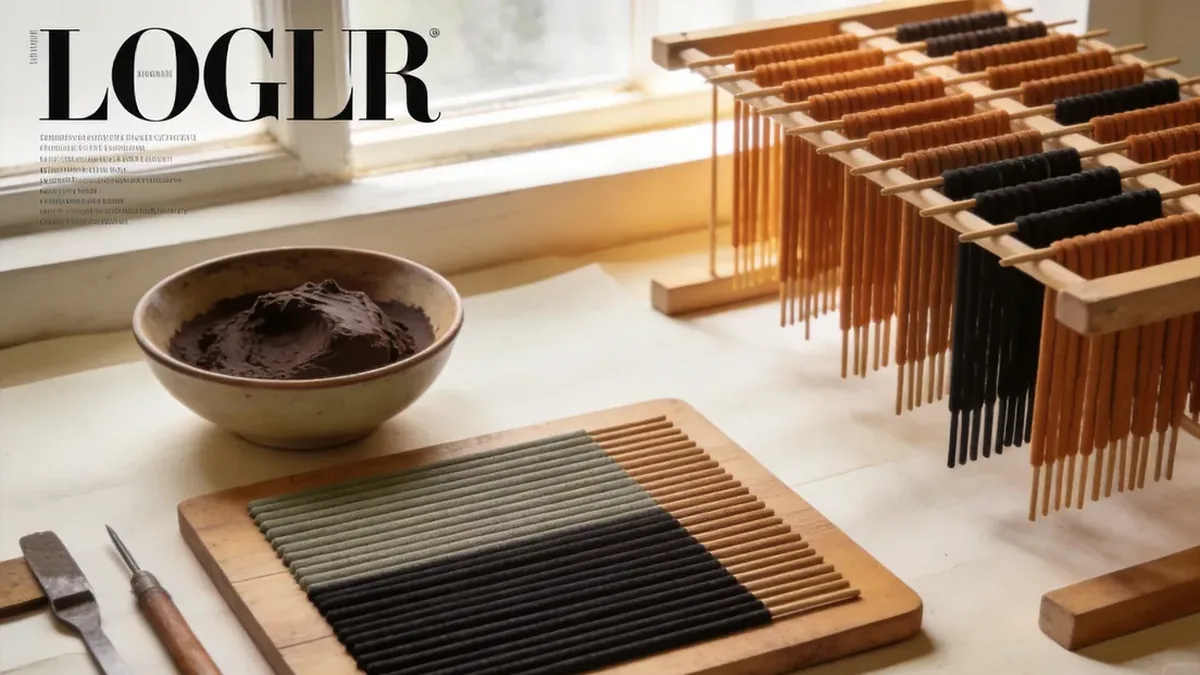
Definition: Incense is made by grinding fragrant materials (woods, resins, flowers, spices) into a powder, blending them — often with a natural binder — adding water to form a paste, then shaping it into sticks, coils, or cones and drying it. There are two broad methods: hand-rolled (from real botanicals) and machine-made (mass-produced, often fragrance-dipped).
Key facts: Traditional Chinese incense is built on the 合香 (hé xiāng) principle of blending multiple ingredients like a formula. The natural binder that holds it together is typically a combustible wood powder, most famously makko (Machilus thunbergii).
Key Takeaways
- The basic process is grind → blend → bind → shape → dry.
- The full production chain is raw materials → processing → formulation → manufacturing → quality control → final product.
- Traditional Chinese incense is blended (合香), not single-note.
- The binder is usually a combustible wood powder (makko), not glue.
- Hand-rolled vs machine-made is the key quality distinction (see the dedicated guide).
- “How it’s made” directly determines what you are actually burning.
The Basic Process
| Step | What happens |
|---|---|
| 1. Grind | Woods, resins, flowers, and spices are ground to a fine powder |
| 2. Blend | Ingredients are combined — in the Chinese tradition, by a 君臣佐使 formula principle |
| 3. Bind | A combustible binder (wood powder such as makko) and water form a workable paste |
| 4. Shape | The paste is extruded, rolled onto a bamboo core, or pressed into cones/coils |
| 5. Dry | The formed incense is dried slowly to lock the shape |
The same basic steps produce sticks (线香), coils (盘香), cones, and even coreless Japanese-style sticks — the shaping step is what differs.
Raw Materials: What Goes In
Direct answer: Incense starts from four functional families of material — the aromatic material (woods, resins, flowers, spices), the binder (a combustible wood powder such as makko), water, and, optionally, a core (bamboo or a neutral base). Each family has a distinct job in the finished product.
Every formed incense is built from a small number of functional components, and “how it is made” begins with which materials sit in each slot.
| Component | What it is | Job in the stick |
|---|---|---|
| Aromatic material | Powdered woods (sandalwood, agarwood), resins (frankincense, benzoin), dried flowers, spices | Supplies the scent |
| Binder | A combustible wood powder — most classically makko (Machilus thunbergii) | Holds the powder together and helps it burn |
| Water | Added to make a workable paste | Enables shaping; removed again in drying |
| Core (optional) | A thin bamboo splint, or a neutral charcoal/sawdust base | Gives a dipped stick its body and burn |
The aromatic material is the point of the product, but the binder is the part most buyers overlook. A proper natural binder — see makko & natural binders — is itself a wood powder, so it binds and burns cleanly rather than adding a glue smell. The full vocabulary of what can go into a blend is covered in the ingredients glossary.
The single most important material distinction, however, is not which wood or resin but whether the scent comes from real botanical powder or a fragrance oil. That question runs through the entire chain, and it is treated separately in what makes incense “natural”.
Processing: Turning Material into Powder
Direct answer: Processing converts whole botanicals into a fine, uniform powder by grinding (and sometimes sieving) so that the particles will burn evenly. The target fineness is not a fixed number — it depends on the material, the formulation, and the burn character the maker wants.
Before anything can be blended, the raw material must be reduced to a powder. This is more consequential than it looks, for two reasons:
- Uniformity. A stick burns only as evenly as its powder is mixed. Lumps or inconsistent particle sizes produce an uneven burn and an uneven scent.
- Material behavior. Different materials grind differently — resins are soft and can smear under heat, woods are fibrous, and oily materials can clog a mill. A maker adjusts the grinding to the material, not the other way around.
The fineness of the grind is a choice, not a spec. A finer powder packs more densely and can burn slower and cooler; a coarser grind burns faster and looser. Exactly what “fine” means in microns, and how a given material responds, depends on the material and formulation — no single number applies across the board. The full treatment of this stage, from raw grading through grinding, particle-size control, and sieving, is in how incense powder is made.
Formulation: Composing the Blend
Direct answer: Formulation is where the powders are combined in proportion. In the Chinese tradition this is a structured act — 合香 (hé xiāng), composed on a 君臣佐使 (chief–minister–assistant–guide) principle — rather than a random mix of smells.
Chinese incense is traditionally not a single material but a blend — 合香 (hé xiāng) — assembled on a formula principle analogous to Chinese herbal compounding (君臣佐使: chief, minister, assistant, guide). This is why “how incense is made” in the Chinese tradition is really “how a formula is composed,” not just “how a stick is rolled.” See the blending system for the full treatment.
The formula principle matters to a buyer because it explains why a classical Chinese incense is rarely a single note, and why “what is in it” matters more than “how it was rolled.” In practice:
- The chief (君) is almost always a wood — agarwood or sandalwood — because woods carry the longest, most stable burn.
- The minister (臣) rounds and reinforces the chief, usually at a fraction of its weight.
- The assistant (佐) supplies the signature note that gives a blend its name and character.
- The guide (使) binds and directs — often a binder or a processing step rather than a scented ingredient.
Note what the recipe logic implies: a maker will not publish exact proportions, because the formula — the ratio of chief to minister to assistant — is the craft itself. This page describes the framework, never a proprietary recipe. What is shared openly is the structure, and that structure is what separates a composed blend from a pile of powder.
Manufacturing: Shaping the Paste
Direct answer: Manufacturing is the shaping stage — the moistened paste is formed into sticks, coils, or cones, either by hand (rolled or extruded) or by machine (extruded or dipped). The method is the single biggest driver of quality and price.
The same blend can become several different products depending on how it is formed:
- Sticks (线香) — a thin rod, either built on a bamboo core or pressed coreless (see incense sticks).
- Coils (盘香) — the same paste wound into a spiral for a multi-hour burn (see incense coils).
- Cones — the paste pressed into a pyramid that burns down in a compact footprint.
Two production methods dominate, and they produce different products:
-
Hand-rolled (masala style) — dry botanical powders are blended into a paste and hand-rolled onto a bamboo core, or extruded as a coreless stick. The scent comes from the actual materials. This is the traditional, higher-end method.
-
Machine-made / dipped — a core (bamboo or charcoal) is machine-coated or dipped in a liquid fragrance. Faster and cheaper, with a uniform — often synthetic — scent.
See hand-rolled vs machine-made for how to tell which you are buying. The key point to carry into any purchase: the shaping method and the material source are two separate questions that usually, but not always, line up.
Drying and Curing
Direct answer: After shaping, the wet incense must be dried — slowly and evenly — to remove the water added for shaping, and often then cured for a period so the blend’s aromas settle and fuse. Both stages change the scent and the burn.
The freshly formed stick is still damp, and what happens next matters almost as much as the blend. Drying is not just “waiting for it to dry out”:
- Drying removes the shaping water. Done too fast or unevenly, a stick can crack, warp, or burn inconsistently.
- Curing is the quieter stage that follows: a rest period in which the volatile aromas of the different ingredients settle and merge into a single, rounded character.
Both stages are covered in depth in how incense is dried and cured. For a buyer the practical takeaway is simple: a well-dried, well-cured stick burns evenly and smells settled, while a rushed one can smell raw or burn unevenly — and neither condition is visible on a shop shelf.
Quality Control
Direct answer: Quality control checks that the finished incense matches its specification — material consistency, particle size, moisture, density, and burn behavior — and that one batch matches the next. It is the difference between a one-off good stick and a reliable product.
How a maker knows a batch is good is a process, not a badge. The checks run from incoming material to the finished stick:
- Incoming inspection — is the raw material the right species and grade? See incense authentication.
- In-process control — is the blend, moisture, and forming held steady during production?
- Final inspection — does the finished product match the agreed specification on burn time, aroma, and form?
The buyer’s side of this — what to look for in consistency, particle size, moisture, density, burn behavior, and batch-to-batch variation — is treated fully in incense manufacturing quality control.
Final Product: Forms, Packaging, and What Reaches You
Direct answer: The finished product is a dried, cured incense in one of several forms — stick, coil, cone, or loose powder — packaged to protect it from moisture and competing odors. Packaging is the last manufacturing step, and it is what preserves the scent until it reaches the buyer.
The end of the line is the product in your hand, and two things about it are worth knowing:
- The form is the product. A stick, a coil, a cone, and loose powder are the same material tradition in different geometries, each suited to a different session length and smoke profile. Choosing between them is covered in which incense format.
- Packaging is not cosmetic. Incense absorbs moisture and ambient odors, so sealing it from air, humidity, and competing scents is what keeps the product stable between the factory and your holder. The practical storage side is in incense storage & longevity.
Common Mistakes
- Assuming all incense is “just wood.” It is a blend of ground materials plus a binder.
- Confusing the binder with glue. The traditional binder is a combustible wood powder (makko), not a chemical adhesive.
- Thinking “hand-rolled” and “natural” are the same. Hand-rolled refers to the method; “natural” refers to the ingredients. They usually overlap but are not identical.
- Ignoring drying and curing. Two sticks with the same ingredients can smell different if one was rushed through drying.
- Assuming a good first batch means a good every batch. Quality control is what makes quality repeatable — it is a process, not a single lucky stick.
The Author’s Take
Position: “How incense is made” is really two questions — the mechanics and the philosophy (合香) — and the philosophy is the one worth knowing.
Reasoning:
- Most content stops at the mechanics.
- 合香 explains why a Chinese incense is rarely a single note — and why “what is in it” matters more than “how it was rolled.”
- The binder question is my favorite litmus test: makko or a chemical adhesive?
- Add to that the stages most buyers never see — grinding, drying, curing, quality control — and you realize a stick is the tip of a much longer process.
This is the author’s editorial view and experience — not a verified fact.
Verification Notes
- The grind → blend → bind → shape → dry process is standard incense-making description.
- Makko as Machilus thunbergii and the 合香 / 君臣佐使 blending principle are standard cultural/technical facts.
- No proprietary formulas are exposed; blending is described at the level of role and principle only.
- No factory experience, production capacity, certification, or test data is asserted. Where quantitative parameters (particle size, moisture, drying time) would apply, they are described as dependent on material and formulation.
- No health or medical claims are made.
Cluster directory
- How Incense Powder Is Made: Grinding, Sieving, and Blending
- How Incense Is Dried and Cured
- Incense Manufacturing Quality Control: What Buyers Should Check
- Hand-Rolled vs Machine-Made Incense: How to Tell the Difference
- The 合香 Blending System: How Chinese Incense Is Composed Like a Formula
- Incense Authentication: How to Spot Fake Agarwood, Sandalwood, and Resin
- Incense Ingredients Glossary: Wood, Resin, Flower, and Spice
- Makko & Natural Binders: The Wood Powder That Holds Incense Together
- Buying 奇楠 (Qinan): What to Check Before You Pay
- What Makes Incense “Natural”? Binders, Bases, and the Label Problem
FAQ
Q: What is incense made of?
A: Incense is made of ground fragrant materials — woods, resins, flowers, and spices — plus a natural combustible binder that holds them together, mixed with water into a workable paste and shaped into sticks, coils, or cones, then dried. The binder is typically a combustible wood powder such as makko (Machilus thunbergii), not glue. In the Chinese tradition, the fragrant materials are usually a blend (合香) rather than a single ingredient, composed on a formula principle. So the answer depends on the product: a hand-rolled stick uses real botanicals, while a dipped stick uses a fragrance.
Q: What holds incense sticks together?
A: A natural binder holds the ingredients together, and it is traditionally a combustible wood powder — most famously makko, from the Machilus thunbergii tree — rather than glue or chemical adhesive. The binder does two jobs: it makes the ground botanicals cohere into a shapeable paste, and because it is itself a wood powder, it burns cleanly along with the incense and helps the stick smolder evenly. In cheap, machine-dipped incense, the base may be charcoal or bamboo dust instead, and the scent is carried by a liquid fragrance rather than the binder’s material.
Q: What is the difference between hand-rolled and machine-made incense?
A: Hand-rolled incense is made by blending dry botanicals into a paste and rolling it onto a bamboo core by hand, or extruding it as a coreless stick — the scent comes from the actual materials. Machine-made incense is mass-produced for speed and consistency, and is often made by coating or dipping a core (bamboo or charcoal) in a liquid fragrance, giving a cheaper, uniform, frequently synthetic scent. The distinction is really about method and ingredients together: hand-rolled usually means real material, machine-dipped usually means fragrance oil. See hand-rolled vs machine-made.
Q: What is 合香 (hé xiāng)?
A: 合香 (hé xiāng) is the Chinese tradition of blended incense — combining multiple fragrant ingredients into a single formula, rather than burning one material alone. It is composed on a principle analogous to Chinese herbal compounding, the 君臣佐使 system, which assigns each ingredient a role: chief (君), minister (臣), assistant (佐), and guide (使). This is why a classical Chinese incense is rarely a single note — the blend is designed to balance top, middle, and base notes. See the blending system for the full framework.
Q: What happens after the incense is shaped?
A: After shaping, the wet incense is dried to remove the water that made it workable, and it is often then cured for a period so the different aromas settle and fuse into a single rounded character. Both stages matter: drying too fast or unevenly can crack a stick or make it burn inconsistently, while curing softens raw edges in the scent. After that, the finished product is checked against its specification — material, moisture, density, and burn behavior — and packaged to protect it from moisture and competing odors. See drying and curing and quality control.
Sources
- Editorial synthesis of established incense-making craft (base, binder, scent material, extrusion/rolling).
- Traditional craft sources on 合香 and stick-making.
- Botanical references on the makko tree, Machilus thunbergii: Machilus in Flora of China and Machilus thunbergii on GBIF.
- EPA indoor air quality — background on smoke from burning incense.
- American Lung Association indoor air pollutants — on particulate matter and indoor burning.
Related Resources
- Makko & Natural Binders
- Hand-Rolled vs Machine-Made
- What Makes Incense “Natural”
- Incense Ingredients Glossary
Natural next step: understand the binder that holds it all together in makko & natural binders, or the quality split in hand-rolled vs machine-made.