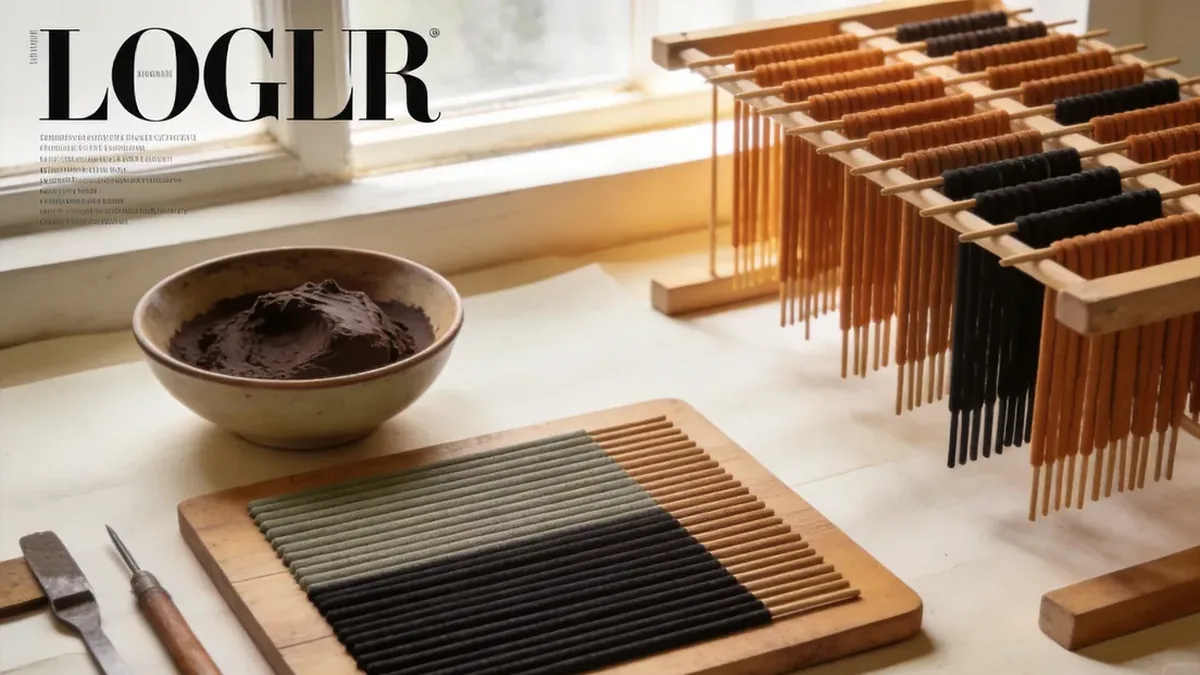
Direct answer: Drying is the stage where the water added to make the incense paste workable is removed, and curing is the rest period that follows, during which the blend’s aromas settle and fuse into a single rounded character. Both stages change how the incense burns and smells, and neither is visible once the product is packaged.
Key facts: Freshly formed incense is damp and raw. Drying too fast or unevenly cracks or warps it; curing too short leaves the scent sharp and unintegrated. The moisture level that matters is not a fixed number — it depends on the material and formulation.
Key Takeaways
- Drying removes shaping water; curing fuses the aromas afterward.
- Both stages are invisible in the finished product but decisive for burn and scent.
- Even, gradual drying beats fast drying — speed causes cracks and uneven burn.
- Moisture affects both burn and aroma, and the target level depends on material and formulation.
- A well-cured stick smells settled and rounded; a rushed one smells raw and sharp.
Why Drying and Curing Matter
Direct answer: Drying and curing matter because incense is shaped wet and finished dry — the transition between those two states determines whether a stick burns evenly and whether its blend smells composed rather than raw.
Most accounts of incense-making stop at “dry it.” That understates the stage. The wet stick that comes off the shaping line is a fragile, unfinished thing:
- It is structurally weak — wet paste will not hold its form or burn.
- It is aromatically raw — the individual ingredients have not yet merged.
Drying and curing are the two stages that fix both problems, and they reward patience in a way that a factory schedule often resists. A stick can be rushed through this stage and still look fine, which is why the distinction is so useful to a buyer: it explains why two sticks with the same listed ingredients can smell and burn differently.
Drying: Removing the Water
Direct answer: Drying removes the water that was added to make the paste workable, so the incense becomes firm, self-supporting, and burnable. The method and the pace both matter — the goal is even, gradual moisture loss.
The water in the paste served one purpose: making the powder blend shapeable. Once shaped, it has to go, and how it goes matters:
| Drying condition | Effect on the stick |
|---|---|
| Slow, even, air-dried | Firm, uncracked, burns evenly |
| Too fast / too hot | Surface dries first and shrinks — cracks and warping |
| Uneven air flow | One side dries faster than the other — a bent or warped stick |
| Insufficient drying | Residually damp — hard to light, weak smolder, mold risk |
The practical principle is gradual and even. Natural air-drying in a cool, well-ventilated space is the traditional and common method; forced or heated drying must be controlled so the surface does not outpace the interior. A stick dried too fast develops a crust that traps moisture inside — it looks dry and is not.
The method itself is less important than the control applied to it. Air-drying is forgiving but slow; forced or heated drying is faster but demands attention, because heat accelerates not just water loss but the loss of volatile aroma compounds. A maker with no drying control will produce a batch that is dry in some sticks and damp in others, and the customer discovers the difference only when lighting them.
Moisture and the burn. The amount of moisture left in the finished stick is a real quality variable, but it is not a single number: it depends on the material and the formulation. What is consistent across products is the direction — too much residual moisture makes a stick hard to light and weak-smoldering, while an overdried stick can become brittle and burn too fast. The maker targets a moisture level matched to the specific blend, not a universal percentage.
Moisture and the aroma. Drying also affects scent. Heat drives off volatile aromatic compounds, so a drying method that is too hot can strip top notes along with the water. This is the same heat-sensitivity that governs grinding — the volatile compounds are the product, and they leave under heat at every stage of the process.
Curing: Letting the Aromas Fuse
Direct answer: Curing is a rest period after drying, during which the volatile aromas of the different ingredients settle, merge, and lose their raw edges, so the blend smells like one composed scent instead of several separate ones.
If drying is about structure, curing is about aroma integration. A freshly dried blended incense can smell like its ingredients are still separate — the wood here, the resin there, the floral on top — because the volatile compounds have not yet settled into balance. Curing is the quiet interval in which that happens.
The traditional Chinese term for this is 窨 (xūn/yìn) — “aging” or “maturing” the blend, the same word used for maturing tea with a scenting material. Classical recipes frequently direct that a finished blend be left to age (久窨) before it is burned, as the 江南李主帐中香 recipe records — the aging is itself a step in the formula, not an afterthought.
What actually happens during curing, stated without over-claiming:
- Volatile compounds equilibrate — the sharper top notes mellow and the blend rounds out.
- The ingredients merge — individual characters soften into a single, integrated scent.
- The burn stabilizes — a settled stick smolders more predictably than a freshly dried one.
Curing is the stage that rewards a maker’s patience and punishes a buyer’s impatience in equal measure. The distinction is practical, not philosophical: a blend composed of resin, wood, and floral reads as three separate smells when fresh, and as one smell when it has rested. Neither is “better” in the abstract — some makers prefer the bright edge of a fresh blend — but they are different products, and a buyer should know which they are getting.
The duration of curing is not a fixed number — it depends on the material and the formulation. Some blends are designed to be used soon; others are traditionally rested for a long period. The honest statement is that curing changes the blend, and that the maker chooses a rest matched to the recipe — no universal “X days” is asserted here.
The Honest Limits
Direct answer: Drying and curing are well-understood craft stages, but their precise parameters — exact moisture targets, exact curing durations — are material- and formulation-specific and are not asserted here.
This page describes the principles of drying and curing — why they matter, what can go wrong, and what they change — without inventing numbers:
- No specific moisture percentage is claimed as universal; it depends on material and formulation.
- No specific curing duration is claimed as universal; it depends on material and formulation.
- No measured scent-profile or burn data is asserted.
The value to a buyer is the concept: drying and curing are real, consequential stages that separate a settled product from a rushed one, even when the two look identical on the shelf.
Common Mistakes
- Assuming drying is just “waiting for it to dry.” The pace and evenness decide whether the stick cracks or burns evenly.
- Confusing drying with curing. Drying removes water; curing fuses aromas. They are separate stages.
- Equating “dry” with “done.” A stick can be dry but not yet cured — raw and sharp rather than settled.
- Expecting one universal moisture or curing number. Both depend on the material and formulation.
- Burning a rushed stick and blaming the blend. An unintegrated scent is often a curing problem, not a formula problem.
The Author’s Take
Position: Drying and curing are the two stages where incense-making stops being a recipe and becomes patience — and it is exactly the patience a rushed market skips.
Reasoning:
- Anyone can grind and blend; the maker is revealed by how they handle the waiting.
- A buyer who has learned to smell the difference between “dry” and “cured” can tell a settled product from a rushed one without seeing the factory.
- The Chinese habit of naming aging (窨) as a step in the formula is the single best clue that the tradition treats time as an ingredient.
This is the author’s editorial view and experience — not a verified fact.
Verification Notes
- The drying/curing distinction and the principle of gradual, even drying are standard incense-making descriptions.
- The use of 窨 (aging/maturing) as a named step in classical 合香 recipes is documented in the recipe texts; see the blending system and recipe library.
- No specific moisture percentages, curing durations, or measured burn/scent data are asserted; quantitative parameters are described as material- and formulation-dependent.
- No factory experience, capacity, certification, or test data is claimed.
- No health or medical claims are made.
FAQ
Q: What is the difference between drying and curing incense?
Drying is the stage that removes the water added to make the incense paste workable, leaving the stick firm, self-supporting, and burnable. Curing is the rest period that follows, during which the volatile aromas of the different ingredients settle and fuse into a single rounded character. They are separate stages with separate jobs: drying fixes the structure, curing integrates the scent. A stick can be dry but not yet cured.
Q: How long does incense need to cure?
There is no single answer — the curing period depends on the material and the formulation. Some blends are designed to be used soon after drying, while others, especially classical Chinese blends, are traditionally rested for a long period so the aromas integrate. The Chinese tradition treats aging (窨) as a named step in the formula rather than a fixed number of days. The reliable statement is that curing changes the blend, and the maker chooses a rest matched to the recipe.
Q: Why does some incense crack or warp?
Cracking and warping are almost always a drying problem. When a stick dries too fast or unevenly, the surface shrinks before the interior, which creates cracks, or one side dries before the other, which bends the stick. A crust can also form on the outside and trap moisture inside, so the stick looks dry but is not. Gradual, even drying in a cool, ventilated space is the standard way to avoid this.
Q: Does moisture affect how incense burns?
Yes. Too much residual moisture makes a stick hard to light and weak-smoldering, and it can encourage mold, while an overdried stick becomes brittle and can burn too fast. The target moisture level is not one universal number — it depends on the material and the formulation — but the direction is consistent: the maker aims for a moisture level matched to the specific blend, and a rushed or uneven dry shows up as a poor burn.
Q: Why does a freshly made blend smell raw?
Because the aromas have not yet integrated. A freshly dried blended incense can smell like its ingredients are still separate — wood here, resin there, floral on top — because the volatile compounds have not settled into balance. Curing is the rest period in which the sharp top notes mellow and the ingredients merge into a single composed scent. A raw, sharp scent is often a sign of too little curing rather than a fault in the formula itself.
Sources
- Editorial synthesis of established incense drying and curing practice (gradual, even drying; aroma integration during rest).
- Traditional craft sources on 合香 and the aging step (窨) in classical recipes.
- EPA indoor air quality — background on smoke from burning incense.
- American Lung Association indoor air pollutants — on particulate matter and indoor burning.
Related Resources
- How Incense Is Made
- How Incense Powder Is Made
- Incense Manufacturing Quality Control
- Incense Storage & Longevity
Natural next step: see the whole chain in how incense is made, or what a finished stick should be checked against in quality control.