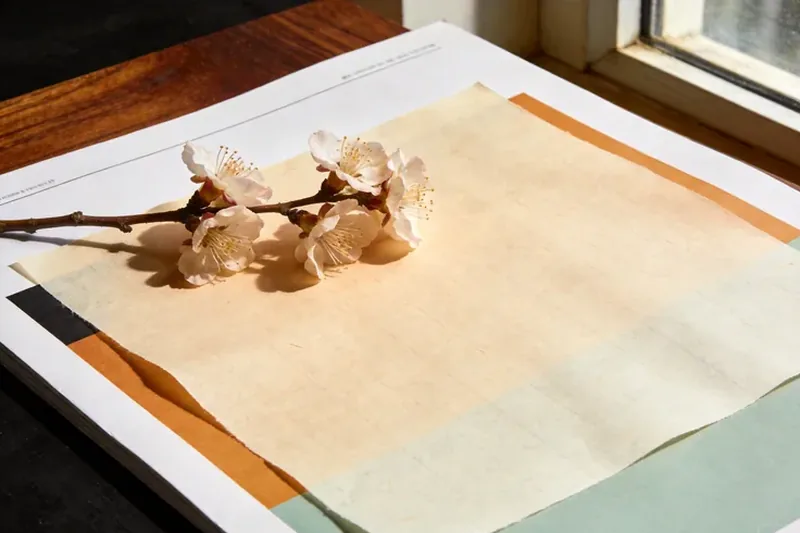
Direct answer: Wintersweet (蜡梅, làmèi) is the flower of Chimonanthus praecox, a winter-flowering shrub of the wintersweet family (Calycanthaceae) native to central China. It is a sweet, honeyed, waxy floral that blooms in deep winter, prized in Chinese gardens and used as a winter floral note in incense. Despite its name, it is not a plum — it belongs to a different family from the true plum blossom (梅花, Prunus mume).
Key facts
| Chinese | 蜡梅 (làmèi) — “wax plum”; also 腊梅 |
| Botanical source | Chimonanthus praecox (family Calycanthaceae) — the flower |
| What it is | A winter-blooming flower, not a plum or a wood |
| Aroma | Sweet, floral, honeyed, waxy |
| Traditional role | Winter floral note; garden ornamental |
Aroma profile
Direct answer: Wintersweet is sweet and honeyed, with a waxy, almost creamy floral character that carries its scent unusually well in cold air — a trait that makes its deep-winter bloom memorable. It is warmer and rounder than the delicate, almondy plum blossom, closer to a honeyed floral than a green one, and in a blend it reads as a soft winter floral.
Wintersweet is sweet and honeyed, with a waxy, almost creamy floral character that carries its scent unusually well in cold air — a trait that makes its deep-winter bloom memorable. It is warmer and rounder than the delicate, almondy plum blossom, closer to a honeyed floral than a green one. In a blend it reads as a soft winter floral, adding a sweet, rounded bloom note.
Botanical identity
Direct answer: Chimonanthus praecox is a deciduous or sometimes persistent-leaved shrub or small tree, 3–13 m tall, of the wintersweet family (Calycanthaceae). Flora of China records its sweetly fragrant flowers, 1.5–4 cm across, with 15–21 yellow tepals — the inner ones usually marked purplish-red — blooming October to March.
Chimonanthus praecox is a deciduous (sometimes partly persistent-leaved) shrub or small tree, 3–13 m tall, of the wintersweet family (Calycanthaceae). Flora of China describes sweetly fragrant flowers 1.5–4 cm in diameter, appearing on the previous year’s branches generally before the leaves, with 15–21 yellow tepals whose inner ones usually carry purplish-red pigment; it blooms from October to March. The family Calycanthaceae is small and distinct from the rose family (Rosaceae) that contains the true plum. The Chinese name 蜡梅 means “wax plum” — a reference to the flower’s waxy, translucent petals, not to any botanical relation to the plum. See Chimonanthus praecox in Flora of China and on GBIF.
Chinese name and terminology
Direct answer: 蜡梅 means “wax plum,” naming the flower’s waxy, translucent petals, and the alternative 腊梅 ties it to the twelfth lunar month (腊月) when it blooms. Neither spelling implies a relationship to the true plum — 蜡梅 is Calycanthaceae, while 梅花 is Prunus mume in the rose family (Rosaceae).
The name 蜡梅 (“wax plum”) refers to the flower’s waxy, almost artificial-looking petals, while the variant 腊梅 ties the plant to 腊月, the twelfth lunar month of deep winter when it blooms. Both spellings record the same plant. The “梅” in the name is a descriptive convenience, not a botanical claim: 蜡梅 (Chimonanthus praecox) sits in the wintersweet family (Calycanthaceae), while the true plum blossom 梅花 (Prunus mume) sits in the rose family (Rosaceae).
蜡梅 vs 梅花: unrelated plants (read this)
Direct answer: 蜡梅 (wintersweet) and 梅花 (plum blossom) are unrelated plants that share a winter-blooming season and a “梅” in their names. 蜡梅 is Chimonanthus praecox (Calycanthaceae), with a honeyed, waxy scent; 梅花 is Prunus mume (Rosaceae), with a delicate, almondy scent. Different families, different characters.
This is the key disambiguation for the material:
- 蜡梅 (wintersweet) — Chimonanthus praecox, wintersweet family (Calycanthaceae). A honeyed, waxy winter floral. This entry.
- 梅花 (plum blossom) — Prunus mume, rose family (Rosaceae). A delicate, almondy, early-spring floral. See plum-blossom.
They share a cold-season bloom and the “梅” character, but they are unrelated plants with different scent characters — and each has its own entry in this encyclopedia. The confusion is reinforced by the fact that both are celebrated winter/early-spring garden flowers, but a buyer or reader should not let the shared character blur their separate botanical identities.
Where does wintersweet come from?
Direct answer: Wintersweet is native to central China and has been cultivated for centuries as a winter-blooming ornamental. Flora of China notes it is now grown throughout most of China and in other temperate regions of the world, particularly for its sweetly fragrant flowers — and that its long cultivation makes some of its reported native distribution uncertain.
Chimonanthus praecox is a Chinese native, cultivated for centuries as a winter-blooming ornamental. Flora of China records that it is “cultivated throughout most of China as well as in other temperate areas of the world as a decorative plant, particularly for its sweetly fragrant flowers,” and notes that because of its extensive and long cultivation, some of the reported distribution is uncertain as to whether it is actually native. This is a plant whose value is horticultural and aromatic, not commercial in the sense of a bulk incense crop — which shapes how it appears in the market (see below).
Why is it used in incense?
Direct answer: Wintersweet is used in incense as a soft, honeyed winter floral note, its scent evoking the deep-winter bloom. It is more often encountered as a garden flower and a fragrance accord than as a bulk incense material, so it functions as a niche sweet-floral accent rather than a staple.
Wintersweet’s role in incense is as a soft, honeyed winter floral note. Its waxy, sweet bloom character suits soft, sweet winter florals rather than bright or spicy blends. It is, however, more often encountered as a garden plant and a fragrance accord than as a bulk material — the flower is not produced at incense-crop scale the way, say, jasmine or rose is — so its incense presence is typically a sweet-floral accent or a perfumery evocation rather than a heavy base.
How is it processed?
Direct answer: Wintersweet is used as the flower, dried or rendered as a fragrance accord. Because it is not a bulk incense crop, it is usually captured as a floral accord or used as small quantities of dried bloom, rather than processed into a standardized powder like jasmine or rose.
The part used is the flower. Because wintersweet is a garden ornamental rather than a bulk crop, its processing differs from the big commercial florals:
- Dried flower — small quantities of dried bloom, for potpourri and niche blends.
- Fragrance accord — more commonly, the wintersweet character is reproduced as a sweet, honeyed-waxy floral accord, since the natural flower is not harvested at scale.
This is the key commercial distinction: wintersweet is a garden flower, not an incense crop, so its scent reaches blends more often as an accord than as a massed dried material.
What determines wintersweet quality?
Direct answer: For the natural flower, quality means a fresh, sweet, honeyed bloom — but because wintersweet is not a bulk crop, “quality” is mostly a horticultural and fragrance-accord matter rather than a graded-material matter. The commercial question is less about grade than about whether the “wintersweet” note is natural flower or a reproduced accord.
The practical points differ from a bulk incense material:
- Natural flower — fresh, sweet, honeyed bloom; a garden rather than a commercial crop.
- Accord vs natural — a “wintersweet” fragrance is often a reproduced accord; whether a buyer wants the natural flower or the accord is a specification question.
- Disambiguation — confirm it is 蜡梅 (Chimonanthus praecox), not 梅花 (Prunus mume), which is a different flower.
Wintersweet carries no standardized incense grading ladder — it is not a bulk material — so “quality” is a horticultural and accord-reproduction matter rather than a graded-material matter.
Common forms
Direct answer: Wintersweet is encountered as a garden flower, as small quantities of dried bloom, and — most commonly in fragrance — as a sweet, honeyed-waxy floral accord. It is not a bulk incense form like jasmine or rose powder.
| Form | Typical use |
|---|---|
| Fresh flower | Garden; seasonal appreciation |
| Dried flower | Potpourri; niche blends |
| Fragrance accord | Perfumery and incense, reproducing the honeyed-waxy note |
In Chinese tradition
- Garden culture: wintersweet is a celebrated winter ornamental of classical Chinese gardens, valued for flowering in the coldest months when little else blooms.
- Incense: the flower is used as a soft, honeyed winter floral note in blends, its scent evoking the deep-winter bloom.
- Materia medica: 蜡梅 appears in traditional Chinese medicine with described uses. This is traditional materia-medica language, not modern clinical evidence.
Traditional use vs modern evidence
Direct answer: Wintersweet’s garden-cultural and aromatic use is well documented. Its medicinal uses are traditional, not established clinical fact, and this page makes no medical claims. The documented non-medical facts are its botanical identity, its Calycanthaceae placement, and its honeyed winter-floral aromatic use.
- Traditional Use — 蜡梅 is a celebrated winter garden ornamental and a soft, honeyed winter floral note.
- Historical Record — its name (wax plum, 蜡梅) and seasonal spelling (腊梅) are established cultural usage; Flora of China records its long cultivation as a fragrant ornamental.
- Scientific Evidence — the flower’s aromatic chemistry is characterized in fragrance work, but we present no clinical or medical efficacy claims.
The garden-cultural and aromatic use is well documented. Medicinal uses are traditional, not established clinical fact, and we make no medical claims.
What buyers should look for
Direct answer: Buyers should first decide whether they want the natural flower or a reproduced accord, since wintersweet is not a bulk crop and its fragrance is usually supplied as an accord. Then confirm the disambiguation — 蜡梅 (Chimonanthus praecox) vs 梅花 (Prunus mume) — and, for the natural flower, check for a fresh, sweet, honeyed bloom.
For an incense maker or sourcing buyer:
- Natural flower vs accord — wintersweet’s scent is usually supplied as a reproduced accord, not a massed dried flower; specify which you want.
- Disambiguation — 蜡梅 (Chimonanthus praecox) vs 梅花 (Prunus mume); unrelated plants despite the shared 梅 name.
- Freshness (natural flower) — a fresh, sweet, honeyed bloom rather than a faded one.
Our Industry View
Direct answer: Wintersweet’s commercial lesson is the garden-versus-crop distinction: it is a celebrated ornamental whose scent reaches incense mostly as a reproduced accord, not as a bulk material. A buyer asking for “wintersweet” should know they are usually buying a honeyed-waxy floral character, not a massed dried flower — and should keep it distinct from the plum blossom.
From a manufacturing perspective, wintersweet is instructive because it is a garden flower, not an incense crop. It blooms in deep winter, is beloved as an ornamental, and has a memorable honeyed-waxy scent — but it is not harvested at the scale of jasmine or rose, so its scent reaches blends mainly as a reproduced accord. Two points follow:
- Know whether you are buying flower or character. A “wintersweet” note in a formula is usually a sweet, honeyed-waxy floral accord, not a massed dried bloom. A buyer who wants the natural flower should say so explicitly — and accept that it will be a niche, seasonal material, not a bulk commodity.
- The 梅 character is a trap. 蜡梅 and 梅花 are unrelated plants — Calycanthaceae vs Rosaceae — sharing a cold-season bloom and a name character. In sourcing, the only reliable identifier is the species name, because “梅” will not keep a waxy winter flower and an almondy early-spring blossom apart.
In our view, wintersweet is a lovely, evocative winter note best understood as a character to be reproduced or a niche natural material — buy it by species, decide flower-versus-accord up front, and do not let the shared 梅 name blur it into the plum blossom.
Summary
Wintersweet (蜡梅) is the flower of Chimonanthus praecox, a wintersweet-family (Calycanthaceae) shrub or small tree native to central China, with a sweet, honeyed, waxy bloom that carries well in cold air. It is a garden ornamental first and an incense note second, usually reaching blends as a reproduced accord rather than a bulk material. Despite its name it is not a plum — it is unrelated to 梅花 (Prunus mume, Rosaceae) — and its medicinal uses are traditional language, not clinical evidence.
FAQ
What is 蜡梅 (wintersweet)? The flower of Chimonanthus praecox, a winter-flowering shrub of the wintersweet family (Calycanthaceae) native to central China. It is a sweet, honeyed, waxy floral that blooms in deep winter and is prized in Chinese gardens. Despite its name, it is not a plum — it belongs to a different family from the true plum blossom.
Is 蜡梅 the same as 梅花 (plum blossom)? No. 蜡梅 (wintersweet) is Chimonanthus praecox in the wintersweet family (Calycanthaceae), while 梅花 (plum blossom) is Prunus mume in the rose family (Rosaceae). They share a winter-blooming season and a “梅” in their names, but they are unrelated plants with different scent characters, and each has its own entry in this encyclopedia.
What does wintersweet smell like? Sweet and honeyed, with a waxy, almost creamy floral character that carries unusually well in cold air — a trait that makes its deep-winter bloom memorable. It is warmer and rounder than the delicate, almondy plum blossom, closer to a honeyed floral than a green one. In a blend it reads as a soft winter floral.
Why is it called “wax plum” (蜡梅)? The Chinese name 蜡梅 means “wax plum,” a reference to the flower’s waxy, translucent, almost artificial-looking petals — not to any botanical relation to the plum. The alternative spelling 腊梅 ties it to the twelfth lunar month (腊月), the deep-winter season when it blooms.
Where is wintersweet used? Primarily as a celebrated winter garden ornamental, and as a niche sweet, honeyed winter floral note in incense and fragrance — usually as an accord rather than a bulk material, since it is not harvested at incense-crop scale. Its documented medicinal uses are traditional language, not modern clinical evidence, and this encyclopedia makes no medical claims.
Is wintersweet a bulk incense material? No. Unlike jasmine or rose, wintersweet is a garden ornamental rather than a bulk incense crop, so its scent usually reaches blends as a reproduced honeyed-waxy floral accord rather than a massed dried flower. A buyer who wants the natural flower is asking for a niche, seasonal material, not a commodity.
See also: plum-blossom, osmanthus, magnolia-flower, daphne and the full scent guide.
Evidence & Sources
Botanical identity
Source: Chimonanthus praecox in Flora of China · Chimonanthus praecox on GBIF. Evidence type: Established.
Traditional Chinese use
Source: 蜡梅 as a winter garden ornamental and honeyed winter floral note; its name (wax plum) and 腊梅 seasonal spelling. Evidence type: Historically documented — cultural and aromatic use; medicinal uses are traditional, not modern clinical evidence.
Authenticity / disambiguation
Source: 蜡梅 (Chimonanthus praecox, Calycanthaceae) vs 梅花 (Prunus mume, Rosaceae) — unrelated plants. Evidence type: Practical screening.
Safety
Source: incense combustion produces smoke and particulate matter; burn in a well-ventilated space. Evidence type: Established.
Evidence status
| Layer | Status |
|---|---|
| Botanical identity | Established |
| Traditional use | Historically documented (cultural) |
| Authenticity test | Practical screening |
| Health claims | Not established |
Sources
Sources: botanical references on Chimonanthus praecox and the wintersweet-vs-plum-blossom distinction. Wintersweet is recorded as a winter ornamental and floral note; medicinal uses are treated as traditional, not established clinical fact. This is editorial knowledge content, not medical advice.