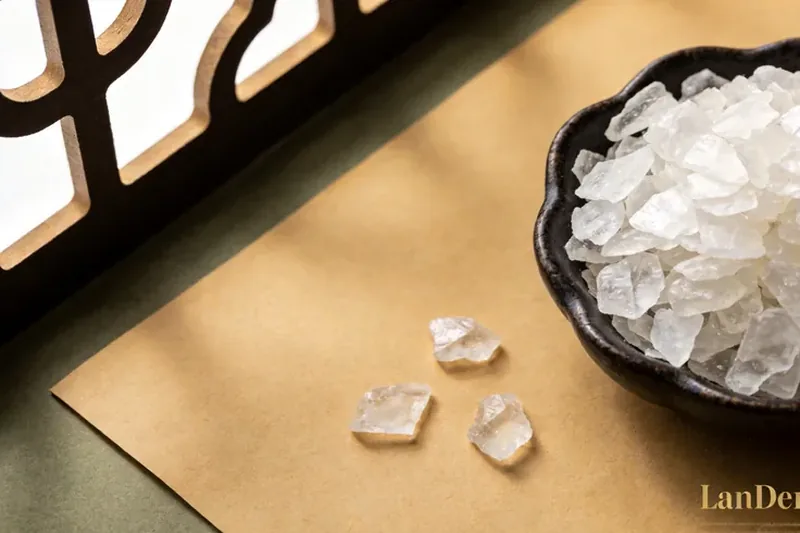
At a glance: Borneol — lóngnǎo (龙脑, literally “dragon brain”) in Chinese — is a crystalline monoterpene with a sharp, camphoraceous, cooling aroma. It is the classic “cooling” note in Chinese incense and materia medica, and one of the materials most prone to source confusion, because “borneol” on a label can be a natural tree-resin crystal, a leaf-distilled crystal, or a fully synthetic compound.
Key facts
| Chinese | 龙脑 (lóngnǎo), also 冰片 (bīngpiàn) for the refined crystal |
| Botanical source | Dryobalanops aromatica (natural d-borneol); Blumea balsamifera (l-borneol / “艾片”) |
| What it is | A crystalline aromatic compound (a monoterpene), not a wood or resin |
| Aroma | Camphoraceous, cooling, minty, slightly woody |
| Traditional role | Incense, perfumery, materia medica |
Aroma profile
Direct answer: Borneol has a sharp, camphor-like, cooling scent, often described as minty or slightly medicinal. It is a bright, penetrating top note that cuts through heavier woods and resins, and it imparts a distinct cooling sensation through the same cold-receptor mechanism as menthol.
Borneol has a sharp, camphor-like, cooling scent — often described as minty or “medicinal.” It is prized as a bright, penetrating top note that cuts through heavier woods and resins, and for the distinct cooling sensation it imparts (it activates the same cold-receptor mechanism as menthol, though more weakly).
Botanical identity
Direct answer: Borneol is not a plant — it is a crystalline monoterpene compound. It is obtained from three main sources: the resin of Dryobalanops aromatica, the leaves of Blumea balsamifera (and the camphor tree Cinnamomum camphora), or chemical synthesis. The same compound thus has botanical and non-botanical origins.
Borneol is a bicyclic monoterpene, a small organic molecule rather than a wood, resin, or flower. Its name records its natural source: the Borneo camphor tree, Dryobalanops aromatica (family Dipterocarpaceae), whose resin yields natural d-borneol. The same compound also appears in other plants — the leaves of Blumea balsamifera (Asteraceae) yield l-borneol (艾片), and camphor-tree (Cinnamomum camphora) leaves yield borneol alongside camphor — and it can be manufactured synthetically. See Blumea balsamifera in Flora of China and Dryobalanops aromatica on GBIF.
Chinese name and terminology
Direct answer: 龙脑 (lóngnǎo, “dragon brain”) is the broad name for borneol; 冰片 (bīngpiàn, “ice slice”) most often means the refined crystal; 艾片 (ài piàn) is leaf-distilled l-borneol; and 机制冰片 is synthetic borneol. The name alone does not identify the source.
The Chinese terms sort roughly by source and form:
- 龙脑 (lóngnǎo) — “dragon brain,” the general name for borneol as an aromatic material.
- 冰片 (bīngpiàn) — “ice slice,” usually the refined crystalline form.
- 艾片 (ài piàn) — l-borneol distilled from the leaves of Blumea balsamifera (艾纳香).
- 机制冰片 (jīzhì bīngpiàn) — synthetic borneol, manufactured from turpentine or camphor.
Because one name covers several sources, the term alone does not tell a buyer what they are getting.
Where does borneol come from?
Direct answer: Natural borneol comes from two plants — the resin of the Borneo camphor tree (Dryobalanops aromatica) and the leaves of Blumea balsamifera — plus the camphor tree. Much commercial borneol is synthetic, made from turpentine or camphor.
Natural borneol’s principal botanical sources are the Borneo camphor tree (Dryobalanops aromatica), whose resin crystallizes d-borneol, and Blumea balsamifera, whose leaves distill to l-borneol (艾片). Camphor-tree (Cinnamomum camphora) leaves also yield borneol as a co-product with camphor. In modern commerce, however, the majority of “borneol / 冰片” is synthetic, manufactured from turpentine or camphor and typically a mixture of isomers.
The source problem (buyer intelligence)
Direct answer: “Borneol” covers natural d-borneol (from resin or leaves), leaf-distilled l-borneol (艾片), and synthetic borneol. They differ in isomer composition, purity, and price, so a label that says only “borneol” does not tell you which you are getting.
“Borneol” (and its Chinese names 龙脑 / 冰片) covers several different materials:
- Natural d-borneol — crystallized from the resin of Dryobalanops aromatica (a dipterocarp tree) or distilled from the leaves of the camphor tree (Cinnamomum camphora). This is the traditional “龙脑冰片.”
- 艾片 (ài piàn) — l-borneol distilled from the leaves of Blumea balsamifera (Asteraceae).
- Synthetic borneol (“机制冰片”) — manufactured from turpentine or camphor; cheaper and commonly a mixture of isomers.
The natural and synthetic forms are chemically related but not identical — they differ in isomer composition and, in practice, in purity and price. A label that says only “borneol” does not tell you which you are getting. This is the same “one name, several materials” pattern as the rest of the trade — see the substitution cross-reference.
Why is borneol used in incense?
Direct answer: Borneol is used as a bright, cooling top note that cuts through heavier woods and resins, adding clarity and an “opening” lift to a blend. It is potent and used sparingly.
Borneol’s role in incense follows from its aroma: sharp, camphoraceous, and cooling, it sits at the top of a blend, where a small amount brightens and “opens” heavier materials that would otherwise feel dense or closed. In 合香 (blended incense) it is a classic 使 (messenger/opener) note, used sparingly precisely because it is potent. Its cooling feel, tied to the TRPM8 receptor, adds a sensory layer that most aromatics lack.
In Chinese tradition
Direct answer: Borneol is a classic cool, sharp top note in Chinese incense (合香), and 冰片 appears in traditional Chinese medicine described for a cooling sensation and as a “carrier” that aids the penetration of other ingredients.
- Incense (香): borneol is a classic cool, sharp top note in 合香 (blended incense), used to brighten and “open” heavier blends.
- Materia medica: 冰片 appears in traditional Chinese medicine, where it is described for a cooling sensation and as a “carrier” that aids the penetration of other ingredients.
- Perfumery: borneol and its relatives are used as a camphoraceous note and fixative.
How is borneol processed?
Direct answer: Natural borneol is obtained by crystallizing d-borneol from the resin of Dryobalanops aromatica, or by distilling l-borneol from Blumea balsamifera leaves. Synthetic borneol is manufactured from turpentine or camphor and is usually an isomer mixture.
The three routes are chemically and commercially distinct:
- Resin crystallization — d-borneol crystallizes from the resin of Dryobalanops aromatica; this is the traditional, higher-value route.
- Leaf distillation — l-borneol (艾片) is distilled from Blumea balsamifera leaves.
- Synthesis — synthetic borneol is made from turpentine or camphor and is typically a mixture of isomers, cheaper than the natural forms.
The route determines isomer composition and price, which is why the source — not just the name — is the buyer’s real question.
What determines borneol quality?
Direct answer: Source and isomer composition drive borneol quality. Natural d-borneol (or l-borneol) is a single enantiomer; synthetic borneol is usually an isomer mixture and cheaper. Purity and whether the label names the source are the key checks.
The quality factors:
- Source — natural (resin or leaf) vs synthetic; the natural forms command a different price.
- Isomer composition — natural borneol is essentially a single enantiomer (d- or l-); synthetic is typically a mixture.
- Purity — the refined crystal (冰片) vs cruder material.
- Aroma — a clean camphoraceous-cooling note without harsh or solvent off-notes.
These are trade distinctions rather than a single standardized grading system.
Common forms
Direct answer: Borneol is sold as translucent crystals (the refined 冰片 form), as powder, and as synthetic “机制冰片.” The crystal and powder are the same compound in different physical forms; the synthetic form is a different source.
| Form | Typical use |
|---|---|
| Crystals (冰片) | Refined form for incense and materia medica |
| Powder | Blended into incense and formulas |
| Synthetic (机制冰片) | Low-cost commercial use, often an isomer mixture |
Borneol vs camphor
Direct answer: Borneol and camphor are related but distinct monoterpenes. Borneol is cooling and minty-woody; camphor is sharper and more pungent. Borneol can slowly oxidize toward camphor, so aged borneol may smell more camphoraceous.
Borneol and camphor are chemically related monoterpenes, and the two are easily confused — both come from the camphor tree and both smell sharp and medicinal. Borneol reads cooling and minty-woody; camphor reads sharper and more pungent. The link is real: borneol can slowly oxidize toward camphor over time, which is why aged borneol may smell more camphoraceous. See camphor for the full distinction.
Traditional use vs modern evidence
Direct answer: 冰片 is described with therapeutic roles in traditional Chinese medicine, but these are traditional or preliminary, not established clinical fact. The one well-documented point is the cooling sensation — borneol activates the TRPM8 cold receptor, which is why it feels cooling.
In traditional Chinese medicine, 冰片 is described with various therapeutic roles. We treat these as traditional or preliminary, not established clinical fact. The one solid, well-documented point is the cooling sensation — borneol activates the TRPM8 cold receptor, which is why it feels “cooling” (like menthol, but weaker). We make no medical claims.
Modern commercial applications
Direct answer: Borneol is used in incense (as a cooling top note), in perfumery, and — in the synthetic form — in industrial and pharmaceutical preparations. The natural crystal, the powder, and the synthetic form serve different markets.
- Incense — a cooling, opening top note in 合香 and stick incense.
- Perfumery — a camphoraceous note and fixative.
- Pharmaceutical / industrial — borneol (especially synthetic) appears in topical preparations and industrial uses; we make no medical claims here.
What buyers should look for
Direct answer: Ask whether the borneol is natural (resin or leaf) or synthetic, and which enantiomer. Check purity and aroma — a clean camphoraceous-cooling note with no harsh or solvent off-notes. Borneol is potent, so dose sparingly.
For an incense maker or sourcing buyer:
- Source — natural d-borneol, leaf-distilled l-borneol (艾片), or synthetic; the label should say which.
- Isomer and purity — a single enantiomer (natural) vs an isomer mixture (synthetic).
- Form — crystal, powder, or synthetic.
- Aroma — clean, cooling, camphoraceous, with no solvent off-notes.
Safety
Incense combustion produces smoke and particulate matter; burn in a well-ventilated space and avoid inhaling concentrated smoke. Borneol is potent — it should be used sparingly and is not for consumption. This is editorial knowledge content, not medical advice.
Our Industry View
Direct answer: In manufacturing, the useful question is the source, not the name. A consistent supply of a single named form — natural d-borneol, 艾片, or synthetic — matters more than an unqualified “borneol” label, because the isomer composition changes the material’s behavior.
From a manufacturing perspective, “borneol” is a compound with several origins, and the origin determines the material’s behavior. What makes a formula repeatable is source consistency: the same form, the same enantiomer, and the same purity, batch after batch.
Two points follow:
- Isomer composition changes the material. Natural borneol is essentially one enantiomer; synthetic is typically a mixture. Where a formula depends on the cooling note and a precise sensory character, swapping natural for synthetic — or d- for l- — is not a like-for-like substitution, even though all are “borneol.”
- It is potent, so dose matters more than for most aromatics. A little borneol opens a blend; too much dominates it. Because it is used at small proportions, even small batch-to-batch differences in purity read more strongly in the finished stick. The correct level depends on formulation — the other ingredients and the target profile — not on a universal figure.
In our view, the commercial value is a documented, consistent single-source supply, not an unqualified “borneol” label.
Summary
Borneol (龙脑 / 冰片) is a crystalline monoterpene, not a wood or resin, obtained from the resin of Dryobalanops aromatica, the leaves of Blumea balsamifera (and the camphor tree), or chemical synthesis. Its sharp, cooling, camphoraceous aroma makes it the classic “opening” top note in Chinese incense, and its cooling sensation is a documented TRPM8 receptor effect. The key buyer distinction is source and isomer composition — natural single-enantiomer against synthetic mixture — which the name “borneol” alone does not reveal.
FAQ
Is borneol the same as camphor? No — borneol and camphor are related but distinct monoterpenes. Borneol has a cooling, minty-woody character, while camphor is sharper and more pungent. They are chemically related, and borneol can slowly oxidize toward camphor over time, which is why aged borneol may smell more camphoraceous, but they are not the same compound. The distinction matters because “borneol” on a label can also hide synthetic material or a mixture of isomers, so the source — not just the name — determines what you are actually getting.
What is the difference between 龙脑 and 冰片? 龙脑 (lóngnǎo) is the broader name for borneol as an aromatic material, literally “dragon brain.” 冰片 (bīngpiàn) most often refers to the refined crystalline form, though the two terms overlap in practice. Both names cover natural and synthetic sources: natural d-borneol from Dryobalanops aromatica resin or camphor-tree leaves, l-borneol (艾片) from Blumea balsamifera, and synthetic borneol made from turpentine or camphor. Because the name does not specify the source, buyers should check which form they are getting.
What does borneol smell like? Borneol has a sharp, camphor-like, cooling scent, often described as minty or slightly medicinal. It is a bright, penetrating top note that cuts through heavier woods and resins, adding clarity to a blend. Alongside the aroma, borneol imparts a distinct cooling sensation — it activates the same TRPM8 cold receptor as menthol, though more weakly. This combination of a piercing scent and a cooling feel is what makes borneol the classic “cooling” note in Chinese incense and materia medica.
Is borneol natural? It can be. Natural d-borneol is crystallized from the resin of Dryobalanops aromatica, a dipterocarp tree, or distilled from camphor-tree (Cinnamomum camphora) leaves — the traditional 龙脑冰片. L-borneol, called 艾片, is distilled from the leaves of Blumea balsamifera. However, much commercial borneol is synthetic, manufactured from turpentine or camphor and often a mixture of isomers. Natural and synthetic forms differ in isomer composition, purity, and price, so a label that says only “borneol” does not tell you which you are buying.
Why does borneol feel cooling? Borneol activates the TRPM8 receptor, the same cold-sensing mechanism behind menthol’s cooling sensation, though borneol’s effect is weaker. This receptor responds to cooling temperatures and to certain compounds, producing a sensation of cold without an actual drop in temperature. That receptor effect is well documented and explains why borneol feels “cooling” or “minty.” It is a sensory fact about how the compound interacts with the body, not a health claim about treating any condition.
What is the difference between borneol and borneol oil? Borneol is the crystalline compound (龙脑 / 冰片); borneol oil (龙脑油) is the aromatic essential-oil extract, distilled from the Borneo camphor tree (Dryobalanops aromatica) or the camphor tree. The crystal is the refined compound, while the oil is the broader volatile extract that contains borneol alongside related constituents. They are different products with different uses.
See also: camphor, Blumea balsamifera, borneol oil, and the full scent guide.
Evidence & Sources
Botanical identity
Source: Blumea balsamifera in Flora of China · Dryobalanops aromatica on GBIF. Evidence type: Established.
Traditional Chinese use
Source: this page records 冰片 in traditional Chinese medicine, described for a cooling sensation and as a “carrier.” Evidence type: Historically documented — traditional materia-medica language, not modern clinical evidence.
Authenticity / adulteration
Source: the source problem — “borneol” on a label can be natural d-borneol, leaf-distilled l-borneol (艾片), or synthetic borneol. Evidence type: Practical screening.
Safety
Source: incense combustion produces smoke and particulate matter; borneol is potent and not for consumption. Evidence type: Established.
Evidence status
| Layer | Status |
|---|---|
| Botanical identity | Established |
| Traditional use | Historically documented |
| Authenticity test | Practical screening |
| Laboratory confirmation | Requires analytical testing |
| Health claims | Not established |
Sources
Sources: botanical and pharmacognosy references on borneol (Dryobalanops aromatica, Blumea balsamifera), the 龙脑/冰片 source distinction, and the TRPM8 cooling mechanism. Medicinal uses are treated as traditional, not established clinical fact. This is editorial knowledge content, not medical advice.