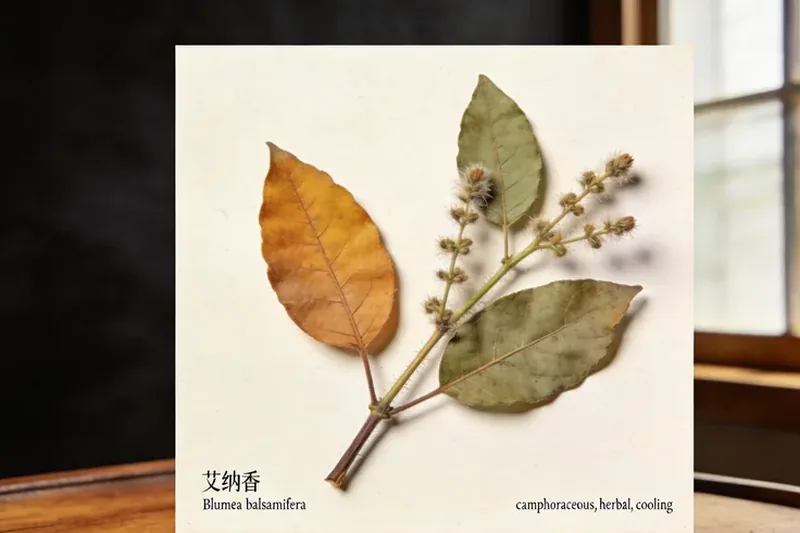
Direct answer: Blumea (艾纳香, àinàxiāng) is the sambong or Ngai camphor plant, Blumea balsamifera, an aromatic shrub of the daisy family (Asteraceae) native to South and Southeast Asia. It is the plant source of l-borneol (艾片), the leaf-distilled form of borneol in the classical 龙脑/冰片 family. The Bencao Gangmu names it 艾纳香, noting its use “to blend the many aromatics.”
Key facts
| Chinese | 艾纳香 (àinàxiāng); also 艾片 (ài piàn) for its borneol crystal |
| Botanical source | Blumea balsamifera (family Asteraceae) — the leaves |
| What it is | An aromatic leaf-distilled shrub; source of l-borneol |
| Aroma | Camphoraceous, herbal, cooling, slightly sweet |
| Traditional role | Leaf aromatics; l-borneol source; 和合诸香 |
Aroma profile
Direct answer: 艾纳香 is camphoraceous and herbal, with a cooling, slightly sweet undertone — the scent of a strongly aromatic leaf rather than a flower or resin. The material of value is the leaf-borne volatile oil, from which l-borneol is isolated as a crystalline “cooling” aromatic that reads as a bright, penetrating, medicinal-herbal note close to camphor.
艾纳香 is camphoraceous and herbal, with a cooling, slightly sweet undertone — the scent of a strongly aromatic leaf rather than a flower or resin. The material of value is the leaf-borne volatile oil, from which l-borneol is isolated as a crystalline “cooling” aromatic. In a blend it reads as a bright, penetrating, medicinal-herbal note close to camphor, used to sharpen and “open” heavier compositions. This is a functional aromatic character — borneol’s cooling, clarifying edge — rather than a sweet or decorative one, which is exactly why the classical record frames it as a blender and harmonizer rather than a lead scent.
The 龙脑 / borneol relationship (read this)
Direct answer: 艾纳香 is a specific plant source within the borneol family, not the compound itself. Borneol (龙脑) is the aromatic compound; 艾片 (l-borneol) is the leaf-distilled form from Blumea balsamifera (this plant), distinct from tree-resin d-borneol (Dryobalanops aromatica) and from synthetic borneol. The three differ in isomer, purity, and price.
艾纳香 belongs to the broader borneol family, but is a distinct plant source:
- 龙脑 (borneol) — the compound borneol, classically crystallized from Dryobalanops aromatica resin (d-borneol) or distilled from camphor-tree leaves, plus synthetic forms. Its own entry.
- 龙脑油 (borneol oil) — the aromatic oil associated with the Borneo camphor tree and camphor tree. Its own entry.
- 艾片 (l-borneol) — l-borneol distilled from the leaves of Blumea balsamifera (this plant).
The Bencao Gangmu (本草纲目), in its herb section (草之三), records 艾纳香, citing the Guangzhi (广志): “艾纳出西国,似细艾” — 艾纳 comes from the western regions and resembles fine mugwort — and adding that it “可以和合诸香,烧之能聚其烟” (can blend the many aromatics; burned, it gathers and holds the smoke). This page describes 艾纳香 = the leaf herb and its l-borneol, not the tree-resin borneol.
Botanical source and origin
Direct answer: Blumea balsamifera is a coarse, aromatic shrub of the daisy family (Asteraceae), native to tropical and subtropical South and Southeast Asia and long naturalized across southern China. Its leaves are the material of value, yielding a camphoraceous volatile oil rich in borneol and related compounds; Flora of China records the species.
Blumea balsamifera is a coarse, aromatic shrub of the daisy family (Asteraceae), native to tropical and subtropical South and Southeast Asia and long naturalized across southern China. Its leaves are the material of value, yielding a camphoraceous volatile oil rich in borneol and related compounds. Flora of China records the species; the leaf is the source of the l-borneol crystal called 艾片. The plant is also widely known across tropical Asia as sambong or Ngai camphor, a regional medicinal and aromatic leaf with a long folk record outside the Chinese incense canon.
Where does 艾纳香 come from?
Direct answer: Blumea balsamifera is native to tropical and subtropical South and Southeast Asia and has naturalized across southern China. It grows as a common aromatic shrub rather than a scarce wild harvest, which is why its leaf-distilled borneol (艾片) has long been the more accessible of the natural borneol forms.
The plant ranges across tropical and subtropical Asia — South and Southeast Asia, and naturalized into southern China — where it grows as a robust, weedy aromatic shrub. Unlike tree-resin borneol, which depends on a specific resin-bearing tree, 艾纳香 is a common leaf crop, renewable and comparatively easy to obtain. This accessibility is a real part of its history: the leaf-distilled l-borneol could be produced more readily than the scarce tree-resin d-borneol, which is one reason the borneol family has three distinct commercial forms rather than one.
In Chinese tradition
Direct answer: 艾纳香 appears in the classical record as a blending leaf aromatic — the Bencao Gangmu records its use 和合诸香 (to blend the many aromatics) and to gather smoke — and as the source of 艾片 (l-borneol), one of the three classical borneol forms. Its materia-medica use is traditional, not modern clinical evidence.
- 和合诸香 (blending the aromatics): the Bencao Gangmu (本草纲目) records 艾纳香 for blending — a leaf aromatic used to bind and harmonize a fragrance and to gather its smoke.
- 艾片 (ài piàn): l-borneol, the leaf-distilled crystal from Blumea balsamifera, is one of the three classical borneol sources alongside tree-resin and synthetic borneol.
- Materia medica: 艾纳香 appears in traditional Chinese medicine. This is traditional materia-medica language, not modern clinical evidence.
Traditional use vs modern evidence
Direct answer: The leaf-aromatic and blending use is documented in the classical record, and the botanical identity and borneol chemistry are established. Medicinal uses are traditional, not clinical fact, and this page makes no medical claims. The documented facts are botanical identity, the Asteraceae placement, and the plant’s role as the l-borneol (艾片) source.
- Traditional Use — 艾纳香 as a blending leaf aromatic (和合诸香) and its traditional materia-medica descriptions. This is traditional language, not modern clinical evidence.
- Historical Record — the Bencao Gangmu (本草纲目), 草之三, records 艾纳香 citing the Guangzhi (广志) and the 和合诸香 / 烧之能聚其烟 blending use; this is a documented classical record.
- Scientific Evidence — the botanical identity of Blumea balsamifera (Asteraceae) and its borneol-rich leaf oil, from which l-borneol (艾片) is isolated, are established. We present no clinical or medical efficacy claims.
How is it processed?
Direct answer: 艾纳香 is processed from the leaf: the aromatic leaves are distilled to yield a borneol-rich volatile oil, from which l-borneol is crystallized as 艾片. It is a distillation product rather than a wood, resin, or directly burned herb, and the crystal, not the raw leaf, is the material of value.
The working material is the leaf, and the process is distillation rather than simple drying or grinding. The aromatic leaves yield a camphoraceous volatile oil rich in borneol and related compounds, and from this oil the l-borneol is isolated and crystallized as 艾片. The practical consequence is that 艾纳香 reaches the market in two distinct forms — the crude leaf and the refined borneol crystal — which are different products with different uses and prices. The crystal is the classical incense material; the crude leaf is more often a regional medicinal and aromatic herb.
What buyers should look for
Direct answer: A buyer should distinguish 艾纳香 (the leaf and its l-borneol, 艾片) from tree-resin borneol (Dryobalanops aromatica) and from synthetic borneol — the three differ in isomer, purity, and price. Confirm the source form and the isomer, since “borneol” alone does not identify which material is being offered.
For a sourcing buyer, the checks are:
- Source form — confirm whether the material is 艾片 (l-borneol, leaf-distilled from Blumea balsamifera), tree-resin d-borneol (Dryobalanops aromatica), or synthetic borneol; the three differ in isomer, purity, and price.
- Isomer — l-borneol (艾片) is the leaf form; d-borneol the tree-resin form; synthetic material may be a mix. The isomer matters for both purity and provenance.
- Format — the refined crystal is the incense material; the crude leaf is a different, more regional product.
- Purity — borneol crystals vary in refinement; for incense, a clean, well-crystallized l-borneol is the benchmark rather than a crude mixed extract.
Our Industry View
Direct answer: 艾纳香’s industrial lesson is that “borneol” is a family, not a single product. The leaf-distilled l-borneol (艾片) sits beside tree-resin d-borneol and synthetic borneol as three materials sharing one name but differing in isomer, cost, and provenance — so the buyer’s first job is to collapse the name into a specific source before any price or quality is discussed.
艾纳香 is the entry where the borneol family’s naming problem is most visible, and it is a genuine sourcing lesson:
- One name, three materials. “Borneol” / 冰片 can mean tree-resin d-borneol, leaf-distilled l-borneol (艾片, from this plant), or synthetic borneol. They share a name but differ in isomer, naturalness, cost, and provenance. A buyer who orders “borneol” without a source has not specified a material.
- The leaf form is the accessible form. Because 艾纳香 is a common, renewable shrub, its l-borneol has historically been the more readily produced natural borneol — a supply fact that shaped why the classical tradition developed three distinct sources rather than relying on the scarce tree resin alone.
- The classical role was functional, not decorative. The Bencao Gangmu frames 艾纳香 as a blender — 和合诸香, to harmonize the many aromatics, and to gather smoke. That is a functional description of a borneol-type material: borneol’s cooling, clarifying, smoke-binding character is a technical asset in 合香, not a decorative top note.
In our view, the commercial sweet spot is a well-crystallized, source-identified l-borneol (艾片), bought with the isomer and the plant source stated explicitly — because in the borneol family, the name alone is a category, and only the source makes it a material.
Summary
艾纳香 (Blumea balsamifera) is the sambong / Ngai camphor shrub, an Asteraceae leaf aromatic of tropical Asia whose borneol-rich oil yields l-borneol (艾片), one of three classical borneol forms alongside tree-resin d-borneol and synthetic borneol. The Bencao Gangmu records it as a blending leaf aromatic — 和合诸香, to harmonize the many aromatics and gather their smoke — a functional rather than decorative role. Its value rests on being a renewable, accessible natural borneol source, and its lesson is that “borneol” is a family that must be collapsed into a specific source before it is a specification.
FAQ
What is 艾纳香 (blumea balsamifera)? The sambong or Ngai camphor plant, Blumea balsamifera, an aromatic shrub of the daisy family (Asteraceae) native to South and Southeast Asia. Its leaves yield a camphoraceous volatile oil from which l-borneol — called 艾片 (ài piàn) — is isolated, making it one of the plant sources of borneol in the classical 龙脑/冰片 family.
What is the difference between 艾纳香 and 龙脑 (borneol)? 艾纳香 is a specific leaf herb, Blumea balsamifera, while 龙脑 (borneol) is the aromatic compound it partly supplies. Classical borneol was crystallized from the resin of Dryobalanops aromatica or distilled from camphor-tree leaves; 艾纳香 contributes the leaf-distilled l-borneol called 艾片. The plant is the source, the compound is the product, and the three borneol forms differ in isomer, purity, and price.
What does 艾纳香 smell like? Camphoraceous and herbal, with a cooling, slightly sweet undertone — the scent of a strongly aromatic leaf rather than a flower or resin. The borneol-rich oil reads as a bright, penetrating, medicinal-herbal note close to camphor, used to sharpen and “open” heavier blends and, per the classical record, to gather and hold the smoke.
Does 艾纳香 appear in classical Chinese records? Yes. The Bencao Gangmu (本草纲目), herb section (草之三), records 艾纳香 and cites the Guangzhi (广志): “艾纳出西国,似细艾” (艾纳 comes from the western regions, resembling fine mugwort), adding that it “可以和合诸香,烧之能聚其烟” — can blend the many aromatics, and burned, gathers the smoke.
Is 艾片 the same as 冰片? Not exactly. 艾片 (ài piàn) is l-borneol distilled from the leaves of Blumea balsamifera, one of three borneol forms. 冰片 (bīngpiàn) more often names the refined crystal generally, covering natural tree-resin d-borneol, leaf-distilled l-borneol, and synthetic borneol. The name alone does not specify the source, so buyers should check which form they are getting.
How is 艾片 (l-borneol) made? By distilling the aromatic leaves of Blumea balsamifera to obtain a borneol-rich volatile oil, from which the l-borneol is crystallized. The result is a refined crystalline material — distinct from the crude leaf and from tree-resin or synthetic borneol — and it is the crystal, not the raw leaf, that is the classical incense material.
See also: borneol, borneol oil, camphor, and the full scent guide.
Evidence & Sources
Botanical identity
Source: Blumea balsamifera in Flora of China · Blumea balsamifera on GBIF. Evidence type: Established.
Traditional Chinese use
Source: the Bencao Gangmu (本草纲目), 草之三, records 艾纳香, citing the Guangzhi (广志) “艾纳出西国,似细艾” and the blending use “和合诸香,烧之能聚其烟”. Evidence type: Historically documented — leaf aromatic and l-borneol (艾片) source.
Authenticity / disambiguation
Source: 艾纳香 (Blumea balsamifera, l-borneol / 艾片) vs tree-resin borneol (Dryobalanops aromatica) vs synthetic borneol. Evidence type: Practical screening.
Safety
Source: incense combustion produces smoke and particulate matter; borneol is potent and not for consumption. Evidence type: Established.
Evidence status
| Layer | Status |
|---|---|
| Botanical identity | Established |
| Traditional use | Historically documented (leaf aromatic, l-borneol source) |
| Authenticity test | Practical screening |
| Health claims | Not established |
Sources
Sources: botanical references on Blumea balsamifera and the Bencao Gangmu (本草纲目) 草之三 record of 艾纳香. 艾纳香 is documented as a leaf aromatic and l-borneol source; medicinal uses are treated as traditional, not established clinical fact. This is editorial knowledge content, not medical advice.