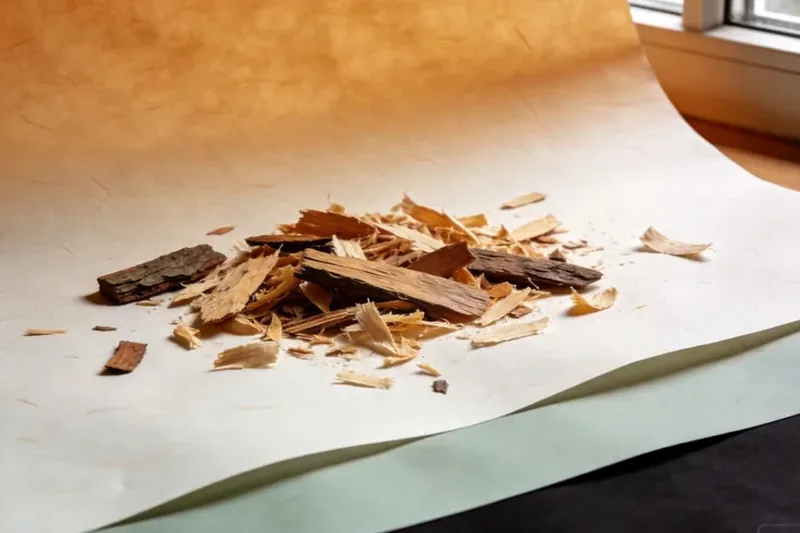
Direct answer: Camphor (樟木 zhāngmù / 樟脑 zhāngnǎo) is the fragrant wood and crystalline extract of Cinnamomum camphora, the camphor laurel, a large evergreen tree native to southern China, Japan, and Taiwan. The wood is strongly aromatic with a cool, medicinal, slightly minty “camphoraceous” scent that also wards off insects. It is used in Chinese incense mainly as a fresh, cooling top note, distinct from 龙脑 (borneol).
Key facts
| Chinese | 樟木 (zhāngmù) wood; 樟脑 (zhāngnǎo) camphor crystal |
| Botanical source | Cinnamomum camphora (family Lauraceae) — wood and extract |
| What it is | An aromatic wood and its crystalline camphor extract |
| Aroma | Camphoraceous, cooling, fresh, slightly minty-woody |
| Traditional role | Cooling aromatic, insect-repellent, incense top note |
Aroma profile
Direct answer: Camphor is sharp, cool, and penetrating — a “medicinal-fresh” scent familiar from moth repellents and liniments, with a slightly minty, woody undertone in the natural wood. It is a bright top note that lifts a blend but easily dominates one if over-used, which is why classical blends use it sparingly.
Camphor is sharp, cool, and penetrating — a “medicinal-fresh” scent familiar from moth repellents and liniments. The wood itself is strongly aromatic, and the crystallized camphor (樟脑) distilled from it is more intense and pure. In incense this is a top note: it lifts a blend with a bright, cooling edge. Used alone and heavily, it can dominate a formula, which is why classical blends use it sparingly.
Botanical identity
Direct answer: Cinnamomum camphora is a large evergreen tree of the laurel family (Lauraceae), native to warm regions of southern China, Taiwan, Japan, and Vietnam. The whole tree is aromatic, but camphor is concentrated in the wood, from which it is steam-distilled as a white crystalline substance. The same genus yields cinnamon/cassia, but camphor laurel is valued for its wood and camphor content rather than its bark.
Cinnamomum camphora is a large evergreen of the laurel family (Lauraceae), native to warm regions of southern China, Taiwan, Japan, and Vietnam. The whole tree is aromatic; camphor is concentrated in the wood, from which it is steam-distilled as a white crystalline substance. The same genus yields cinnamon/cassia (Cinnamomum cassia, 桂皮), but camphor laurel is valued for its wood and camphor content rather than its bark. See Cinnamomum camphora in Flora of China.
Chinese name and terminology
Direct answer: The name 樟木 means “camphor wood,” and it carries an important split that the English word “camphor” hides: 樟木 is the aromatic wood, while 樟脑 (literally “camphor brain/marrow”) is the distilled crystalline substance. They are the same tree but different commercial materials — wood versus crystal.
The Chinese terminology splits what English calls “camphor” into two distinct materials from one tree:
- 樟木 (zhāngmù) — the aromatic wood of the camphor laurel, used in incense, carving, and furniture.
- 樟脑 (zhāngnǎo) — the white crystalline camphor distilled from the wood; the concentrated, purified form, used in insect repellents, external preparations, and as a potent aromatic.
This split matters for a buyer: “camphor” on a label can mean the wood, the natural crystal, or a synthetic substitute — three different commercial objects, one English word.
Same tree, different products — and the borneol trap (read this)
Direct answer: Camphor (樟脑) and borneol (龙脑) are different crystalline aromatics from different plants, though both smell “camphoraceous.” Camphor comes from Cinnamomum camphora; borneol comes from Dryobalanops aromatica and Blumea balsamifera. A label saying “camphor” or “borneol” names distinct materials — and within camphor itself, the wood and the crystal are different products.
Two confusions sit inside the word “camphor,” and both matter for sourcing:
- Wood vs crystal. The same tree yields 樟木 (wood) and 樟脑 (crystal). The wood is a usable incense material in its own right; the crystal is its concentrated, purified essence. A buyer who wants the wood’s soft minty-woody note and is handed a crystal has been given a different, far more intense material.
- Camphor vs borneol. 樟脑 (camphor) and 龙脑 (borneol) are different crystals from different plants — Cinnamomum camphora versus Dryobalanops aromatica and Blumea balsamifera — yet both are called “camphoraceous” in English. This is a genuine false-friend: the shared adjective makes two unrelated materials sound like one.
This page describes 樟木/樟脑 = camphor, from Cinnamomum camphora. When a source means 龙脑, it is describing borneol. See borneol.
Where does camphor come from?
Direct answer: Camphor comes from the camphor laurel, Cinnamomum camphora, native to warm regions of southern China, Taiwan, Japan, and Vietnam. The tree is grown and harvested for its aromatic wood, from which camphor crystals are steam-distilled.
Cinnamomum camphora grows across the warm, subtropical regions of southern China, Taiwan, Japan, and Vietnam. The tree is cultivated and harvested for its wood, and camphor is recovered by steam-distilling chips and shavings of that wood, from which the white crystalline camphor condenses. Historically a significant industry in Taiwan and Japan, camphor production is today supplemented and often displaced by synthetic camphor, which is cheaper and chemically similar.
Why is it used in incense?
Direct answer: Camphor is used in incense as a fresh, cooling top note — a bright, medicinal-fresh lift that cuts through heavier woods and resins. Its intensity is the point and the constraint: it lifts a blend but dominates one if over-dosed, so it is an accent, not a base.
Camphor’s role in incense is a fresh, cooling top note: a bright, penetrating edge that lifts and sharpens heavier woods and resins. Because the note is so intense, classical blended-incense practice treats camphoraceous materials as accents rather than bases — a small amount lifts a formula, while a heavy hand makes the whole blend read “medicinal.” The same intensity underlies its better-known non-incense use as an insect repellent, where the goal is deterrence rather than fragrance.
How is it processed?
Direct answer: Camphor is obtained by steam-distilling the wood of Cinnamomum camphora, which yields white camphor crystals that are then purified. The wood itself can also be used directly — dried and cut or ground. The crystal and the wood are two processing outcomes of the same tree.
The tree’s aromatic wood is the source of both products:
- Wood — dried and cut for incense, carving, and furniture, or chipped for distillation.
- Camphor crystal (樟脑) — produced by steam-distilling the wood chips, condensing the vapor, and purifying the resulting white crystals.
- Synthetic camphor — manufactured chemically and widely used as a cheaper substitute for the natural crystal.
The distinction between natural distilled camphor and synthetic camphor is a sourcing question, not an aromatic one — both are strongly camphoraceous.
What determines camphor quality?
Direct answer: For the wood, quality is a clean, dense, strongly aromatic material; for the crystal, it is white, strongly penetrating, and — if natural origin matters — genuinely distilled from Cinnamomum camphora rather than synthetic. Because camphor is intense, purity and source matter more than subtle aromatic grading.
The quality factors:
- Wood condition — clean, dense, strongly aromatic wood; the scent should be cool and penetrating.
- Crystal purity — white, strongly scented crystals; discolored or weak crystals are inferior.
- Source — natural camphor (distilled from Cinnamomum camphora) versus synthetic; confirm source if natural origin matters.
- Intensity discipline — camphor is potent, so the buyer is often specifying a small amount of a strong material, not a large amount of a weak one.
Common forms
Direct answer: Camphor is sold as aromatic wood, chips and shavings for distillation or incense, purified white camphor crystals, and synthetic camphor. The wood is the incense and carving material; the crystal is the concentrated aromatic and repellent; synthetic camphor is the cheap substitute.
| Form | Typical use |
|---|---|
| Aromatic wood | Incense, carving, furniture |
| Chips / shavings | Distillation; incense warming |
| Camphor crystals (樟脑) | Insect repellent, external aromatic, concentrated note |
| Synthetic camphor | Cheaper commercial substitute |
In Chinese tradition
- Cooling aromatic (Traditional Use): camphor’s cool, penetrating scent is used in traditional practice for its perceived clearing and insect-repelling qualities.
- Insect repellent (Historical Record): camphor wood and camphor crystals have long been placed with clothing and books to keep insects away — one of its most durable practical uses.
- Incense context (Traditional Use): camphor appears in Chinese incense as a fresh top note, though classical huxiang (合香) manuals treat the intense camphoraceous materials as accents, not bases.
- Materia medica (Traditional Use): 樟脑 is recorded in traditional Chinese medicine for external, cooling applications. This is traditional materia-medica language, not modern clinical evidence.
Traditional use vs modern evidence
Direct answer: The insect-repelling and aromatic roles are well documented. Medicinal uses are traditional, not established clinical fact, and this page makes no medical claims. Camphor is also a potent substance — concentrated camphor is not for internal use — and this page describes its aromatic and historical roles only.
- Traditional Use — camphor’s cooling aromatic role in incense and its traditional materia-medica descriptions (external, cooling).
- Historical Record — the durable, documented insect-repelling use of camphor wood and crystals with clothing, books, and stored goods.
- Scientific Evidence — the botanical identity of Cinnamomum camphora (Lauraceae) and camphor’s chemistry are documented. We present no clinical or medical efficacy claims, and note that concentrated camphor is not for internal use.
What buyers should look for
Direct answer: Buyers should distinguish the wood from the crystal, and natural camphor from synthetic. The wood should be clean, dense, and strongly aromatic; the crystal should be white and penetrating; and — because camphor is intense — it should be treated as a small accent, not a base. Confirm source if natural origin matters.
For an incense maker or sourcing buyer:
- Form — know whether you want the wood (樟木) or the crystal (樟脑); they are different materials with different intensities.
- Source — natural camphor is often replaced by synthetic; confirm source if natural origin matters.
- Condition — clean, dense, strongly aromatic wood; white, penetrating crystals.
- Dosing — camphor is intense; specify it as a small accent, not a base.
Safety
Incense combustion produces smoke and particulate matter; burn in a well-ventilated space and avoid inhaling concentrated smoke. Camphor is a strong aromatic; concentrated camphor products are not for ingestion and should be kept away from children and pets. This is editorial knowledge content, not medical advice.
Camphor vs borneol
Direct answer: These are two “camphoraceous” crystals from different plants. Camphor (樟脑) is distilled from the camphor laurel, Cinnamomum camphora; borneol (龙脑) comes from Dryobalanops aromatica or Blumea balsamifera. They share a cool, sharp character but are distinct materials with distinct sources, and the English words should not be used interchangeably.
| Camphor (樟脑) | Borneol (龙脑) | |
|---|---|---|
| Botanical source | Cinnamomum camphora (Lauraceae) | Dryobalanops aromatica / Blumea balsamifera |
| What it is | Distilled crystal from camphor laurel wood | Natural or leaf-distilled crystal; also synthetic |
| Character | Sharp, cool, penetrating, medicinal-fresh | Camphoraceous, cooling, minty, woody |
| Wood product | 樟木 — aromatic wood used in incense | Aromatica wood (see borneol entry) |
See borneol, cinnamon, and the material comparison matrix.
Our Industry View
Direct answer: Camphor’s commercial lesson is that intensity is a specification, not a flaw. A manufacturer buys camphor for a small, strong, cooling lift — so purity and source (natural versus synthetic) matter more than aromatic subtlety, and the dose is the formula’s real variable. The wood and the crystal are two different purchase decisions, even though they come from one tree.
From a manufacturing perspective, camphor is a material where intensity, not pleasantness, is the specification:
- The dose is the formula. Camphor is bought for a small, bright, cooling lift. The practical consequence is that the quantity in a formula — usually tiny — is what determines success, not the subtle grading of the material itself. A little lifts; a lot ruins. This is the opposite of a base wood, where you buy volume and want gentle consistency.
- Wood and crystal are two purchase decisions. 樟木 and 樟脑 come from one tree but are different commercial objects with different uses, prices, and safety profiles. A buyer who conflates them buys the wrong intensity.
- Natural versus synthetic is a real, if often hidden, split. Synthetic camphor is cheaper and chemically similar, and labels do not always distinguish it. If natural origin matters — for incense or traditional use — the source must be confirmed, because “camphor” alone does not say.
In our view, camphor is a potent top-note accent whose real procurement questions are form (wood or crystal), source (natural or synthetic), and dose — and whose value lies in a sharp, clean cooling character used in disciplined small amounts.
Summary
Camphor (樟木/樟脑) is the aromatic wood and distilled crystal of Cinnamomum camphora, the camphor laurel, a Lauraceae tree of southern China, Japan, Taiwan, and Vietnam. It is a sharp, cool, penetrating “camphoraceous” note used in incense as a sparing top note and, more durably, as an insect repellent. The Chinese terminology splits wood (樟木) from crystal (樟脑), and the English word further collapses camphor with the unrelated borneol (龙脑) and with synthetic substitutes — so a buyer’s first job is to fix form, source, and dose. Its medicinal uses are traditional language, not clinical evidence, and concentrated camphor is not for internal use.
FAQ
What is the difference between camphor and borneol? They are different aromatic crystals from different plants, though both smell “camphoraceous.” Camphor (樟脑) is distilled from the wood of the camphor laurel, Cinnamomum camphora. Borneol (龙脑) comes from Dryobalanops aromatica (Borneo camphor tree) or Blumea balsamifera. The two are distinct materials with distinct botanical sources, and the English words should not be used interchangeably.
What does camphor smell like? Sharp, cool, penetrating, and medicinal-fresh — the familiar scent of moth repellents and liniments, with a slightly minty, woody undertone in the natural wood. It is a bright top note that lifts a blend but easily dominates one if over-used. The crystallized camphor (樟脑) is more intense and pure than the aromatic wood itself.
Is camphor an insect repellent? Yes — this is one of its most durable and well-documented uses. Camphor wood and camphor crystals have long been placed with clothing, books, and stored goods to repel insects, and the scent is still used this way today. This practical role is separate from any medicinal claim, which this page does not make.
How is camphor used in Chinese incense? As a fresh, cooling top note, usually in small amounts. Because camphor is so intense, classical blended-incense practice treats strong camphoraceous materials as accents that lift a formula rather than as the base. The wood and the crystalline extract are both aromatic, with the crystal being the more concentrated form.
Is natural camphor different from synthetic camphor? Yes. Natural camphor is distilled from Cinnamomum camphora wood, while synthetic camphor is manufactured and widely used as a cheaper replacement in commerce. Both are strongly aromatic, but if natural origin matters for incense or traditional use, the source should be confirmed, since the two are not always distinguished on labels.
What is the difference between 樟木 and 樟脑? They are the same tree, different materials. 樟木 is the aromatic camphor wood itself, used in incense, carving, and furniture. 樟脑 is the white crystalline camphor distilled from that wood — the concentrated, purified, far more intense form. A buyer should know which one they want, because they are different commercial objects with different uses and potencies.
See also: borneol, cinnamon, eucalyptus and the full scent guide.
Evidence & Sources
Botanical identity
Source: Cinnamomum camphora in Flora of China · Cinnamomum camphora on GBIF. Evidence type: Established.
Traditional Chinese use
Source: camphor’s cooling aromatic and insect-repelling uses; 樟脑 in the traditional materia medica for external applications. Evidence type: Historically documented — traditional materia-medica language, not modern clinical evidence.
Authenticity / disambiguation
Source: camphor (樟脑) vs borneol (龙脑) — distinct crystals from distinct plants. Evidence type: Practical screening.
Safety
Source: incense combustion produces smoke and particulate matter; concentrated camphor is a strong aromatic not for ingestion. Evidence type: Established.
Evidence status
| Layer | Status |
|---|---|
| Botanical identity | Established |
| Traditional use | Historically documented |
| Authenticity test | Practical screening |
| Health claims | Not established |
Sources
Sources: botanical references on Cinnamomum camphora and the camphor-vs-borneol distinction. Camphor’s aromatic and insect-repelling uses are documented; medicinal uses are treated as traditional, not established clinical fact. This is editorial knowledge content, not medical advice.