Direct answer: Eucalyptus (桉叶, ānyè) is here the leaf of Eucalyptus globulus, the blue gum, a tall evergreen tree of the myrtle family (Myrtaceae) native to Australia. Its leaves carry a sharp, camphoraceous, fresh, slightly medicinal scent from a eucalyptol-rich essential oil. It is a modern crossover, not a classical Chinese incense ingredient.
Key facts
| Chinese | 桉叶 (ānyè) — eucalyptus leaf; the tree is 蓝桉 (lán’ān) |
| Botanical source | Eucalyptus globulus (family Myrtaceae) — the leaves |
| What it is | An Australian myrtle-family tree, grown in China as a plantation timber |
| Aroma | Camphoraceous, fresh, sharp, slightly medicinal, clean |
| Traditional role | None in classical Chinese incense; modern aromatherapy/herbal |
Aroma profile
Direct answer: 桉叶 (eucalyptus) is sharp, clean, and camphoraceous, with a fresh, slightly medicinal, cooling character — the crisp, penetrating smell of crushed eucalyptus leaf. It is dominated by the compound eucalyptol (1,8-cineole), which gives it its distinctive fresh-clearing quality, and it reads as a clean, invigorating green note rather than a sweet one.
桉叶 (eucalyptus) is sharp, clean, and camphoraceous, with a fresh, slightly medicinal, cooling character — the crisp, penetrating smell of crushed eucalyptus leaf. It is dominated by the compound eucalyptol (1,8-cineole), which gives it its distinctive fresh-clearing quality. It reads as a clean, invigorating green note rather than a sweet one. This “camphoraceous” register — sharp, cool, medicinal-fresh — is a chemistry family, and eucalyptus shares it with camphor and borneol, which is why the three are so often compared (and confused).
A provenance note (read this)
Direct answer: 桉叶 (eucalyptus) is a modern crossover, not a classical Chinese 香材. Eucalyptus globulus is native to southeastern Australia and Tasmania, introduced to China in the 19th century as a plantation timber, and recorded by Flora of China as a cultivated/introduced tree. Its fragrance use is a modern Western tradition, absent from the classical canon.
桉叶 (eucalyptus) is a modern crossover, not a classical Chinese 香材:
- Eucalyptus globulus is native to southeastern Australia and Tasmania. It was introduced to China in the 19th century as a fast-growing plantation timber, and Flora of China records it as a cultivated/introduced tree, not a native wild species.
- The Chinese name 桉叶 is modern; eucalyptus as a fragrance and aromatherapy material is a modern Western tradition, absent from the classical 香材 canon.
- Its use is modern aromatherapy, home fragrance, and occasional incense — not a classical Chinese incense ingredient.
This page records it honestly as a modern aromatic leaf — no classical Chinese origin is claimed, and none is fabricated.
Botanical source and origin
Direct answer: Eucalyptus globulus, the blue gum or Tasmanian blue gum, is a large evergreen of the myrtle family (Myrtaceae), with smooth, exfoliating grayish-blue bark, young leaves opposite and sessile, and mature lanceolate, falcate leaves 15–30 × 1–2 cm. Flora of China records it as cultivated in Fujian, Guangxi, Guizhou, Jiangxi, Sichuan, Taiwan, Yunnan, and Zhejiang — native to southeastern Australia and Tasmania.
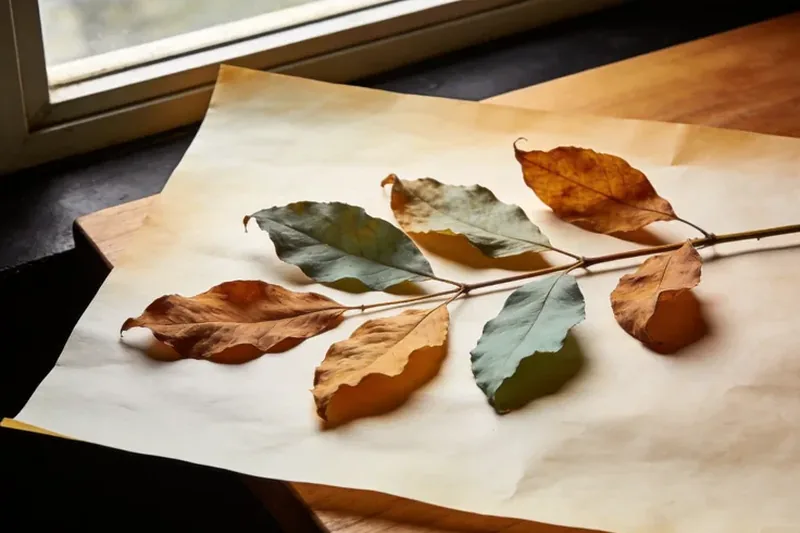
Eucalyptus globulus, the blue gum or Tasmanian blue gum, is a large evergreen tree of the myrtle family (Myrtaceae), native to southeastern Australia and Tasmania. Flora of China records it as a large tree with smooth, exfoliating grayish-blue bark, young leaves opposite and sessile, ovate, glaucescent, and mature leaves lanceolate, 15–30 × 1–2 cm, falcate, leathery, with both surfaces glandular. It is recorded as cultivated in Fujian, Guangxi, Guizhou, Jiangxi, Sichuan, Taiwan, Yunnan, and Zhejiang, native to southeastern Australia and Tasmania. The fragrant part is the leaf, whose oil glands hold the volatile essential oil. It is one of many Eucalyptus species; E. globulus is the classic “eucalyptus” of aromatherapy. See Eucalyptus globulus in Flora of China.
Chinese name and terminology
Direct answer: 桉叶 (ānyè) means “eucalyptus leaf” — 桉 “eucalyptus” + 叶 “leaf” — while the tree is 蓝桉 (lán’ān, “blue gum”). The name is modern and part-specific: it names the leaf, the fragrant part, rather than the tree’s timber. This matters because eucalyptus is grown in China chiefly for timber, and the leaf is a secondary aromatic use.
The Chinese terminology is modern and part-precise: 桉 (ān) is the eucalyptus (the genus Eucalyptus), and 叶 (yè) is the leaf, so 桉叶 names the leaf specifically. The tree itself is 蓝桉 (lán’ān), “blue gum,” after its blue-gray bark. This part-precision is the practical point: eucalyptus in China is grown primarily as plantation timber, and the fragrant leaf — the aromatherapy material — is a secondary use. A buyer who specifies 桉叶 is asking for the leaf (and its oil), not the wood, and should confirm which Eucalyptus species is meant, since the genus is large and the leaf oils differ by species.
The camphoraceous family (read this)
Direct answer: Eucalyptus belongs to a “camphoraceous” chemistry family it shares with camphor (樟脑) and borneol (龙脑) — sharp, cool, medicinal-fresh notes. But they are different plants with different sources: eucalyptus is a eucalyptol-bearing Australian leaf, camphor a distilled crystal from the camphor laurel, borneol a crystal from Dryobalanops or Blumea. The shared adjective hides a real botanical split.
The word “camphoraceous” names a chemistry family, not a plant, and it hides a real split:
- 桉叶 (eucalyptus) — Eucalyptus globulus, an Australian leaf whose note is dominated by eucalyptol (1,8-cineole). This entry.
- 樟脑 (camphor) — Cinnamomum camphora, the camphor laurel, whose camphor crystal is steam-distilled from the wood.
- 龙脑 (borneol) — Dryobalanops aromatica or Blumea balsamifera, a borneol crystal from a different plant.
All three read “camphoraceous,” but they are different materials with different sources and chemistries. The shared adjective is a false-friend, exactly like the camphor-vs-borneol confusion within the camphor entry itself. See camphor (樟木) and borneol (龙脑).
In modern use
- Aromatherapy and home fragrance (Modern use): eucalyptus oil is a staple modern aromatherapy and home-fragrance note, prized for its fresh, clearing character.
- Incense (Modern use): eucalyptus appears occasionally in modern incense as a clean, camphoraceous green note.
- Not classical Chinese incense (Provenance): eucalyptus has no place in the classical 香材 canon; its Chinese use is modern and Western-influenced.
Traditional use vs modern evidence
Direct answer: There is no classical Chinese incense record for 桉叶 (eucalyptus); its position is entirely modern. The documented facts are botanical identity, the Myrtaceae placement, its modern aromatic role, and the established chemistry of its eucalyptol-rich oil.
- Traditional Use — none in classical Chinese incense; eucalyptus is not a 香材, and no traditional aromatic or materia-medica role is claimed for 桉叶 here.
- Historical Record — the introduction of Eucalyptus globulus to China as a 19th-century plantation timber (recorded by Flora of China as cultivated/introduced) is documented; this is a horticultural history, not a Chinese classical record.
- Scientific Evidence — the botanical identity of Eucalyptus globulus (Myrtaceae) and the eucalyptol (1,8-cineole)-dominated essential oil are established. We present no medical claims.
There is no classical Chinese incense record for 桉叶 (eucalyptus); its position is entirely modern. We make no medical claims.
How is eucalyptus used in incense?
Direct answer: Eucalyptus is not a classical incense material, so in incense it appears only as a modern fragrance note — usually an essential oil or an accord reproducing the fresh, camphoraceous character — rather than as a burned leaf. Its sharp, clean lift is a top note and a blending accent, not a base.
Because eucalyptus has no classical Chinese incense role, its incense use is entirely modern and borrowed from aromatherapy. Where it does appear, it is as a clean, camphoraceous top note, typically delivered as an essential oil or a fragrance accord rather than as dried leaf to be burned. Its eucalyptol-fresh character lifts and clears heavier blends — a role closer to camphor than to a floral or sweet note. The practical point for a formulator is that eucalyptus’s charm is volatile and top-note in nature: it brightens a blend but does not anchor it, and it is easily lost under heat or buried by heavier materials.
How is it processed?
Direct answer: Eucalyptus is processed by harvesting the leaf and steam-distilling its essential oil; the leaf itself can also be dried. The oil is the commercial aromatic product, and the leaf’s high eucalyptol content is what makes it a potent, single-note oil rather than a subtle one.
The processing of eucalyptus is oil-oriented:
- Harvest — the leaves are harvested.
- Distillation — the leaves are steam-distilled to recover the eucalyptol-rich essential oil.
- Dried leaf (optional) — the leaf can also be dried for direct use.
The essential oil is the commercial aromatic product, and because the leaf is strongly eucalyptol-dominant, it is a potent, single-note oil rather than a subtle or complex one — which is why it is dosed sparingly and blended rather than used neat.
What determines quality?
Direct answer: For the oil, quality is a high, clean eucalyptol content from a correctly identified species — Eucalyptus globulus is the classic source, but other species differ. For the leaf, quality is clean, fresh material with a sharp, penetrating scent. The species is the key variable, since “eucalyptus” spans a large genus.
The quality factors:
- Species — E. globulus is the classic aromatherapy source, but other species’ oils differ; specify the species.
- Oil composition — a high, clean eucalyptol (1,8-cineole) content.
- Freshness — clean, fresh leaf with a sharp, penetrating scent.
Because the genus Eucalyptus is large and the leaf oils differ by species, the species is the decisive quality variable — “eucalyptus” alone is under-specified.
Common forms
Direct answer: Eucalyptus is sold as the essential oil (the main commercial form), the dried leaf, and fragrance accords. The oil is the aromatherapy and fragrance product; the leaf is the direct botanical; accords reproduce the note synthetically.
| Form | Typical use |
|---|---|
| Eucalyptus essential oil | Aromatherapy, home fragrance, blending |
| Dried leaf | Direct use; mild aromatic |
| Fragrance accord | Synthetic reproduction of the note |
The oil is the main commercial aromatic form, and it is potent and single-note in character.
What buyers should look for
Direct answer: Buyers should specify the species (Eucalyptus globulus vs others) and the form (oil vs leaf), and expect a sharp, camphoraceous, eucalyptol-fresh scent. Because eucalyptus is potent and single-note, it is a blending accent — dosed sparingly — and its provenance (a modern, introduced aromatic) should be understood rather than inflated.
For a formulator or sourcing buyer:
- Species — confirm Eucalyptus globulus (or specify another species); the oils differ, and “eucalyptus” alone is under-specified.
- Form — oil, dried leaf, or accord; the oil is the main aromatic product.
- Character — a sharp, clean, camphoraceous, eucalyptol-fresh note; confirm it is the leaf material, not the timber.
- Dosing — eucalyptus is potent and top-note; specify it as a small blending accent, not a base.
Safety
Incense combustion produces smoke and particulate matter. Burn in a well-ventilated space, avoid inhaling concentrated smoke, and keep away from children and pets. Eucalyptus oil is concentrated; use as directed. This is editorial knowledge content, not medical advice.
Eucalyptus vs camphor vs borneol
Direct answer: These are three “camphoraceous” aromatics from different plants. Eucalyptus is a eucalyptol-rich Australian leaf; camphor (樟脑) is a distilled crystal from the camphor laurel; borneol (龙脑) is a crystal from Dryobalanops or Blumea. They share a cool, sharp character but are distinct materials with distinct sources.
| Eucalyptus (桉叶) | Camphor (樟脑) | Borneol (龙脑) | |
|---|---|---|---|
| Botanical source | Eucalyptus globulus (Myrtaceae) leaf | Cinnamomum camphora (Lauraceae) wood | Dryobalanops / Blumea balsamifera |
| Aromatic driver | Eucalyptol (1,8-cineole) | Camphor | Borneol |
| Form | Essential oil / leaf | Crystal / wood | Crystal |
All three are “camphoraceous,” but the shared adjective hides three different plants and chemistries. See camphor (樟木) and borneol (龙脑) for the full treatment.
Our Industry View
Direct answer: Eucalyptus’s lesson is that “camphoraceous” names a chemistry, not a plant — and a modern, introduced aromatic must be sourced by species and understood as a crossover, not a classical 香材. The disciplined buyer names the species and the form (oil vs leaf) and doses the potent, single-note oil sparingly, rather than buying “eucalyptus” as a category.
From a manufacturing and sourcing perspective, eucalyptus carries two lessons that run through every modern crossover in this encyclopedia:
- The note is a chemistry, not a plant. “Camphoraceous” describes a sharp, cool, medicinal-fresh register shared by eucalyptus, camphor, and borneol — three different plants. A buyer who orders “something camphoraceous” is ordering a register, not a material, and the result could be an Australian leaf when they wanted a distilled crystal, or vice versa.
- The genus is not a spec. Eucalyptus is a large genus, and the leaf oils differ by species. “Eucalyptus” alone does not say which oil, which eucalyptol level, or which character — the species (E. globulus and which chemotype) is the real specification.
- Provenance honesty is the editorial position. Eucalyptus is a modern, introduced aromatic with no classical Chinese record, and this page says so plainly. That honesty — labeling a modern material as modern — is itself the point: it prevents a Western aromatherapy staple from being passed off as a classical 香材.
In our view, the useful takeaway is procedural: name the species, name the form, state the provenance, and dose a potent single-note oil sparingly — and a “camphoraceous” material becomes fully specifiable instead of a source of confusion.
Summary
Eucalyptus (桉叶) is the leaf of Eucalyptus globulus, the blue gum, a myrtle-family (Myrtaceae) tree native to southeastern Australia and Tasmania and introduced to China as a 19th-century plantation timber. Its sharp, camphoraceous, eucalyptol-fresh note is a modern aromatherapy and fragrance material with no classical Chinese incense record, a provenance this page states plainly. It shares the “camphoraceous” register with camphor (樟脑) and borneol (龙脑) — three different plants, three chemistries — so the species and the form (oil vs leaf) are the buyer’s real specification, and the potent, single-note oil is a blending accent, not a base.
FAQ
What is 桉叶 (eucalyptus)? The leaf of Eucalyptus globulus, the blue gum, a tall evergreen tree of the myrtle family (Myrtaceae) native to Australia and introduced to China as a plantation timber. Its leaves carry a sharp, camphoraceous, fresh, slightly medicinal scent. It is a modern crossover, not a classical Chinese incense ingredient.
Is eucalyptus a classical Chinese incense ingredient? No. Eucalyptus is native to Australia and was introduced to China only in the 19th century. It has no place in the classical 香材 canon, and its fragrance use is a modern Western aromatherapy tradition, not a classical Chinese one.
What does eucalyptus smell like? Sharp, clean, and camphoraceous, with a fresh, slightly medicinal, cooling character — the crisp, penetrating smell of crushed eucalyptus leaf. It is dominated by eucalyptol (1,8-cineole), which gives it its distinctive fresh-clearing quality.
How is eucalyptus different from camphor and borneol? They are three “camphoraceous” aromatics from different plants. Eucalyptus is a eucalyptol-rich Australian leaf (Eucalyptus globulus); camphor (樟脑) is a distilled crystal from the camphor laurel (Cinnamomum camphora); borneol (龙脑) is a crystal from Dryobalanops or Blumea balsamifera. They share a cool, sharp character but are distinct materials with distinct sources.
How is eucalyptus used? Primarily in modern aromatherapy and home fragrance for its fresh, clearing character, and occasionally in modern incense as a clean camphoraceous green note. It is a modern, Western-influenced use, not a classical Chinese incense material, and it is usually blended rather than used neat.
What part of the eucalyptus is used? The leaf, whose oil glands hold the volatile essential oil. The Chinese name 桉叶 means “eucalyptus leaf”; the tree itself is 蓝桉 (Eucalyptus globulus), recorded by Flora of China as an introduced plantation species. The fragrant leaf is a secondary use, since the tree is grown chiefly for timber.
See also: camphor (樟木), borneol (龙脑), rosemary (迷迭香), pine needles (松针), and the full scent guide.
Evidence & Sources
Botanical identity
Source: Eucalyptus globulus in Flora of China · Eucalyptus globulus on GBIF. Evidence type: Established.
Modern use
Source: eucalyptus as a modern aromatherapy and home-fragrance note; a modern crossover with no classical Chinese incense record. Evidence type: Modern aromatherapy — no classical Chinese record; none claimed.
Authenticity / provenance
Source: 桉叶 (Eucalyptus globulus leaf) as a modern introduced aromatic, vs classical camphor-bearing aromatics. Evidence type: Practical screening.
Safety
Source: incense combustion produces smoke and particulate matter; burn in a well-ventilated space. Evidence type: Established.
Evidence status
| Layer | Status |
|---|---|
| Botanical identity | Established |
| Traditional use | None (modern aromatherapy) |
| Authenticity test | Practical screening |
| Health claims | Not established |
Sources
Sources: botanical references on Eucalyptus globulus. 桉叶 (eucalyptus) is a modern aromatic leaf with no classical Chinese incense record; no such origin is claimed. This is editorial knowledge content, not medical advice.