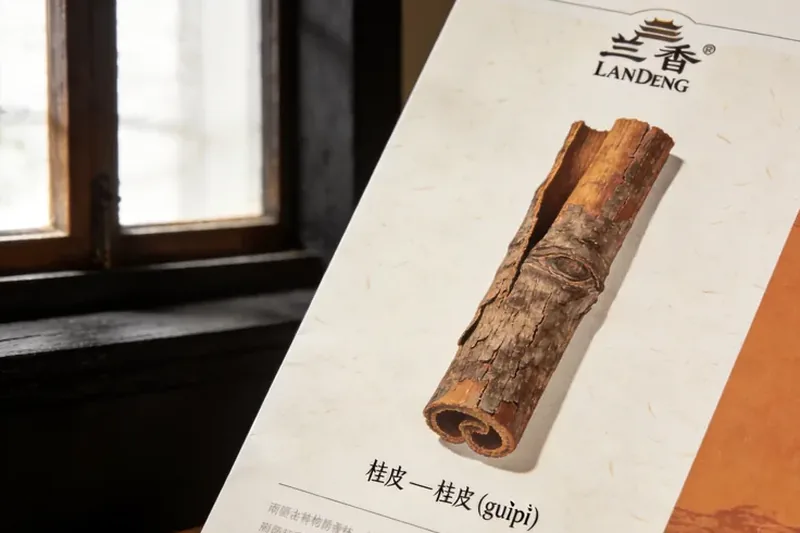
Data summary: In Chinese tradition, “cinnamon” most often means Chinese cassia — the bark of Cinnamomum cassia (桂皮, guìpí), a tree native to southern China. It has a warm, spicy, sweet aroma and is used as a spice, in incense, and in traditional materia medica. The same tree also yields 桂枝 (cassia twig), a distinct part that is easily confused with the bark.
Key facts
| Chinese | 桂皮 (guìpí) — cassia bark; also 肉桂 (ròuguì) |
| Botanical source | Cinnamomum cassia (Chinese cinnamon/cassia) |
| What it is | Dried bark (not a wood or flower) |
| Aroma | Warm, spicy, sweet |
| Traditional role | Spice, incense, perfume |
Aroma profile
Direct answer: Cassia has a warm, sweet-spicy aroma driven by cinnamaldehyde. Chinese cassia is stronger, thicker, and less delicate than Ceylon cinnamon; in a blend it reads as a warming spice — sweet up front, then a pungent, almost hot finish.
Cinnamon/cassia has a warm, sweet-spicy aroma driven by cinnamaldehyde. Chinese cassia is stronger and less delicate than Ceylon cinnamon; its bark is thicker and harder.
In an incense blend, cassia reads as a warming spice — sweet up front, then a pungent, almost hot finish. It is a supporting note that adds “heat” and depth, often paired with clove or citrus peel rather than burned as a solo scent. Its role is closer to a spice-cabinet accent than to the sweet woods (sandalwood) or resins (frankincense) that anchor a blend.
Botanical identity
Direct answer: Cassia is the dried bark of Cinnamomum cassia, a laurel-family (Lauraceae) tree native to southern China and Vietnam. The fragrant part is the bark — not the wood, flower, or leaf — and the same tree yields the young twig (桂枝) as a separate part.
Cinnamomum cassia is an evergreen tree in the laurel family, Lauraceae. The aromatic product is the bark, which is stripped, dried, and traded as rolled “quills” or broken strips. Two things make its identity worth pinning down:
- Bark vs twig — the same tree yields 桂枝 (cassia twig), the young branch, which is a distinct materia-medica part with a lighter, woodier scent. See cassia twig (桂枝).
- Synonymy — the species is also recorded as C. aromaticum; GBIF treats C. cassia as a synonym. See Cinnamomum cassia in Flora of China.
Chinese name and terminology (桂皮 vs 肉桂)
Direct answer: Chinese distinguishes 桂皮 (the coarser outer bark, the everyday cooking spice) from 肉桂 (the finer inner bark, more expensive). Both come from Cinnamomum cassia; the difference is grade and which layer of bark is used.
Chinese itself distinguishes two “cinnamon” words that English flattens into one:
- 桂皮 (guìpí) — literally “cassia bark,” the coarser outer bark, the everyday cooking spice.
- 肉桂 (ròuguì) — “meat cinnamon,” the finer inner bark, more expensive and more refined.
Both come from Cinnamomum cassia; the difference is grade and which layer of bark is used. In a Chinese incense or cooking context, “cinnamon” usually means cassia (桂皮) — strong and economical rather than the delicate Ceylon “true cinnamon.” For the young twig of the same tree, see cassia twig (桂枝).
The “cinnamon vs cassia” distinction (buyer intelligence)
Direct answer: “Cinnamon” is an ambiguous name. Chinese cassia (C. cassia) is the strong, thick-barked standard in North America and Chinese cooking/incense; Ceylon cinnamon (C. verum) is milder, finer, and more expensive. Both are Cinnamomum barks; in a Chinese incense context, “cinnamon” means cassia.
- Chinese cassia (C. cassia) — the standard “cinnamon” in North America and in Chinese cooking/incense; stronger, thicker bark.
- Ceylon cinnamon (C. verum, “true cinnamon”) — milder, finer, more expensive; favored in parts of Europe/South America.
Both are legitimate Cinnamomum barks; the aroma and price differ. In a Chinese incense context, “cinnamon” usually means cassia (桂皮).
Where does cassia come from?
Direct answer: Chinese cassia is native to southern China and Vietnam, where it has long been cultivated for its bark. Guangxi and Guangdong in southern China are traditional producing regions for the bark that reaches both the kitchen and the incense workshop.
Cinnamomum cassia is native to southern China and northern Vietnam, and the bark has been a regional product for centuries. The Chinese producing regions — centered on Guangxi and Guangdong — supply the cassia bark used both as a cooking spice and as an incense ingredient, which is why its aroma reads as familiar and food-adjacent. Because the same tree grows across the region and is cultivated rather than wild-collected, supply is stable and the material is economical compared with wild-harvested resins and woods.
Why is cassia used in incense?
Direct answer: Cassia is used in Chinese 合香 (blended incense) as a classic warm-spice accent, adding warmth and pungency to a formula. It usually plays a supporting role, and its strong aroma means it is blended — often with clove or citrus peel — rather than burned alone.
In Chinese incense, cassia’s job is to add heat: a warm, sweet-pungent note that lifts a blend and gives it a familiar, food-adjacent warmth. Because the aroma is strong, it is a seasoning, not a base — a small proportion in a compound, typically alongside clove, citrus peel, or the other spices of Chinese five-spice. See the clove page for its frequent partner and the scent guide for where spice notes sit in a blend.
How is cassia processed?
Direct answer: Cassia bark is harvested by stripping bark from branches or trunks; as it dries it curls into the familiar rolled quills or is broken into strips. The finer inner bark (肉桂) is separated from the coarser outer bark (桂皮) as a grade distinction.
The processing is bark-based and simple:
- Stripping — bark is cut and peeled from the branches or trunk of the cassia tree.
- Drying — as the bark dries it curls into quills (rolls) or is sold as broken strips.
- Grading by layer — the finer inner bark is sorted as 肉桂, the coarser outer bark as 桂皮; both are Cinnamomum cassia, differing in grade and layer.
For powder, the dried bark is ground; particle size and moisture affect how it behaves in a stick, as with any bark or wood powder. See incense powder & resin.
What determines cassia quality?
Direct answer: Quality rests on bark layer (肉桂 inner bark grades higher than 桂皮 outer bark), oil content (cinnamaldehyde), and thickness. The finer inner bark is more refined and expensive; the coarser outer bark is the economical standard.
The main quality factors:
- Bark layer — 肉桂 (inner bark) grades higher than 桂皮 (outer bark).
- Oil content — the cinnamaldehyde level drives the aroma’s strength and pungency.
- Thickness and cleanliness — intact, well-dried bark without debris or mold.
- Species — Chinese cassia vs Ceylon cinnamon; a different material, not just a different grade.
These are trade distinctions, not a single standardized grading system.
Common forms
Direct answer: Cassia is sold as bark quills, broken bark strips, and ground powder. Quills suit whole-bark use, broken strips suit blending, and powder suits stick-making; the essential oil is a separate distilled product.
| Form | Typical use |
|---|---|
| Bark quills | Whole-bark use; easy to identify and grade |
| Broken strips | Blending and spice use |
| Ground powder | Incense sticks and cones |
| Cassia oil | A separate distilled extract, used in flavor and fragrance |
The distinction between bark and powder is functional — the same material in different physical forms. See incense powder & resin for how bark powder behaves in practice.
Traditional use vs modern evidence
Direct answer: Cassia bark has traditional uses in food and materia medica (warming formulas), described in traditional language, not modern clinical evidence. The bark also contains coumarin, which matters for large-quantity dietary consumption — a factual note, not a recommendation, and irrelevant to incense use.
- Traditional Use — cassia bark appears in warming-formula uses in traditional Chinese materia medica.
- Historical Record — cassia is a long-standing spice and incense ingredient, and the 桂枝/桂皮 part distinction is documented in classical materia medica.
- Scientific Evidence — cassia bark contains cinnamaldehyde (the aroma compound) and coumarin; coumarin is a consideration for large dietary quantities, not for incense burning.
We describe its aromatic and culinary use; we do not make medical claims.
Adulteration & misidentification
Direct answer: The main buying risk is substitution — Ceylon cinnamon (C. verum) sold as, or confused with, Chinese cassia, and vice versa. Both are genuine Cinnamomum barks, but they differ in aroma, thickness, and price, so the label should name the species.
The practical screening point is the cassia vs Ceylon distinction already covered above: both are real cinnamon barks, but a buyer who wants the strong, thick cassia of Chinese incense should not receive the milder, finer Ceylon type. The two are told apart by bark thickness (cassia is thicker and harder), aroma strength, and price. This is a species/labeling matter, not a counterfeit-versus-genuine issue in the way agarwood adulteration is.
Sustainability & sourcing
Direct answer: Cassia is a cultivated tree, not a wild-harvested or endangered material, so its supply is renewable and stable. Sourcing should confirm the species (cassia vs Ceylon), the bark layer (桂皮 vs 肉桂), and the form.
Chinese cassia is farmed in southern China and Vietnam, so unlike wild-harvested aromatics, it carries no meaningful conservation or legal risk. For a buyer, the practical questions are commercial: which species, which bark layer (桂皮 vs 肉桂), and which form (quill, strip, or powder). See the wholesale guide for the general sourcing framework.
Modern commercial applications
Direct answer: Cassia bark goes to spice and flavor use (including Chinese five-spice), incense blending, and — as a distilled oil — flavor and fragrance. The bark serves spice and incense; the oil serves flavor and fragrance as a separate product.
- Spice and flavor — cassia is a core culinary spice and a component of Chinese five-spice (五香粉).
- Incense — the bark and its powder are blended into sticks and cones as a warm-spice note.
- Flavor and fragrance oil — cassia oil is distilled for flavor and fragrance applications, a separate product from the bark.
What buyers should look for
Direct answer: Buyers should confirm the species (Chinese cassia vs Ceylon cinnamon), the bark layer (桂皮 vs 肉桂), and the form (quill, strip, or powder). Ask for oil content where it matters, and request a sample against the formula rather than accepting a generic “cinnamon” label.
For an incense maker or sourcing buyer:
- Species — Chinese cassia vs Ceylon cinnamon; a real seller names which.
- Bark layer — 桂皮 (outer bark, economical) vs 肉桂 (inner bark, finer); the two differ in grade and price.
- Form — quill, strip, or powder; each behaves differently in a blend.
- Aroma strength — a warm, sweet-pungent scent; cassia should read stronger and thicker than Ceylon.
Safety
Incense combustion produces smoke and particulate matter — burn in a well-ventilated space. Cassia bark contains coumarin; this matters for large dietary consumption, not for incense use.
Our Industry View
Direct answer: In manufacturing, cassia is a cheap, potent warm-spice accent — its value is controlled pungency, not rarity. The key variables are species, bark layer, and form consistency, because a strong note like cassia must be dosed carefully or it overpowers a blend.
Cassia’s commercial logic is the reverse of the premium aromatics: it is abundant and strong, so its value lies in consistent, economical pungency rather than scarcity.
- The name hides three different materials. “Cinnamon” can mean Chinese cassia, Ceylon cinnamon, or — in a Chinese context — the bark (桂皮) versus the twig (桂枝). Each behaves differently in a blend, so a formula built on one will not reproduce if the source switches silently.
- Dosing is the constraint. Cassia is potent and food-adjacent, so it is easy to overuse; the useful range is a small proportion in a compound. The right amount depends on formulation — what it is meant to warm, and how much pungency the finished incense should carry — so no single figure transfers between recipes.
In our view, the commercial sweet spot is a named species and bark layer, bought in a consistent form, used as a controlled accent rather than a lead note.
Summary
Cassia (桂皮) is the dried bark of Cinnamomum cassia, a laurel-family tree native to southern China, with a warm, sweet-spicy aroma driven by cinnamaldehyde. It is distinct from Ceylon cinnamon (C. verum) and from the young twig (桂枝) of the same tree, and it serves Chinese 合香 as an economical warm-spice accent rather than a lead note. Its value rests on species, bark layer, and disciplined dosing; the coumarin in its bark is a dietary consideration, not an incense concern.
FAQ
Is Chinese cinnamon the same as Ceylon cinnamon? No. Chinese cassia (Cinnamomum cassia) is stronger, with thicker, harder bark, and is the standard “cinnamon” in North America and in Chinese cooking and incense. Ceylon cinnamon (Cinnamomum verum, “true cinnamon”) is milder, finer, and more expensive, and is favored in parts of Europe and South America. Both are legitimate Cinnamomum barks, but the aroma and price differ. In a Chinese incense context, “cinnamon” almost always means cassia (桂皮), not the delicate Ceylon type.
What is the difference between 桂皮 and 肉桂? Both are bark from Cinnamomum cassia, but they differ in grade and which layer is used. 桂皮 (guìpí) is the coarser outer bark, the everyday cooking spice, and is strong and economical. 肉桂 (ròuguì) is the finer inner bark, more refined and more expensive. The two names are often flattened into a single English “cinnamon,” but Chinese distinguishes them. In a Chinese incense or cooking context, “cinnamon” usually refers to the coarser cassia bark (桂皮).
What does cinnamon/cassia incense smell like? Cassia incense has a warm, sweet, spicy aroma driven by cinnamaldehyde, the compound that gives cinnamon its characteristic scent. It reads as a warming spice — sweet up front, then a pungent, almost hot finish — and is stronger and less delicate than Ceylon cinnamon. In a blend, cassia acts as a supporting note that adds heat and depth, often paired with clove or citrus peel rather than burned as a solo scent. Its role is closer to a spice-cabinet accent than a sweet base.
Is cinnamon used in Chinese incense? Yes. Cassia bark (桂皮) is a classic warm-spice note in Chinese 合香 (blended incense), used to add warmth and pungency. It usually plays a supporting role rather than leading the scent, adding a familiar, food-adjacent warmth that comes from its overlap with Chinese five-spice. Because its aroma is strong, cassia is typically blended with other ingredients — often clove or citrus peel — rather than burned alone. It is one of the traditional spice accents of classical Chinese incense formulas.
Does cassia bark contain coumarin? Yes — cassia bark contains coumarin, a naturally occurring compound that is a consideration for large dietary quantities but is not relevant to incense use. Coumarin is present at higher levels in cassia than in Ceylon cinnamon, which is why some health authorities advise caution about consuming large amounts of cassia. This is a factual note about the bark’s composition, not a health recommendation, and it does not affect the safety or aroma of burning cassia as incense.
Is cassia the “cinnamon” in Chinese five-spice? Yes. Cassia (桂皮) is one of the traditional five-spice (五香粉) components, alongside star anise, cloves, Sichuan pepper, and fennel. This is why its aroma reads as familiar and food-adjacent — the same spice that warms a Chinese braise also warms an incense blend. The overlap between culinary and incense use is common for cassia, and it explains why the scent feels immediately recognizable even outside a cooking context.
What is the difference between cassia bark and cassia twig (桂枝)? Both come from the same tree, Cinnamomum cassia, but they are different parts. 桂皮 is the mature bark — dense, strong, and pungent; 桂枝 is the young twig — lighter and more woody-green. The two are recorded as separate parts in classical Chinese materia medica, and they are not interchangeable in a blend. See the cassia twig (桂枝) page.
See also: clove, its frequent spice partner, mustard seed and the full scent guide.
Evidence & Sources
Botanical identity
Source: Cinnamomum cassia in Flora of China · Cinnamomum aromaticum on GBIF. Evidence type: Established.
Traditional Chinese use
Source: this page records cassia bark’s traditional warming-formula uses in Chinese medicine and its role in 合香 (blended incense). Evidence type: Historically documented — traditional materia-medica language, not modern clinical evidence.
Commercial grading
Source: the 桂皮 (guìpí) vs 肉桂 (ròuguì) grade/layer distinction and Chinese cassia vs Ceylon cinnamon (C. verum). Evidence type: Trade terminology.
Authenticity / adulteration
Source: the “cinnamon vs cassia” buyer note — both are Cinnamomum barks but differ in aroma and price. Evidence type: Practical screening.
Safety
Source: incense combustion produces smoke and particulate matter; cassia bark contains coumarin (relevant to large dietary consumption, not incense use). Evidence type: Established.
Evidence status
| Layer | Status |
|---|---|
| Botanical identity | Established |
| Traditional use | Historically documented |
| Commercial grading | Trade terminology |
| Authenticity test | Practical screening |
| Health claims | Not established |
Sources
Sources: botanical references on Cinnamomum cassia and C. verum (cinnamaldehyde, coumarin, 桂皮/肉桂 usage). This is editorial knowledge content, not medical advice.