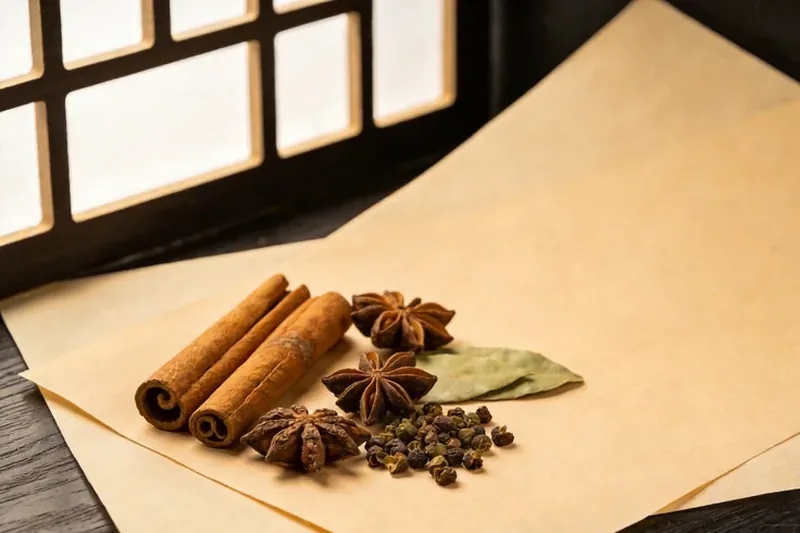
Data summary: Clove — dīngxiāng (丁香) in Chinese — is the dried flower bud of Syzygium aromaticum, prized for a warm, spicy, penetrating aroma. It is used as a spice, in incense, and in traditional materia medica.
Key facts
| Chinese | 丁香 (dīngxiāng) |
| Botanical source | Syzygium aromaticum (dried flower buds) |
| What it is | A dried flower bud (not a wood) |
| Aroma | Spicy, warm, aromatic |
| Traditional role | Spice, incense, perfume |
Aroma profile
Direct answer: Clove has a sharp, warm, spicy, slightly sweet aroma — one of the most penetrating spice notes. Its pungency comes from eugenol, and a little goes a long way: clove is a supporting “hot spice” that balances a soft base, not a lead note.
Clove has a sharp, warm, spicy, slightly sweet aroma — one of the most penetrating spice notes. A little goes a long way; it is usually a supporting note in blends rather than a base.
The scent is driven by eugenol, which gives clove its characteristic “clove oil” pungency. In an incense blend, clove adds a bright, almost medicinal sharpness that cuts through sweeter woods and resins — useful in small doses, overwhelming in large ones. It is the “hot spice” that balances a soft base like sandalwood or benzoin.
What clove is (botany)
Direct answer: Clove is the unopened flower bud of Syzygium aromaticum, a myrtle-family (Myrtaceae) tree. The buds are picked before they open and dried, turning from red to the brown “nail” shape — the English name “clove” comes from the Latin clavus, “nail.”
Clove is the unopened flower bud of the clove tree (Syzygium aromaticum), a member of the myrtle family (Myrtaceae). The buds are harvested before they open and dried, turning from red to the familiar brown “nail” shape (the English word “clove” itself comes from the Latin clavus, “nail”). Major producing regions include Indonesia (historically the Moluccas), Madagascar, Zanzibar, and Sri Lanka.
Chinese name and terminology (丁香 vs 欧丁香)
Direct answer: The Chinese name 丁香 (dīngxiāng) names two unrelated plants: the spice clove (Syzygium aromaticum) and the ornamental lilac (Syringa species). In any spice or incense context, 丁香 means clove; only a gardening context makes it lilac.
In Chinese, 丁香 (dīngxiāng) means two different plants:
- Clove — Syzygium aromaticum, the spice/incense material.
- Lilac — Syringa species, the ornamental flowering shrub (sometimes called 欧丁香, “European clove”).
The spice clove and the ornamental lilac are botanically unrelated. Context distinguishes them; in an incense/spice context, 丁香 means clove. This is one of the classic traps in translating Chinese incense and spice ingredient lists.
Where does clove come from?
Direct answer: Clove is native to the Moluccas (the “Spice Islands”) of eastern Indonesia, and is now grown across the tropics — Indonesia, Madagascar, Zanzibar, and Sri Lanka are the major producers. The buds are hand-picked before they open, which is labor-intensive and contributes to the cost.
Clove’s home is the Moluccas of eastern Indonesia, the original “Spice Islands,” and it remains a major producing region today. From there cultivation spread across the humid tropics, with Indonesia, Madagascar, Zanzibar, and Sri Lanka now the leading suppliers. Because each bud must be picked by hand at the precise moment before it opens, harvest is labor-intensive — a cost that runs through the whole supply chain, from the spice jar to the incense workshop.
Why is clove used in incense?
Direct answer: Clove is used in Chinese 合香 (blended incense) as a classic warm-spice accent — a pungent, aromatic lift that cuts through sweeter woods and resins. Its strength means it is always blended, usually with cinnamon, citrus peel, or the other five-spice notes.
In Chinese incense, clove’s job is to add a bright, warm, pungent lift to a compound. Because its aroma is intense, it is a seasoning, not a base — a small proportion alongside the other warm spices. It appears in two familiar contexts:
- 合香 (blended incense): clove is a classic warm-spice ingredient, adding a pungent, aromatic lift.
- Five-spice (五香粉): clove is one of the traditional five-spice components (with star anise, cassia/cinnamon, Sichuan pepper, and fennel), which is why its aroma reads as familiar and food-adjacent.
Clove vs cinnamon
Direct answer: Both are warm spices used in 合香, but clove is sharper and more pungent (eugenol), while cassia is sweeter and rounder (cinnamaldehyde). Clove “cuts” a blend; cinnamon “warms” it. They are frequent partners — clove adds the bright spice, cinnamon the sweet depth.
Both are warm spices used in 合香, but clove is sharper and more pungent (eugenol), while cassia is sweeter and rounder (cinnamaldehyde). Clove “cuts” a blend; cinnamon “warms” it. They are frequent partners, with clove adding the bright spice and cinnamon the sweet depth. See cinnamon and star anise, its other five-spice partners.
How is clove processed?
Direct answer: Clove buds are harvested just before opening, then dried whole until they turn brown. From there they are sold whole or ground; a separate distillation step produces clove oil, whose pungency is concentrated eugenol.
Clove processing follows the bud:
- Harvest — buds are picked by hand just before they open, when the oil content is at its peak.
- Drying — the buds are dried whole, turning from red to the familiar brown “nail” shape.
- Grinding — dried buds are ground to powder for blending; particle size and moisture affect how the powder behaves in a stick.
- Distillation — clove oil is steam-distilled from the buds (and sometimes the stems), concentrating the eugenol.
The distinction between whole buds, ground clove, and clove oil is functional — the same material at different stages of processing. See incense powder & resin for how spice powder behaves in practice.
What determines clove quality?
Direct answer: Quality rests on oil (eugenol) content, bud integrity, and size. Plump, intact buds with a high oil content are the standard; broken, stem-heavy, or exhausted material grades lower. The scent is the most reliable indicator.
The main quality factors:
- Oil content — eugenol level drives the pungency; higher-oil buds are stronger and more valuable.
- Bud integrity — whole, plump buds beat broken or stem-heavy material.
- Freshness — well-stored buds retain their oil; old or poorly stored material loses punch.
- Origin — Indonesian and Malagasy clove are widely regarded as the aromatic benchmarks, though origin alone does not guarantee quality.
Clove is not graded by a single standardized system; these are trade distinctions, and the aroma is the practical test.
Common forms
Direct answer: Clove is sold as whole dried buds, ground powder, and clove oil. Whole buds suit spice use and visual grading; powder suits stick-making; and clove oil is a separate, concentrated distilled product.
| Form | Typical use |
|---|---|
| Whole buds | Spice use; easy to assess by eye for size and plumpness |
| Ground clove | Incense sticks and cones; spice blending |
| Clove oil | A concentrated distilled product, used in fragrance and flavor |
The distinction between bud and powder is functional, not a quality statement — the same material in different physical forms.
Traditional use vs modern evidence
Direct answer: Clove’s principal compound, eugenol, is studied in the laboratory for anti-inflammatory, analgesic, and antimicrobial activity, and clove is described in traditional materia medica as a warming herb. Both are traditional and/or preliminary research, not established clinical fact; we make no medical claims.
Clove’s principal compound, eugenol, is the subject of laboratory research on anti-inflammatory, analgesic, and antimicrobial activity. In traditional materia medica, clove is described as a warming herb.
- Traditional Use — clove (丁香) is a warming herb in traditional Chinese medicine and a warm-spice ingredient in 合香 and five-spice.
- Historical Record — clove was one of the great spices of the early modern trade, carried from the Moluccas to China, the Middle East, and Europe.
- Scientific Evidence — eugenol is studied for its pharmacological activity, but this is preliminary laboratory research, not established clinical efficacy.
Important: we treat medicinal claims about clove as traditional and/or preliminary research, not established clinical fact. We describe clove’s aromatic and culinary use; we do not make medical claims.
Adulteration & misidentification
Direct answer: The two buying risks are naming (丁香 means clove or lilac) and material quality — “exhausted” cloves from which the oil has already been distilled, which look intact but smell weak. A strong, oily aroma is the practical screen.
Beyond the 丁香 clove/lilac naming trap, the practical quality risk is exhausted cloves: buds from which the essential oil has already been distilled, then sold as if whole. They look nearly identical to fresh buds but carry little of the pungency, so a buyer who judges only by appearance can be misled. The scent — sharp, warm, and penetrating — is the reliable check; a weak or flat-smelling lot is a warning sign.
Sustainability & sourcing
Direct answer: Clove is a cultivated tropical tree, not a wild-harvested or endangered material, so its supply is renewable and stable. Sourcing should confirm the form (whole, ground, or oil) and check the oil content, since exhausted material is the main quality trap.
Clove is farmed across the humid tropics, so unlike wild-harvested aromatics it carries no meaningful conservation or legal risk. The practical sourcing questions are commercial: which form (whole bud, ground, or oil), and how much oil is actually left in the material. See the wholesale guide for the general sourcing framework.
Modern commercial applications
Direct answer: Clove serves spice and flavor use (including five-spice), incense blending, and — as clove oil — flavor, fragrance, and a long-standing use in dental care. The buds serve spice and incense; the oil serves flavor and fragrance as a separate product.
- Spice and flavor — clove is a core culinary spice and a component of Chinese five-spice (五香粉).
- Incense — the buds and their powder are blended into sticks and cones as a warm-spice note.
- Clove oil — the distilled oil is used in flavor, fragrance, and a long-standing role in dental care (its eugenol is the traditional “clove oil” remedy).
What buyers should look for
Direct answer: Buyers should confirm the form (whole, ground, or oil), check the oil content by scent, and prefer plump, intact buds. For powder, confirm particle size and moisture, and test a sample against the formula rather than accepting a generic “clove” label.
For an incense maker or sourcing buyer:
- Form — whole bud, ground, or oil; each behaves differently in a blend.
- Oil content — the scent is the test; a strong, warm, penetrating aroma indicates high eugenol.
- Bud quality — plump, intact buds over broken or stem-heavy material.
- Powder consistency — confirm particle size and moisture, and request a sample against your formula.
Safety
Clove oil/eugenol is potent and can be irritating; it should not be applied undiluted. Incense combustion produces smoke and particulate matter — burn in a well-ventilated space.
Our Industry View
Direct answer: In manufacturing, clove is a cheap, potent warm-spice accent whose value is controlled pungency, not rarity. The key variables are form and oil content, because a strong note like clove must be dosed carefully or it overpowers a blend.
Clove’s commercial logic is like cassia’s: it is abundant and strong, so its value lies in consistent, economical pungency rather than scarcity.
- The name hides two plants. 丁香 is clove in a spice context and lilac in a garden context; in a Chinese ingredient list the distinction is assumed, but a buyer should still confirm they are getting Syzygium aromaticum buds, not a mislabeled or exhausted lot.
- Oil content is the specification that matters. Because clove’s entire character is its eugenol pungency, an exhausted or low-oil lot is a different material in practice — even though it looks the same. The right way to buy is by scent and oil content, not by appearance.
- Dosing is the constraint. Clove is easy to overuse; the useful range is a small proportion in a compound. The right amount depends on formulation — what it is meant to sharpen, and how much pungency the finished incense should carry — so no single figure transfers between recipes.
In our view, the commercial sweet spot is a fresh, high-oil clove bought in a consistent form, used as a controlled accent rather than a lead note.
Summary
Clove (丁香) is the dried, unopened flower bud of Syzygium aromaticum, a myrtle-family tree, with a sharp, warm, spicy aroma driven by eugenol. It is distinct from the ornamental lilac (Syringa) that shares its Chinese name, and it serves Chinese 合香 and five-spice as an economical warm-spice accent. Its value rests on oil content, bud integrity, and disciplined dosing; its “warming herb” reputation is traditional materia-medica language, and eugenol’s pharmacological activity is preliminary research, not established clinical fact.
FAQ
Is 丁香 clove or lilac? Both — the Chinese word 丁香 (dīngxiāng) names two different plants. In a spice or incense context, it means clove, Syzygium aromaticum, the dried flower bud prized for its warm, spicy aroma. In a gardening context, it means lilac, Syringa species, an ornamental flowering shrub sometimes called 欧丁香 (“European clove”). The two are botanically unrelated, and context distinguishes them. This is one of the classic traps in translating Chinese ingredient lists, so in an incense or spice setting 丁香 always means clove.
Is clove a wood or a flower? A flower bud. Clove is the unopened, dried flower bud of Syzygium aromaticum, a member of the myrtle family (Myrtaceae), not a wood or bark. The buds are harvested before they open and dried, turning from red to the familiar brown “nail” shape — the English word “clove” itself derives from the Latin clavus, meaning “nail.” Because the aromatic part is the bud rather than wood or resin, clove has a distinctive sharp, spicy character unlike woody or resinous ingredients.
What does clove smell like? Clove has a sharp, warm, spicy, slightly sweet aroma — one of the most penetrating spice notes. Its scent is driven by eugenol, which gives clove oil its characteristic pungency. In an incense blend, clove adds a bright, almost medicinal sharpness that cuts through sweeter woods and resins. It is useful in small doses and overwhelming in large ones, which is why it usually acts as a supporting “hot spice” note that balances a soft base like sandalwood or benzoin rather than leading the blend.
Is clove used in Chinese incense? Yes. Clove (丁香) is a classic warm-spice ingredient in Chinese 合香 (blended incense), adding a pungent, aromatic lift. Its bright, penetrating character cuts through sweeter woods and resins, so it is used in small amounts as an accent rather than a base. Clove also appears in Chinese five-spice (五香粉), alongside star anise, cassia, Sichuan pepper, and fennel, which is why its aroma reads as familiar and food-adjacent. It is one of the traditional spice notes of classical incense formulas.
Where does clove come from? Clove comes from the dried flower buds of Syzygium aromaticum, harvested before the buds open and then dried until they turn brown. Major producing regions include Indonesia — historically the Moluccas, the spice’s original home — as well as Madagascar, Zanzibar, and Sri Lanka. The buds are picked by hand before flowering, which is labor-intensive and contributes to clove’s value. After drying, the buds are sold whole or ground for use as a spice, in incense, and in traditional materia medica.
What is clove oil, and how does it differ from the buds? Clove oil is the essential oil steam-distilled from the buds (and sometimes the stems), concentrating the eugenol that gives clove its pungency. The buds are the whole aromatic material; the oil is a separate, far more concentrated product, used in flavor, fragrance, and dental care. Because eugenol is potent and can be irritating, clove oil is not applied undiluted, whereas the whole buds are used directly as a spice or incense ingredient.
See also: cinnamon, star anise, fennel, nutmeg and the full scent guide.
Evidence & Sources
Botanical identity
Source: Syzygium in Flora of China · Syzygium aromaticum on GBIF. Evidence type: Established.
Traditional Chinese use
Source: this page records clove (丁香) as a warming herb in traditional Chinese medicine and a classic warm-spice ingredient in 合香. Evidence type: Historically documented — traditional materia-medica language, not modern clinical evidence.
Authenticity / adulteration
Source: the 丁香 clove (Syzygium aromaticum) vs lilac (Syringa) naming trap. Evidence type: Practical screening.
Safety
Source: clove oil/eugenol is potent and can be irritating; incense combustion produces smoke and particulate matter. Evidence type: Established.
Evidence status
| Layer | Status |
|---|---|
| Botanical identity | Established |
| Traditional use | Historically documented |
| Authenticity test | Practical screening |
| Laboratory confirmation | Requires analytical testing |
| Health claims | Not established |
Sources
Sources: botanical references on Syzygium aromaticum (eugenol, harvest regions) and the clove/lilac naming note. Medicinal claims are treated as traditional/preliminary. This is editorial knowledge content, not medical advice.