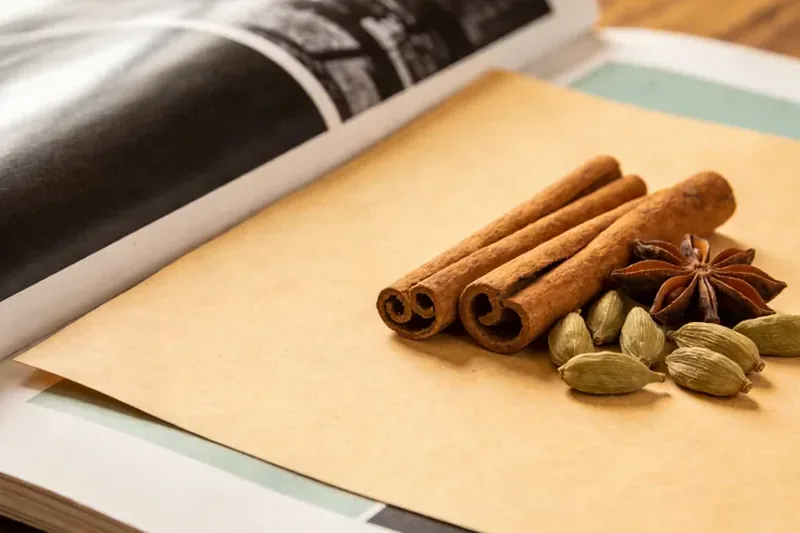
Technical answer: Fennel — xiǎohuíxiāng (小茴香) in Chinese — is the dried seed-like fruit of Foeniculum vulgare, a herbaceous plant of the carrot family (Apiaceae). It is best known as a sweet, anise-like culinary spice, and it appears in Chinese incense as a warm, sweet supporting note in classical 合香 (blended incense) formulas — including the famous 寿阳公主梅花香 (Shouyang princess’s plum incense), where it is listed as 茴香. It is distinct from the larger, star-shaped 八角 (star anise, Illicium verum), which Chinese usage sometimes also calls 大茴香.
Key facts
| Chinese | 小茴香 (xiǎohuíxiāng), also 茴香; cf. 大茴香/八角 (star anise) |
| Botanical source | Foeniculum vulgare (family Apiaceae) — the dried fruit |
| What it is | A dried aromatic seed-fruit, a spice |
| Aroma | Sweet, anise-like, warm, slightly herbaceous |
| Traditional role | Culinary spice, materia medica, 合香 supporting note |
What is fennel?
Direct answer: Fennel (小茴香, xiǎohuíxiāng) is the dried, ridged seed-fruit of Foeniculum vulgare, a carrot-family (Apiaceae) herb native to the Mediterranean and long cultivated in China. It is a sweet, anise-like spice used in cooking, in traditional materia medica, and — in Chinese incense — as a warm sweet-spice supporting note in classical 合香 blends.
Fennel is best understood as a spice that crossed over into incense, not a classical incense canon material in its own right. The plant is a hardy herb whose small, ridged fruit is the material of trade. Its defining chemistry — the aromatic anethole — is what links it to anise and star anise, two unrelated plants that share the same sweet, licorice-like note, and it is this shared chemistry (and the shared 茴香 name) that causes the three to be confused.
Botanical identity
Direct answer: Foeniculum vulgare is a herbaceous plant of the Apiaceae (carrot) family. Flora of China records it as 0.4–2 m tall, with finely dissected, thread-like leaves and compound umbels; the fruit is a small, ridged, seed-like schizocarp 4–6(–10) mm long. The part used is this dried fruit.
Flora of China records Foeniculum vulgare as a plant 0.4–2 m tall, with broadly triangular, finely dissected (4–5-pinnatisect) leaves whose ultimate segments are thread-like. The small yellow flowers are borne in compound umbels 5–9 cm across, with 6–29(–40) rays. The fruit — the part of trade — is a small, ridged, seed-like schizocarp 4–6(–10) × 1.5–2.2(–2.5) mm. It flowers May–June and fruits July–September, and in China it is cultivated and adventive at 200–2600 m. See Foeniculum vulgare in Flora of China and Foeniculum vulgare on GBIF.
Chinese name and terminology
Direct answer: 小茴香 (xiǎohuíxiāng) means “small fennel,” and 茴香 (huíxiāng) is its shorter form. The name overlaps with 大茴香/八角 (star anise) — a different plant — because both carry the anethole sweetness; classical recipes listing 茴香 are usually read as fennel, but the ambiguity is real.
The 茴香 name is the central naming trap in this entry:
- 小茴香 (xiǎohuíxiāng) — fennel, Foeniculum vulgare; “small fennel.”
- 大茴香 / 八角 (dàhuíxiāng / bājiǎo) — star anise, Illicium verum; “large fennel,” an unrelated evergreen tree.
The two share the 茴香 element because they share the anethole sweetness, and a third relative — 茴芹 (anise, Pimpinella anisum) — completes the “anise-sweet” family under its own name. When a classical recipe lists 茴香 without qualifier, it is usually read as fennel, but a buyer should confirm which plant a label means. See star anise and anise.
Where does fennel come from?
Direct answer: Fennel is native to the Mediterranean region and was introduced into China long ago, where it is now cultivated and adventive at 200–2600 m. Its supply follows the ordinary spice-herb trade rather than a dedicated incense-material industry.
Foeniculum vulgare is native to the Mediterranean, and Flora of China records it as cultivated and adventive throughout China — a naturalized culinary and medicinal herb rather than a native incense material. This has a practical consequence: fennel enters the incense trade as a culinary spice with an incense sideline, priced and graded like a spice, not like a specialty aromatic.
Aroma profile
Direct answer: Fennel is sweet and anise-like — warm, herbaceous, and softly licorice-scented, driven largely by the anethole it shares with anise and star anise. It is a gentler, greener “sweet-spice” note than star anise, and in incense it supports and rounds a blend rather than leading it.
Fennel is sweet and anise-like — warm, herbaceous, and softly licorice-scented, driven largely by the aromatic anethole that it shares with anise and star anise. It is a gentler, greener “sweet-spice” note than star anise: star anise reads sharper and more penetrating, while fennel reads softer and more food-adjacent. In incense it adds a warm, food-adjacent sweetness that supports and rounds a blend rather than leading it.
Why is it used in incense?
Direct answer: Fennel is used in incense as a warm, sweet supporting note in classical 合香 blends — most famously in 寿阳公主梅花香 (Shouyang princess’s plum incense), where it is listed as 茴香 alongside clove bark and rosewood. Its role is to round and sweeten, not to carry a formula.
Fennel’s incense role is documented through classical formula rather than solo use:
- 合香 supporting note: 茴香 is listed in classical blended-incense formulas — most notably the 寿阳公主梅花香 (Shouyang princess’s plum incense), where it contributes warm spice-and-sweetness alongside clove bark and rosewood.
- Never a lead material: fennel is a food-adjacent sweetener of blends, not a base or a self-sufficient fragrance.
See the Shouyang princess plum recipe for the formula context.
How is it processed?
Direct answer: Fennel is processed by drying the ripe fruit, which is used whole or ground. There is no extraction step in the whole/ground form; for incense blending it is ground to powder, with particle size and moisture depending on the formula.
The essential step is simple: the ripe fruit is harvested and dried to a stable, storable form, then used whole or ground. For powder buyers, the same practical variables as any seed spice apply: particle size and moisture affect how the material packs, burns, and releases aroma, and the right target depends on the formula — the binder, other ingredients, and the production line. The grinding mechanics sit within the wider how incense is made process, and seed-spice powder behavior is covered in incense powder & resin.
What determines fennel quality?
Direct answer: Quality turns on whole, greenish-brown, strongly sweet-anise fruit with an intact aroma. The aroma is the main indicator — faded, musty, or ground-too-long fennel loses its anethole sweetness. There is no standardized numerical grading.
The practical quality factors, in rough order:
- Aroma — a strong, clean, sweet-anise scent; the primary indicator, since anethole is volatile.
- Whole vs ground — whole fruit retains aroma better than pre-ground; pre-ground fennel fades faster.
- Cleanliness and colour — greenish-brown, well-formed fruit without debris or off-odour.
- For powder — consistent particle size and moisture, judged against the specific formula.
Common forms
Direct answer: Fennel is sold as whole dried fruit and as ground powder. Whole fruit serves culinary and traditional use and retains aroma best; powder serves incense blending — the same material in different physical forms, not a quality distinction.
| Form | Typical use |
|---|---|
| Whole dried fruit | Culinary spice, traditional use, inspection |
| Ground powder | Blended into incense sticks and cones |
The distinction is functional, not a quality statement — though whole fruit keeps its anethole longer than pre-ground. See incense powder & resin for how seed powder behaves in practice.
In Chinese tradition
- Culinary spice: 小茴香 is a staple of Chinese braising and spice blends, valued for its warm, sweet, anise-like character. Historical Record — documented culinary use.
- Materia medica: 小茴香 appears in traditional Chinese medicine as a warming aromatic; Flora of China notes the stem, leaves, and fruit are used as the dietary herb “xiao hui xiang” to aid digestion. Traditional Use — traditional materia-medica language, not modern clinical evidence.
- Incense context: 茴香 is listed as an ingredient in classical 合香 formulas — most notably the 寿阳公主梅花香 (Shouyang princess’s plum incense), where it acts as a warm spice-and-sweetness note alongside clove bark and rosewood. Historical Record — documented formula use.
Traditional use vs modern evidence
The culinary role is unambiguous and well documented. Medicinal uses are traditional, not established clinical fact, and we make no medical claims. In incense, fennel’s documented role is a warm sweet-spice supporting note in classical blended formulas.
Fennel vs related “anise-sweet” materials
Direct answer: Fennel, star anise, and anise are three unrelated plants that converge on the same anethole sweetness — which is why their Chinese names overlap around 茴香. Fennel (Foeniculum vulgare, Apiaceae) is the soft, green seed-fruit; star anise (Illicium verum) is the sharp, star-shaped fruit of a tree; anise (Pimpinella anisum) is another Apiaceae seed with the same note.
| Material | Botanical source | Aroma |
|---|---|---|
| Fennel 小茴香 | Foeniculum vulgare, Apiaceae | Sweet, anise-like, soft, herbaceous |
| Star anise 八角/大茴香 | Illicium verum, Schisandraceae | Sharp, penetrating, licorice |
| Anise 茴芹 | Pimpinella anisum, Apiaceae | Sweet, clean licorice |
The three are distinct plants that meet on the anethole molecule. See star anise, anise, and the material comparison matrix for the general logic.
Adulteration & misidentification
Direct answer: Fennel is not a heavily faked aromatic; its main risk is naming — 茴香 covers both fennel and star anise, two different plants. The fix is to confirm the scientific name (Foeniculum vulgare) when a label or recipe says 茴香.
Fennel is an inexpensive spice, so adulteration is not the same concern as with agarwood. The real risk is misidentification through the shared 茴香 name: a label that says only 茴香 could mean fennel or star anise. Specifying Foeniculum vulgare resolves it.
What buyers should look for
Direct answer: Buyers should confirm the scientific name (Foeniculum vulgare), prefer whole fruit for aroma retention, and check for a strong, clean sweet-anise scent. For powder, test particle size and moisture against the formula.
For an incense maker or sourcing buyer:
- Species — confirm Foeniculum vulgare; the shared 茴香 name makes this the first check.
- Form — whole fruit retains anethole better than pre-ground; each behaves differently in a blend.
- Aroma — a strong, clean sweet-anise scent; the primary quality indicator.
- Powder consistency — confirm particle size and moisture, and test a sample against your formula.
Safety
Incense combustion produces smoke and particulate matter. Burn in a well-ventilated space, avoid inhaling concentrated smoke, and keep away from children and pets. This is editorial knowledge content, not medical advice.
Our Industry View
Direct answer: In manufacturing, fennel is a warm sweet-spice supporting note, not a base. Its value is a food-adjacent sweetness that rounds a blend — but because it is a volatile-spice note, whole-fruit storage and dose matter more than the nominal name.
From a manufacturing perspective, fennel’s defining traits are sweetness and volatility. It supplies a warm, food-adjacent sweetness that softens sharper spices and resins, but its anethole is volatile, so the material fades if stored ground for long.
Two points follow:
- It is a supporting note, not a base. Fennel rounds and sweetens a blend but will not carry it. A buyer who expects it to lead a fragrance will be disappointed, while one who doses it as a sweet-spice accent gets real value.
- Aroma retention is the formulation variable. Because anethole is volatile, whole-fruit storage and grinding-to-order matter; the practical dose and particle-size targets depend on formulation, so a figure that works in one factory does not transfer to another.
In our view, fennel’s commercial value lies in its role as a correctly identified, whole-fruit, sweet-spice accent used to round classical and modern blends — a supporting spice whose real value is its anethole freshness, not its price.
Summary
Fennel (小茴香) is the dried ridged fruit of Foeniculum vulgare, an Apiaceae herb native to the Mediterranean and cultivated throughout China, valued for a sweet, anise-like anethole aroma it shares with the unrelated star anise and anise. In Chinese tradition it is a culinary spice, a materia-medica warming aromatic, and a documented 合香 supporting note in 寿阳公主梅花香. Its main identification risk is the shared 茴香 name with star anise. In incense it is a warm, sweet supporting note, not a base; commercially, correct identification and whole-fruit aroma retention outweigh price.
FAQ
Is fennel the same as star anise? No. Fennel (小茴香, Foeniculum vulgare) is the small seed-like fruit of a carrot-family herb; star anise (八角 / 大茴香, Illicium verum) is the star-shaped fruit of an unrelated evergreen tree. Both carry the sweet anethole note and both share the Chinese name element 茴香, which is why they are confused. Classical recipes listing 茴香 are usually read as fennel, but the ambiguity is real and worth checking.
What does fennel smell like? Sweet and anise-like — warm, herbaceous, and softly licorice-scented. The anethole molecule it shares with anise and star anise drives the sweetness. Fennel is a gentler, greener note than star anise, and in incense it adds a warm, food-adjacent sweetness that supports a blend rather than dominating it.
Is fennel a Chinese incense ingredient? Yes, as a supporting note. 茴香 is listed in classical 合香 (blended incense) formulas, most famously the 寿阳公主梅花香 (Shouyang princess’s plum incense), where it contributes warm spice-and-sweetness alongside clove bark and rosewood. It is a blended-formula ingredient, not a material burned alone, and its role is aromatic rather than anything this page would describe as medical.
What part of the fennel plant is used? The small, ridged, seed-like fruit — commonly called “fennel seed.” It is used whole or ground, both as a culinary spice and as an incense ingredient. The plant’s foliage is also aromatic, but the fruit is the material of trade and the part named 小茴香.
Why does fennel taste and smell like licorice? Because of anethole, the aromatic compound fennel shares with anise and star anise. Anethole is what gives all three their characteristic sweet, licorice-like scent and flavor. The three are unrelated plants, but they converge on the same aromatic chemistry — which is also why their Chinese names overlap around 茴香.
What is the difference between fennel and anise? They are two different Apiaceae (carrot-family) plants with the same anethole note. Fennel is Foeniculum vulgare (小茴香), whose small ridged fruit is a culinary spice; anise is Pimpinella anisum (茴芹), whose smaller seed has a cleaner, more purely licorice character. Both are unrelated to star anise, yet all three share the sweet anethole molecule and the overlapping 茴香/茴芹 naming.
See also: star-anise, anise, clove, the Shouyang princess plum recipe, dill, fenugreek and the full scent guide.
Evidence & Sources
Botanical identity
Source: Foeniculum vulgare in Flora of China · Foeniculum vulgare on GBIF. Evidence type: Established.
Traditional Chinese use
Source: 小茴香 as a culinary spice and materia-medica aromatic (Flora of China notes its use as the dietary herb “xiao hui xiang”); 茴香 listed in the 寿阳公主梅花香 formula (香乘). Evidence type: Historically documented — culinary use; medicinal uses are traditional, not modern clinical evidence.
Authenticity / disambiguation
Source: 小茴香 (fennel, Foeniculum vulgare) vs 大茴香/八角 (star anise, Illicium verum) vs 茴芹 (anise, Pimpinella anisum) — the shared 茴香 name and anethole note. Evidence type: Practical screening.
Safety
Source: incense combustion produces smoke and particulate matter; burn in a well-ventilated space. Evidence type: Established.
Evidence status
| Layer | Status |
|---|---|
| Botanical identity | Established |
| Traditional use | Historically documented (culinary) |
| Authenticity test | Practical screening |
| Health claims | Not established |
Sources
Sources: botanical references on Foeniculum vulgare and the 小茴香/大茴香 (fennel vs star anise) and 茴芹 (anise) distinctions. Fennel is recorded as a culinary spice and a 合香 supporting note; medicinal uses are treated as traditional, not established clinical fact. This is editorial knowledge content, not medical advice.