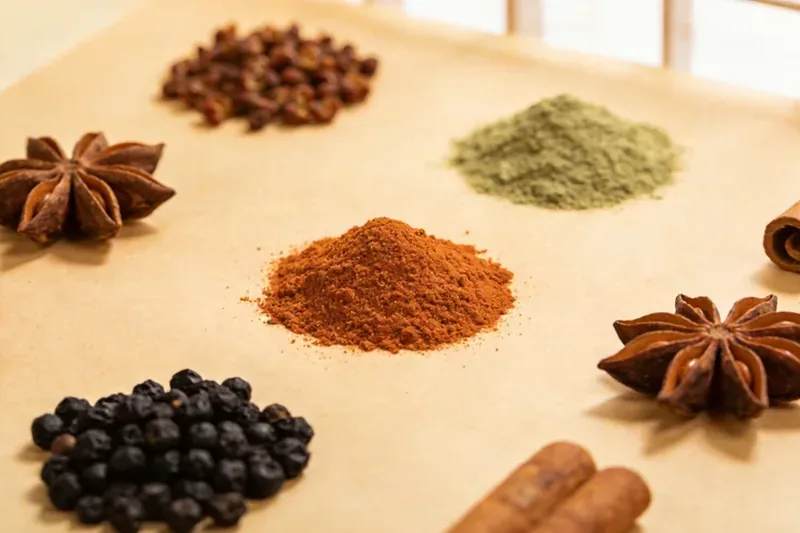
Direct answer: Dill (莳萝, shíluó) is the seed of Anethum graveolens, an annual herb of the carrot family (Apiaceae) native to the Mediterranean and Southwest Asia. It is a culinary spice whose seed and feathery leaf carry a fresh, herbal, anise-like scent. The Bencao Gangmu records 莳萝 under the names 慈谋勒 and 小茴香, noting its use mainly to season food.
Key facts
| Chinese | 莳萝 (shíluó); also 慈谋勒, 小茴香 |
| Botanical source | Anethum graveolens (family Apiaceae) — the seed (and leaf) |
| What it is | An annual culinary spice herb |
| Aroma | Herbal, fresh, anise-like, slightly sweet |
| Traditional role | Culinary spice (香药); 小茴香 in materia medica |
Aroma profile
Direct answer: Dill is herbal and fresh, with a clean, anise-like sweetness and a faint green sharpness. The seed and the feathery leaf share the character but differ in weight — the seed is warmer and more aromatic, the leaf greener and more delicate. As a scent it reads closer to a kitchen seasoning than to a flower or resin, which is exactly its traditional role: a 香药, an aromatic used to flavor and correct other foods.
Dill is herbal and fresh, with a clean, anise-like sweetness and a faint green sharpness. The seed and the feathery leaf share the character but differ in weight — the seed is warmer and more aromatic, the leaf greener and more delicate. As a scent it reads closer to a kitchen seasoning than to a flower or resin, which is exactly its traditional role: a 香药, an aromatic used to flavor and correct other foods. The “anise-like” character is the point that needs care, because it is the source of dill’s entanglement with fennel and anise.
A naming note (read this)
Direct answer: 莳萝 sits among several anise-like aromatics and should not be confused with them. The Bencao Gangmu complicates the picture by giving 莳萝 the alternate name 小茴香 — the same name the fennel seed also carries — so dill and fennel are historically entangled even though they are different plants.
莳萝 sits among several anise-like aromatics and should not be confused with them:
- 莳萝 (dill) — Anethum graveolens, a fresh, anise-like herb. This entry.
- 小茴香 (fennel) — Foeniculum vulgare, a sweeter, warmer anise-like seed, a distinct plant with its own entry.
- 茴芹 (anise) — Pimpinella anisum, the licorice-sweet spice, again distinct.
The Bencao Gangmu (本草纲目) complicates the picture by giving 莳萝 the alternate name 小茴香 — the same name the fennel seed also carries — so the two are historically entangled even though the plants differ. This is the central sourcing hazard: a name that points at two different plants.
Botanical source and origin
Direct answer: Anethum graveolens is an annual herb 30–75 (–100) cm tall of the carrot family (Apiaceae), strongly aromatic, with 3–4-pinnately dissected leaves and brown fruits 3–5 × 2–2.5 mm. Flora of China records it as cultivated and adventive in Gansu, Guangdong, Guangxi, and Sichuan, native to the Mediterranean and cultivated worldwide.
Anethum graveolens is an annual herb of the carrot family (Apiaceae), native to the Mediterranean region and Southwest Asia and cultivated worldwide as a culinary and, historically, medicinal herb. Flora of China records it as a plant 30–75 (–100) cm tall, glabrous, strongly aromatic, with 3–4-pinnately dissected basal leaves and a brown fruit 3–5 × 2–2.5 mm with gray-white, narrowly winged lateral ribs, flowering May–August and fruiting July–September. It is recorded as cultivated and adventive in Gansu, Guangdong, Guangxi, and Sichuan, native to the Mediterranean and cultivated worldwide, and Flora of China adds that “the fruits are used in traditional Chinese medicine ‘shi luo’ and as a spice (dill).” The part used is the seed (莳萝子), with the fresh leaf also used as a kitchen herb. See Anethum graveolens in Flora of China.
Chinese name and terminology
Direct answer: 莳萝 (shíluó) is the plant’s name; its alternate names in the Bencao Gangmu are 慈谋勒 and 小茴香. The alias 小茴香 is the trap: it is also the standard name for fennel (Foeniculum vulgare), so the same name points at two different Apiaceae plants.
The Chinese terminology is where dill’s sourcing risk lives:
- 莳萝 (shíluó) — dill, the plant Anethum graveolens.
- 慈谋勒 (címóulè) — an alternate name recorded in the Bencao Gangmu.
- 小茴香 (xiǎohuíxiāng) — an alternate name that is also the standard name for fennel (Foeniculum vulgare).
The alias 小茴香 is the trap: the Bencao Gangmu records it for both 莳萝 (dill) and 小茴香 (fennel), so the same name has pointed at two different Apiaceae plants across history. This is why a buyer must check the plant, not just the name.
The 茴 family entanglement (read this)
Direct answer: Dill, fennel, and anise are three different Apiaceae plants that converge on an anise-like register and share the 茴 name element — and the Bencao Gangmu deepens the confusion by giving dill the fennel name 小茴香. The three are distinguished by plant, not by name, and by their chemistry (dill’s carvone vs fennel/anise’s anethole).
The anise-like aromatics form a genuine family — and a genuine naming tangle:
- 莳萝 (dill) — Anethum graveolens; fresh, anise-like, driven by carvone and dill ether.
- 小茴香 (fennel) — Foeniculum vulgare; sweeter, warmer, anise-like, driven by anethole.
- 茴芹 (anise) — Pimpinella anisum; the purest licorice-sweet note, driven almost entirely by anethole.
The three are different plants, and their chemistry differs: dill’s character is more carvone-driven, while fennel and anise are anethole-driven. But the Bencao Gangmu’s reuse of 小茴香 across dill and fennel means the name cannot be trusted alone. See fennel (小茴香) and anise (茴芹).
In Chinese tradition
- Culinary spice (香药) (Historical Record): the Bencao Gangmu (本草纲目) records 莳萝 for seasoning — “今人多用和五味” (now mostly used to blend and season food).
- Materia medica (Traditional Use): 莳萝 and its seed appear in traditional Chinese medicine under names including 小茴香. This is traditional materia-medica language, not modern clinical evidence.
Traditional use vs modern evidence
Direct answer: The culinary use is unambiguous and well documented; the medicinal uses are traditional, not established clinical fact. The documented, non-medical facts are botanical identity, the Apiaceae placement, and the culinary-spice record.
- Traditional Use — 莳萝/莳萝子 in traditional Chinese medicine. Traditional materia-medica language, not modern clinical evidence.
- Historical Record — the Bencao Gangmu record of 莳萝 (with 慈谋勒 and 小茴香), noting “今人多用和五味” (seasoning use).
- Scientific Evidence — the botanical identity of Anethum graveolens (Apiaceae) is established. We present no clinical or medical efficacy claims.
The culinary use is unambiguous and well documented. Medicinal uses are traditional, not established clinical fact, and we make no medical claims.
Why is dill catalogued here? (a framing note)
Direct answer: Dill is a culinary spice and 香药, not a burned incense material — and it is catalogued here for its documented record and its place in the anise-like family, positioned honestly rather than invented as an incense staple. Its value to this encyclopedia is the 茴-family naming lesson it illustrates.
莳萝 is not a classical burned-incense material, and this page does not claim otherwise. It is catalogued because:
- It is a named spice with a documented record (莳萝/慈谋勒/小茴香 in the Bencao Gangmu), which the spice coverage should include.
- It is a 香药 — an aromatic used to flavor and correct foods — a distinct Chinese category worth recording.
- Its naming entanglement with fennel (the shared 小茴香) is a genuine sourcing lesson that belongs in the encyclopedia.
The honest position is the point: a culinary spice is catalogued for what it genuinely is, with its incense absence stated plainly.
How is it processed?
Direct answer: Dill is processed by harvesting and drying the seed (and, for the leaf, using it fresh or dried). There is no classical incense-processing record; processing is culinary, and the seed is the more aromatic, warmer form.
The processing of 莳萝 is seed-drying:
- Harvest — the seeds (and, separately, the leaves) are harvested.
- Dry — the seed is dried; the leaf is used fresh or dried.
- Use whole or ground — the seed is used whole or ground as a spice.
There is no classical incense-processing record for dill; it is prepared as a culinary spice, with the seed the warmer, more aromatic form.
What determines quality?
Direct answer: Quality turns on a clean, aromatic seed with a fresh, anise-like character — the seed being warmer and more aromatic than the leaf. There is no incense-grading standard, because dill is a spice, not an incense material.
The quality factors:
- Seed condition — clean, sound seed with a fresh, anise-like aroma.
- Seed vs leaf — the seed is warmer and more aromatic; the leaf is greener and more delicate.
- Freshness — the volatile anise-like note fades with age.
There is no standardized incense-grading ladder; dill is graded as a spice, not as a 香材.
Common forms
Direct answer: Dill is sold as the dried seed, the fresh or dried leaf (dill weed), and the essential oil. The seed is the more aromatic spice form; the leaf is the kitchen herb; the oil is a fragrance/culinary form.
| Form | Typical use |
|---|---|
| Dried seed (莳萝子) | Spice; the more aromatic form |
| Dill leaf (dill weed) | Kitchen herb; greener, more delicate |
| Dill essential oil | Culinary and fragrance use |
The seed and the leaf are the same plant in different forms, with the seed the warmer, more aromatic material.
What buyers should look for
Direct answer: Buyers should distinguish dill (Anethum graveolens) from fennel (小茴香, Foeniculum vulgare) and anise (茴芹, Pimpinella anisum) — the Bencao Gangmu shares the name 小茴香 across dill and fennel, so check the plant, not just the name. Expect a fresh, herbal, anise-like scent, with the seed warmer than the leaf.
For a culinary or sourcing buyer:
- Species — confirm Anethum graveolens; distinguish it from fennel and anise.
- Naming awareness — the name 小茴香 is shared with fennel; the scientific name, not the label, must carry the specification.
- Form — seed (warmer, more aromatic) or leaf (greener, more delicate).
- Role — understand it is a culinary spice and 香药, not a burned incense material.
Safety
Incense combustion produces smoke and particulate matter. Burn in a well-ventilated space, avoid inhaling concentrated smoke, and keep away from children and pets. This is editorial knowledge content, not medical advice.
Dill vs fennel vs anise
Direct answer: Dill (莳萝), fennel (小茴香), and anise (茴芹) are three different Apiaceae plants that share an anise-like register and the 茴 name element. Dill is carvone-driven and fresh; fennel and anise are anethole-driven and sweeter. The Bencao Gangmu’s reuse of 小茴香 across dill and fennel is why the name cannot be trusted alone.
| Dill (莳萝) | Fennel (小茴香) | Anise (茴芹) | |
|---|---|---|---|
| Botanical source | Anethum graveolens | Foeniculum vulgare | Pimpinella anisum |
| Character | Fresh, herbal, anise-like | Sweet, warm, anise-like | Sweet, licorice, purest anethole |
| Driver | Carvone / dill ether | Anethole | Anethole |
The three are different plants, and dill’s character is more carvone-driven while fennel and anise are anethole-driven. See fennel (小茴香), anise (茴芹), and star anise (八角).
Our Industry View
Direct answer: Dill’s lesson is the 茴-family naming trap: one classical name (小茴香) points at two different plants, so “anise-like” is a register, not a spec. The disciplined buyer names the species and the form, and treats a shared name as a signal to check the plant — the same procedural lesson that runs through every anise-like aromatic in this encyclopedia.
From a sourcing perspective, dill is the clearest case of a specific hazard in the anise-like family: the name is shared, the plants are not.
- One name, two plants. The Bencao Gangmu gives 莳萝 the alternate name 小茴香 — the same name the fennel seed carries. A buyer who orders “小茴香” is ordering a name, not a plant, and will receive dill or fennel depending on the seller’s region. The scientific name is the only reliable key.
- The register is chemistry, not identity. Dill’s fresh, anise-like character (carvone) and fennel/anise’s sweeter note (anethole) share a family resemblance but are different chemistries. “Anise-like” is a register, not a spec — a point that runs through dill, fennel, anise, and star anise alike.
- The honest position is the editorial one. Dill is a culinary 香药, not an incense material, and this page says so plainly rather than inventing a burned-incense role. That honesty is part of the discipline: a spice is catalogued for what it is.
In our view, the useful takeaway is procedural: name the species, name the form, and treat a shared classical name as a flag to verify the plant — and an “anise-like” aromatic becomes fully specifiable instead of a source of confusion.
Summary
Dill (莳萝) is the seed (and leaf) of Anethum graveolens, an annual Apiaceae herb native to the Mediterranean and Southwest Asia, recorded by Flora of China as cultivated and adventive in southern China. It is a culinary spice and 香药 — the Bencao Gangmu records it under 慈谋勒 and 小茴香, noting “今人多用和五味” (seasoning use) — with a fresh, herbal, anise-like scent. Its central sourcing hazard is the 茴-family naming trap: the alias 小茴香 is also the fennel name, so the same name points at two different plants, and dill’s carvone-driven character must be distinguished from fennel and anise’s anethole. It is honestly positioned as a culinary spice, not an incense material.
FAQ
What is 莳萝 (dill)? Dill, Anethum graveolens, an annual herb of the carrot family (Apiaceae) native to the Mediterranean and Southwest Asia. Its seed and feathery leaf carry a fresh, herbal, anise-like scent, and it is used chiefly as a culinary spice — a 香药 — rather than a burned incense material.
Does 莳萝 appear in the Bencao Gangmu? Yes. The Bencao Gangmu (本草纲目) records 莳萝 with the alternate names 慈谋勒 and 小茴香, noting “今人多用和五味” — people now use it mainly to blend and season food. The culinary use is the documented role, while medicinal uses are traditional, not established clinical fact.
Is dill the same as fennel? No. Dill (莳萝, Anethum graveolens) and fennel (小茴香, Foeniculum vulgare) are different plants, though both are anise-like Apiaceae aromatics. The Bencao Gangmu complicates this by giving 莳萝 the alternate name 小茴香 — a name the fennel seed also carries — so the two are historically entangled and should be checked by plant, not by name alone.
What does dill smell like? Herbal and fresh, with a clean, anise-like sweetness and a faint green sharpness. The seed is warmer and more aromatic, the feathery leaf greener and more delicate. The scent reads closer to a kitchen seasoning than to a flower or resin, matching its traditional role as a 香药 used to flavor and correct other foods.
Is dill a classical incense ingredient? Not in the burned-incense tradition. Dill’s role is culinary — a seasoning 香药 — rather than a material of 合香 (blended incense) or the 香乘 canon. Its value in aromatics is as a fresh, anise-like kitchen note, not as a lead fragrance.
Why is dill confused with fennel? Because the Bencao Gangmu records the name 小茴香 for both dill (莳萝) and fennel, so the same classical name has pointed at two different Apiaceae plants across history. The two differ in chemistry — dill is more carvone-driven, fennel more anethole-driven — but the shared name is the trap, which is why the scientific name is the reliable key.
See also: fennel (小茴香), anise (茴芹), cumin (孜然), coriander seed (芫荽子), star anise (八角), and the full scent guide.
Evidence & Sources
Botanical identity
Source: Anethum graveolens in Flora of China · Anethum graveolens on GBIF. Evidence type: Established.
Traditional Chinese use
Source: the Bencao Gangmu (本草纲目), 菜之一, records 莳萝 with the names 慈谋勒 and 小茴香, noting “今人多用和五味”. Evidence type: Historically documented — culinary spice; medicinal uses are traditional, not modern clinical evidence.
Authenticity / disambiguation
Source: 莳萝 (dill, Anethum graveolens) vs 小茴香 (fennel, Foeniculum vulgare) vs 茴芹 (anise, Pimpinella anisum). Evidence type: Practical screening.
Safety
Source: incense combustion produces smoke and particulate matter; burn in a well-ventilated space. Evidence type: Established.
Evidence status
| Layer | Status |
|---|---|
| Botanical identity | Established |
| Traditional use | Historically documented (culinary) |
| Authenticity test | Practical screening |
| Health claims | Not established |
Sources
Sources: botanical references on Anethum graveolens and the Bencao Gangmu (本草纲目) 菜之一 record of 莳萝. 莳萝 is documented as a culinary spice; medicinal uses are treated as traditional, not established clinical fact. This is editorial knowledge content, not medical advice.