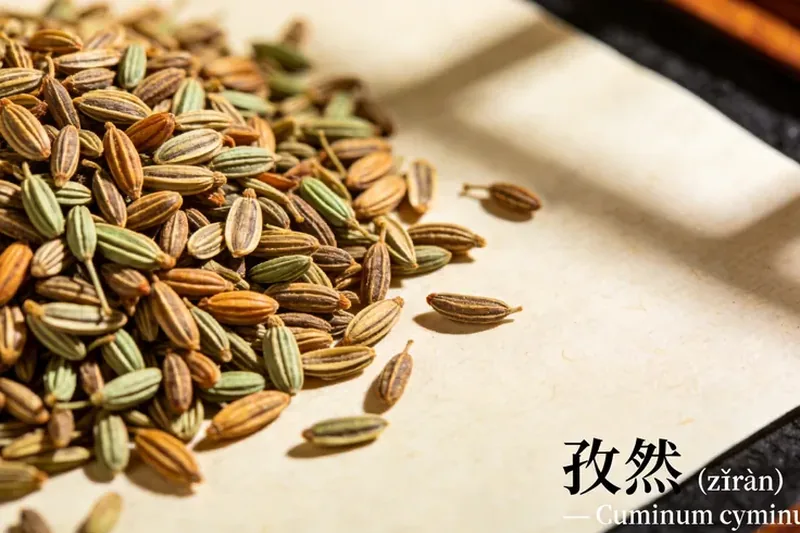
Direct answer: Cumin (孜然, zīrán) is the seed-fruit of Cuminum cyminum, a herbaceous plant of the carrot family (Apiaceae) whose small dried fruits carry a warm, earthy, slightly bitter spice aroma. It is a Western-Regions (西域) spice that reached China through Central Asian trade, and is absent from both the Ming Xiangcheng (香乘) and the Bencao Gangmu under the name 孜然.
Key facts
| Chinese | 孜然 (zīrán) — a Western-Regions loanword |
| Botanical source | Cuminum cyminum (family Apiaceae) — the dried fruit |
| What it is | A dried aromatic seed-fruit, a spice |
| Aroma | Warm, spicy, earthy, slightly bitter |
| Traditional role | Central/West Asian culinary spice |
Aroma profile
Cumin is warm and spicy, earthy and slightly bitter, with a distinctive, almost smoky-penetrating character unlike any other seed spice. It is not sweet — it leans savory, musky, and pungent, and it dominates a blend rather than supporting it. In incense and aromatics it reads as a bold, warm, food-adjacent spice, more at home in the kitchen (Central Asian, South Asian, Middle Eastern, and especially the cumin-heavy cooking of China’s northwest) than in a classical Chinese temple formula.
A Western-Regions spice, honestly placed (read this)
孜然 is the Chinese name for cumin, and it is a loanword of Western-Regions origin — reflecting the spice’s arrival in China through Central Asian trade rather than a native Chinese record. The word 孜然 (zīrán) transcribes a Central/West Asian source (compare Uyghur, Persian zire, Arabic kammūn), and the spice’s documented Chinese culinary role is concentrated in the northwest, where Xinjiang and adjacent cuisines use it heavily. It does not appear in the Ming-dynasty Xiangcheng (香乘) or the Bencao Gangmu (本草纲目) as 孜然, and Flora of China does not treat Cuminum cyminum as a native species.
This page describes 孜然 = cumin as a Western-Regions spice. We do not retrofit it into the classical Chinese incense record; its genuine story is the Silk-Road route by which it entered Chinese kitchens.
Botanical source and origin
Cuminum cyminum is an annual herb of the carrot family, native to the eastern Mediterranean through southwestern Asia, and cultivated since antiquity across the Middle East, South Asia, and Central Asia. The part used is the small, ridged, seed-like fruit, whose volatile oils (cuminaldehyde and related compounds) give the warm, earthy, penetrating aroma. It is not a Flora of China species, which is consistent with its status as an introduced Western-Regions spice.
In Chinese and regional tradition
- Northwest Chinese cuisine: 孜然 is the signature spice of Xinjiang and northwest Chinese cooking, especially cumin-spiced lamb and grilled meats.
- Central and West Asian staple: cumin is central to Middle Eastern, Central Asian, South Asian, and Mexican cuisines.
- Not a classical incense material: 孜然 is absent from the 香乘 and 本草 as a named ingredient; its Chinese story is culinary and trade-borne, not incense.
Traditional use vs modern evidence
The culinary use is unambiguous and well documented. We make no medical claims. The documented, non-medical facts are botanical identity, the Apiaceae placement, and the Western-Regions culinary role.
Quality and sourcing notes
Practical points for buyers:
- 孜然 is cumin (Cuminum cyminum); expect a warm, spicy, earthy, slightly bitter, penetrating aroma.
- It is a Western-Regions spice, not a classical Chinese incense material — its Chinese name 孜然 is a Central-Asian loanword.
- Distinguish it from fennel (小茴香) and coriander seed (芫荽籽), carrot-family seed spices with very different (sweet vs savory) profiles.
Safety
Incense combustion produces smoke and particulate matter. Burn in a well-ventilated space, avoid inhaling concentrated smoke, and keep away from children and pets. This is editorial knowledge content, not medical advice.
FAQ
What is 孜然 (cumin)? Cumin, Cuminum cyminum, an annual herb of the carrot family (Apiaceae) native to the eastern Mediterranean through southwestern Asia. Its small dried fruits carry a warm, earthy, slightly bitter spice aroma, and it is a Western-Regions (西域) spice that reached China through Central Asian trade.
Is cumin a classical Chinese incense ingredient? No. 孜然 does not appear in the Ming-dynasty Xiangcheng (香乘) or the Bencao Gangmu (本草纲目) as a named ingredient, and it is not a native Flora of China species. Its Chinese story is culinary and trade-borne — the signature spice of Xinjiang and northwest cooking — not incense.
Where does the name 孜然 come from? It is a loanword of Western-Regions origin, transcribing a Central or West Asian source for cumin (compare Persian zire, Arabic kammūn). The name itself records the spice’s arrival in China through Central Asian trade.
What does cumin smell like? Warm and spicy, earthy and slightly bitter, with a penetrating, almost smoky-savory character unlike any other seed spice. It leans savory and musky rather than sweet, and it dominates a blend rather than supporting it.
Is cumin the same as fennel? No. Cumin (孜然, Cuminum cyminum) is warm, earthy, and savory-bitter, while fennel (小茴香, Foeniculum vulgare) is sweet and anise-like. Both are carrot-family (Apiaceae) seed-fruits, but their aromatic profiles are opposite — sweet-licorice versus warm-earthy — and they are unrelated plants.
How is cumin used in China? Primarily as the signature spice of Xinjiang and northwest Chinese cooking, especially cumin-spiced lamb and grilled meats, where it is used generously whole or ground. This is a culinary role, not an incense role.
See also: coriander-seed, fennel, dill, fenugreek and the full scent guide.
Evidence & Sources
Botanical identity
Source: Cuminum cyminum on GBIF. Evidence type: Established. Note: not a Flora of China species — consistent with its introduced Western-Regions status.
Traditional Chinese use
Source: 孜然 as a Western-Regions culinary spice (a Central-Asian loanword), the signature of Xinjiang and northwest cooking; absent from the 香乘 and 本草 under this name. Evidence type: Historically documented — culinary use; absence in the classical incense record recorded honestly.
Authenticity / disambiguation
Source: 孜然 (cumin, Cuminum cyminum) vs 小茴香 (fennel, Foeniculum vulgare) vs 芫荽籽 (coriander seed, Coriandrum sativum). Evidence type: Practical screening.
Safety
Source: incense combustion produces smoke and particulate matter; burn in a well-ventilated space. Evidence type: Established.
Evidence status
| Layer | Status |
|---|---|
| Botanical identity | Established |
| Traditional use | Historically documented (culinary, Western Regions) |
| Authenticity test | Practical screening |
| Health claims | Not established |
Sources
Sources: botanical references on Cuminum cyminum. 孜然 (cumin) is documented as a Western-Regions culinary spice, not a classical Chinese incense material, and no classical incense role is claimed; no medical claims are made. This is editorial knowledge content, not medical advice.