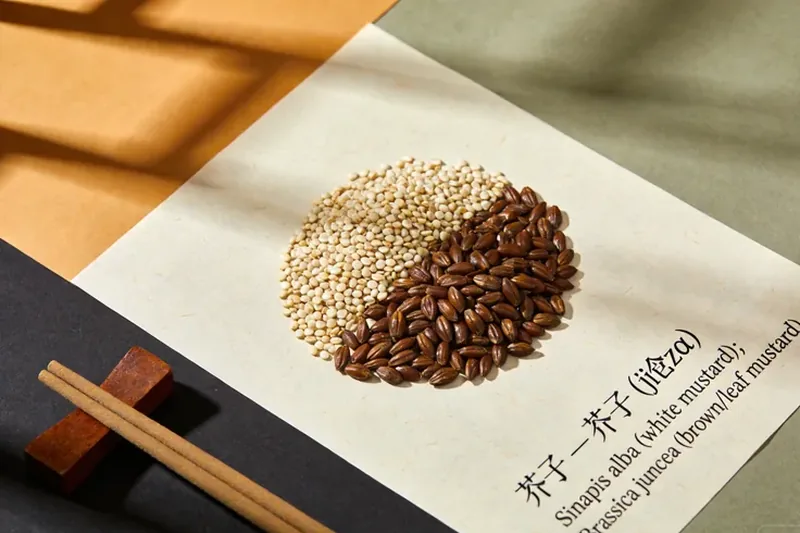
Direct answer: Mustard seed (芥子, jièzǐ) is the pungent seed of mustards in the cabbage family (Brassicaceae): white mustard (Sinapis alba) and brown or leaf mustard (Brassica juncea). It is a sharp, spicy culinary seed whose heat is released only when the ground seed meets water. The Bencao Gangmu records 芥 in its vegetable section, noting the white mustard seed (白芥子) is “甚辛美” — very pungent and fine.
Key facts
| Chinese | 芥子 (jièzǐ); 白芥子 = white mustard seed |
| Botanical source | Sinapis alba (white mustard); Brassica juncea (brown/leaf mustard), Brassicaceae — the seed |
| What it is | A pungent culinary spice seed |
| Aroma | Pungent, sharp, spicy, green |
| Traditional role | Culinary spice (香药); 芥子 in materia medica |
Aroma profile
Mustard seed is pungent and sharp, with a hot, green, horseradish-like bite that appears only when the crushed seed is moistened — dry, the seed is almost scentless. The heat is a chemical defense (the enzyme myrosinase acting on glucosinolates), not a lingering spice warmth like pepper or cinnamon. It is a food aroma first, and its role in aromatics is as a sharp, corrective seasoning rather than a lead fragrance.
Botanical source and origin
Mustard covers several cabbage-family plants. The two most relevant to 芥子 are white mustard (Sinapis alba), native to the Mediterranean and West Asia, and brown or leaf mustard (Brassica juncea), long cultivated across Asia for both its pungent seed and its leafy vegetable form (芥菜). The seed is the material of value; it is ground, sometimes after roasting, and mixed with liquid to develop its heat. Flora of China records Brassica juncea.
In Chinese tradition
- Culinary spice (香药): mustard seed is a sharp seasoning; the Bencao Gangmu (本草纲目) records 芥 among the cultivated vegetables, with the white seed (白芥子) noted as “甚辛美” (very pungent and fine).
- Materia medica: 芥子 appears in traditional Chinese medicine. This is traditional materia-medica language, not modern clinical evidence.
Traditional use vs modern evidence
The culinary use is unambiguous and well documented. Medicinal uses are traditional, not established clinical fact, and we make no medical claims. The documented, non-medical facts are botanical identity, the Brassicaceae placement, and the culinary-spice record.
Quality and sourcing notes
Practical points for buyers:
- 芥子 is mustard seed — white mustard (Sinapis alba) or brown/leaf mustard (Brassica juncea); expect a sharp, hot, green bite released only when the ground seed is moistened.
- Dry mustard seed is nearly scentless; the pungency develops on wetting or grinding with liquid.
- It is a culinary spice and 香药, not a burned incense material and not a classical 香乘 ingredient.
Safety
Incense combustion produces smoke and particulate matter. Burn in a well-ventilated space, avoid inhaling concentrated smoke, and keep away from children and pets. This is editorial knowledge content, not medical advice.
FAQ
What is 芥子 (mustard seed)? The pungent seed of mustards in the cabbage family (Brassicaceae) — chiefly white mustard (Sinapis alba) and brown or leaf mustard (Brassica juncea). It is a sharp, spicy culinary seed whose heat is released only when the crushed seed meets water, and it is used as a seasoning 香药 rather than a burned incense material.
Why does dry mustard seed have little smell? Because its pungency is a chemical defense, not a stored aroma. The enzyme myrosinase reacts with glucosinolates only when the crushed seed is moistened, producing the sharp, hot, horseradish-like bite. Dry, whole seed is nearly scentless; wetting or grinding with liquid unlocks the heat.
Does 芥子 appear in the Bencao Gangmu? Yes. The Bencao Gangmu (本草纲目), vegetable section (菜之一), records 芥 among the cultivated vegetables, describing several kinds, and notes the white mustard seed (白芥子) as “甚辛美” — very pungent and fine. The culinary use is the documented role, while medicinal uses are traditional, not established clinical fact.
What is the difference between white and brown mustard? White mustard (Sinapis alba) has a milder, more evenly pungent seed and is the source of the classic pale table mustard; brown or leaf mustard (Brassica juncea) is hotter and is the seed behind many Asian mustards and the leafy vegetable 芥菜. Both contribute to the name 芥子, and they differ in heat, color, and culinary use.
Is mustard a classical incense ingredient? Not in the burned-incense tradition. Mustard’s role is culinary — a sharp seasoning 香药 — rather than a material of 合香 (blended incense) or the 香乘 canon. Its aromatic value is as a hot, corrective food note, not a lead fragrance.
See also: pepper, cinnamon, dried ginger, and the full scent guide.
Evidence & Sources
Botanical identity
Source: Brassica juncea in Flora of China · Sinapis alba on GBIF · Brassica juncea on GBIF. Evidence type: Established.
Traditional Chinese use
Source: the Bencao Gangmu (本草纲目), 菜之一, records 芥 with the white seed (白芥子) noted as “甚辛美”. Evidence type: Historically documented — culinary spice; medicinal uses are traditional, not modern clinical evidence.
Authenticity / disambiguation
Source: 芥子 (white mustard Sinapis alba vs brown/leaf mustard Brassica juncea). Evidence type: Practical screening.
Safety
Source: incense combustion produces smoke and particulate matter; burn in a well-ventilated space. Evidence type: Established.
Evidence status
| Layer | Status |
|---|---|
| Botanical identity | Established |
| Traditional use | Historically documented (culinary) |
| Authenticity test | Practical screening |
| Health claims | Not established |
Sources
- Brassica juncea in Flora of China
- Sinapis alba on GBIF
- Brassica juncea on GBIF
- 本草纲目 菜之一 on Wikisource
Sources: botanical references on Sinapis alba and Brassica juncea and the Bencao Gangmu (本草纲目) 菜之一 record of 芥. 芥子 is documented as a culinary spice; medicinal uses are treated as traditional, not established clinical fact. This is editorial knowledge content, not medical advice.