Direct answer: Cassia twig (桂枝, guìzhī) is the young, slender branch of the cassia tree, Cinnamomum cassia (syn. C. aromaticum), the same tree that yields cinnamon bark (桂皮). It has a warm, spicy, sweet, woody-bark scent and is a classical Chinese materia-medica part. It is the young twig of the same tree as 桂皮 — same species, different part.
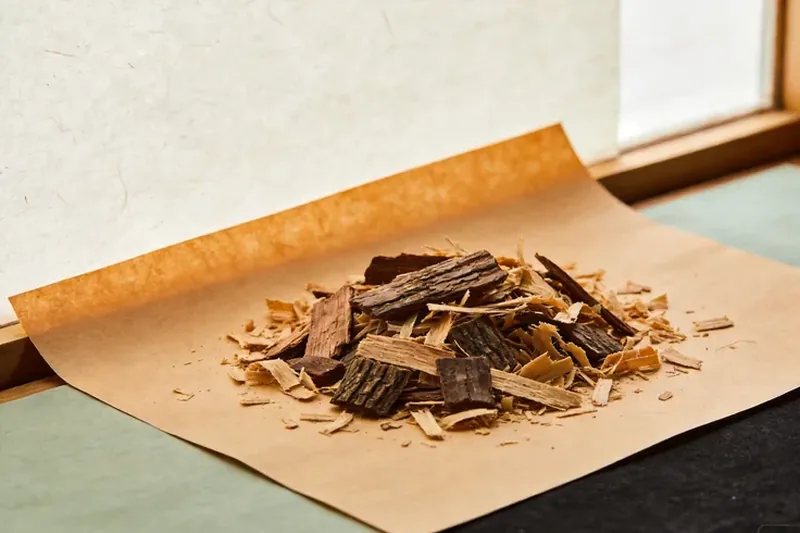
Key facts
| Chinese | 桂枝 (guìzhī); tree = 桂 (guì) |
| Botanical source | Cinnamomum cassia (syn. C. aromaticum), family Lauraceae — the young twig |
| What it is | The young branch of the cassia tree, distinct from its bark |
| Aroma | Warm, spicy, sweet, woody |
| Traditional role | Materia medica; same tree as 桂皮 (cinnamon bark) |
Aroma profile
桂枝 has a warm, spicy, sweet, woody-cinnamon scent — the familiar cassia aroma, but from the young twig rather than the mature bark. It is lighter and more woody-green than the dense, pungent bark (桂皮), carrying the same cinnamon warmth with a fresher, branch-like edge.
The 桂枝 / 桂皮 distinction (read this)
桂枝 and 桂皮 come from the same tree, different parts:
- 桂枝 (cassia twig) — the young, slender branch of Cinnamomum cassia. This entry.
- 桂皮 (cinnamon bark) — the mature bark of the same tree. Its own entry (the “cinnamon” entry on this site).
The Bencao Gangmu (本草纲目), 木之一, records the tree under 桂, distinguishing its parts — the bark (桂皮/肉桂) and the young twig (桂枝) — with the classical note “桂枝之下無雜木” (no other wood grows beneath the cassia twig), from the Lüshi Chunqiu. This page describes 桂枝 = the young twig, not the bark.
Botanical source and origin
Cinnamomum cassia (syn. C. aromaticum), the Chinese cassia, is a laurel-family tree (Lauraceae) native to southern China and Vietnam. Its bark is the spice “cassia” (桂皮), and its young twigs (桂枝) are a distinct materia-medica part. Flora of China records the species; the same botanical identity underlies both the twig and bark entries here.
In Chinese tradition
- Materia medica: 桂枝 is a classical Chinese materia-medica part. This is traditional materia-medica language, not modern clinical evidence.
- Naming: the Bencao Gangmu (本草纲目) records the tree under 桂, distinguishing the bark (桂皮) and the young twig (桂枝).
- Symbolism: the classical line “桂枝之下無雜木” (no other wood grows beneath cassia) reflects the tree’s reputed dominance over its surroundings.
Traditional use vs modern evidence
The materia-medica record is traditional, not established clinical fact, and we make no medical claims. The documented facts are botanical identity, the Lauraceae placement, and the twig’s distinction from the bark.
Quality and sourcing notes
Practical points for buyers:
- 桂枝 is the young twig of Cinnamomum cassia (syn. C. aromaticum); expect a warm, spicy, sweet, woody-cinnamon scent.
- Distinguish it from 桂皮 (cinnamon bark) — the same tree’s bark, denser and more pungent, with its own entry.
- The twig is lighter and woodier than the bark; specify the part (桂枝 vs 桂皮) when sourcing.
Safety
Incense combustion produces smoke and particulate matter. Burn in a well-ventilated space, avoid inhaling concentrated smoke, and keep away from children and pets. This is editorial knowledge content, not medical advice.
FAQ
What is 桂枝 (cassia twig)? The young, slender branch of the cassia tree, Cinnamomum cassia (syn. C. aromaticum), the same tree that yields cinnamon bark (桂皮). It has a warm, spicy, sweet, woody-cinnamon scent and is a classical Chinese materia-medica part.
Is 桂枝 the same as 桂皮 (cinnamon bark)? No — same tree, different parts. 桂枝 is the young twig, lighter and woodier; 桂皮 is the mature bark, denser and more pungent. The Bencao Gangmu (本草纲目) records the tree under 桂 and distinguishes its parts — the bark (桂皮) and the young twig (桂枝).
What does 桂枝 smell like? Warm, spicy, sweet, and woody-cinnamon — the familiar cassia aroma, but from the young twig rather than the bark. It is lighter and more woody-green than the dense, pungent bark (桂皮), carrying the same warmth with a fresher, branch-like edge.
Is cassia twig an incense ingredient? It is primarily a materia-medica part. Its warm cassia scent can lend a woody-spicy accent, and it is the twig of the same tree as the incense spice cassia (桂皮), but its classical role is in materia medica rather than as a lead 香材.
Where does the saying “桂枝之下无杂木” come from? From the classical Lüshi Chunqiu, quoted in the Bencao Gangmu (本草纲目): “桂枝之下無雜木” — no other wood grows beneath the cassia twig. It reflects the cassia tree’s reputed dominance over its surroundings.
See also: cinnamon (桂皮), clove, ginger, and the full scent guide.
Evidence & Sources
Botanical identity
Source: Cinnamomum cassia in Flora of China · Cinnamomum aromaticum on GBIF. Evidence type: Established (GBIF treats C. cassia as a synonym of C. aromaticum).
Traditional Chinese use
Source: the Bencao Gangmu (本草纲目), 木之一, records 桂, distinguishing 桂皮 and 桂枝 (“桂枝之下無雜木”, quoting the Lüshi Chunqiu). Evidence type: Historically documented — materia medica; medicinal uses are traditional, not modern clinical evidence.
Authenticity / disambiguation
Source: 桂枝 (twig) vs 桂皮 (bark) — same tree, Cinnamomum cassia, different parts. Evidence type: Practical screening.
Safety
Source: incense combustion produces smoke and particulate matter; burn in a well-ventilated space. Evidence type: Established.
Evidence status
| Layer | Status |
|---|---|
| Botanical identity | Established |
| Traditional use | Historically documented (materia medica) |
| Authenticity test | Practical screening |
| Health claims | Not established |
Sources
Sources: botanical references on Cinnamomum cassia and the Bencao Gangmu (本草纲目) 木之一 record of 桂/桂枝. 桂枝 is documented as the young cassia twig, distinct from the bark 桂皮; medicinal uses are treated as traditional, not established clinical fact. This is editorial knowledge content, not medical advice.