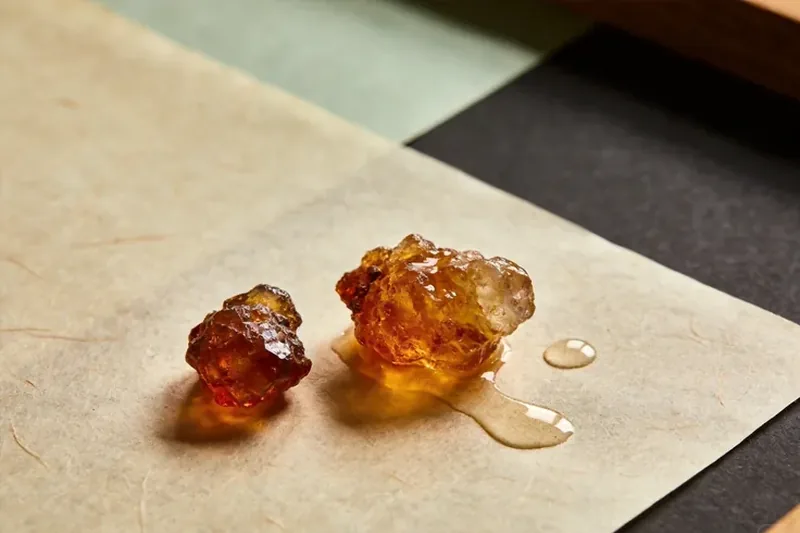
Direct answer: Sweetgum (枫香, fēngxiāng) is the aromatic resin of the sweetgum tree, Liquidambar formosana (family Altingiaceae). It has a sweet, balsamic, warm aroma and is used in incense and perfumery, where it is closely related to (but distinct from) the imported storax (苏合香). The resin is properly called 枫香脂 (fēngxiāngzhī), and classical sources note that it was used both on its own and to adulterate frankincense.
Key facts
| Chinese | 枫香 (fēngxiāng); the resin is 枫香脂 (fēngxiāngzhī) |
| Botanical source | Liquidambar formosana (Chinese sweetgum) |
| What it is | A balsamic tree resin |
| Aroma | Sweet, balsamic, resinous, warm |
| Traditional role | Incense, perfumery, traditional use |
Aroma profile
Direct answer: Sweetgum resin has a sweet, warm, balsamic scent with a resinous depth — soft and comforting, in the same broad family as benzoin but with its own character. It reads as a sweet base or supporting note rather than a bright top, rounding out heavier woods and resins rather than leading a blend.
Sweetgum resin has a sweet, warm, balsamic scent with a resinous depth — soft and comforting, in the same broad family as benzoin but with its own character. It reads as a sweet base or supporting note rather than a bright top. The classical Xiangcheng (香乘) gives a precise pointer to its character: 枫香 is so close in appearance to frankincense (乳香) that Li Shizhen noted the two are told apart only by burning — which tells us the material reads as a warm, resinous, frankincense-adjacent note rather than as a sharp or floral one.
Botanical identity
Direct answer: Liquidambar formosana is the Chinese sweetgum, a tree of the sweetgum family (Altingiaceae, formerly placed in Hamamelidaceae). Flora of China describes a tree to 30 m tall with a trunk to 1 m in diameter, palmately three-lobed leaves, and a March–June flowering season; its wounded bark yields the balsamic resin 枫香脂.
Liquidambar formosana is the Chinese sweetgum, a tree of the sweetgum family (Altingiaceae, historically placed in Hamamelidaceae). Flora of China describes it precisely: trees to 30 m tall, the trunk sometimes 1 m in diameter, with gray-brown bark; leaf blades broadly ovate, palmately three-lobed and three-veined, with a glandular-serrate margin; male inflorescences in short spikes, female inflorescences 24–43-flowered; infructescence globose, 3–4 cm wide; flowering March–June, fruiting July–September. It grows in sunny places, near villages, and in montane forests at 500–800 m, from Anhui, Fujian, Guangdong, Guizhou, Hainan, Hubei, Jiangsu, Jiangxi, Sichuan, Taiwan, and Zhejiang south to Korea, Laos, and northern Vietnam. The fragrant part is the resin (枫香脂), tapped from the wounded bark — not the wood itself. See Liquidambar formosana in Flora of China and Liquidambar formosana on GBIF.
Chinese name and terminology
Direct answer: The name 枫香 names the tree and, by extension, its fragrant resin — but the resin carries its own precise term, 枫香脂 (fēngxiāngzhī). The Xiangcheng (香乘) records an older alternative name, 白胶香 (“white gum fragrance”), giving the resin a distinct identity from the tree.
The terminology needs a small precision:
- 枫香 (fēngxiāng) — the tree, and loosely the material.
- 枫香脂 (fēngxiāngzhī) — the resin, the actual fragrant substance.
- 白胶香 (báijiāoxiāng) — “white gum fragrance,” an older name the Xiangcheng (香乘) records for 枫香脂, and which the Golden Light Sutra renders in transliteration as 须萨析罗婆.
Because the tree and the resin share the name 枫香, a buyer should pin down whether a label means the wood or the resin — almost always it is the resin (枫香脂), which is the part with commercial fragrance value.
The storax / sweetgum distinction (buyer intelligence)
Direct answer: “Sweetgum” resin and “storax” are often confused because both come from Liquidambar trees — but they are different species from different regions. 枫香脂 is Liquidambar formosana (the native Chinese sweetgum); storax (苏合香) is Liquidambar orientalis (the Oriental sweetgum of Asia Minor). They are related resins from related trees, not the same product.
Two Liquidambar resins sit side by side and are routinely conflated:
- 枫香脂 (sweetgum resin) — Liquidambar formosana, the native Chinese sweetgum. This entry.
- 苏合香 / storax — Liquidambar orientalis, the Oriental sweetgum of Asia Minor, the classical imported balsam (see styrax-resin).
They are related resins from related trees in the same family (Altingiaceae), but not the same product: one is the native Chinese resin, the other the imported storax. When a label says “sweetgum” or “storax,” the species matters for the exact aroma, origin, and price.
The frankincense-adulteration record (香乘考据)
Direct answer: The Xiangcheng (香乘) records a sharp practical fact: 枫香 was used to adulterate frankincense (乳香), and Li Shizhen noted the two are told apart only by burning. Both 枫香 and pine resin could pass for frankincense, but 枫香 was slightly whitish-yellow — so the burn test was the discriminating check.
The most useful classical observation about 枫香 is a supply-chain warning, and it reads like modern buyer intelligence:
- 枫香 fakes frankincense. The Xiangcheng (香乘) records, quoting Li Shizhen: “乳香,今人多以枫香杂之,惟烧时可辨” — today people adulterate frankincense with 枫香, and the two are told apart only by burning.
- Both 枫香 and pine resin could fake it. “枫香、松脂皆可乱乳香,但枫香微白黄色,烧之可见真” — both 枫香 and pine resin can pass for frankincense, but 枫香 is slightly whitish-yellow, and burning reveals the truth.
The same principle runs in both directions: 枫香 is close enough to frankincense to be used as an adulterant, which means a buyer should distinguish 枫香 from frankincense (乳香) on the one hand, and from the imported storax on the other. The burn test is the classical discriminator.
Where does sweetgum come from?
Direct answer: 枫香 resin comes from Liquidambar formosana, the native Chinese sweetgum, which grows across central and southern China and south to Korea, Laos, and northern Vietnam. Unlike storax (imported from Asia Minor), 枫香 is a native Chinese resin, which is part of its identity — and part of why it was cheaper and more available than the imported storax.
Liquidambar formosana grows natively across Anhui, Fujian, Guangdong, Guizhou, Hainan, Hubei, Jiangsu, Jiangxi, Sichuan, Taiwan, and Zhejiang, and south to Korea, Laos, and northern Vietnam, in sunny places, near villages, and in montane forests at 500–800 m. The resin (枫香脂) is tapped from the wounded bark. This native, widely available status contrasts with storax (苏合香, Liquidambar orientalis), which classical texts record as an imported resin from Central Asia — a difference that matters for price, availability, and identity.
Why is it used in incense?
Direct answer: 枫香脂 is used in incense as a sweet-balsamic ingredient that adds warmth and roundness to 合香 blends, and as a supporting or fixative note that rounds out woods and resins. The Xiangcheng records it in formulas, including a step where 枫香 is melted with cassia to blend the two resins.
枫香脂’s role in incense is as a sweet-balsamic warmth: a supporting and fixative note that rounds out woods and resins. The Xiangcheng (香乘) records it in actual formulas — for example “通明枫香二两,火上溶,间桂末一两,入香内搅匀” (two parts clear 枫香, melted over fire, with one part cassia powder stirred in) — showing it was handled as a meltable resin that could be blended warm with other aromatics. It adds warmth and roundness to a blend rather than leading it, and its closeness to frankincense made it both a substitute and (in the hands of the unscrupulous) an adulterant.
How is it processed?
Direct answer: 枫香脂 is a resin tapped from the wounded bark of the sweetgum, hardening into tears or a soft mass. Processing is resin-tapping and, as the Xiangcheng shows, warm melting for blending — the resin is melted over fire and stirred into other aromatics rather than simply ground.
枫香脂 is a resin, obtained by tapping the wounded bark of the tree and letting the exudate harden. Processing therefore runs:
- Tapping — the bark is wounded, and the balsamic resin exudes and hardens into tears or a soft mass.
- Warm melting — the Xiangcheng records 枫香 being melted over fire and stirred into a blend with cassia (“通明枫香二两,火上溶,间桂末一两,入香内搅匀”), a warm-blending step suited to a meltable resin.
The key point is that 枫香脂 is a meltable balsamic resin, handled by tapping and warm blending, not by the grinding route of a wood or root. The wider resin-handling logic is in incense powder & resin.
What determines sweetgum quality?
Direct answer: Quality turns on resin content and clarity — a clean, fragrant, balsamic resin rather than a woody or debris-laden one. The Xiangcheng records “通明枫香” (clear/translucent 枫香) as the good grade, and classical sources value the resin that reveals itself by burning; a pale, clean, aromatic resin beats a dark or woody one.
The quality factors, in rough order:
- Resin content and clarity — the aromatic value is in the balsamic resin; the Xiangcheng specifies “通明枫香” (clear 枫香) as the good grade.
- Aroma — sweet, balsamic, warm; a rich, clean scent beats a flat or smoky one.
- Purity — freedom from bark, wood, and debris; and correct identity (枫香脂 vs frankincense vs storax).
- Burn character — the classical burn test discriminates 枫香 from frankincense, which is also a purity check.
There is no standardized commercial grading ladder, but “clear, clean, and aromatic” is the durable signal.
Common forms
Direct answer: 枫香脂 is sold as a resin — tears or a soft balsamic mass — and, for blending, melted and incorporated warm. The resin is the fragrant material; the wood of the sweetgum tree is not an incense material in the same sense.
| Form | Typical use |
|---|---|
| Resin tears / mass | Incense blending; warming on charcoal or a heater |
| Melted / blended resin | 合香 formulas, mixed warm with other aromatics |
In Chinese tradition
- Incense (香) (Traditional Use): 枫香脂 is a sweet-balsamic ingredient in Chinese 合香, adding warmth and roundness.
- Historical Record (香乘): the Ming Xiangcheng (香乘) records 枫香脂 under its older name 白胶香 (with the Golden Light Sutra transliteration 须萨析罗婆), and records both its formula uses and its use to adulterate frankincense — “乳香,今人多以枫香杂之,惟烧时可辨” and “枫香、松脂皆可乱乳香.”
- Cultural note: 枫 (maple/sweetgum) trees carry their own seasonal and literary associations in Chinese culture.
Traditional use vs modern evidence
Direct answer: Sweetgum resin appears in traditional uses; we describe its aromatic role and make no medical claims. The documented facts are botanical identity, the Liquidambar genus placement, the storax/frankincense distinctions, and the Xiangcheng adulteration record. Its perfumery value is a matter of aroma and fixative character, not health benefit.
- Traditional Use — 枫香脂 as a sweet-balsamic incense and perfumery resin.
- Historical Record — the Ming Xiangcheng (香乘) records 白胶香/枫香脂, its formula uses, and its use to adulterate frankincense.
- Scientific Evidence — the botanical identity of Liquidambar formosana and the resin’s balsamic chemistry are documented; we present no clinical or medical efficacy claims.
Sweetgum resin appears in traditional uses; we describe its aromatic role and make no medical claims.
What buyers should look for
Direct answer: Buyers should pin down species first — 枫香脂 (Liquidambar formosana), not storax (L. orientalis) or frankincense (Boswellia) — then check resin content and clarity. The Xiangcheng records that 枫香 was used to adulterate frankincense, so identity is the first check, and a clean, aromatic, resin-rich material is the good grade.
For an incense maker or sourcing buyer:
- Species — 枫香脂 is Liquidambar formosana; distinguish from storax (L. orientalis) and frankincense (Boswellia).
- Resin content and clarity — “通明” (clear) resin is the classical good grade; a pale, clean, aromatic resin beats a woody or debris-laden one.
- Aroma — sweet, balsamic, warm.
- Burn test — the classical discriminator; it separates 枫香 from frankincense and reveals a smoky or off material.
Our Industry View
Direct answer: 枫香 is a native Chinese sweet-balsamic resin whose commercial story is about substitution. It is close enough to frankincense to serve as an adulterant and close enough to storax to be conflated by name — so the buyer’s core job is to resolve the species and check the burn, not to trust the label.
From a manufacturing perspective, 枫香 is a material defined by its substitutions. Two points follow:
- It is an adulterant and a substitute at once. The Xiangcheng records 枫香 being used to adulterate frankincense (“乳香,今人多以枫香杂之”), which tells us two things at once: it is cheap enough and close enough to frankincense to be passed off as it, and a buyer receiving “frankincense” must be able to tell the two apart. The burn test is the classical discriminator, and it still applies.
- Native resin, not imported. Unlike storax (苏合香), which classical texts record as imported, 枫香 is the native Chinese sweetgum resin — more available and cheaper, which is exactly why it entered the substitution trade. A buyer who understands the native/imported distinction understands the price and the risk.
In our view, 枫香脂 is a fine sweet-balsamic resin for rounding a blend — buy it by species name, check that it is clear, clean, and aromatic, and use the burn test to keep it (and frankincense) honest.
Summary
枫香 (fēngxiāng) is the sweet-balsamic resin 枫香脂 of the Chinese sweetgum, Liquidambar formosana (Altingiaceae), a native tree of central and southern China whose wounded bark yields the resin. It is distinct from the imported storax (Liquidambar orientalis, 苏合香) despite sharing the genus, and the Ming Xiangcheng (香乘) records — under the name 白胶香 — both its formula uses and its use to adulterate frankincense, a practice Li Shizhen said was revealed only by burning. Its medicinal claims are traditional language, not clinical evidence.
FAQ
Is sweetgum the same as storax? Closely related but not identical — sweetgum resin (枫香脂) comes from Liquidambar formosana, while storax (苏合香) comes from Liquidambar orientalis. They are related resins from related trees in the same family (Altingiaceae), which is the source of the confusion, but they are different products with distinct origins and, to an extent, different aromatic profiles and prices. When a label says “sweetgum” or “storax,” the species matters for the exact aroma.
Is sweetgum a wood or a resin? In incense, “sweetgum” means the resin (枫香脂) tapped from the tree, not the wood itself. The sweetgum tree (Liquidambar formosana) yields a balsamic resin that is the actual incense and perfumery material, in the same broad family as storax and benzoin. When a label lists “sweetgum” without saying resin or wood, it almost always means the resin, since that is the part with commercial fragrance value.
What does sweetgum smell like? Sweet, warm, and balsamic with a resinous depth — a soft, comforting base note in the benzoin family. It reads as a sweet base or supporting note rather than a bright top, with a character that rounds out and warms heavier woods and resins. It sits in the same broad family as benzoin but carries its own distinct character rather than being a straight copy.
Was sweetgum used to fake frankincense? Yes. The Ming Xiangcheng (香乘) records, quoting Li Shizhen, that “乳香,今人多以枫香杂之,惟烧时可辨” — frankincense was often adulterated with 枫香, and the two were told apart only by burning. It also records that both 枫香 and pine resin could pass for frankincense, but 枫香 was slightly whitish-yellow, and burning revealed the truth. This is a 500-year-old supply-chain warning that still applies.
What is sweetgum resin used for in incense? It adds a sweet-balsamic warmth to blends and acts as a supporting/fixative note, rounding out woods and resins. The Xiangcheng records it being melted over fire and stirred into a blend with cassia (“通明枫香二两,火上溶,间桂末一两,入香内搅匀”), showing it was handled as a meltable resin blended warm rather than simply ground.
How do you burn sweetgum resin? Like other resins — on a lit charcoal disc (in sand or ash) or gently on an electric incense heater, using small pieces at a time. The charcoal method is hotter and smokier; the electric heater is slower and lower in smoke. Burn in a well-ventilated space and avoid inhaling concentrated smoke, and keep the resin stored away from flame and heat.
What is the difference between 枫香 and 白胶香? They are the same material under different names. 白胶香 (“white gum fragrance”) is the older name for 枫香脂 (sweetgum resin) recorded in the Ming Xiangcheng (香乘), which also notes the Golden Light Sutra transliteration 须萨析罗婆. The tree is 枫香, and the resin is 枫香脂 or, classically, 白胶香.
See also: styrax-resin, benzoin, borneol, frankincense, and the full scent guide.
Evidence & Sources
Botanical identity
Source: Liquidambar formosana in Flora of China · Liquidambar formosana on GBIF. Evidence type: Established.
Traditional Chinese use
Source: the Ming Xiangcheng (香乘) records 枫香脂 under the name 白胶香 (with the Golden Light Sutra transliteration 须萨析罗婆), its formula uses (“通明枫香二两,火上溶,间桂末一两”), and its use to adulterate frankincense (“乳香,今人多以枫香杂之,惟烧时可辨”; “枫香、松脂皆可乱乳香”). Evidence type: Historically documented — traditional use, not modern clinical evidence.
Authenticity / disambiguation
Source: the 枫香脂 (Liquidambar formosana) vs storax (苏合香, L. orientalis) vs frankincense (Boswellia) distinction. Evidence type: Practical screening.
Safety
Source: incense combustion produces smoke and particulate matter; burn in a well-ventilated space. Evidence type: Established.
Evidence status
| Layer | Status |
|---|---|
| Botanical identity | Established |
| Traditional use | Historically documented |
| Authenticity test | Practical screening |
| Health claims | Not established |
Sources
Sources: botanical references on Liquidambar formosana, the Ming Xiangcheng (香乘) records of 白胶香/枫香脂, and the sweetgum/storax/frankincense distinctions. This is editorial knowledge content, not medical advice.