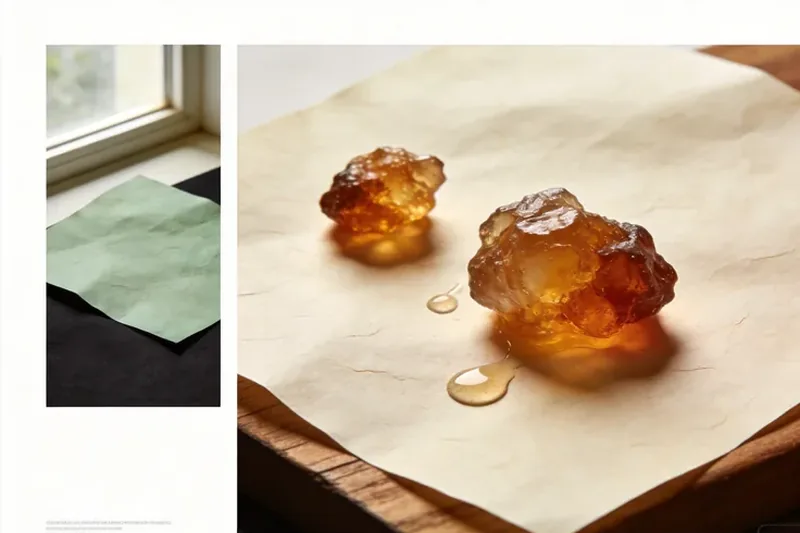
Direct answer: Storax (苏合香, sūhéxiāng) is an aromatic balsam produced from the inner bark of Liquidambar orientalis, the Oriental sweetgum of Asia Minor. In classical Chinese incense it was a prized imported resin, distinct from the native Chinese sweetgum (枫香, Liquidambar formosana), with a sweet, balsamic, cinnamon-like warmth.
Key facts
| Chinese | 苏合香 (sūhéxiāng) |
| Botanical source | Liquidambar orientalis (Oriental sweetgum) — the balsam/resin |
| What it is | An aromatic balsam, not a wood or root |
| Aroma | Sweet, balsamic, resinous, warm, faintly cinnamon-like |
| Traditional role | Imported incense resin; classical materia medica |
Aroma profile
Direct answer: Storax has a sweet, balsamic, resinous scent with a warm, faintly cinnamon-vanilla character. It is a softening resin that rounds and sweetens a blend rather than adding a sharp or smoky edge, which is why classical sources valued the “aromatic, oily” grade over a woody, scentless one.
Storax has a sweet, balsamic, resinous scent with a warm, faintly cinnamon-vanilla character. It is a softening resin — it rounds and sweetens a blend rather than adding a sharp or smoky edge, which is why classical sources valued the “aromatic, oily” grade over a woody, scentless one.
Botanical identity
Direct answer: Liquidambar orientalis is the Oriental sweetgum, a tree of the sweetgum family (Altingiaceae, formerly placed in Hamamelidaceae), native to southwestern Asia Minor. Its wounded inner bark yields storax balsam. It is a different species from the Chinese sweetgum Liquidambar formosana (枫香), whose related resin is a separate material.
Liquidambar orientalis is the Oriental sweetgum, native to southwestern Asia Minor, whose wounded bark yields storax balsam. It belongs to the sweetgum family (Altingiaceae, historically placed in Hamamelidaceae), and it is a different species from the Chinese sweetgum:
- 苏合香 (storax) — Liquidambar orientalis, the imported balsam of classical texts. This entry.
- 枫香 (Chinese sweetgum) — Liquidambar formosana, the native Chinese tree, treated on this site as a separate material (see sweetgum).
The two are related trees with related resins, but the classical 苏合香 was specifically the imported storax. See Liquidambar orientalis on GBIF and Liquidambar formosana (枫香) on GBIF.
Chinese name and terminology
Direct answer: 苏合香 is a foreign name for an imported resin. The Song-dynasty Xiangpu (香譜) traces it to 苏合国 (“Sogdiana”) and gives the Sanskrit name 咄鲁瑟剑 (duruṣka, “storax”) — recording both its Central Asian trade origin and its foreign name. It is distinct from 枫香 (the native sweetgum) and from 安息香 (benzoin).
The name 苏合香 is a loanword for an imported resin. The Song-dynasty Xiangpu (香譜) traces it to 苏合国 (“Sogdiana”) and gives the Sanskrit name 咄鲁瑟剑 (duruṣka, “storax”) — a record of both its Central Asian trade origin and its foreign name. The terminology requires care because three similar-sounding materials sit nearby:
- 苏合香 (storax) — Liquidambar orientalis, the imported balsam. This entry.
- 枫香 (Chinese sweetgum) — Liquidambar formosana, the native resin. See sweetgum.
- 安息香 (benzoin) — Styrax genus resin, a different family with a sweet-vanilla scent. See benzoin.
Storax vs benzoin: the “styrax” trap (read this)
Direct answer: Storax and benzoin are different resins from different plants, but the English words “storax” and “styrax” resemble each other, causing classic confusion. Storax (苏合香) comes from Liquidambar orientalis (sweetgum family); benzoin (安息香) comes from Styrax trees (Styracaceae). Sweet-balsamic-cinnamon vs sweet-vanilla — different materials.
This is the key disambiguation, and it is a trap built into English itself:
- Storax (苏合香) — Liquidambar orientalis, the Oriental sweetgum (Altingiaceae); a sweet, balsamic, cinnamon-like resin. This entry.
- Benzoin (安息香) — Styrax species (Styracaceae), a sweet-vanilla resin from a different plant family.
The confusion arises because the English word “storax” resembles “styrax,” the genus name for the benzoin trees — yet benzoin comes from Styrax and storax comes from Liquidambar. They are different resins with different scents: storax is sweet-balsamic and faintly cinnamon-like, benzoin is sweet-vanilla. See benzoin.
Where does storax come from?
Direct answer: Storax comes from Liquidambar orientalis, the Oriental sweetgum native to southwestern Asia Minor. In classical Chinese texts it was an imported resin, traced to 苏合国 (Sogdiana) with the Sanskrit name 咄鲁瑟剑 (duruṣka). Its import status is part of its identity — a prized foreign aromatic, distinct from native Chinese resins.
Storax balsam comes from the wounded inner bark of Liquidambar orientalis, the Oriental sweetgum native to southwestern Asia Minor (the modern region of southwestern Turkey). In classical Chinese texts it was an imported resin, traced to 苏合国 (Sogdiana) with the Sanskrit name 咄鲁瑟剑 (duruṣka). Its import status is part of its identity: 苏合香 was a prized foreign aromatic that arrived via Central Asian trade routes, distinct from the native Chinese sweetgum resin (枫香).
Why is it used in incense?
Direct answer: Storax was used in classical incense as a valued imported resin — described as dense (“heavy as stone”) and aromatic, with the best grade burning to white ash. It is a softening, sweet-balsamic resin that rounds and sweetens a blend, prized for its warm, cinnamon-like character.
Storax’s role in incense is as a prized, sweet-balsamic softening resin. Classical sources describe it as dense (“heavy as stone”) and aromatic, with the best grade burning to white ash (烧之灰白者好). It rounds and sweetens a blend rather than adding a sharp or smoky edge, which made it a valued imported material in classical incense. Its sweetness and warmth made it a complementary resin alongside the sharper frankincense and myrrh.
The “oily grade” buyer-intelligence note
Direct answer: Classical texts specify that only the oily, resinous storax is genuinely aromatic — 药中只用有膏油者极芳烈 — and record that producers extracted the fragrant balsam first, leaving a woody residue of little scent (大秦国人采得苏合香先煎其汁以为香膏乃卖其滓). This is a 1,000-year-old supply-chain warning that still applies: a dry, low-resin “storax” is not the aromatic grade.
This is one of the most useful classical observations about storax, and it reads like a modern supply-chain warning:
- Only the oily fraction is aromatic. Classical texts specify that only the oily, resinous storax is genuinely aromatic — 药中只用有膏油者极芳烈.
- The residue was sold separately. Producers extracted the fragrant balsam first and sold the spent woody residue — 大秦国人采得苏合香先煎其汁以为香膏乃卖其滓 — leaving a material of little scent.
The same principle applies today: the aromatic value is in the resinous, oily fraction, and a dry, woody, low-resin “storax” is not the aromatic grade. This is buyer-intelligence that has not aged in a millennium.
How is it processed?
Direct answer: Storax is obtained by wounding the inner bark of the sweetgum and collecting the balsam that exudes — a resin-tapping process, not a simple harvest. The aromatic value is in the oily, resinous fraction, so processing separates the fragrant balsam from the woody residue.
Storax is a balsam, obtained by wounding the inner bark of the tree and collecting the resin that exudes. Processing is therefore a resin-tapping sequence:
- Tapping — the bark is wounded, and the balsam exudes and is collected.
- Separation — the fragrant, oily balsam is separated from the spent woody residue; as classical sources note, this separation is what defines the aromatic grade.
The key point is that storax’s value is concentrated in the oily fraction — a dry, woody material has little scent. The wider resin-handling behavior is covered in incense powder & resin.
What determines storax quality?
Direct answer: Quality is determined by resin content: the aromatic value is in the oily, resinous fraction, so a resin-rich, fragrant balsam is the good grade and a dry, woody, low-resin material has little scent. Classical sources made this same point, valuing the grade that burns to white ash. Species identity — Liquidambar orientalis, not the native 枫香 or benzoin — is the other key check.
The quality factors, in rough order:
- Resin content — the oily, resinous fraction carries the aroma; a dry, woody “storax” has little scent.
- Aroma — sweet, balsamic, faintly cinnamon-like; a rich, warm scent beats a flat or woody one.
- Burn character — the classical standard values the grade that burns to white ash (烧之灰白者好).
- Species identity — Liquidambar orientalis (storax) vs 枫香 (L. formosana) vs benzoin (Styrax spp.); different resins.
Storax carries no standardized commercial grading ladder, but the classical “oily grade is the aromatic grade” principle is a durable quality signal.
Common forms
Direct answer: Storax is sold as a balsam/resin — a semi-solid or solid aromatic resin — and, less commonly, as a processed extract. The resin form is the traditional material; a dry, woody “storax” is the spent residue, not the aromatic grade.
| Form | Typical use |
|---|---|
| Balsam / resin | Incense blending; classical aromatic use |
| Spent woody residue | Low-aroma material — not the aromatic grade |
In Chinese tradition
- Incense: 苏合香 was a valued imported resin, described as dense (“heavy as stone”) and aromatic, with the best grade burning to white ash (烧之灰白者好).
- The oil note: classical texts specify that only the oily, resinous storax is genuinely aromatic — 药中只用有膏油者极芳烈 — and record that producers extracted the fragrant balsam first, leaving a woody residue of little scent.
- Materia medica: storax appears in classical Chinese medicine (most famously the 苏合香丸 formula). We treat any such use as traditional, not established clinical fact.
Traditional use vs modern evidence
Direct answer: The classical descriptions of storax — its origin, appearance, and the “oily grade is the aromatic grade” distinction — are historical and observational. Its medicinal uses are traditional, not established clinical fact, and this page makes no medical claims. The documented non-medical facts are its botanical identity and its long role as an imported aromatic resin.
- Traditional Use — storax is a valued imported incense resin, prized for its sweet, balsamic, softening character.
- Historical Record — the Song-dynasty Xiangpu (香譜) and Ming Xiangcheng (香乘) record 苏合香 as an imported resin (苏合国 / Sanskrit 咄鲁瑟剑 duruṣka), “heavy as stone,” with the best grade burning to white ash and only the oily grade being aromatic.
- Scientific Evidence — the balsam’s aromatic chemistry is characterized, but we present no clinical or medical efficacy claims.
The classical descriptions are historical and observational. The medicinal uses (苏合香丸) are traditional, not established clinical fact, and we make no medical claims.
What buyers should look for
Direct answer: Buyers should confirm species first — Liquidambar orientalis (storax), not 枫香 or benzoin — then check resin content: the aromatic value is in the oily fraction, so a resin-rich, fragrant balsam is the good grade and a dry, woody material is not. The storax/benzoin “styrax” naming trap should be resolved to a species.
For an incense maker or sourcing buyer:
- Species — storax is Liquidambar orientalis; distinguish it from benzoin (Styrax spp.) and the native 枫香 (L. formosana).
- Resin content — the oily, resinous fraction carries the aroma; a dry, woody “storax” has little scent.
- Aroma — sweet, balsamic, faintly cinnamon-like.
- Naming — resolve the “storax” vs “styrax” trap to a botanical species before buying.
Our Industry View
Direct answer: Storax’s commercial lesson is that the “oily grade is the aromatic grade” warning from classical texts is still the buyer’s core check today. A dry, low-resin storax is the spent residue, not the aromatic material — and the storax/benzoin “styrax” naming trap means the species name is the only reliable identifier.
From a manufacturing perspective, storax is a material where a thousand-year-old observation remains the most useful buyer-intelligence. Two points follow:
- The oily fraction is the value, and that has not changed. Classical sources recorded that producers extracted the fragrant balsam first and sold the spent woody residue — a dry, low-resin material with little scent. The same split exists today: a buyer who receives dry, woody “storax” is receiving the residue, not the aromatic grade. Resin content is the core quality check.
- The “styrax/storax” trap is a species question. Because the English words resemble each other, storax (Liquidambar orientalis, sweetgum family) and benzoin (Styrax species, Styracaceae) are routinely conflated. They are different resins with different scents, and only the botanical name resolves them.
In our view, storax is a fine sweet-balsamic softening resin — buy it by species name, check the oily resin fraction, and treat the classical “oily grade” warning as the quality gate it has always been.
Summary
Storax (苏合香) is the balsam of Liquidambar orientalis, the Oriental sweetgum of Asia Minor — a classical Chinese imported resin, distinct from the native 枫香 (L. formosana) and from benzoin (Styrax spp.), whose English name “styrax” causes a classic confusion. It is a sweet, balsamic, cinnamon-like softening resin, and classical sources record that only the oily, resinous fraction is aromatic — a quality principle that still holds. Its medicinal uses are traditional language, not clinical evidence.
FAQ
Is storax the same as benzoin? No, and the naming overlap is a classic trap. Storax (苏合香) comes from Liquidambar orientalis, the Oriental sweetgum. Benzoin (安息香) comes from trees in the Styrax genus — despite the confusing fact that the English word “styrax” resembles “storax.” They are different resins from different plants with different scents: storax is sweet-balsamic and cinnamon-like, benzoin is sweet-vanilla. See our benzoin page.
What is the difference between 苏合香 and 枫香? Both are sweetgum resins, but from different trees. 苏合香 (storax) is Liquidambar orientalis, the imported balsam of classical Chinese texts; 枫香 (Chinese sweetgum) is Liquidambar formosana, the native tree. The classical 苏合香 was specifically the imported storax, which is why the two are treated as separate materials on this site.
What does storax smell like? Storax is sweet, balsamic, and resinous, with a warm, faintly cinnamon-vanilla character. It is a softening resin that rounds and sweetens a blend. Classical sources emphasize that only the oily, resinous grade is genuinely aromatic — the woody, low-resin material has little scent — a distinction that still matters for buyers.
Where does storax come from? Storax balsam comes from the wounded inner bark of Liquidambar orientalis, the Oriental sweetgum native to southwestern Asia Minor. In classical Chinese texts it was an imported resin, traced to 苏合国 (Sogdiana) with the Sanskrit name 咄鲁瑟剑 (duruṣka). Its import status is part of its identity — it was a prized foreign aromatic, distinct from native Chinese resins.
Why do classical texts emphasize the “oily” grade of storax? Because the aromatic compounds are concentrated in the resinous, oily fraction. Classical sources record that producers extracted the fragrant balsam first and sold the spent woody residue — 大秦国人采得苏合香先煎其汁以为香膏乃卖其滓 — leaving a material with little scent. The same principle applies today: a dry, low-resin “storax” is not the aromatic grade.
Is storax a wood? No — storax is an aromatic balsam (resin) exuded from the wounded inner bark of the sweetgum tree. It is a resin material, not a wood, although the spent woody residue left after the balsam is extracted is sometimes encountered in commerce — and that residue, lacking the oily fraction, has little aroma.
See also: sweetgum, benzoin, amber and the full scent guide.
Evidence & Sources
Botanical identity
Source: Liquidambar orientalis on GBIF · Liquidambar formosana (枫香, for the distinction) on GBIF. Evidence type: Established.
Traditional Chinese use
Source: the Song-dynasty Xiangpu (香譜) and Ming-dynasty Xiangcheng (香乘) record 苏合香 as an imported resin (苏合国 / Sanskrit 咄鲁瑟剑 duruṣka), “heavy as stone,” with the best grade burning to white ash and only the oily grade being aromatic. Evidence type: Historically documented — traditional, not modern clinical evidence.
Authenticity / disambiguation
Source: storax (Liquidambar orientalis) vs 枫香 (Liquidambar formosana) vs benzoin (Styrax genus) distinction. Evidence type: Practical screening.
Safety
Source: incense combustion produces smoke and particulate matter; burn in a well-ventilated space. Evidence type: Established.
Evidence status
| Layer | Status |
|---|---|
| Botanical identity | Established |
| Traditional use | Historically documented |
| Authenticity test | Practical screening |
| Health claims | Not established |
Sources
Sources: botanical references on Liquidambar orientalis (storax) and the native Liquidambar formosana (枫香), plus the Song-dynasty Xiangpu (香譜) and Ming Xiangcheng (香乘) records of 苏合香. The storax / benzoin / 枫香 disambiguation is recorded as practical screening. Medicinal uses (苏合香丸) are treated as traditional, not established clinical fact. This is editorial knowledge content, not medical advice.