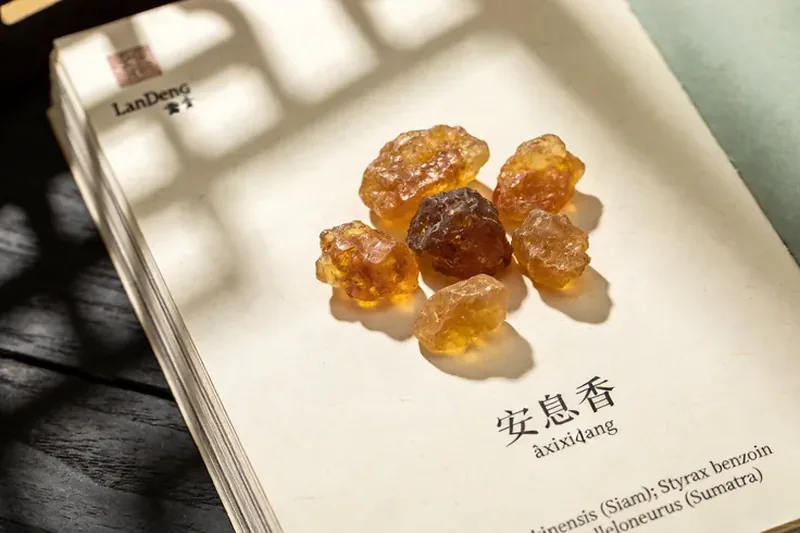
Technical answer: Benzoin — ānxīxiāng (安息香) in Chinese — is a balsamic resin from Styrax trees, prized for a sweet, vanilla-like, balsamic aroma. It is a common ingredient in incense (including church and Chinese incense) and a perfumery fixative.
Key facts
| Chinese | 安息香 (ānxīxiāng) |
| Botanical source | Styrax trees — Siam benzoin (S. tonkinensis), Sumatra benzoin (S. benzoin) |
| What it is | A balsamic resin from tree bark |
| Aroma | Sweet, vanilla, balsamic, woody |
| Traditional role | Incense, perfume fixative |
Aroma profile
Direct answer: Benzoin has a sweet, warm, vanilla-like balsamic scent, valued both for its own soft sweetness and as a fixative that helps other aromas last. Siam benzoin is the smooth vanilla reference; Sumatra is spicier and more resinous.
Benzoin has a sweet, warm, vanilla-like balsamic scent. It is valued as a fixative — it helps other aromas last — in addition to its own soft sweetness.
The character differs by origin. Siam benzoin reads as the “classic” perfume note: sweet, smooth, vanilla-balsamic with a slightly powdery, woody undertone. Sumatra benzoin is a touch spicier and more resinous. Neither is sharp; both sit at the soft, comforting end of the resin family, which is why benzoin is usually a base or supporting note rather than the star of a blend.
Botanical identity
Direct answer: Benzoin is a balsamic resin from Styrax trees in the family Styracaceae — chiefly Styrax tonkinensis (Siam benzoin) and Styrax benzoin / S. paralleloneurus (Sumatra benzoin). It is collected from the bark, not from the wood.
The genus Styrax (family Styracaceae) contains trees and shrubs native to Asia and the Americas. Benzoin comes from the resin the tree exudes when its bark is wounded. The two commercial types map to two species groups: Siam benzoin from Styrax tonkinensis, and Sumatra benzoin from Styrax benzoin (and the closely related S. paralleloneurus). See Styrax in Flora of China and Styrax on GBIF.
Chinese name and terminology
Direct answer: 安息香 (ānxīxiāng) is glossed as “the fragrance of Parthia (安息),” recording the resin’s arrival in China as an overland import. Two naming traps recur: benzoin (Styrax) vs storax (Liquidambar), and the resin vs the chemical compound.
The Chinese name 安息香 (ānxīxiāng) is often glossed as “the fragrance of Parthia (安息)” — a name that records the resin’s arrival in China as an import over the ancient overland trade routes, in the same class as frankincense and myrrh. Two naming traps recur:
- Benzoin vs storax. Benzoin comes from Styrax (安息香); storax (苏合香) comes from a different tree, Liquidambar orientalis, and is a separate balsamic resin. The shared “styrax” spelling in English causes confusion. See storax.
- Benzoin the resin vs benzoin the compound (covered below).
Where does benzoin come from?
Direct answer: Siam benzoin comes from Laos, Thailand, and Vietnam (Styrax tonkinensis); Sumatra benzoin comes from Sumatra, Indonesia (Styrax benzoin / S. paralleloneurus). The two types differ in aroma and in acid content.
Siam benzoin is tapped from Styrax tonkinensis in Laos, northern Thailand, and Vietnam — the classic source of the smooth, vanilla “Siam” grade. Sumatra benzoin is tapped from Styrax benzoin and related species on the Indonesian island of Sumatra, and is the spicier, more resinous type. Both are collected from wild and semi-cultivated trees by incising the bark, and both arrived in China historically as imported resins.
The two kinds (buyer intelligence)
Direct answer: Siam benzoin is the reference vanilla-balsamic resin (sweet, smooth, powdery), while Sumatra benzoin is spicier and more resinous and contains cinnamic acid in addition to benzoic acid. The distinction matters mainly to perfumers and profile-specific buyers.
- Siam benzoin (Styrax tonkinensis): sweet, vanilla, balsamic, woody, powdery; used in fragrance and flavoring.
- Sumatra benzoin (Styrax benzoin / S. paralleloneurus): sweet, spicy, vanilla, balsamic; contains cinnamic acid in addition to benzoic acid.
The distinction matters mainly to perfumers and to buyers who want a specific profile: Siam is the reference “vanilla” resin, Sumatra the “spicier” one. For incense use, either works; the label should tell you which you are getting.
A naming disambiguation
Direct answer: “Benzoin” the resin is not the chemical compound “benzoin.” The resin’s main active component is benzoic acid (with cinnamic acid in the Sumatra type) — a different substance that shares part of the name.
“Benzoin” the resin is not the same as the chemical compound “benzoin.” The resin’s main active component is benzoic acid (with cinnamic acid in the Sumatra type). This is a common source of confusion in ingredient lists: a perfume note may list “benzoin” (the resin) while a laboratory catalog lists “benzoin” (the compound). They are different things.
Why is benzoin used in incense?
Direct answer: Benzoin is used as a sweet base and a fixative: its vanilla-balsamic scent rounds out a blend and softens sharper notes, while its fixative properties help lighter, more volatile aromas persist.
Benzoin’s value in incense is twofold. As an aroma, its sweet, vanilla-balsamic character rounds a blend and softens harsher notes. As a fixative, it slows the evaporation of lighter, more volatile ingredients, so the blend holds together longer. This dual role — sweet base plus fixative — is why benzoin appears so widely, from church incense blended with frankincense and myrrh to Chinese 合香 and Japanese and Indian stick incense. See incense powder & resin for how resins behave in a blend.
Harvest & processing
Direct answer: Benzoin is collected by incising the bark of Styrax trees; the resin hardens into tears or blocks over time and is then scraped off. It is a “balsamic” resin, containing benzoic and/or cinnamic acids alongside the resin itself.
Benzoin is collected by making incisions in the bark of Styrax trees; the tree exudes a resin that hardens into tears or blocks over time, which are then scraped off. The resin is a “balsamic” resin — meaning it contains benzoic/cinnamic acids in addition to the resin itself — which is what gives it the distinctive vanilla-sweet character and its fixative power.
In incense & Chinese tradition
Direct answer: Benzoin is a staple sweet base and fixative across traditions — church incense, Chinese 合香, Japanese and Indian stick incense, and Arabic bakhoor. Its Chinese name records its import origin (“fragrance of Parthia”).
- Church incense: benzoin is a staple of Christian incense (Eastern Orthodox, Catholic), often blended with frankincense and myrrh.
- Chinese incense (安息香): benzoin appears as a sweet base in 合香 (blended incense), adding warmth and roundness.
- Japanese and Indian incense also use benzoin as a sweetener/fixative.
- Bakhoor: the Arabic tradition of prepared wood chips sometimes includes benzoin in the fragrance blend.
The Chinese name 安息香 is often glossed as “the fragrance of Parthia (安息),” reflecting the resin’s ancient overland trade origin — a reminder that this material arrived in China as an import, like frankincense and myrrh.
Traditional vs modern evidence
Direct answer: Benzoin has a long traditional use in incense and perfumery. Its resin acids (benzoic acid, cinnamic acid) are the subject of laboratory research, but this is largely preclinical or industrial — benzoic acid is used as a preservative. No medical claims are made here.
Benzoin has a long traditional use in incense and perfumery.
- Traditional Use — burned as a sweet base in church and Chinese incense; used as a perfumery fixative.
- Historical Record — 安息香 appears as an imported aromatic in Chinese tradition, named for its Parthian trade origin.
- Scientific Evidence — its resin acids (benzoic acid, cinnamic acid) are well characterized, and benzoic acid has industrial uses (e.g., as a preservative), but this is not clinical evidence of a medical effect from burning the resin.
We describe benzoin’s aromatic and fixative role; we do not make medical claims.
What determines benzoin quality?
Direct answer: Quality is read from type (Siam vs Sumatra), color, and cleanliness. Pale, clean Siam tears or blocks are the reference; darker, dustier, or mixed material ranks lower. The aromatic character — smooth vanilla vs spicy resin — is the other marker.
The quality factors:
- Type — Siam benzoin is the reference “vanilla” grade; Sumatra is the “spicier” grade.
- Color and cleanliness — pale, clean material ranks higher than dark or dusty material.
- Aroma character — the smooth vanilla-balsamic note of good Siam material is the benchmark.
- Form and freshness — clean tears/blocks with no foreign matter.
These are trade distinctions, not a single standardized grading system.
Common forms
Direct answer: Benzoin is sold as tears or blocks, as powder, and as an extract (resinoid or tincture). Tears and blocks suit incense; powder suits blending; the extract suits perfumery.
| Form | Typical use |
|---|---|
| Tears / blocks | Warmed in incense or broken for blending |
| Powder | Blended into incense sticks and cones |
| Resinoid / tincture | Perfumery and fragrance work |
Sustainability & sourcing
Direct answer: Benzoin is tapped from wild and semi-cultivated Styrax trees, so supply depends on the health of those stands. Sourcing should confirm type (Siam vs Sumatra) and origin, since the two are different products.
Benzoin is collected largely from wild or semi-cultivated trees rather than large plantations, so long-term supply depends on continued access to those stands. For a buyer, the practical questions are which type (Siam or Sumatra), which origin, and which form — the label should distinguish Siam from Sumatra rather than offering an unqualified “benzoin.” See the wholesale guide for the sourcing framework.
Modern commercial applications
Direct answer: Benzoin goes into incense, perfumery (as a fixative), and — in the case of benzoic acid — industrial and preservative uses. The resin and the derived acid serve different markets.
- Incense — sweet base and fixative in church, Chinese, Japanese, and Indian incense.
- Perfumery — a classic vanilla-balsamic base note and fixative.
- Industrial — benzoic acid, derived from the resin or synthesized, is used as a preservative in unrelated industrial applications.
What buyers should look for
Direct answer: Confirm the type (Siam vs Sumatra), check for clean, pale tears or blocks, and specify the form — tears, powder, or extract — since each behaves differently in a blend.
For an incense maker or sourcing buyer:
- Type — Siam (vanilla reference) vs Sumatra (spicier); a real seller names which.
- Color and cleanliness — pale, clean material over dark, dusty, or mixed lots.
- Form — tears/blocks for incense, powder for blending, extract for perfumery.
- Aroma — the smooth vanilla-balsamic note of good Siam material.
Safety
Incense combustion produces smoke and particulate matter. Burn in a well-ventilated space; avoid inhaling concentrated smoke; keep away from children and pets. Benzoin resin itself is a fragrance/fixative material, not a food or medicine.
Our Industry View
Direct answer: In manufacturing, the useful question is which benzoin and in what form — Siam vs Sumatra, tears vs powder — because the type changes the aroma and the form changes how the resin behaves in a stick. Consistency of type and grade matters more than a generic label.
From a manufacturing perspective, “benzoin” is two products sharing one name, and the form adds a third variable. What makes a formula repeatable is type consistency, grade consistency, and form — the same Siam or Sumatra source, the same color and cleanliness, and the same particle size in powder.
Two points follow:
- The type changes the blend. Siam and Sumatra benzoin read differently — smooth vanilla against spicy resin — and Sumatra’s cinnamic acid content is a real chemical difference, not just a marketing distinction. A formula built on one will drift if the source switches.
- Resin powder is sticky and heat-sensitive. Benzoin powder behaves differently from wood powder in grinding and blending; its grind and how it is combined with a binder affect burn, and the right settings depend on the specific formula. There is no universal figure — sample against your own production.
In our view, the commercial value is a documented, consistent type-and-grade supply, not an unqualified “benzoin” label.
Summary
Benzoin (安息香) is a balsamic resin from Styrax trees, prized for a sweet, vanilla-balsamic aroma and its role as a perfumery and incense fixative. It comes in two types — Siam (S. tonkinensis), the smooth vanilla reference, and Sumatra (S. benzoin / S. paralleloneurus), the spicier, cinnamic-acid-bearing type. It is a staple sweet base across church, Chinese, Japanese, and Indian incense, and its name records an ancient import trade. For a buyer, the working questions are type, form, and consistency.
FAQ
Is benzoin a wood? No — benzoin is not the wood of the Styrax tree. It is a balsamic resin collected from the tree’s bark. The resin is produced by making incisions in the bark; the tree exudes a sticky substance that hardens into “tears” or blocks, which are then scraped off and sold. Benzoin is classed as a balsamic resin because it contains benzoic acid (and cinnamic acid in the Sumatra type) in addition to the resin itself, which gives it its vanilla-sweet character and fixative power.
Is “benzoin” the same as the chemical? No. The word “benzoin” names two different things that are easily confused. The incense and perfume ingredient is a balsamic resin from Styrax trees, whose main active component is benzoic acid (with cinnamic acid in the Sumatra type). Separately, “benzoin” is also the name of an organic chemical compound used in laboratories. A perfume note listing “benzoin” means the resin; a laboratory catalog listing “benzoin” means the compound. They share a name but are different materials.
What is benzoin used for in incense? Benzoin is used mainly as a sweet base and a fixative in incense. Its warm, vanilla-like, balsamic scent rounds out a blend, softening sharper notes, while its fixative properties help lighter, more volatile aromas persist longer. It is a staple of church incense, where it is often blended with frankincense and myrrh, and it appears in Chinese 合香 as a sweet base, in Japanese and Indian incense as a sweetener, and in the Arabic bakhoor tradition.
Is Siam benzoin different from Sumatra benzoin? Yes. Siam benzoin (Styrax tonkinensis) is the classic, reference vanilla-balsamic resin: sweet, smooth, and powdery, used widely in fragrance and flavoring. Sumatra benzoin (Styrax benzoin or S. paralleloneurus) is a touch spicier and more resinous, and it contains cinnamic acid in addition to benzoic acid. The difference matters mainly to perfumers and buyers who want a specific profile — Siam for the classic vanilla note, Sumatra for the spicier edge. For general incense use either works; the label should say which you are getting.
How do you burn benzoin resin? Benzoin is burned like other resins, either on a lit charcoal disc or, more gently, on an electric incense heater. For the charcoal method, place the disc on a heatproof surface in sand or ash, light it, and add a small amount of resin once it glows. An electric heater avoids charcoal smoke and lets the resin warm slowly, releasing its vanilla-sweet aroma more cleanly. Benzoin is usually blended with frankincense or myrrh rather than burned alone, and only a small amount is needed.
What is the difference between benzoin and storax? They are different resins from different trees. Benzoin (安息香) comes from Styrax trees and is a sweet, vanilla-balsamic resin. Storax (苏合香) comes from Liquidambar orientalis, the Oriental sweetgum, and is a separate balsamic resin with its own profile. The English names overlap because “styrax” historically covered both, but the botanical sources are distinct.
See also: frankincense and myrrh, its resin relatives, plus storax, copaiba, shellac and the full scent guide.
Evidence & Sources
Botanical identity
Source: Styrax in Flora of China · Styrax on GBIF. Evidence type: Established.
Traditional Chinese use
Source: this page records 安息香 as a sweet base in 合香 (blended incense), with the name glossed as “the fragrance of Parthia (安息).” Evidence type: Historically documented — traditional materia-medica language, not modern clinical evidence.
Commercial grading
Source: the Siam (Styrax tonkinensis) vs Sumatra (S. benzoin / S. paralleloneurus) distinction and their benzoic/cinnamic acid profiles. Evidence type: Trade terminology.
Authenticity / adulteration
Source: the “benzoin the resin” vs “benzoin the compound” naming disambiguation. Evidence type: Practical screening.
Safety
Source: incense combustion produces smoke and particulate matter; benzoin resin is a fragrance/fixative material, not a food or medicine. Evidence type: Established.
Evidence status
| Layer | Status |
|---|---|
| Botanical identity | Established |
| Traditional use | Historically documented |
| Commercial grading | Trade terminology |
| Authenticity test | Practical screening |
| Laboratory confirmation | Requires analytical testing |
| Health claims | Not established |
Sources
Sources: botanical references on Styrax and benzoin resin (Siam vs Sumatra distinction, benzoic/cinnamic acid). This is editorial knowledge content, not medical advice.