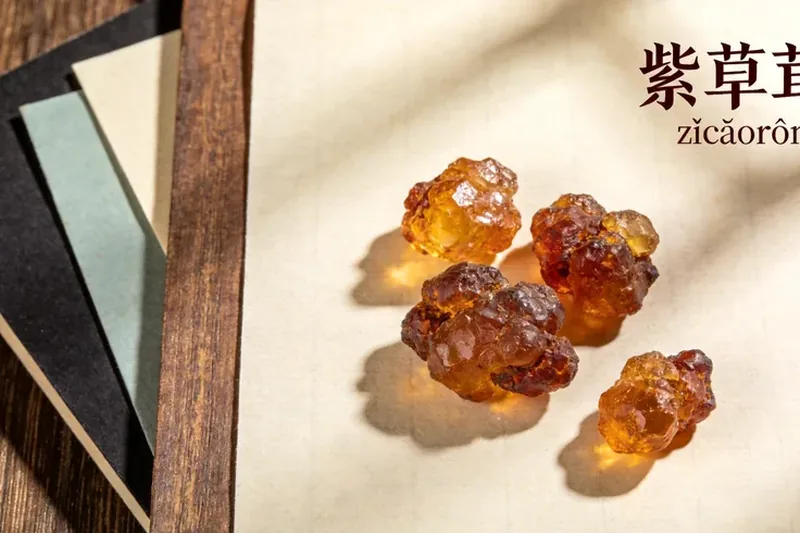
Direct answer: Shellac (紫草茸, zǐcǎoróng) is lac resin, the resinous secretion of the lac insect Kerria lacca, a scale insect that coats twigs with a hard crust. It is an insect-derived resin, not a plant material; the Bencao Gangmu records lac under 紫鉚, and the Ming Xiangcheng (香乘) lists 紫矿 in incense formulas.
Key facts
| Chinese | 紫草茸 (zǐcǎoróng); classical 紫鉚/紫矿, 赤胶, 紫梗 |
| Source | Kerria lacca (lac insect, Kerriidae) — the resinous secretion |
| What it is | An insect-derived resin (shellac), not a plant material |
| Aroma | Resinous, waxy, subtle, slightly sweet |
| Traditional role | Dye and incense ingredient; 紫矿 in 香乘 formulas |
Aroma profile
Lac resin is resinous and waxy, with a subtle, faintly sweet, slightly smoky character when gently heated. It is not a powerful fragrance on its own — its historical value was as a red dye and a fixative-binder in incense formulas, not as a lead scent.
An insect resin, not a botanical (read this)
紫草茸 must be understood for what it is: the resinous secretion of a scale insect, not a plant material. The classical sources understood this clearly:
- The Bencao Gangmu (本草纲目), in its insect section (虫之一), records lac under 紫鉚, noting “蚁于海畔树藤皮中为之……正如蜂造蜜也” — insects make it on the bark of trees and vines by the sea, just as bees make honey.
- The Xiangcheng (香乘) lists 紫矿 (lac) in incense formulas — for example the 宝金香 formula, which calls for “沉香一两、檀香一两、乳香一钱、紫矿二钱、安息香一钱” (agarwood, sandalwood, frankincense, lac, benzoin) — as a minor ingredient ground and blended with the aromatics.
This page describes 紫草茸 = lac resin = shellac. It is insect-derived, and we state that plainly rather than filing it under a living plant. The modern term “shellac” refers to the purified form used as a varnish, and it is the same material.
Botanical source and origin
Lac resin is produced by the lac insect Kerria lacca (family Kerriidae), a scale insect that colonizes the twigs of certain host trees (in South and Southeast Asia) and secretes a protective resinous coating. The resin is harvested, crushed, washed, and melted to form shellac. The host trees are incidental — the material itself is the insect’s secretion. In classical Chinese usage, lac was known as 紫鉚 or 紫矿 (also 紫草茸, 赤胶, 紫梗) and valued as a red dye and an incense-formula ingredient.
In Chinese tradition
- Red dye: lac was historically prized as a red dye and colorant (紫矿/紫鉚), used to color fabrics and as a pigment.
- Incense formula ingredient: the Xiangcheng (香乘) lists 紫矿 in formulas such as 宝金香, as a minor supporting ingredient.
- Insect origin understood: the Bencao Gangmu (本草纲目) records that lac is made by insects “正如蜂造蜜也” (just as bees make honey) — an accurate classical account of its animal origin.
Traditional use vs modern evidence
The dye and incense-formula use is documented. We make no medical claims. The documented, non-medical facts are the insect-derived identity, the classical 紫鉚/紫矿 records, and the dye/formula use.
Quality and sourcing notes
Practical points for buyers:
- 紫草茸 is lac resin (shellac), the secretion of the lac insect Kerria lacca — an insect-derived resin, not a plant material.
- It is a dye and a minor incense-formula ingredient, not a lead fragrance; expect a subtle resinous-waxy character rather than a strong scent.
- Distinguish it from dragon’s blood (血竭), another red resin — dragon’s blood comes from a plant (Daemonorops/Calamus fruit resin), lac from an insect.
Safety
Incense combustion produces smoke and particulate matter. Burn in a well-ventilated space, avoid inhaling concentrated smoke, and keep away from children and pets. This is editorial knowledge content, not medical advice.
FAQ
What is 紫草茸 (lac resin / shellac)? The resinous secretion of the lac insect Kerria lacca (formerly Laccifer lacca), a scale insect of the family Kerriidae that coats the twigs of host trees with a hard resin. It is an insect-derived resin — not a plant material — and the purified form is known as shellac.
Is lac resin a botanical? No. Lac is produced by a scale insect, not by a plant. The Bencao Gangmu (本草纲目) records this accurately: lac is made by insects on tree bark “正如蜂造蜜也” (just as bees make honey). The host tree is incidental; the material is the insect’s secretion.
How is 紫草茸 recorded in the classical texts? As 紫鉚 or 紫矿 in the Bencao Gangmu (本草纲目) insect section, and as 紫矿 in the Ming-dynasty Xiangcheng (香乘), which lists it in incense formulas — for example 宝金香, where it appears alongside agarwood, sandalwood, frankincense, and benzoin as a minor ground ingredient.
What was lac resin used for? Primarily as a red dye and colorant, and secondarily as a minor ingredient in incense formulas. Its incense role in the 香乘 is supporting rather than leading — it is not a strong fragrance on its own, but a resinous, waxy, subtle material.
Is 紫草茸 the same as dragon’s blood (血竭)? No. Both are red resins, but dragon’s blood (血竭) comes from a plant — the fruit resin of Daemonorops (syn. Calamus) palms — while lac (紫草茸) is the secretion of an insect. The Bencao Gangmu (本草纲目) itself notes the two were formerly confused and then separated, as they differ in origin and use.
What is the difference between lac and shellac? They are the same material. “Shellac” is the modern English name for the purified, processed form of lac resin — the insect secretion melted and formed into flakes — used as a varnish and finish. 紫草茸/紫鉚/紫矿 are the classical Chinese names for the same insect resin.
See also: dragons-blood, benzoin, and the full scent guide.
Evidence & Sources
Identity
Source: lac resin as the secretion of the lac insect Kerria lacca (formerly Laccifer lacca), family Kerriidae — insect-derived, not botanical. Kerria lacca on GBIF. Evidence type: Established — insect-derived resin.
Traditional Chinese use
Source: the Bencao Gangmu (本草纲目), 虫之一, records lac under 紫鉚 (“蚁于海畔树藤皮中为之……正如蜂造蜜也”); the Ming-dynasty Xiangcheng (香乘) lists 紫矿 in the 宝金香 formula. Evidence type: Historically documented — dye and incense-formula use.
Authenticity / disambiguation
Source: 紫草茸/紫鉚 (lac, insect resin) vs 血竭 (dragon’s blood, plant resin) — both red resins, different origins. Evidence type: Practical screening.
Safety
Source: incense combustion produces smoke and particulate matter; burn in a well-ventilated space. Evidence type: Established.
Evidence status
| Layer | Status |
|---|---|
| Identity | Established (insect-derived resin) |
| Traditional use | Historically documented (dye, formula) |
| Authenticity test | Practical screening |
| Health claims | Not established |
Sources
Sources: the lac insect Kerria lacca as the source of lac resin, the Bencao Gangmu (本草纲目) 虫之一 record of 紫鉚, and the Ming-dynasty Xiangcheng (香乘) listing of 紫矿 in the 宝金香 formula. 紫草茸 is an insect-derived resin, not a botanical; no medical claims are made. This is editorial knowledge content, not medical advice.