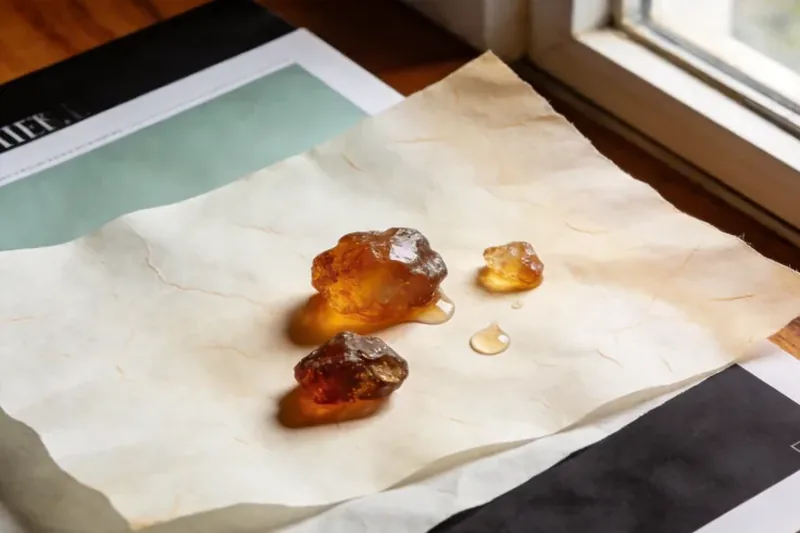
Quick answer: Frankincense — rǔxiāng (乳香, “milk fragrance”) in Chinese — is the aromatic gum-resin of Boswellia trees (family Burseraceae). It is one of the world’s oldest incense resins, used for religious ritual, fumigation, perfume, and traditional medicine.
Key facts
| Chinese | 乳香 (rǔxiāng) — “milk fragrance” |
| Botanical source | Boswellia trees (Burseraceae) — incl. B. sacra, B. serrata, B. carterii |
| What it is | A dried gum-resin (not a wood or flower) |
| Aroma | Resinous, citrus, earthy, creamy |
| Traditional role | Ritual incense, fumigation, perfume |
Aroma profile
Direct answer: Frankincense has a fresh, resinous, slightly citrus (lemony) aroma over a warm, creamy, earthy base. When gently heated it releases a clean, bright scent, distinct from the deep sweetness of woods like agarwood or sandalwood.
Frankincense has a fresh, resinous, slightly citrus (lemony) aroma over a warm, creamy, earthy base. When gently heated it releases a clean, bright scent — distinct from the deep sweetness of woods like agarwood or sandalwood.
Botanical identity
Direct answer: Frankincense is a gum-resin, not a wood or flower. It is collected from Boswellia trees in the family Burseraceae — chiefly B. sacra, B. carterii, and B. serrata — which exude a milky resin when their bark is scored.
Boswellia is a genus of small trees and shrubs in the family Burseraceae, native to arid regions of northeastern Africa, the Arabian Peninsula, and India. The aromatic product is the oleo-gum-resin the tree exudes from wounds in its bark — a resin, not the wood of the tree. The three names that dominate commerce are Boswellia sacra (Arabia), B. carterii (the Horn of Africa, especially Somalia), and B. serrata (India). See Boswellia sacra on GBIF.
Chinese name and terminology
Direct answer: 乳香 (rǔxiāng) means “milk fragrance,” describing the milky resin that hardens into tears. It is classically paired with 没药 (myrrh) in Chinese materia medica — a pairing that also runs through Western religious and perfumery tradition.
The Chinese name 乳香 (rǔxiāng) means “milk fragrance” — a direct description of the milky resin that hardens into the aromatic tears. In Chinese materia medica, 乳香 is classically paired with 没药 (mòyào, myrrh), and the two are habitually named together. The pairing is not a Chinese invention alone: frankincense and myrrh travel together through Western religious and perfumery tradition as well, because both are gum-resins from the same plant family (Burseraceae) and complement each other’s aroma. See myrrh.
Where does frankincense come from?
Direct answer: Frankincense comes from arid regions around the Red Sea and Arabian Peninsula — chiefly Oman and Yemen (B. sacra), Somalia and the Horn of Africa (B. carterii), and India (B. serrata) — where the resin is tapped by hand from scored trees.
The traditional and still-current producing belt runs from Oman and Yemen through Somalia, Ethiopia, and the Horn of Africa, to western India. Omani and Yemeni material (B. sacra) has long been regarded as the reference grade; Somali material (B. carterii) dominates commercial volume and reads clean and citrus; Indian material (B. serrata) is earthier and more balsamic. The resin has been traded across this region for thousands of years, which is how it reached China as an import.
Why is frankincense used in incense?
Direct answer: Frankincense is used in incense for its clean, bright, resinous aroma and its ritual history. It is typically heated rather than burned directly, so the resin melts and releases scent without the charred note of an open flame.
Frankincense’s role follows from its physical form: as a resin it melts and volatilizes under gentle heat, so the classical method is to warm tears on a charcoal disc or electric heater rather than burn them in a flame. Its fresh, citrus-bright scent makes it a “top” note that lifts heavier woods and resins, and its long ritual use — in temple, church, and fumigation — gives it a cultural weight that matches its aroma. See the frankincense incense guide.
In Chinese tradition
Direct answer: Frankincense has been burned in religious and ceremonial contexts, used as a classic heated resin in incense and fumigation, and recorded in Chinese materia medica — classically paired with myrrh and described for “activating blood” and relieving pain in traditional language.
- Ritual and religious use: frankincense has been burned in religious and ceremonial contexts for centuries, in China and across the ancient world.
- Incense and fumigation: it is a classic resin incense ingredient, often heated rather than burned directly.
- Traditional materia medica: in traditional Chinese medicine, 乳香 is classically paired with myrrh (没药) and described for “activating blood” (活血) and relieving pain.
Traditional use vs modern evidence
Direct answer: Frankincense resin contains boswellic acids, the subject of modern laboratory research on inflammation. Medicinal claims — treating arthritis, asthma, cancer, or other conditions — are traditional use or preliminary research, not established clinical fact. Burning it is an aromatic/ritual practice, not a medical treatment.
Frankincense resin contains boswellic acids (notably AKBA), which are the subject of modern laboratory research on inflammation. Some preliminary and experimental studies exist.
- Traditional Use — burned as ritual incense and used in fumigation and traditional materia medica.
- Historical Record — 乳香 appears in classical Chinese materia medica, classically paired with myrrh (没药).
- Scientific Evidence — boswellic acids are studied in laboratory and experimental settings, but clinical efficacy is not established.
Important: we treat medicinal claims about frankincense (treating arthritis, asthma, cancer, or other conditions) as traditional use and/or preliminary research, not established clinical fact. Burning frankincense as incense is an aromatic/ritual practice; it is not a medical treatment.
Harvest & processing
Direct answer: Frankincense is harvested by scoring the bark of Boswellia trees; the milky resin hardens into droplets (“tears”) over days to weeks. The tears are collected by hand and graded by size, color, and clarity, then burned whole, ground, or distilled for oil.
Frankincense is harvested by scoring the bark of Boswellia trees; the tree exudes a milky resin that hardens into droplets (“tears”) over days to weeks. The tears are collected by hand and graded by size, color, and clarity — larger, paler, cleaner tears are generally considered higher grade, while dust and mixed fragments are lower grade. The resin is burned whole, ground, or steam-distilled for essential oil.
Species & origins
Direct answer: Not all frankincense is the same — different Boswellia species and regions produce different aroma profiles. B. sacra (Oman/Yemen) is classic, B. carterii (Somalia) is clean and citrus, and B. serrata (India) is earthier and more balsamic.
Not all frankincense is the same — different Boswellia species and regions produce different aroma profiles:
- B. sacra (Oman / Yemen) — the classic, often considered the reference grade.
- B. carterii (Somalia) — common in commerce, clean and citrus.
- B. serrata (India) — earthier and more balsamic.
The species and origin affect the aroma, so a label that names them is more informative than one that just says “frankincense.”
What determines frankincense quality?
Direct answer: Quality is graded by tear size, color, and clarity — larger, paler, cleaner tears rank higher — plus species and origin, which set the aroma profile. Dust and mixed fragments are lower grade.
The quality factors:
- Tear size — larger, whole tears are preferred over dust and fragments.
- Color and clarity — pale, clean, translucent tears generally rank higher than dark or cloudy material.
- Species and origin — B. sacra is the reference; B. carterii and B. serrata have their own profiles.
- Aroma freshness — a clean, bright, citrus-resinous scent with no stale or smoky off-notes.
These are trade distinctions, not a single standardized grading system.
Common forms
Direct answer: Frankincense is sold as whole tears, powder, and essential oil. Tears suit gentle heating; powder suits blending into sticks and pastes; oil is a distilled extract. They are the same resin in different physical forms.
| Form | Typical use |
|---|---|
| Tears (whole resin) | Warmed on charcoal or an electric heater |
| Powder | Blended into incense pastes and sticks |
| Essential oil | Perfumery and scented products |
Tears are preferred for gentle heating because they melt and release aroma slowly, and whole pieces are easier to grade by size and color. Powder suits blending, where a uniform, fast-burning form is needed. See incense powder & resin.
Frankincense vs myrrh
Direct answer: Both are resins from the same plant family (Burseraceae), but from different genera. Frankincense (Boswellia) is fresh, citrus, and creamy; myrrh (Commiphora) is bitter, balsamic, and earthy. The two are classically paired.
Both are resins from the same plant family (Burseraceae), but from different genera:
| Frankincense (乳香) | Myrrh (没药) | |
|---|---|---|
| Genus | Boswellia | Commiphora |
| Aroma | Fresh, citrus, creamy | Bitter, balsamic, earthy |
| Character | Bright, clean | Dark, heavy |
| Traditional pairing | Often paired with myrrh | Often paired with frankincense |
Sustainability & sourcing
Direct answer: Frankincense supply depends on wild and semi-wild Boswellia trees in arid regions, and over-tapping is a documented concern in parts of the range. Sourcing should confirm species, origin, and ideally the harvest practice.
Frankincense is mostly tapped from wild or semi-managed trees rather than plantations, so long-term supply depends on the health of those stands. Over-tapping and the conversion of dryland forest have been reported as pressures in parts of the range. For a buyer, the practical questions are the same as for other resins: which species, which origin, and how is it harvested — with documentation, where available. See the wholesale guide for the sourcing framework.
Modern commercial applications
Direct answer: Frankincense goes into incense (loose resin and sticks), perfumery (frankincense oil), and personal care. The resin, the powder, and the oil serve different markets.
- Incense — loose tears for heating, and resin powder blended into sticks and cones.
- Perfumery — frankincense essential oil as a fresh, resinous note and fixative.
- Personal care and cosmetics — the oil in soaps, creams, and aromatherapy products.
What buyers should look for
Direct answer: Ask for species and origin, look for whole, pale, clean tears over dust, and confirm the form — tears, powder, or oil — since each behaves differently in a blend.
For an incense maker or sourcing buyer:
- Species and origin — B. sacra, B. carterii, or B. serrata; a real seller names them.
- Tear quality — whole, pale, clean tears over dust and mixed fragments.
- Form — tears for heating, powder for blending, oil for fragrance; they are not interchangeable.
- Aroma — clean, bright, citrus-resinous, with no stale or smoky off-notes.
Safety
Incense combustion produces smoke and particulate matter. Burn in a well-ventilated space; avoid inhaling concentrated smoke. Do not consume resin based on traditional-medicine claims without professional guidance.
Our Industry View
Direct answer: In manufacturing, the useful variable is not “frankincense” as a single material but species, grade, and physical form. A steady supply of one named species in a consistent grind or tear grade matters more than a generic label.
From a manufacturing perspective, “frankincense” is a family of materials, not one. What determines whether a formula is repeatable is species, grade, and form consistency — the same Boswellia species, the same tear grade, and the same particle size in powder, batch after batch.
Two points follow:
- Species changes the aroma, not just the name. B. carterii and B. serrata will read differently in the same blend, so a formula built on one will not smell the same if the source switches without notice.
- Powder behavior depends on the formula. Resin powder is sticky and heat-sensitive compared with wood powder; its grind, moisture, and how it is combined with a binder all affect burn, and the right settings depend on the specific stick. There is no universal figure — the buyer should sample against their own production.
In our view, the commercial value is a documented, consistent species-and-grade supply, not a generic “frankincense” label.
Summary
Frankincense (乳香) is the aromatic gum-resin of Boswellia trees, harvested as tears and graded by size, color, and clarity. Its fresh, citrus-bright, resinous aroma makes it a classic heated incense and a top note in blends, and it is habitually paired with myrrh. Species (B. sacra / B. carterii / B. serrata) set the aroma profile, boswellic acids are the subject of preliminary research (not clinical proof), and for a buyer the working questions are species, tear grade, and form.
FAQ
What is the difference between frankincense and myrrh? Both are resins from the same plant family, Burseraceae, but from different genera. Frankincense comes from Boswellia trees and has a fresh, citrusy, creamy aroma; myrrh comes from Commiphora trees and is bitter, balsamic, and earthy. Frankincense reads bright and clean, while myrrh is darker and heavier. The two are classically paired in Chinese tradition, where 乳香 (frankincense) and 没药 (myrrh) are used together, and in Western religious and perfumery tradition, where the pairing is equally old.
Is frankincense a wood? No — frankincense is a gum-resin, not wood. It is collected from the bark of Boswellia trees, which are scored so the tree exudes a milky resin that hardens into droplets called “tears.” These tears are harvested by hand and graded by size, color, and clarity. The aromatic material is the hardened resin, not the wood of the tree itself. Frankincense is therefore classed as a resin incense ingredient, distinct from aromatic woods like sandalwood or agarwood.
What does frankincense smell like? Frankincense has a fresh, resinous, slightly citrus (lemony) aroma over a warm, creamy, earthy base. When gently heated, it releases a clean, bright scent that is distinct from the deep sweetness of woods like agarwood or sandalwood. The exact character varies by species and origin — B. sacra from Oman and Yemen is classic, B. carterii from Somalia is clean and citrusy, and B. serrata from India is earthier and more balsamic. Overall it reads bright and clean rather than dark and heavy.
How do you burn frankincense resin? Frankincense is traditionally burned on a lit charcoal disc. Place the disc on a heatproof surface in sand or ash, light it until it glows, and add small tears or granules of resin, which will melt and release their aroma. A gentler method is an electric incense heater, which warms the resin slowly without charcoal smoke and gives a cleaner scent. Small tears work best because they heat evenly; large lumps may only partially melt. Avoid inhaling the smoke directly and keep the area ventilated.
Is frankincense the same as oud or agarwood? No. Frankincense is a gum-resin from Boswellia trees (family Burseraceae), while oud, also called agarwood, is resin-impregnated Aquilaria wood. They are different materials from different plants with different aromas: frankincense is fresh, citrusy, and resinous, while agarwood is deep, sweet, and woody. The confusion sometimes arises because both are premium aromatic materials, but they are not interchangeable and come from entirely different botanical sources.
What is the difference between frankincense tears and powder? Tears are the whole dried resin droplets, while powder is the same resin ground fine. They suit different uses. Tears are preferred for gentle heating because they melt and release their aroma slowly, and whole pieces are easier to grade by size and color. Powder is used for blending into incense pastes and sticks, where a uniform, fast-burning form is needed. Both are the same material — Boswellia resin — simply in different physical forms, and neither is inherently higher quality.
What are boswellic acids? Boswellic acids are compounds found in frankincense resin, the most studied being AKBA (acetyl-11-keto-β-boswellic acid). They are the subject of laboratory and experimental research on inflammation. This is preliminary research interest, not established clinical proof, and it does not make burning frankincense a medical treatment. We mention them only to distinguish what is studied from what is proven.
See also: the frankincense incense guide, the material comparison matrix, galbanum, mastic and the full scent guide.
Evidence & Sources
Botanical identity
Source: Boswellia sacra on GBIF · Boswellia sacra in the CITES species checklist. Evidence type: Established.
Traditional Chinese use
Source: 本草綱目 (Bencao Gangmu) full text on Wikisource and this page’s record that 乳香 is classically paired with myrrh (没药) and described for “activating blood” (活血) and relieving pain. Evidence type: Historically documented — traditional materia-medica language, not modern clinical evidence.
Commercial grading
Source: species/origin profiles (B. sacra, B. carterii, B. serrata) and tear grading by size, color, and clarity. Evidence type: Trade terminology.
Authenticity / adulteration
Source: the species-and-origin note — a label naming the species is more informative than one that just says “frankincense.” Evidence type: Practical screening.
Safety
Source: incense combustion produces smoke and particulate matter; do not consume resin based on traditional-medicine claims without professional guidance. Evidence type: Established.
Evidence status
| Layer | Status |
|---|---|
| Botanical identity | Established |
| Traditional use | Historically documented |
| Commercial grading | Trade terminology |
| Authenticity test | Practical screening |
| Laboratory confirmation | Requires analytical testing |
| Health claims | Not established |
Sources
- Boswellia sacra on GBIF
- Boswellia sacra in the CITES species checklist
- Bencao Gangmu (本草綱目) full text on Wikisource
Sources: botanical and pharmacological references on Boswellia. Medicinal claims are treated as traditional/preliminary, not established clinical fact. This is editorial knowledge content, not medical advice.