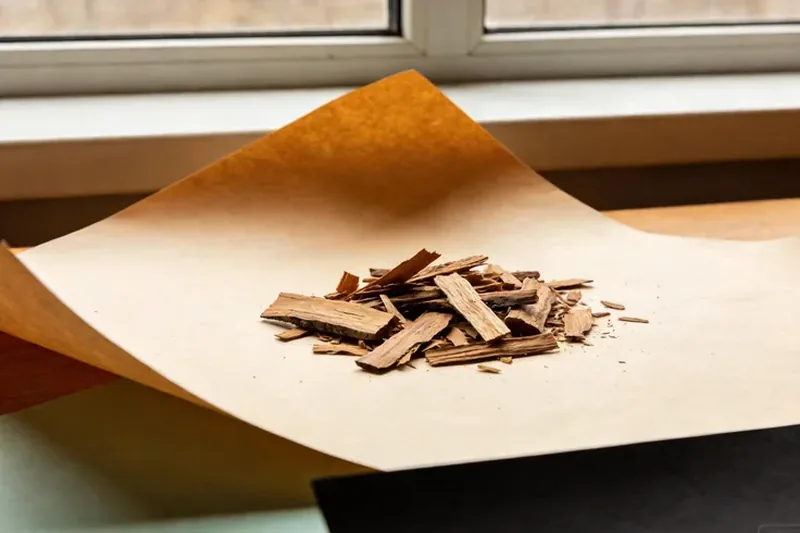
Data summary: Agarwood — chenxiang (沉香, “sinking fragrance”) in Chinese — is the resin-impregnated heartwood of Aquilaria trees, formed when the tree responds to wounding or fungal infection by saturating its wood with aromatic resin. It is one of the most prized aromatic woods in Chinese incense, perfume, and traditional practice. The name comes from the fact that the most resin-dense pieces sink in water.
Key facts
| Chinese | 沉香 (chénxiāng) |
| Botanical source | Aquilaria trees (Thymelaeaceae) — incl. A. sinensis (白木香), A. malaccensis |
| What it is | Resin-impregnated heartwood (not a distinct species) |
| Aroma | Woody, resinous, sweet, complex; develops with heat |
| Top grade | 奇楠 (qínán / “kyara-grade”) — see below |
| Key risk | Heavy adulteration (fake oil-dyed, injected, or foreign wood) |
Aroma profile
Direct answer: Agarwood is woody and resinous at its base, with a sweetness that varies by origin and grade. Its defining trait is that it develops in stages as it warms — top note, body, dry-down — rather than presenting a single flat scent.
Agarwood’s scent is woody and resinous at its base, with a sweetness that varies by origin and grade. Unlike a simple floral or wood note, it develops in stages as it warms — a quality described in Chinese practice as 头香 (top note), 本香 (body), and 尾香 (dry-down). High-grade material is aromatic even unheated; ordinary material needs gentle heat to release its scent.
Botanical identity
Direct answer: Agarwood is not a species but a condition of the wood. It forms inside Aquilaria trees — chiefly Aquilaria sinensis in southern China and Aquilaria malaccensis in Southeast Asia — when the tree is injured and responds by depositing resin in its heartwood.
Agarwood is not a plant; it is a product of injury. The genus Aquilaria belongs to the family Thymelaeaceae, a group of roughly 15–20 tree species native to South and Southeast Asia. The two names buyers encounter most are Aquilaria sinensis (白木香, the species traditionally harvested in southern China) and Aquilaria malaccensis (the main commercial species in Southeast Asia, listed in CITES Appendix II). Both are large evergreen trees whose healthy wood is pale, light, and nearly odorless — the fragrance appears only after resin accumulation. See Aquilaria sinensis in Flora of China and Aquilaria malaccensis on GBIF.
Chinese name and terminology
Direct answer: The name 沉香 means “sinking fragrance,” recording the density test that grades the wood. The same material travels under many names — 沉香/沉水香 in Chinese, oud in Arabic, jinkō/kyara in Japanese — so the name alone does not identify species or grade.
The Chinese name 沉香 (chénxiāng) is literal: 沉 “to sink” + 香 “fragrance.” It records the classical quality test — wood dense enough with resin to sink in water. The term appears across East Asian incense culture under different names that all point to the same material family:
- 沉香 / 沉水香 (chénxiāng / chénshuǐxiāng) — standard and “sinking-grade” names in Chinese.
- 伽楠 / 伽罗 / 棋楠 (qínán / qiēluó / qínán) — alternate Chinese spellings of the top grade (see below).
- Oud / oudh — the Arabic name, now the dominant term in Western perfumery.
- Jinkō (沈香) / kyara (伽羅) — the Japanese terms, where kyara names the top grade.
Because one material travels under many names, a buyer’s first job is to pin down what species and what grade the seller means — the name alone does not identify the material.
How agarwood forms
Direct answer: Healthy Aquilaria wood is pale, light, and scentless. Agarwood is the result of injury: when the tree is wounded, it saturates the damaged heartwood with resin over years or decades, darkening, densifying, and scenting the wood. Resin-bearing wood typically appears in trees older than about 20 years.
Healthy Aquilaria wood is pale, light, and essentially scentless. Agarwood is what happens after injury: when the tree is wounded — by insects, broken branches, lightning, or deliberate wounding — it mounts a defense, gradually saturating the damaged heartwood with resin over years or decades. The wood darkens, densifies, and becomes fragrant. Resin-bearing wood is typically found in trees older than ~20 years.
Botanical vs trade identity: “agarwood” is not a species — it is a condition of the wood. This matters for buyers: what is sold as agarwood may come from different Aquilaria species, or (fraudulently) from unrelated woods dressed up to resemble it.
Where does agarwood come from?
Direct answer: Wild Aquilaria grows across South and Southeast Asia — from southern China (Hainan, Guangdong, Guangxi, Yunnan) through Vietnam, Cambodia, Laos, Thailand, Malaysia, and Indonesia. Wild stands are depleted and CITES-listed, so most supply is now cultivated plantation agarwood.
Agarwood is an old-growth product of a broad belt of tropical and subtropical forest. Wild Aquilaria grows from Assam and the eastern Himalaya through Southeast Asia — southern China (Hainan, Guangdong, Guangxi, Yunnan), Vietnam, Cambodia, Laos, Thailand, Malaysia, Indonesia, and Bangladesh. Historically the most celebrated producing regions in Chinese trade were Hainan and Vietnam, whose material was long regarded as the aromatic benchmark.
Decades of wild harvesting have depleted natural stands, which is why Aquilaria malaccensis and the genus as a whole are CITES-listed. Most commercial agarwood today is cultivated (plantation) agarwood, produced by deliberately inoculating farmed trees to induce resin formation — a practice that yields lower-grade but legal and renewable material, distinct from the rare wild or old-growth wood that commands the highest prices.
Grades: the “sinking” system (沉水)
Direct answer: Chinese practice grades agarwood primarily by resin density, using a water test. 沉水 (“sinks in water”) is the most resin-saturated and valuable; 半沉半浮 (“half-sinks”) is medium; floating material is lowest. The test is a density guide, not a proof of authenticity.
Chinese practice grades agarwood primarily by resin density, using a simple water test:
| Grade | Chinese | Meaning |
|---|---|---|
| 沉水 (chénshuǐ) | “sinks in water” | Highest resin content — most valuable |
| 半沉半浮 (bànchénbànfú) | “half-sinks” | Medium |
| floating | — | Lower (historically 黄熟香) |
Beyond density, Chinese trade also distinguishes material by origin (Hainan and Vietnamese material long favored), by color (green, black, yellow, and other resin tones), and by aroma character — a layered, sweet, enduring aroma commands more than a flat or short-lived one. These are market distinctions, not a single standardized system; the full treatment is in the agarwood grading guide.
奇楠 (qínán) — the top grade
Direct answer: 奇楠 (qínán, roughly “kyara-grade”) is the highest agarwood grade, structurally different from ordinary agarwood: the fiber is so saturated with resin that it becomes soft and pliable, shaving into curls and kneading into pellets, and fragrant even at room temperature.
Qínán (also written 伽楠 / 伽罗 / 棋楠; roughly “kyara-grade” agarwood) is the highest grade, distinguished from ordinary agarwood by a structural difference:
- Ordinary agarwood is “wood wraps oil” (木包油) — hard wood with resin veins.
- 奇楠 is “oil wraps wood” (油包木) — the wood fiber is so thoroughly transformed by resin that it becomes soft and pliable. A good piece shaves into curls and kneads into pellets (削之成卷、捏之成丸), and is fragrant even at room temperature.
奇楠 is further graded by color into five grades — 白/绿/紫/黄/黑 (white/green/purple/yellow/black). Note: the hierarchy of these color grades is disputed across sources (whether some are distinct grades or aging stages), and the etymology of “qínán” itself is uncertain. We present these as market terminology, not settled taxonomy. See qínán / kyara and how to buy qínán without being misled.
Why is agarwood used in incense?
Direct answer: Agarwood is used in incense for its layered, evolving aroma and its cultural status as the most prized of aromatic woods. It is typically warmed rather than burned, so its top note, body, and dry-down unfold in sequence instead of charring into a single note.
Agarwood’s role in incense is inseparable from its aroma behavior: because it develops in stages, it rewards gentle, indirect heat rather than open flame. The refined method is 隔火焚香 (géhuǒ fénxiāng) — resting the material above charcoal buried in ash, so it releases scent without a charred note. Agarwood also serves as the premium anchor in 合香 (blended incense), where a small amount lifts and deepens an entire formula. Its cultural weight is at least as important as its chemistry: agarwood (沉香) and sandalwood (檀香) are the two reference woods of Chinese incense, and agarwood is the more rare and reverenced of the pair. See the agarwood incense guide.
How is agarwood processed?
Direct answer: Agarwood is processed by cleaning the resin-bearing wood, cutting away the non-resinous sapwood, and either shaping it into chips and carvings or grinding the resin-rich portion to powder. No extraction step is involved in the wood forms; only the oil requires distillation.
Resin-bearing heartwood is separated from the pale, scentless sapwood, cleaned, and dried. From there it branches by end use:
- Chips and slivers — cut pieces for warming on charcoal or an electric heater; small, even pieces heat most uniformly.
- Powder — ground resin wood for blending into sticks and cones; particle size affects how the powder packs, burns, and releases aroma.
- Whole pieces and carvings — high-grade material is kept whole for beads, sculptures, and display.
- Oud oil — the essential oil, obtained by (usually steam or water) distillation; a distinct product from the wood itself.
For powder buyers, particle size and moisture content are the practical variables — but the exact target depends on the stick formula, binder, and production line, so no single figure applies across the board (see Our Industry View below). The grinding and forming mechanics sit within the wider how incense is made process.
What determines agarwood quality?
Direct answer: Resin content is the core driver — it sets density, aroma intensity, and longevity. Around it, origin, age, formation type, and aroma character all matter. High-grade material is dense, fragrant at room temperature, and complex rather than flat.
The quality factors, in rough order of importance:
- Resin content — the single most decisive factor; it sets density (the sinking test) and aroma intensity.
- Origin — Hainan and Vietnamese material are traditionally ranked highest, but origin alone does not guarantee quality.
- Formation type and age — older, naturally formed resin reads differently from younger, inoculated resin.
- Aroma character — sweetness, complexity, and endurance; a layered, evolving scent beats a flat one.
- Physical condition — cleanliness, freedom from rot and non-resinous wood, and (for powder) particle consistency.
None of these is independently sufficient: a “sinking” piece can still be a sophisticated fake, which is why authenticity checks (below) matter as much as grading vocabulary.
Common forms
Direct answer: Agarwood is sold as chips, powder, whole pieces and carvings, beads, and distilled oil. Chips suit warming, powder suits stick-making, and whole pieces suit carving or collection; oil is a separate distilled product, not ground wood.
| Form | Typical use |
|---|---|
| Chips / slivers | Warmed on charcoal or an electric heater |
| Powder | Blended into incense sticks and cones |
| Whole pieces / carvings | Beads, sculpture, collection |
| Oud oil | Perfumery and scented products |
The distinction between chips and powder is functional, not a quality statement — the same wood in different physical forms. See incense powder & resin for how wood powder behaves in practice.
Adulteration: how to spot a fake
Direct answer: Because genuine agarwood is expensive, it is heavily faked. Common substitutes are dyed or oil-soaked white wood, unrelated woods treated with fragrance, and oil-injected low-grade material. Practical checks are the burn test, gentle-heat test, and the water test — none is a laboratory proof.
Because genuine agarwood is expensive, it is one of the most heavily adulterated aromatic materials. Common fakes:
- Dyed white wood — non-resinous Aquilaria wood soaked in fragrance oil and dyed dark.
- Foreign woods — unrelated woods (e.g., Lauraceae, Burseraceae) treated with synthetic fragrance.
- Oil-injected / “boiled” — lower-grade agarwood pumped with resin or oil to add weight.
Practical authenticity checks (traditional + trade practice, not laboratory proof):
- Burn a small piece: genuine agarwood gives white smoke with visible oil seepage and a clean sweet aroma; fakes give black smoke and a “burnt wood / perfume” smell.
- Gentle heat (not flame) should release a complex, evolving aroma.
- The water test (沉水) is a density guide, not a guarantee — sophisticated fakes can be made to sink.
These screening methods sit alongside the broader incense authentication database and substitution cross-reference.
Traditional use vs modern evidence
Direct answer: Agarwood has a long record in Chinese materia medica, where it is described in traditional language — “moving qi and relieving pain” and warming the middle. That is traditional materia-medica language, not modern clinical evidence; burning agarwood is an aromatic practice, not a medical treatment.
In Chinese materia medica (本草), agarwood is traditionally described as “moving qi and relieving pain” (行气止痛) and warming the middle (温中).
- Traditional Use — agarwood is burned in ritual, meditation, and daily incense practice for its aroma and its long-standing cultural association with calm and refinement.
- Historical Record — agarwood appears in classical Chinese materia medica and incense manuals as a high-ranking aromatic; the 沉水 grading test is documented trade practice.
- Scientific Evidence — the resin’s chemistry (sesquiterpenes and related compounds) is studied, but we do not present any clinical or medical efficacy claims.
This is traditional materia-medica language, not modern clinical evidence. We do not repeat or imply that burning agarwood treats any medical condition.
Sustainability & sourcing
Direct answer: Wild agarwood is depleted, and the genus is CITES-listed, so most commercial supply is now cultivated plantation agarwood. Sourcing should verify species, origin, and whether the material is wild, cultivated, or — in the case of oil — responsibly documented.
Because Aquilaria is CITES-listed and wild stands are depleted, responsible sourcing turns on two questions: which species, and whether the material is wild or cultivated. Wild old-growth agarwood is scarce and legally sensitive; plantation agarwood, produced by inoculating farmed trees, is the renewable mainstream. For buyers, the practical implication is documentation: a credible supplier should be able to name the species and origin and state whether the material is wild or cultivated, rather than offering only an unqualified “agarwood” label. For the commercial side of sourcing, see the wholesale guide.
Modern commercial applications
Direct answer: Agarwood is used in premium incense sticks, perfumery (as oud oil), and carved goods such as beads and sculptures. The wood goes to incense and carving, while the distilled oil goes to fragrance; they are different products with different price structures.
Agarwood reaches the market through distinct channels:
- Incense sticks and cones — usually a small proportion of agarwood powder in a blend; the premium positioning comes from the material, not the filler.
- Perfumery — “oud” (agarwood oil) is a high-value fragrance ingredient; the oil market is separate from the wood market.
- Carving and beads — high-grade wood is kept whole for beads and sculpture, where the resin pattern itself is the value.
- Loose chips and powder — sold to incense makers and end users for warming or blending.
What buyers should look for
Direct answer: Buyers should pin down species, origin, density, and authenticity before price. Ask whether the material is wild or cultivated, check aroma on gentle heat, and — for powder — ask about particle size and moisture, since these affect how the material behaves in a formula.
For an incense maker or sourcing buyer, the checks are:
- Species and origin — ask which Aquilaria species and which region; a real seller can answer.
- Density — the sinking test is a rough resin-content guide, not a guarantee.
- Aroma on gentle heat — the decisive test; it should be complex and evolving, not flat or “burnt.”
- Wild vs cultivated — a documentation question with legal and price implications.
- Form and consistency — for powder, confirm particle size and moisture, and request a sample against your formula rather than accepting a nominal grade.
None of these should be taken on the label’s word alone; the authentication database walks through the screening logic.
Safety
Incense combustion produces smoke and particulate matter. Burn in a well-ventilated space; avoid inhaling concentrated smoke; keep away from children and pets. See our safety guide.
Agarwood vs sandalwood
Direct answer: Both are premium aromatic woods, but they form differently and smell different. Agarwood is resin-saturated wood produced by injury, with a woody-resinous-sweet scent; sandalwood is fragrant heartwood whose scent is present in the living tree, with a creamy-sweet-soft profile.
Both are premium aromatic woods, but they form differently and smell different:
| Agarwood (沉香) | Sandalwood (檀香) | |
|---|---|---|
| What it is | Resin-impregnated heartwood (forms after injury) | Fragrant heartwood (scent present in the living wood) |
| Botanical source | Aquilaria spp. | Santalum album |
| Aroma | Woody, resinous, sweet, complex | Creamy, sweet, soft, woody |
| Key buying risk | Heavy adulteration (dyed / injected wood) | Species substitution (non-album “sandalwood”) |
The two are complements, not substitutes, in Chinese incense: sandalwood is the gentle, creamy staple and base, agarwood the deeper, rarer premium wood. See sandalwood and the material comparison matrix.
Our Industry View
Direct answer: From a manufacturing perspective, the nominal name “agarwood” matters less than consistency — of aroma, particle size, moisture, contamination, and batch-to-batch variation. For a repeatable stick, a steady mid-grade material often beats an irreproducible top grade.
From a manufacturing perspective, the most important issue is not simply the nominal ingredient name, but consistency of aroma, particle size, moisture, contamination control, and batch-to-batch variation. A single exceptional piece of agarwood proves little about a production run; what matters is whether the next batch smells and behaves like the last.
Two points follow:
- Particle size and moisture affect behavior, not just aroma. In powder, particle size changes how the material packs, draws air, and burns; moisture changes how it grinds and how the finished stick dries and stores. The right target depends on formulation — the binder, the other ingredients, and the production line — so a figure that works in one factory is not transferable to another.
- Aroma changes through processing. Grinding, heating, and aging can shift the scent, so the aroma of the raw wood is not identical to the aroma of the finished stick. A buyer who approves a raw sample should also approve the blended result.
In our view, the commercial sweet spot is a consistent, well-documented mid-grade material with a known species and origin, rather than an irreproducible top grade that cannot be reordered to the same specification.
Summary
Agarwood (沉香) is resin-impregnated Aquilaria heartwood formed by injury, graded in Chinese practice by resin density (the sinking test) with 奇楠 (qínán) as the structurally distinct top grade. Its value rests on resin content, origin, and aroma complexity, and it is among the most heavily adulterated aromatics, so authenticity checks matter as much as grading vocabulary. In incense it is warmed rather than burned, prized for a layered aroma that unfolds in stages; commercially, consistency and documentation outweigh a one-off exceptional piece.
FAQ
What is the difference between agarwood and 奇楠? 奇楠 (qínán) is the highest grade of agarwood, not a separate plant. The difference is structural: ordinary agarwood shows a “wood wraps oil” (木包油) pattern, where hard wood carries resin veins, while 奇楠 shows “oil wraps wood” (油包木) — the fiber is so thoroughly saturated with resin that it turns soft and pliable, aromatic even at room temperature. A good piece shaves into curls and kneads into pellets. 奇楠 is further divided into color grades, though the hierarchy among those is disputed and treated here as market terminology.
Is agarwood a type of tree? No — agarwood is not a species; it is a condition of the wood. It forms inside Aquilaria trees when the tree responds to wounding or fungal infection by saturating its heartwood with resin. Healthy Aquilaria wood is pale, light, and nearly scentless; only after years of injury and resin accumulation does it darken, densify, and become fragrant. Because several Aquilaria species can produce it, the material sold as agarwood may come from different species, which is a key point for buyers checking authenticity.
Why is agarwood so expensive? Agarwood is expensive because it forms slowly and unpredictably. Resin accumulates only after a tree is wounded — by insects, broken branches, lightning, or deliberate injury — and mature resin-bearing wood typically takes decades to develop. Wild Aquilaria resources are depleted, and high-grade material is scarce, so most commercial supply today is cultivated or low-grade. The top grade, 奇楠, is rarer still, and heavy adulteration in the market further pushes up the price of genuine material.
How do I burn agarwood? The refined traditional method is indirect heat (隔火焚香): the material is rested above charcoal buried in ash on a plate, so it releases aroma without an open flame. This gentle warming avoids the charred note of direct burning and lets the complex scent develop in stages. Chips can also be warmed on an electric incense heater, which gives steadier temperature control. For high-grade material, avoid flame; ordinary material benefits from gentle, gradual heat rather than burning.
Is agarwood the same as oud? Largely yes. “Oud” (also written oudh) is the Arabic name for the same resin-impregnated Aquilaria wood called 沉香 (chénxiāng) in Chinese and jinkō or kyara in Japanese. They are one material family under different regional names. There are minor differences in grading vocabulary — for example, the top grade is called 奇楠 in Chinese and kyara in Japanese — but the underlying material is the same resin-saturated heartwood.
What does “sinking-grade” (沉水) agarwood mean? “Sinking-grade” refers to the classic Chinese density test. The most resin-saturated pieces are dense enough to sink in water, which is why the name 沉香 means “sinking fragrance.” This water test sorts material into grades: 沉水 (sinks), 半沉半浮 (half-sinks), and floating, with sinking pieces carrying the most resin and the highest value. It is a density guide, not a proof of authenticity — sophisticated fakes can be made to sink, so it should be combined with other checks.
What is the difference between wild and cultivated agarwood? Wild agarwood forms naturally in mature trees over decades, and it is now scarce and CITES-regulated. Cultivated (plantation) agarwood is produced by inoculating farmed trees to induce resin formation, yielding legal, renewable material that is typically lower-grade than old-growth wild wood. The two differ in age, resin character, price, and legal status, so a buyer should ask which a seller is offering rather than assuming.
What is the difference between agarwood chips and powder? They are the same resin wood in different physical forms. Chips are cut pieces meant to be warmed on charcoal or an electric heater, where whole surfaces release aroma slowly. Powder is ground resin wood for blending into incense sticks and cones, where a uniform particle size helps the material pack and burn consistently. Neither form is inherently higher quality, but for stick-making, particle size and moisture affect how the powder behaves in a formula.
See also: the agarwood incense guide, the agarwood grading guide, bletilla and the full scent guide.
Evidence & Sources
Botanical identity
Source: Aquilaria sinensis in Flora of China · Aquilaria malaccensis on GBIF · Aquilaria malaccensis in the CITES species checklist. Evidence type: Established.
Traditional Chinese use
Source: this page records agarwood as traditionally described for “moving qi and relieving pain” (行气止痛) and warming the middle (温中). Evidence type: Historically documented — traditional materia-medica language, not modern clinical evidence.
Commercial grading
Source: the “sinking” water test (沉水 / 半沉半浮 / floating) and the 奇楠 (qínán) five color grades (白/绿/紫/黄/黑) are market terminology. Evidence type: Trade terminology.
Authenticity / adulteration
Source: documented fakes (dyed white wood, foreign woods, oil-injected material) and practical checks (burn test, gentle heat, water test). Evidence type: Practical screening.
Safety
Source: incense combustion produces smoke and particulate matter; burn in a well-ventilated space. Evidence type: Established.
Evidence status
| Layer | Status |
|---|---|
| Botanical identity | Established |
| Traditional use | Historically documented |
| Commercial grading | Trade terminology |
| Authenticity test | Practical screening |
| Laboratory confirmation | Requires analytical testing |
| Health claims | Not established |
Sources
- Aquilaria sinensis in Flora of China
- Aquilaria malaccensis on GBIF
- Aquilaria in the CITES species checklist
Sources: this page synthesizes Chinese-language trade/specialist sources (奇楠 grading, adulteration) and botanical references (Aquilaria sinensis). Etymology of “qínán” and the 奇楠 color-grade hierarchy remain disputed and are noted as such. This is editorial knowledge content, not medical or investment advice.