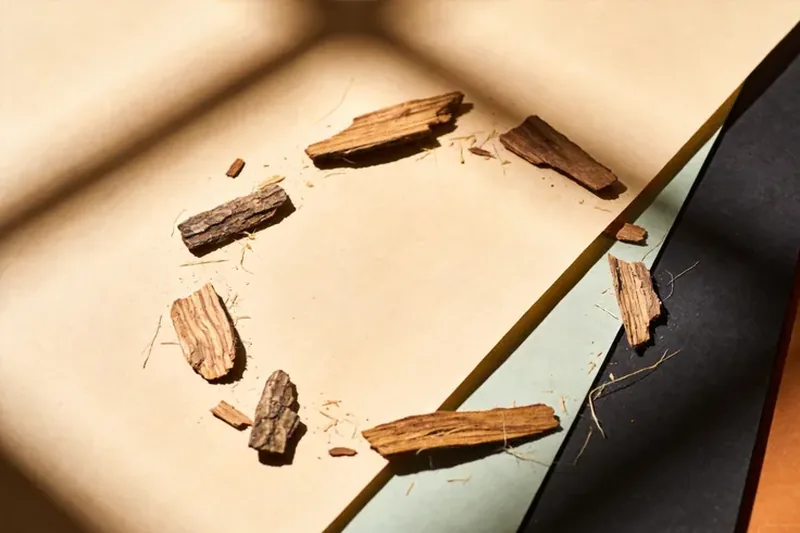
At a glance: Sandalwood — tanxiang (檀香) in Chinese — is the fragrant heartwood of Santalum trees, most classically Indian sandalwood (Santalum album). It is prized in Chinese incense for a warm, creamy, sweet, woody aroma, and has a long history in ritual, incense sticks, perfume, and carving.
Key facts
| Chinese | 檀香 (tánxiāng) |
| Botanical source | Santalum trees (Santalaceae) — primarily S. album (Indian/white sandalwood) |
| What it is | Fragrant heartwood (a hemiparasitic tree genus) |
| Aroma | Creamy, sweet, soft, woody (“buttery” in good material) |
| Key risk | Species substitution; cheap sticks are often fragrance oil, not real wood |
Aroma profile
Direct answer: Sandalwood is warm, creamy, sweet, and soft-woody, with a “buttery” smoothness in good material. Its scent is gentle and long-lasting rather than sharp, which is why it serves as a base and blending material.
Sandalwood’s scent is warm, creamy, and sweet with a soft woody base. The best material has a distinctive “buttery” smoothness that distinguishes it from sharper or synthetic “sandalwood” fragrances. It is widely used as a base or blending material because its aroma is gentle and long-lasting rather than sharp.
Botanical identity
Direct answer: Sandalwood is the fragrant heartwood of Santalum, a genus of hemiparasitic trees in the family Santalaceae. The classic species is Santalum album, a slow-growing tree whose heartwood develops its aroma only over decades.
Santalum belongs to the family Santalaceae, and its species are hemiparasitic — they tap the roots of host plants for water and nutrients while still photosynthesizing. This habit matters in cultivation: sandalwood trees need suitable host species, which is part of why they are slow and costly to establish. The aromatic value lies in the heartwood, which develops its characteristic oil over decades; young trees and sapwood carry little scent. See Santalum album on GBIF.
Chinese name and terminology
Direct answer: 檀香 (tánxiāng) means “sandalwood fragrance.” Two naming traps recur: 紫檀 (red sandalwood) is a different plant, Pterocarpus santalinus; and 白檀 / 印度檀香 usually specify Santalum album among the Santalum species.
The Chinese name 檀香 (tánxiāng) means “sandalwood fragrance.” Two naming traps recur in trade:
- 檀香 vs 紫檀. 檀香 (tánxiāng) is sandalwood, Santalum album. 紫檀 (zǐtán) — “red sandalwood” — is a different plant entirely, Pterocarpus santalinus, valued as a crimson dye wood, not for the creamy sandalwood aroma. The shared character 檀 causes persistent confusion. See red sandalwood.
- 白檀 / 印度檀香. In Chinese, 白檀 (báitán, “white sandalwood”) and 印度檀香 (yìndù tánxiāng, “Indian sandalwood”) usually mean Santalum album specifically, distinguishing it from other Santalum species.
Because one English word covers several Santalum species, the Chinese and scientific names are the reliable anchors.
Species: what “sandalwood” means
Direct answer: “Sandalwood” is not one tree — it can mean several Santalum species. Santalum album (Indian/white sandalwood) is the reference standard; S. spicatum (Australian), S. austrocaledonicum (New Caledonian), and S. paniculatum (Hawaiian) are legitimate but aromatically and commercially different.
“Sandalwood” is not one tree. In trade it can refer to several Santalum species:
- Santalum album — Indian / white sandalwood; the classic incense wood and the reference standard.
- Santalum spicatum — Australian sandalwood; a common commercial substitute.
- Santalum austrocaledonicum — New Caledonian sandalwood.
- Santalum paniculatum — Hawaiian sandalwood.
Buyer note: “sandalwood” on a label does not guarantee S. album. Species substitution is common; the aroma and price differ meaningfully. This is a key authenticity point, not a triviality.
Where does sandalwood come from?
Direct answer: Classic sandalwood comes from southern India, where Santalum album is native and historically cultivated. Australian sandalwood (S. spicatum) is the main legal commercial substitute, with smaller supplies from New Caledonia and Hawaii. Wild S. album is depleted and CITES-listed.
The traditional source of the reference material is southern India — Karnataka, Tamil Nadu, and neighboring regions — where Santalum album has been grown and harvested for centuries. As Indian wild stocks were depleted and regulated, Australian sandalwood (S. spicatum) became the workhorse of the legal commercial market, alongside plantation S. album. Smaller volumes come from New Caledonia (S. austrocaledonicum) and Hawaii (S. paniculatum). The Indian species is CITES-listed, reflecting the pressure on wild populations.
Traditional use vs modern evidence
Direct answer: Sandalwood has a long record of traditional and ritual use, and a warm, grounding aroma used for centuries in meditation. But online “sandalwood benefits” claims — treating insomnia, anxiety, or other conditions — are traditional belief or unverified claims, not established medical fact.
Sandalwood has a long record of traditional and ritual use — in incense, Buddhist and Taoist practice, perfume, carving, and traditional materia medica. It is widely described as “calming” and “grounding” in aromatherapy contexts.
- Traditional Use — burned for its warm, grounding aroma in meditation, temple, and evening ritual; used in perfume and carving.
- Historical Record — sandalwood appears in classical Chinese materia medica and incense tradition as a standard aromatic wood.
- Scientific Evidence — the wood’s essential oil is well characterized chemically, but health-effect claims are not established clinical fact.
Important: much of the online content about “sandalwood incense benefits” repeats health claims — relieving insomnia, relieving anxiety, lowering cortisol, lowering blood pressure, immune support — with little or no sourced evidence. We treat these as traditional belief or unverified claims, not established medical fact.
- What we can say: sandalwood has a warm, grounding aroma used for centuries in meditation and ritual settings.
- What we do not claim: that burning sandalwood treats insomnia, anxiety, or any medical condition.
In Chinese incense
Direct answer: Sandalwood (檀香) is a staple of Chinese incense alongside agarwood (沉香). It is used in incense sticks, blended incense (合香), and temple ritual, where its gentle, creamy aroma makes it a common base or pairing material.
Sandalwood (檀香) is a staple material in Chinese incense alongside agarwood (沉香). It is used in incense sticks (线香), in blended incense (合香), and in temple/ritual settings. Its gentle, sweet aroma makes it a common pairing or base material. Because its scent is smooth and long-lasting rather than sharp, it anchors a blend and lets brighter notes sit on top without clashing. See the sandalwood incense guide for how it behaves in practice.
How is sandalwood processed?
Direct answer: Sandalwood is processed from the heartwood: the fragrant core is chipped or ground to powder for incense, or steam-distilled to yield sandalwood oil. The sapwood and young wood carry little scent and are separated out.
The aromatic part is the mature heartwood, not the whole trunk. Processing splits by end use:
- Chips and powder — heartwood is chipped and, for incense, ground to a controlled particle size for blending into sticks and cones.
- Oil — heartwood is steam-distilled over a long cycle to extract the essential oil, a separate product from the wood powder.
- Carving and beads — solid heartwood is carved; the material is dense and slow-burning.
For powder, particle size and moisture affect how the powder blends and burns, but the correct target depends on the specific stick formula and binder — there is no universal figure. The mechanics fit within how incense is made and the binder that holds a stick together.
What determines sandalwood quality?
Direct answer: Species, heartwood content, oil content, and age drive sandalwood quality. Santalum album is the reference, but within any species, older, oil-rich heartwood with a creamy, long-lasting aroma ranks above young, pale sapwood.
The quality factors:
- Species — S. album is the reference standard; other Santalum species differ in aroma and price.
- Heartwood vs sapwood — only the mature heartwood is fragrant; sapwood dilutes the material.
- Oil content and age — older, slower-grown heartwood carries more oil and a richer aroma.
- Aroma character — the “buttery” creaminess of good material is the marker to seek.
These factors, not the price tag, are what a buyer is actually paying for — and cheap “sandalwood” is usually a fragrance-oil imitation of exactly this character.
Common forms
Direct answer: Sandalwood is sold as chips, powder, oil, whole wood for carving, and finished incense sticks. Powder is ground heartwood for stick-making; oil is a distilled extract with a different, brighter scent; the two are not interchangeable.
| Form | Typical use |
|---|---|
| Chips | Warmed or ground for incense |
| Powder | Blended into incense sticks and cones |
| Oil | Perfumery and scented products (steam-distilled) |
| Whole wood / carving | Beads, sculpture, solid pieces |
| Sticks / cones | Finished incense |
The powder-vs-oil distinction matters because they smell different: oil gives bright, immediate notes, while the wood gives the slower, deeper “cooked” aroma. See incense powder & resin.
Quality & authenticity (buyer intelligence)
Direct answer: Real sandalwood powder is expensive, but price alone proves nothing. Very cheap “sandalwood” sticks are almost always synthetic fragrance oil, not wood. Check the species and whether the label names real wood powder versus oil.
- Real sandalwood powder is expensive — but price alone proves nothing. Prices vary substantially by species, origin, heartwood content, grade, purity and market channel, so a low retail price cannot by itself establish authenticity. Very cheap “sandalwood” sticks are almost always synthetic fragrance oil, not wood.
- Oil ≠ wood. Sticks made with sandalwood oil smell distinctly different from those made with the actual wood; the wood gives the “buttery” note.
- Species matters. S. album is the reference standard; substitutes (Australian, New Caledonian) are legitimate but different in aroma and price.
The same “one name, several materials” problem runs through the whole incense trade — see the substitution cross-reference for the general pattern.
Sustainability & sourcing
Direct answer: Wild Santalum album is depleted and CITES-listed, so the legal market runs on plantation S. album and Australian S. spicatum. Sourcing should confirm species and whether the material is plantation-grown or sustainably harvested.
Indian sandalwood’s wild decline, and its CITES listing, pushed the market toward two sustainable routes: plantation S. album (grown with managed host trees) and Australian S. spicatum, which is harvested under regulated management and is now a large share of the legal sandalwood trade. For a buyer, the documentation question is the same as with agarwood: can the supplier name the species, the origin, and the harvest basis? A label that says only “sandalwood” answers none of these. See the wholesale guide for the sourcing framework.
Modern commercial applications
Direct answer: Sandalwood goes into incense sticks, perfumery (sandalwood oil is a long-standing fragrance ingredient), carving, and cosmetics. The oil and the wood serve different markets with different price structures.
Sandalwood reaches buyers through distinct channels:
- Incense sticks and cones — sandalwood powder as a base or feature note in blended sticks.
- Perfumery — sandalwood oil is a classic base note and fixative.
- Carving and beads — dense heartwood for sculpture and beads.
- Cosmetics and personal care — the oil appears in soaps and creams.
What buyers should look for
Direct answer: Ask which Santalum species, whether the label means wood or oil, and the origin and harvest basis. Verify the “buttery” aroma and, for powder, confirm particle size and moisture against your own formula.
For an incense maker or sourcing buyer:
- Species — S. album is the reference; other species are legitimate but different. A real seller names the species.
- Wood vs oil — the label should say which; they are different materials with different scents.
- Origin and harvest basis — plantation vs wild, and which region, with documentation.
- Aroma — the creamy “buttery” note marks good material; sharp or soapy usually marks synthetic.
- Form and consistency — for powder, particle size and moisture affect blending and burn; confirm against your formula.
Safety
Incense combustion produces smoke and particulate matter. Burn in a well-ventilated space; avoid inhaling concentrated smoke; keep away from children and pets. See our safety guide.
Our Industry View
Direct answer: In manufacturing, consistency matters more than the species name on the label. A steady, well-documented supply of one Santalum species with known particle size and moisture beats an unverifiable “S. album” claim that cannot be reordered to the same specification.
From a manufacturing perspective, the species name is only the first question. What actually determines whether a stick is repeatable is consistency: the same species, the same heartwood grade, the same particle size, and the same moisture, batch after batch.
Two points follow:
- “Sandalwood” on the label is a claim, not a material. Species substitution and oil-for-wood substitution mean the name alone does not tell you what will actually burn in your formula. The substitution cross-reference is the general map of this problem.
- Particle size and moisture depend on formulation. The correct grind and moisture for one stick formula — with a particular binder and burn target — will not transfer to another. Rather than a nominal “sandalwood powder” grade, a buyer should specify how the powder must behave in their own production, and sample against that.
In our view, the commercial sweet spot is a documented, consistent supply of a named species, not an unverifiable premium label.
Summary
Sandalwood (檀香) is the fragrant heartwood of Santalum trees, with Santalum album as the classic reference species and Australian S. spicatum as the main legal commercial substitute. Its creamy, sweet, “buttery” aroma makes it a base and blending staple in Chinese incense. The key buyer risks are species substitution and oil-for-wood substitution, and its health-benefit claims are traditional belief, not established evidence — so the name, the species, and the form (wood vs oil) all need to be verified.
FAQ
What is the difference between sandalwood and agarwood? Both are prized woods, but they differ: sandalwood is the fragrant heartwood of Santalum trees (creamy, sweet, woody), while agarwood is resin-impregnated Aquilaria wood formed after injury (woody, resinous, sweet, complex). Sandalwood’s scent is present in the living heartwood; agarwood’s forms only through a wounding process. They sit side by side in Chinese incense, sandalwood as the gentle, creamy staple and agarwood as the deeper, more complex premium wood.
Is “sandalwood incense” real sandalwood? Often not — many commercial sticks use synthetic fragrance. Check species and whether it lists real wood powder vs fragrance oil. Genuine sandalwood powder is expensive, so very cheap sticks are almost always synthetic fragrance oil rather than wood; the label should name a Santalum species and state whether it is wood or oil. Species substitution is common, and the aroma and price differ meaningfully between real and synthetic or between different species.
Does sandalwood help you sleep? There is no established clinical evidence that burning sandalwood treats insomnia, and no fragrance should be treated as a medical sleep aid. Sandalwood does have a traditional use as a calming ritual scent, and its warm, grounding aroma has been used for centuries in meditation and evening ritual settings. Describing it as “calming” is an aromatherapy observation about how a familiar scent can anchor an unwinding routine, not a proven treatment for any sleep condition. If a product claims to cure insomnia, that claim is unverified and should be read with skepticism.
What does sandalwood smell like? Warm, creamy, sweet, and soft-woody — the best material has a distinctly “buttery” smoothness that distinguishes it from sharper or synthetic “sandalwood” fragrances. The aroma is gentle and long-lasting rather than sharp, which is why sandalwood is widely used as a base or blending material. This smooth, buttery quality is the mark of good material and is lost in cheap synthetic versions.
Is sandalwood oil the same as sandalwood powder? No. Oil is the concentrated steam-distilled extract; powder is the ground heartwood. Oil gives bright, immediate notes; wood gives the slower, deeper “cooked” aroma. Sticks made with oil smell distinctly different from those made with actual wood — the wood is what supplies the characteristic “buttery” note. So the same word, “sandalwood,” can mean two quite different materials in practice.
Why is real sandalwood so expensive? Santalum album is slow-growing and hemiparasitic, its heartwood takes decades to develop aroma, and wild stands are depleted. Scarcity plus demand drives the price — cheap “sandalwood” is usually synthetic. The species is also CITES-listed, which reflects pressure on wild populations and adds to the cost of genuine material. All of this means real sandalwood powder commands a meaningful price in craft supply.
What is the difference between sandalwood and red sandalwood? They are different plants that share only the character 檀 in their Chinese names. Sandalwood (檀香, Santalum album) is a creamy, sweet-scented incense wood. Red sandalwood (紫檀, Pterocarpus santalinus) is a crimson dye wood valued for color, not for the sandalwood aroma. The similarity of the names causes persistent confusion, so the scientific name is the reliable anchor.
See also: the sandalwood incense guide, the material comparison matrix, bletilla and the full scent guide.
Evidence & Sources
Botanical identity
Source: Santalum album on GBIF · Santalum album in the CITES species checklist. Evidence type: Established.
Traditional Chinese use
Source: 本草綱目 (Bencao Gangmu) full text on Wikisource and this page’s record of sandalwood’s long traditional and ritual use (incense, Buddhist and Taoist practice, materia medica). Evidence type: Historically documented — traditional materia-medica language, not modern clinical evidence.
Commercial grading
Source: the species distinction among Santalum album / S. spicatum / S. austrocaledonicum / S. paniculatum is market-relevant terminology. Evidence type: Trade terminology.
Authenticity / adulteration
Source: species substitution and “oil vs wood” (synthetic fragrance oil vs real wood) are the page’s buyer-intelligence points. Evidence type: Practical screening.
Safety
Source: incense combustion produces smoke and particulate matter; burn in a well-ventilated space. Evidence type: Established.
Evidence status
| Layer | Status |
|---|---|
| Botanical identity | Established |
| Traditional use | Historically documented |
| Commercial grading | Trade terminology |
| Authenticity test | Practical screening |
| Health claims | Not established |
Sources
- Santalum album on GBIF
- Santalum album in the CITES species checklist
- 本草綱目 (Bencao Gangmu) full text on Wikisource
Sources: botanical references on Santalum spp. and commercial/enthusiast accounts of the sandalwood trade. Health-benefit claims circulating online are treated as traditional/unverified, not established evidence. This is editorial knowledge content, not medical advice.