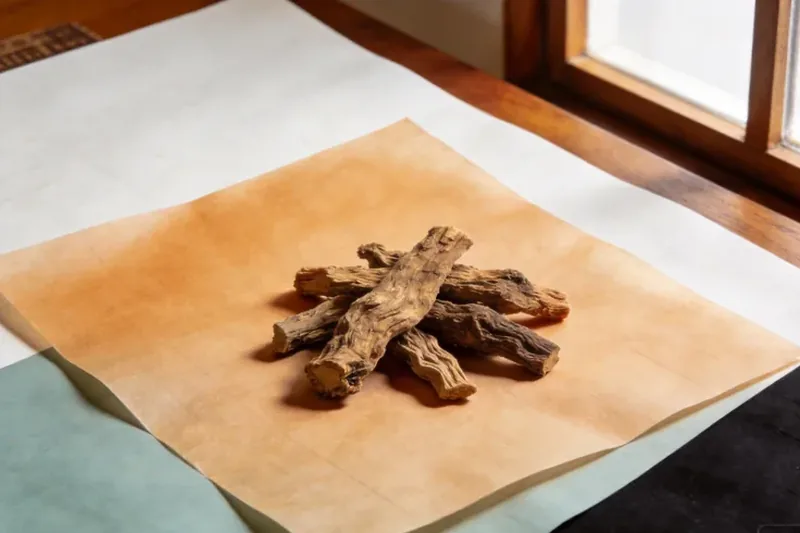
Definition: Vetiver — yánláncǎo (岩兰草) in Chinese — is a tropical grass whose roots yield a deep, earthy, woody, slightly smoky essential oil, used primarily as a base note in perfumery and incense. The fragrant part is the root, steam-distilled — not a wood, and not the grass’s leaves.
Key facts
| Chinese | 岩兰草 (yánláncǎo) |
| Botanical source | Chrysopogon zizanioides (syn. Vetiveria zizanioides), a grass |
| What it is | The roots (steam-distilled), not a wood |
| Aroma | Earthy, deep, woody, smoky, warm |
| Traditional role | Perfumery base note, incense |
Aroma profile
Direct answer: Vetiver has a deep, earthy, “rooty” aroma with woody and slightly smoky warmth — the reference “earthy” note, darker than patchouli and smoother than cedar. It is a heavy, long-lasting base note used to anchor lighter notes.
Vetiver has a deep, earthy, “rooty” aroma with woody and slightly smoky warmth. It is a classic base note — heavy and long-lasting — used to anchor lighter notes in a blend. It is sometimes called “oil of tranquillity” for its grounding character (an aromatherapy description, not a medical claim).
The scent is genuinely “underground”: damp earth, dry roots, and a faint smoky-green sweetness. It is the reference “earthy” note, darker than patchouli’s musty-spice and smoother than cedar’s dry wood. Because it is tenacious, a small amount of vetiver can carry a blend for hours.
Botanical identity
Direct answer: Vetiver is a grass in the family Poaceae. The accepted name is Chrysopogon zizanioides (the older name Vetiveria zizanioides is a synonym), and the fragrant part is the deep, dense root, steam-distilled — unlike woods or resins, which use heartwood or exudate.
Vetiver is a grass (family Poaceae). The name has been revised from Vetiveria zizanioides to Chrysopogon zizanioides. It is also known as “khus” in India. Unlike woods or resins, the fragrant part is the root, steam-distilled. See Chrysopogon zizanioides in Flora of China.
The roots are famously deep and dense (they are also used for erosion control and woven into screens and mats — a separate, non-fragrance use). The essential oil is distilled from the washed, dried roots.
Chinese name and terminology
Direct answer: 岩兰草 (yánláncǎo) is the Chinese name for vetiver, and “khus” is the Indian name for the same grass. Both point to Chrysopogon zizanioides; the names vary by region, but the material is the same root-distilled grass.
- 岩兰草 (yánláncǎo) — the Chinese name, where 草 marks it as a grass rather than a wood or resin.
- Khus (खस) — the Indian name, common on Indian vetiver products and in South Asian perfumery and cooling drinks.
- Vetiver — the international trade name, from the Tamil word for the grass.
The name alone does not identify the origin or grade; “vetiver” on a label can be several different scent profiles.
Where does vetiver come from?
Direct answer: Vetiver is a tropical grass native to India and now cultivated across the tropics. The major producing regions are India, Haiti, and Indonesia (Java), with Réunion (Bourbon) historically the quality benchmark — and origin meaningfully changes the aroma.
Vetiver is a tropical grass native to India, now planted across the tropics for its root and for erosion control. The oil is produced across these regions, and origin meaningfully changes the aroma:
- India (khus) — the classic, earthy-woody profile; the historical reference.
- Haiti — lighter, cleaner, often described as more floral/sweet.
- Java (Indonesia) — smoky, dry, and woody.
- Réunion (Bourbon) — prized, floral-earthy; historically the benchmark for quality.
The origin note matters because “vetiver” on a label can be several different scent profiles. In incense, the earthy Indian/Java types are the most common.
Why is vetiver used in incense?
Direct answer: Vetiver is used in incense as a base note — it sits under brighter top notes and gives a blend its depth and staying power. It is almost always blended (with sandalwood, cedar, or citrus) rather than burned alone.
Vetiver is almost always a base note: it sits under brighter top notes and gives a blend its depth and staying power. In incense it is usually paired with sandalwood or cedar (woody warmth) or brightened with citrus. It is rarely burned alone — its job is to anchor, not to lead. See the scent guide for where vetiver sits among base notes.
How is vetiver processed?
Direct answer: Vetiver oil is made by washing and drying the grass’s deep roots, then steam-distilling them. The root is the fragrant part; the grass’s leaves are not used for the oil.
The processing is root-first:
- Harvest — the deep, dense root system is dug up; this is labor-intensive because the roots run deep.
- Wash and dry — the roots are washed and dried before distillation.
- Distill — the dried roots are steam-distilled to yield the deep, earthy essential oil.
The same roots have a separate, non-fragrance life — woven into screens, mats, and used for erosion control — but the fragrance material is the distilled root.
What determines vetiver quality?
Direct answer: Quality is driven chiefly by origin, which sets the aroma profile — Indian (khus) is earthy-woody, Haitian is lighter and cleaner, Java is smoky and dry, and Réunion (Bourbon) is the prized floral-earthy benchmark. Root quality and distillation care also matter.
The quality factors:
- Origin — the single biggest driver; different regions yield different profiles.
- Root quality — mature, clean, well-dried roots.
- Distillation — careful distillation preserves the deep, earthy character.
- Aroma balance — a full, warm, earthy profile with no thin or harsh off-notes.
These are trade distinctions, not a single standardized grading system.
Common forms
Direct answer: Vetiver is sold chiefly as essential oil, and to a lesser extent as dried root (whole or for sachets and screens). The oil is the perfumery and incense-blending form; the dried root has fragrance and non-fragrance uses.
| Form | Typical use |
|---|---|
| Essential oil | Perfumery base note; incense blending (the dominant form) |
| Dried roots | Woven into screens/mats; sachets; erosion control |
| Powder | Ground root (less common than the oil) |
The distinction is functional: the oil is a concentrated base note, while the dried root is a bulk botanical with both fragrance and non-fragrance uses. See incense powder & resin.
Vetiver vs patchouli
Direct answer: Both are earthy base notes, but vetiver is a grass root and patchouli a mint-family leaf. Vetiver is smokier and smoother; patchouli is mustier and spicier. They are often used together to build a deep, earthy base.
| Vetiver (岩兰草) | Patchouli (广藿香) | |
|---|---|---|
| Plant part | Grass root | Mint-family leaf |
| Character | Earthy, smoky-green, smooth | Earthy, musty-sweet, spicy |
| Role | Grounding base | Anchoring base |
Vetiver is smoother and “drier”; patchouli is mustier and spicier. They are often used together to build a deep, earthy base under woods and florals. See patchouli and the material comparison matrix.
Traditional use vs modern evidence
Direct answer: Vetiver is described in aromatherapy as “calming” and “grounding” — aromatic and experiential descriptions, not medical claims. This page does not claim vetiver treats any condition.
- Traditional Use — vetiver has a long history as a perfumery base note and a fragrance material; its roots are also used in Indian cooling drinks (khus sherbet).
- Historical Record — khus has long been used in Indian perfumery, and the grass is planted for erosion control.
- Scientific Evidence — none is claimed; “calming”/“grounding” are aromatic/experiential descriptions.
We treat these as aromatic/experiential descriptions, not medical claims. We do not claim vetiver treats any condition.
Sustainability & sourcing
Direct answer: Vetiver is a cultivated, renewable crop with a documented non-fragrance benefit — its deep roots are planted for erosion control and soil conservation. Sourcing should confirm the origin, since origin sets the aroma profile.
Vetiver is planted, not wild-harvested, and its deep root system makes it a recognized erosion-control and soil-conservation crop — a genuine sustainability benefit that runs alongside its fragrance use. For a buyer, the practical question is which origin, because the label “vetiver” can be several different scent profiles depending on where the grass was grown and distilled. See the wholesale guide.
Modern commercial applications
Direct answer: Vetiver oil is a major perfumery base note and fixative, and it also goes into incense blends and scented products. Separately, the dried root is used in erosion control, screens, and mats — a non-fragrance use of the same grass.
- Perfumery — vetiver oil is a staple base note and fixative across fragrance families.
- Incense — the oil is blended into sticks and cones as a grounding base.
- Culinary (regional) — khus roots flavor cooling drinks and sherbets in South Asia.
- Non-fragrance — the grass’s roots are used for erosion control and woven into screens and mats.
What buyers should look for
Direct answer: Buyers should ask for the origin, since it sets the aroma — Indian (khus) earthy-woody, Haitian lighter, Java smoky, Réunion prized — and confirm the form (oil vs dried root). A sample against the formula matters more than a generic “vetiver” label.
For an incense maker or sourcing buyer:
- Origin — India, Haiti, Java, or Réunion; each is a different profile, and a real seller names it.
- Form — essential oil versus dried root; they are not interchangeable.
- Aroma — a full, earthy, woody profile with no thin or harsh off-notes.
- Consistency — because origin shifts the scent, a repeatable source matters more than a one-off lot.
Safety
Incense/essential-oil combustion produces smoke and particulate matter. Burn in a well-ventilated space; avoid inhaling concentrated smoke.
Our Industry View
Direct answer: In manufacturing, vetiver’s value is a reliable, grounding base note — and the working variable is origin, because “vetiver” is several different scent profiles, not one. A formula built on one origin will not reproduce if the source switches silently.
Vetiver’s commercial logic is origin-first: the name hides several different aromas, and which one a formula is built on matters more than the word “vetiver.”
- Origin is the identity. Indian khus, Haitian, and Java vetiver will read differently in the same blend, so a formula built on one will not smell the same if the source switches. The buyer’s first question is not “is this vetiver” but “which vetiver.”
- It is a base, not a lead. Vetiver’s job is to anchor and extend, so it is used in a supporting proportion. The right dose depends on formulation — what it is meant to ground and how long the dry-down should last — so no single percentage transfers between recipes.
In our view, the commercial sweet spot is a named origin, bought consistently, used as a grounding base rather than a showcase note.
Summary
Vetiver (岩兰草) is the steam-distilled root of the tropical grass Chrysopogon zizanioides, prized as a deep, earthy, woody, slightly smoky base note in perfumery and incense. Origin is the key quality variable — Indian (khus), Haitian, Java, and Réunion vetiver are different scent profiles — and the material is almost always blended as an anchor rather than burned alone. It is a cultivated, renewable crop whose roots also serve erosion control; “calming”/“grounding” descriptions are aromatic, not medical claims.
FAQ
Is vetiver a wood? No — it is a grass; the fragrant part is the steam-distilled root. Vetiver belongs to the grass family (Poaceae), and unlike woods or resins, the aromatic material is the washed and dried root, which is steam-distilled to yield the deep, earthy essential oil. So although vetiver reads as woody and earthy, its botanical source is a tropical grass, not a tree.
What does vetiver smell like? Deep, earthy, woody, slightly smoky — a heavy base note. The scent is genuinely “underground”: damp earth, dry roots, and a faint smoky-green sweetness. It is the reference “earthy” note, darker than patchouli’s musty-spice and smoother than cedar’s dry wood, and it is tenacious enough to carry a blend for hours. This grounding character is why it is sometimes called “oil of tranquillity,” an aromatherapy description rather than a medical claim.
Where does vetiver come from? Major producing regions include India, Haiti, and Indonesia (Java). It is a tropical grass whose roots are steam-distilled. The origin meaningfully changes the aroma — Indian (khus) vetiver is the classic earthy-woody profile, Haitian is lighter and cleaner, and Java vetiver is smokier and drier. So “vetiver” on a label can be several different scent profiles depending on where the grass was grown and distilled.
What does vetiver pair with? It anchors heavier blends — classically with sandalwood, cedar, and citrus. It works as a base note rather than a solo star. Vetiver sits under brighter top notes and gives a blend its depth and staying power, so it is almost never burned alone. Its earthy warmth pairs naturally with woods and is often brightened with a citrus top note to lift the heavier base.
Does vetiver oil differ by origin? Yes — Indian (khus) vetiver is the classic earthy-woody profile, Haitian is lighter and cleaner, and Java vetiver is smokier and drier. Origin changes the aroma meaningfully, so “vetiver” on a label can be several different scent profiles; in incense, the earthy Indian and Java types are the most common. A fourth, Réunion (Bourbon) vetiver, is prized for its floral-earthy quality and is historically the benchmark.
What is khus? The Indian name for vetiver. Khus is used in Indian perfumery and in cooling drinks and sherbets in South Asia — a separate, culinary use of the same grass. The word is common on Indian vetiver products and simply refers to the same Chrysopogon zizanioides plant. In Indian perfumery, khus oil is the classic earthy-woody reference profile, and khus sherbet is a well-known summer drink.
See also: patchouli and cedar, its fellow earthy/woody notes, cyperus, valerian plus the full scent guide.
Evidence & Sources
Botanical identity
Source: Chrysopogon in Flora of China · Chrysopogon on GBIF — note the Vetiveria → Chrysopogon name revision. Evidence type: Established.
Traditional Chinese use
Source: this page records vetiver (岩兰草) as a perfumery and incense base note, described in aromatherapy as “calming”/“grounding.” Evidence type: Historically documented — traditional use, not modern clinical evidence.
Commercial grading
Source: the origin grades (India/khus, Haiti, Java, Réunion/Bourbon) that change the aroma. Evidence type: Trade terminology.
Safety
Source: incense/essential-oil combustion produces smoke and particulate matter; burn in a well-ventilated space. Evidence type: Established.
Evidence status
| Layer | Status |
|---|---|
| Botanical identity | Established |
| Traditional use | Historically documented |
| Commercial grading | Trade terminology |
| Health claims | Not established |
Sources
Sources: botanical and perfumery references on Chrysopogon zizanioides (Poaceae, origin grades). This is editorial knowledge content, not medical advice.