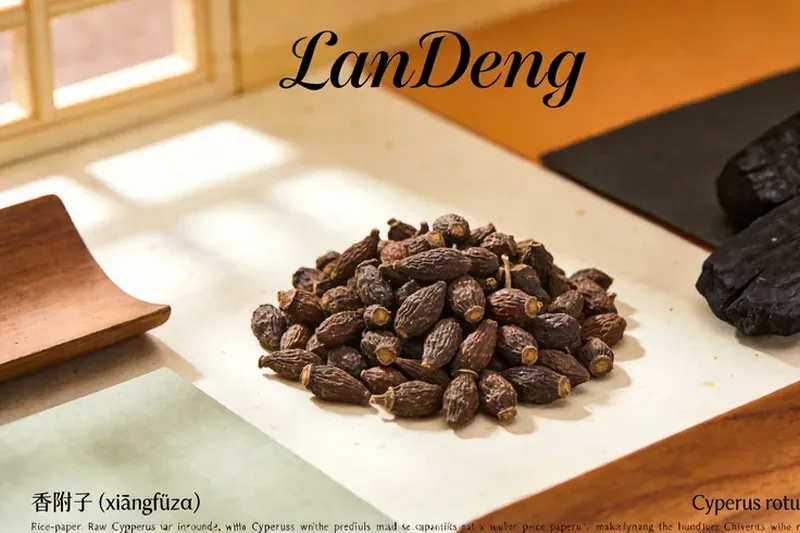
Direct answer: Cyperus (香附子, xiāngfùzǐ, “fragrant tuber”) is the aromatic tuber/rhizome of Cyperus rotundus, the purple nutsedge, one of the world’s most widespread weeds. It is a classical Chinese incense blending ingredient, and serves as a traditional substitute where the rarer spikenard (甘松) is unavailable.
Key facts
| Chinese | 香附子 (xiāngfùzǐ), also 香附 / 莎草根 / 雀头香 |
| Botanical source | Cyperus rotundus (family Cyperaceae) — the tuber/rhizome |
| What it is | An aromatic tuber, not a wood or resin |
| Aroma | Woody, spicy, earthy, slightly smoky |
| Traditional role | 合香 (blended incense), materia medica |
Aroma profile
Direct answer: 香附子 has a woody, spicy, earthy aroma with a slightly smoky, rooty undertone — a grounded, dry note rather than a sweet or floral one. It is a supporting incense material, contributing earthy body and warmth to a blend, and its character is close enough to spikenard’s earthy-sweet root note that it has served as a traditional stand-in.
香附子 has a woody, spicy, earthy aroma with a slightly smoky, rooty undertone — a grounded, dry note rather than a sweet or floral one. It is a supporting incense material, contributing earthy body and warmth to a blend. Its character is close enough to spikenard’s earthy-sweet root note that it has served as a traditional stand-in.
Botanical identity
Direct answer: Cyperus rotundus is a perennial sedge of the family Cyperaceae, with slender stolons bearing ellipsoidal tubers and culms 15–90 cm tall. Flora of China records it from near sea level to 2100 m across a vast global range. It is the “purple nutsedge,” a notorious agricultural weed whose small aromatic tubers are the incense material.
Cyperus rotundus (purple nutsedge) is a perennial sedge of the Cyperaceae family. Flora of China describes slender stolons bearing ellipsoidal tubers, solitary culms 15–90 cm tall with a swollen tuberous base, and narrow bluish-green leaf blades 2–5 mm wide, flowering and fruiting May–November. It grows from near sea level to 2100 m, in grasslands, stream margins, trail edges, and paddy-field margins. The aromatic part is the small tuber — an ordinary-looking structure on an ordinary-looking weed, but the whole source of its incense and materia-medica value. See Cyperus rotundus in Flora of China and on GBIF.
Chinese name and terminology
Direct answer: 香附子 means “fragrant fuzi tuber,” naming both its scent and the tuber’s resemblance to the aconite root (fuzi). Classical sources record several names — 香附 (the shortened form), 莎草根 (“sedge root”), and 雀头香 (“sparrow-head incense,” from the tuber’s shape). The variety of names reflects the plant’s ubiquity, not confusion about the plant.
The name 香附子 (“fragrant fuzi tuber”) reflects both its scent and the tuber’s resemblance to the fuzi (aconite) root. Classical sources record several names for it:
- 香附子 / 香附 — the standard and shortened names.
- 莎草根 — “sedge root,” from the plant Cyperus rotundus.
- 雀头香 — “sparrow-head incense,” from the tuber’s shape.
The variety of names reflects the plant’s ubiquity across regions and centuries, not any confusion about the plant itself — unlike the genuinely confusing 木香 or 藿香 names elsewhere in this encyclopedia.
A humble plant with a big role
Direct answer: Cyperus rotundus is an ordinary-looking sedge — and one of the most widespread weeds on earth — but its small, aromatic tubers made it a standard incense and materia-medica item. Its abundance is precisely what made it a practical substitute for the scarcer spikenard, an economic inversion worth understanding.
Cyperus rotundus (purple nutsedge) is an ordinary-looking sedge — and one of the most widespread weeds on earth — but its small, aromatic tubers made it a standard incense and materia-medica item. The name 香附子 (“fragrant fuzi tuber”) reflects both its scent and the tuber’s resemblance to the fuzi (aconite) root. Classical sources record several names for it, including 莎草根 (sedge root) and 雀头香 (“sparrow-head incense,” from the tuber’s shape).
Where does cyperus come from?
Direct answer: Cyperus rotundus is one of the most widely distributed plants on earth. Flora of China records it across most of China, and globally from Africa and Asia through Australia, Europe, and the Americas — near sea level to 2100 m. Its abundance is central to its role: it is a cheap, everywhere-available substitute, not a rarity.
Cyperus rotundus is one of the world’s most cosmopolitan weeds. Flora of China lists it across nearly every Chinese province and beyond, and its global range spans Africa, Asia, Australia, Europe, the Pacific islands, and the Americas. It grows from near sea level to 2100 m in grasslands, field margins, and wet or dry disturbed ground. This abundance is the economic heart of the material: cyperus is a cheap, everywhere-available tuber, which is exactly why it served as a substitute for the scarce, high-Himalayan spikenard (甘松).
Why is it used in incense?
Direct answer: Cyperus is used in incense as a classical 合香 (blended-incense) ingredient, contributing an earthy, woody body and warmth that grounds a formula. It is a blender, not a lead note, and its earthy-sweet character made it a traditional stand-in where the scarcer spikenard was unavailable.
Cyperus’s role in incense is as a classical blending ingredient. It appears in standard formulas — the Ming Xiangcheng (香乘) records it in the Han-dynasty 建宁宫中香 palace-incense formula alongside 藿香, 零陵香, 檀香, 白芷, and 甘松 — where it contributes an earthy, woody body and warmth. It is a supporting note that grounds a formula rather than leading with a bright fragrance, and its earthy-sweet character close to spikenard’s made it a practical substitute where spikenard was scarce or costly.
How is it processed?
Direct answer: Cyperus is used as the dried tuber, harvested, cleaned, and dried whole, then used as whole tubers or ground to powder for blending. No extraction step is needed for the incense tuber; it is a dried-root material, and processing is simple.
The part used is the small aromatic tuber. Processing is simple:
- Whole dried tubers — cleaned and dried, for storage and slow aromatic release.
- Powder — ground tuber for blending into sticks and cones; particle size and moisture affect how the powder packs and burns.
The grinding and forming mechanics sit within the wider how incense is made process, and the powder-handling behavior is covered in incense powder & resin.
What determines cyperus quality?
Direct answer: Quality turns on the tuber’s condition and aroma: a good cyperus tuber is small, dense, and woody-spicy-earthy when warmed, without mustiness. Because the plant is abundant and ungraded, quality means freshness and cleanliness rather than origin or density-grade — unlike the spikenard it substitutes for.
The practical quality points, in rough order:
- Tuber condition and aroma — small, dense tubers with a woody-spicy, earthy scent when warmed; musty or hollow tubers are poor.
- Cleanliness — freedom from soil, root hairs, and foreign material.
- Freshness — a dry, intact tuber beats a damp or decayed one.
Cyperus carries no standardized grading ladder — it is an abundant weed tuber, not a graded resin or wood — so quality means freshness and cleanliness rather than origin or a density grade.
Common forms
Direct answer: Cyperus is sold as whole dried tubers and as ground powder. Whole tubers suit storage and slow release; powder suits stick-making. The forms are the same tuber in different physical states.
| Form | Typical use |
|---|---|
| Whole dried tubers | Storage; slow aromatic release |
| Powder | Incense sticks and cones |
In Chinese tradition
- 合香 (blended incense): 香附子 is a classical blending ingredient. It appears in standard formulas — the Xiangcheng (香乘) records it in the Han-dynasty 建宁宫中香 palace-incense formula alongside 藿香, 零陵香, 檀香, 白芷, 甘松, and others.
- A traditional substitute for spikenard: 香附子 has been used where 甘松 (spikenard) is scarce or costly — a substitution recorded in classical and trade practice.
- Materia medica: 香附 is a major traditional-medicine herb, classically described for “regulating qi” (理气) and related uses. This is traditional materia-medica language, not modern clinical evidence.
Traditional use vs modern evidence
Direct answer: Cyperus’s aromatic role — a blending tuber and a spikenard substitute — is well documented in the classical manuals. Its medicinal uses are traditional, not established clinical fact, and this page makes no medical claims. The documented non-medical facts are its botanical identity and its long use as a common, earthy incense tuber.
- Traditional Use — 香附子 is a classical 合香 blending ingredient, contributing an earthy, woody body.
- Historical Record — the Song-dynasty Xiangpu (香譜) records 香附子 as 雀头香 / 莎草根 (卷二, citing 《本草》); the Ming Xiangcheng (香乘) records it in the Han-dynasty 建宁宫中香 palace-incense formula.
- Scientific Evidence — the tuber’s aromatic chemistry is characterized, but we present no clinical or medical efficacy claims.
The aromatic role is well documented. The medicinal uses are traditional, not established clinical fact, and we make no medical claims.
What buyers should look for
Direct answer: Buyers should check for small, dense, clean tubers with a woody-spicy, earthy scent, and understand that cyperus is an abundant, ungraded tuber — in contrast to the scarce wild spikenard it sometimes substitutes for. For powder, confirm particle size and moisture against the formula.
For an incense maker or sourcing buyer:
- Tuber condition and aroma — small, dense tubers with a woody-spicy, earthy scent; musty or hollow tubers are poor.
- Cleanliness — freedom from soil and foreign material.
- Substitution awareness — cyperus is a spikenard substitute, not spikenard; know which you are buying.
- Powder consistency — confirm particle size and moisture, and test a sample against your formula.
Our Industry View
Direct answer: Cyperus’s commercial lesson is the economic inversion behind substitution: an abundant weed tuber stands in for a scarce high-Himalayan root. That is why cyperus matters commercially — it is cheap and everywhere — and why a buyer should know explicitly whether they are paying for cyperus or for the spikenard it imitates.
From a manufacturing perspective, cyperus is instructive because its value is inversely related to its abundance. It is one of the world’s most widespread weeds, cheap and everywhere, yet it holds a named place in classical incense formulas because its earthy-sweet root note can stand in for the scarce, costly spikenard. Two points follow:
- Substitution is the material’s real function. Cyperus’s historical role is as a spikenard stand-in, and that substitution logic is economic, not botanical. A buyer who wants spikenard’s character but accepts cyperus is making a cost decision — which is legitimate, but should be a conscious one. The two are different plants with related, not identical, earthy notes.
- Abundance means consistency, not grading. Unlike a graded resin or a scarce root, cyperus has no rarity premium and no standardized ladder. The buyer’s variables are freshness and cleanliness — a steady, well-dried tuber — which makes it a forgiving, low-risk blender.
In our view, cyperus is a cheap, reliable earthy blender whose chief commercial value is as a declared substitute for spikenard — buy it for body and warmth, specify whether you want it or the real spikenard, and treat its abundance as a cost advantage rather than a prestige signal.
Summary
Cyperus (香附子) is the aromatic tuber of Cyperus rotundus, the purple nutsedge — one of the world’s most widespread weeds — whose small tubers carry a woody, spicy, earthy scent. It is a classical 合香 blending ingredient, recorded in the Han-dynasty 建宁宫中香 formula, and a traditional substitute for the scarcer spikenard (甘松). Its value rests on abundance, freshness, and correct use as a declared substitute, and its medicinal uses are traditional language, not clinical evidence.
FAQ
What is 香附子? 香附子 is the aromatic tuber of Cyperus rotundus, the purple nutsedge — an ordinary-looking sedge that is one of the world’s most widespread weeds. Its small tubers carry a woody, spicy, earthy scent and made it a standard Chinese incense blending ingredient, as well as a traditional-medicine herb. The name means “fragrant fuzi tuber,” referring to its scent and the tuber’s resemblance to aconite root.
Is 香附子 the same as spikenard? No, but it has served as a traditional substitute. 香附子 is Cyperus rotundus (a sedge); spikenard (甘松) is Nardostachys jatamansi (a Himalayan herb). Their earthy root notes are similar enough that cyperus has been used where the scarcer spikenard is unavailable or costly — a substitution recorded in classical and trade practice, not a botanical identity.
What does cyperus smell like? Cyperus tuber has a woody, spicy, earthy aroma with a slightly smoky, rooty undertone — a grounded, dry note rather than a sweet or floral one. It is a supporting incense material, contributing earthy body and warmth to a blend, and its character is close enough to spikenard’s earthy-sweet note that it has worked as a stand-in.
What are the other names for 香附子? Classical sources record several names, including 香附 (the shortened form), 莎草根 (“sedge root,” from the plant Cyperus rotundus), and 雀头香 (“sparrow-head incense,” from the tuber’s shape). The variety of names reflects the plant’s ubiquity and its long use across regions, rather than any confusion about the plant itself.
How is cyperus used in incense? Cyperus is a classical 合香 (blended-incense) ingredient. The Ming-dynasty Xiangcheng (香乘) records it in the Han-dynasty 建宁宫中香 palace-incense formula alongside 藿香, 零陵香, 檀香, 白芷, and 甘松. It contributes an earthy, woody body and warmth — a supporting note that grounds a formula rather than leading with a bright fragrance.
Why is cyperus so common? Because Cyperus rotundus (purple nutsedge) is one of the world’s most widespread weeds, growing from near sea level to 2100 m across Africa, Asia, Australia, Europe, and the Americas. That abundance is exactly what made it a cheap, practical incense tuber and a substitute for the scarce high-Himalayan spikenard — its value is tied to how common it is.
See also: vetiver, calamus, spikenard-nardostachys, and the full scent guide.
Evidence & Sources
Botanical identity
Source: Cyperus rotundus in Flora of China · Cyperus rotundus on GBIF. Evidence type: Established.
Traditional Chinese use
Source: the Song-dynasty Xiangpu (香譜) records 香附子 as 雀头香 / 莎草根 (卷二, citing 《本草》); the Ming Xiangcheng (香乘) records it in the Han-dynasty 建宁宫中香 palace-incense formula. Evidence type: Historically documented — traditional, not modern clinical evidence.
Authenticity / disambiguation
Source: the 香附子 (Cyperus rotundus) vs 甘松 (Nardostachys jatamansi) substitution note. Evidence type: Practical screening.
Safety
Source: incense combustion produces smoke and particulate matter; burn in a well-ventilated space. Evidence type: Established.
Evidence status
| Layer | Status |
|---|---|
| Botanical identity | Established |
| Traditional use | Historically documented |
| Authenticity test | Practical screening |
| Health claims | Not established |
Sources
Sources: botanical references on Cyperus rotundus and the Song-dynasty Xiangpu (香譜) / Ming Xiangcheng (香乘) records of 香附子 (雀头香 / 莎草根). The 香附子 / 甘松 substitution note is recorded as classical and trade practice. Medicinal uses are treated as traditional, not established clinical fact. This is editorial knowledge content, not medical advice.