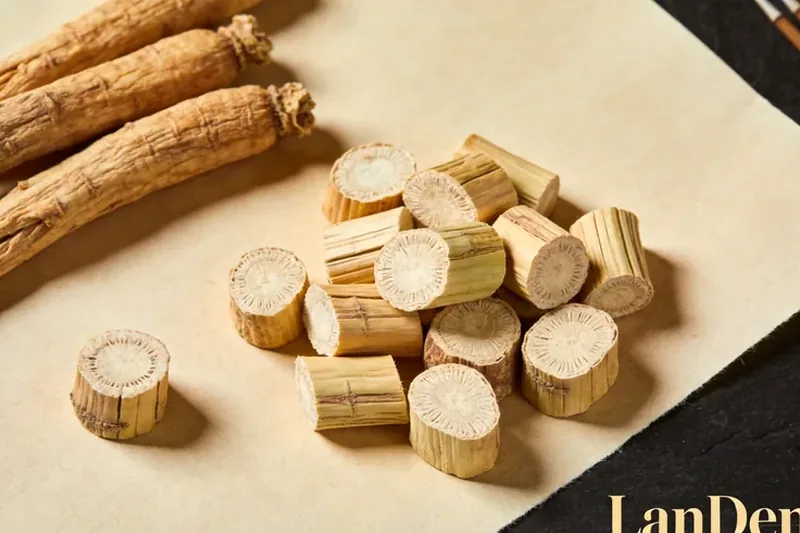
Definition: Calamus — chāngpú (菖蒲) in Chinese — is the aromatic rhizome of Acorus calamus (sweet flag), with a warm, spicy, slightly sweet, earthy scent. It is a traditional aromatic herb, but it carries an important safety caveat: the essential oil of many calamus varieties contains β-asarone, which is restricted in food use in several jurisdictions.
Key facts
| Chinese | 菖蒲 (chāngpú) |
| Botanical source | Acorus calamus (Acoraceae) — the rhizome |
| What it is | A dried aromatic rhizome (underground stem) |
| Aroma | Herbal, spicy, sweet, earthy |
| Traditional role | Incense, traditional herb, insect-repellent folklore |
Aroma profile
Direct answer: Calamus has a warm, spicy, slightly sweet, earthy aroma with a subtle bittersweet undertone — a “rooty” herbal note closer to a spice than to a flower, and usually a supporting character in blends rather than a solo scent.
Calamus has a warm, spicy, slightly sweet, earthy aroma with a subtle bittersweet undertone. It is a “rooty” herbal note — closer to a spice than a flower — and it is usually a supporting character in blends rather than a solo scent. Where orris root reads sweet and powdery and angelica reads green and musky, calamus reads dry, warm, and grounding — a note that adds body to the lower register of a formula rather than lifting its top.
Botanical identity
Direct answer: Calamus is the rhizome of Acorus calamus, a perennial, rhizomatous herb in the family Acoraceae (long placed in Araceae), recorded by Flora of China with ensiform leaves up to 150 cm long. It is a root material — the aromatic part is the underground rhizome, not a wood or resin.
Acorus calamus is a perennial, rhizomatous herb. Flora of China records its leaves as ensiform (sword-shaped), (60–)70–100(–150) cm long and mostly 1–1.5 cm wide. The genus Acorus is a small, taxonomically tangled one: it was long classified within the arum family (Araceae) but is now placed in its own family, Acoraceae, and the name Acorus calamus has accumulated many synonyms and named forms. The aromatic part is the rhizome, the underground stem. See Acorus in Flora of China and Acorus calamus on GBIF.
Chinese name and terminology
Direct answer: 菖蒲 (chāngpú) is the standard Chinese name, and “sweet flag” is the usual English name — the same plant. The name covers a genus of closely related rhizomatous herbs, and a buyer’s first job is to confirm the Acorus species and variety, since the safety-relevant chemistry (β-asarone) differs among them.
The name 菖蒲 is specific enough in everyday use, but the genus is more complicated than the single name suggests:
- 菖蒲 (chāngpú) — Acorus calamus, sweet flag, the aromatic rhizome this page describes.
- “Sweet flag” — the standard English name for the same plant; there is no difference between “calamus” and “sweet flag.”
Because the Acorus genus has many named forms and the β-asarone content varies by variety (see the safety caveat below), the practical question is less “calamus or sweet flag” than “which Acorus variety, and what is its β-asarone level.”
The safety caveat (read this)
This is the one ingredient where the honest guidance goes beyond “ventilate”:
- β-asarone — calamus essential oil can contain high levels of β-asarone, which is carcinogenic in rodent studies.
- Food restrictions — the US FDA banned calamus in food in 1968; the European Commission set strict limits on β-asarone in foods and beverages.
- Variety matters — diploid Acorus calamus varieties are reported to contain little or no β-asarone, while other varieties (notably tetraploid) are high in it.
The key point: this restriction is about ingestion (food and internal use), not about the well-understood smoke exposure that applies to all incense. We make no claim that burning calamus incense is harmless, and no medical claims of any kind.
Where does calamus come from?
Direct answer: Acorus calamus is a widespread wetland and waterside perennial found across Asia, Europe, and North America, growing in or beside slow water. It is a common wild and cultivated herb rather than a plantation crop.
Acorus calamus is a semi-aquatic perennial of marshes, pond margins, and slow streams, with a broad natural and introduced range across temperate Asia, Europe, and North America. The rhizome is harvested and dried. Unlike the tropical woods and resins of the incense trade, calamus is a temperate wetland herb whose supply follows the patterns of wild collection and small-scale cultivation rather than a dedicated aromatic industry.
Why is it used in incense?
Direct answer: Calamus is one of the classical aromatic roots of Chinese 合香, where it adds a spicy-herbal body to the lower register of a blend. It is a supporting root, not a lead material — and it is also tied to seasonal use, hung alongside mugwort at the Dragon Boat Festival.
Calamus serves two distinct roles in Chinese tradition:
- Incense (香): calamus is one of the classical aromatic roots of Chinese 合香, adding a spicy-herbal body that complements other roots and herbs.
- Seasonal use: 菖蒲 is traditionally hung or used around the Dragon Boat Festival (端午节), often alongside mugwort (艾草).
That seasonal pairing with mugwort is worth knowing: the two are linked as a traditional herbal combination, not as a botanical relationship — calamus is Acorus, mugwort is Artemisia, and they meet in festival practice rather than in taxonomy. See mugwort.
How is it processed?
Direct answer: Calamus is processed by harvesting the rhizome, cleaning it, and drying it — whole, sliced, or ground to powder. The drying method and the resulting moisture and particle size depend on the producer and the intended use, so no single specification applies across the trade.
The essential step is simple: the rhizome is dug, cleaned, and dried to a stable, storable form. From there it branches by end use — whole or sliced rhizome for traditional use, or ground powder for blending into incense. For powder buyers, the same practical variables as any root powder apply: particle size and moisture affect how the material packs, burns, and releases aroma, and the right target depends on the formula — the binder, the other ingredients, and the production line (see Our Industry View below). The drying and grinding mechanics sit within the wider how incense is made process.
What determines calamus quality?
Direct answer: Quality turns on the variety (which determines the β-asarone-relevant chemistry), the cleanliness and dryness of the rhizome, and the strength of the characteristic warm, spicy aroma. There is no standardized numerical grading system; the buyer evaluates the physical condition of the lot.
The practical quality factors, in rough order:
- Variety — which Acorus form, since β-asarone content differs among them (a food-use concern; see the safety caveat).
- Cleanliness — freedom from soil, foreign roots, and mold.
- Dryness and storage — a properly dried rhizome keeps its warm, spicy aroma rather than turning musty.
- Aroma — a clean, warm, spicy-earthy scent, not stale or faded.
- For powder — consistent particle size and moisture, judged against the specific formula.
Common forms
Direct answer: Calamus is sold as whole dried rhizomes, cut slices, and ground powder. Whole rhizomes and slices serve traditional use and inspection; powder serves incense blending — the same material in different physical forms, not a quality distinction.
| Form | Typical use |
|---|---|
| Whole dried rhizome | Traditional use, display |
| Cut slices | Inspection, traditional use |
| Powder | Blended into incense sticks and cones |
The distinction is functional, not a quality statement. See incense powder & resin for how root powder behaves in practice.
In Chinese tradition
- Incense (香): calamus is one of the classical aromatic roots of Chinese 合香, adding a spicy-herbal body. Historical Record — documented as a classical aromatic root.
- Seasonal use: 菖蒲 is traditionally hung or used around the Dragon Boat Festival (端午节), often alongside mugwort (艾草). Historical Record — documented festival practice.
- Traditional herb: calamus has a long history in Asian and Ayurvedic traditions. Traditional Use — traditional materia-medica and folk language, not modern clinical evidence.
Traditional use vs modern evidence
Calamus appears in traditional medical systems across Asia, but its uses are traditional, not established clinical fact. The one well-documented point is the β-asarone safety concern, which is a matter of toxicology, not a health benefit. We make no medical claims.
Calamus vs related aromatics
Direct answer: Calamus is often confused with orris root because both are aromatic rhizomes — but they are unrelated plants with different aromas. Calamus (Acorus calamus, Acoraceae) is spicy and earthy; orris root (Iris, Iridaceae) is sweet, powdery, and violet-like.
| Rhizome | Plant | Aroma |
|---|---|---|
| Calamus (菖蒲) | Acorus calamus, Acoraceae | Spicy, earthy, warm |
| Orris root | Iris spp., Iridaceae | Sweet, powdery, violet-like |
The two are sometimes confused because both are aromatic rhizomes, but botanically and olfactorily they are distinct. See orris-root and the substitution cross-reference for the general screening logic.
Adulteration & misidentification
Direct answer: Calamus is not a heavily faked aromatic in the way agarwood is; its risk is twofold — confusion with other aromatic rhizomes (such as orris root), and the variety-dependent β-asarone chemistry that matters for any food-adjacent use. The botanical name and variety on the label resolve both.
Calamus is not an expensive, heavily faked material. Its risks are a naming and identification matter (confusion with other aromatic rhizomes) and a chemistry matter (β-asarone content by variety). Neither is resolved by the word “calamus” alone; the species and variety name carry the answer.
Modern commercial applications
Direct answer: Calamus reaches the market mainly as a traditional herb and a fragrance raw material, with a small role in herbal-incense blends. Because of the β-asarone restriction, its food and internal use is limited in several jurisdictions, which shapes where it can legally be sold.
Calamus’ commercial life is split by the safety caveat. As an incense and fragrance material, the rhizome and its essential oil add a spicy-herbal body; as a food or internal ingredient, it is restricted in the US (FDA 1968 ban) and limited by European Commission β-asarone limits. For a sourcing buyer, this split matters because a calamus product’s allowable end use depends on its β-asarone content and the target market’s regulation — a vendor should be able to state the variety and its intended use rather than offering an unqualified “calamus.”
What buyers should look for
Direct answer: Buyers should confirm the Acorus species and variety (for the β-asarone chemistry), the form, and the physical condition — clean, dry, warm-spicy rhizome with no mold or foreign matter. For powder, test particle size and moisture against the formula.
For an incense maker or sourcing buyer:
- Species and variety — confirm which Acorus form; a real seller can state it and address β-asarone content.
- End use — incense and fragrance differ legally from food and internal use; confirm the material is fit for your application and market.
- Form — whole rhizome, slices, or powder; each behaves differently in a blend.
- Physical condition — clean, dry, warm-spicy rhizome with no mold or debris.
- Powder consistency — confirm particle size and moisture, and test a sample against your formula.
Safety
Like all burning plant material, calamus smoke contains particulate matter — burn in a well-ventilated space and avoid inhaling concentrated smoke. Beyond that, note the β-asarone ingestion concern above. This is editorial knowledge content, not medical advice.
Our Industry View
Direct answer: In manufacturing, calamus is a supporting root, not a base. Its value is a warm, spicy-earthy body in the lower register — but its β-asarone chemistry makes the variety and the end use a compliance question first and a fragrance question second.
From a manufacturing perspective, calamus’ defining traits are body and caution. It supplies a warm, spicy-earthy grounding that lighter herbs and florals cannot, but its β-asarone chemistry means it is the one incense root where the variety is a compliance variable, not merely a grade label.
Two points follow:
- It is a supporting root, not a base. Calamus adds body to the lower register but will not carry a formula the way sandalwood or agarwood can. Its role is to deepen and warm a blend; a buyer who expects it to anchor a fragrance will be disappointed, while one who doses it as a spice-root accent gets real value.
- Variety is a compliance question. Because β-asarone content varies by ploidy, a manufacturer’s first question about a calamus lot is which variety and what chemistry, then the fragrance questions of particle size and moisture — which themselves depend on formulation, so a figure that works in one factory does not transfer to another.
In our view, the commercial sweet spot is a correctly identified, documented-variety calamus rhizome used as a measured spicy-herbal body note — a material whose real cost is not the price per kilo but the diligence required to use it safely and within regulation.
Summary
Calamus (菖蒲) is the dried rhizome of Acorus calamus (sweet flag), an Acoraceae perennial whose ensiform leaves are recorded by Flora of China at up to 150 cm long, valued in Chinese tradition as a classical aromatic root of 合香 and as a Dragon Boat Festival herb hung with mugwort. Its defining caveat is β-asarone — restricted in food in the US and limited in the EU, with content varying by variety. Its main identification risk is confusion with orris root, another aromatic rhizome. In incense it is a warm, spicy-herbal supporting note, not a base; commercially, variety documentation and end-use compliance outweigh the variety name.
FAQ
Is calamus safe? The answer depends on how it is used. For ingestion, calamus is restricted in several jurisdictions because its essential oil can contain β-asarone, which is carcinogenic in rodent studies — the US FDA banned calamus in food in 1968, and the European Commission set limits on β-asarone. For incense, the relevant caution is the same as for any burning plant material: the smoke contains particulate matter, so burn in a well-ventilated space and avoid inhaling concentrated smoke. We make no claim that calamus incense is safe or unsafe beyond this.
What is the difference between calamus and sweet flag? There is no difference — they are the same plant. Acorus calamus is commonly called “sweet flag” in English, and calamus (菖蒲, chāngpú) is the Chinese name. The aromatic part is the rhizome, the underground stem, which has a warm, spicy, slightly sweet, earthy scent. The name varies by language and tradition, but the plant is the same, and the rhizome is the part used in incense and traditional practice.
What does calamus smell like? Calamus has a warm, spicy, slightly sweet, earthy aroma with a subtle bittersweet undertone. It is a “rooty” herbal note, closer to a spice than to a flower, and it usually acts as a supporting character in blends rather than a solo scent. The rhizome’s dry, earthy warmth adds body to Chinese 合香 formulas, complementing other aromatic roots and herbs. Because the scent is not sweet or floral, calamus reads as a grounding, herbal element rather than a bright top note.
Is calamus the same as orris root? No. Calamus is the rhizome of Acorus calamus, in the family Acoraceae, while orris root is the rhizome of the iris (Iris species, family Iridaceae). They are unrelated plants with different aromas and uses. Orris root has a sweet, powdery, violet-like scent prized in perfumery, whereas calamus is spicy, earthy, and herbal. The two are sometimes confused because both are aromatic rhizomes, but botanically and olfactorily they are distinct.
Why is calamus restricted in food? Calamus is restricted in food because its essential oil can contain β-asarone, a compound that is carcinogenic in rodent studies. The US FDA banned calamus in food in 1968, and the European Commission established strict limits on β-asarone in foods and beverages. The level of β-asarone varies by variety: diploid Acorus calamus is reported to contain little or none, while other varieties, notably tetraploid, are high in it. This restriction concerns ingestion and internal use, not the smoke exposure that applies to all incense.
What family does calamus belong to? Calamus belongs to the family Acoraceae. The genus Acorus was long classified within the arum family (Araceae), but it is now placed in its own family, Acoraceae — a small, taxonomically tangled group in which Acorus calamus has accumulated many synonyms and named forms. The aromatic part is the rhizome, and Flora of China records the ensiform leaves at up to 150 cm long.
See also: angelica, mugwort, orris-root, cyperus and the full scent guide.
Evidence & Sources
Botanical identity
Source: Acorus in Flora of China · Acorus calamus on GBIF. Evidence type: Established.
Traditional Chinese use
Source: this page records calamus (菖蒲) as a classical aromatic root of 合香 and a Dragon Boat Festival (端午节) herb. Evidence type: Historically documented — traditional materia-medica language, not modern clinical evidence.
Safety
Source: like all burning plant material, calamus smoke contains particulate matter; its essential oil can contain β-asarone (FDA 1968 food ban; European Commission limits) — an ingestion concern. Evidence type: Established.
Evidence status
| Layer | Status |
|---|---|
| Botanical identity | Established |
| Traditional use | Historically documented |
| Health claims | Not established |
Sources
Sources: botanical and toxicological references on Acorus calamus and β-asarone (FDA 1968 ban; European Commission limits; diploid-vs-tetraploid variety distinction). Medicinal uses are treated as traditional, not established clinical fact. This is editorial knowledge content, not medical advice.