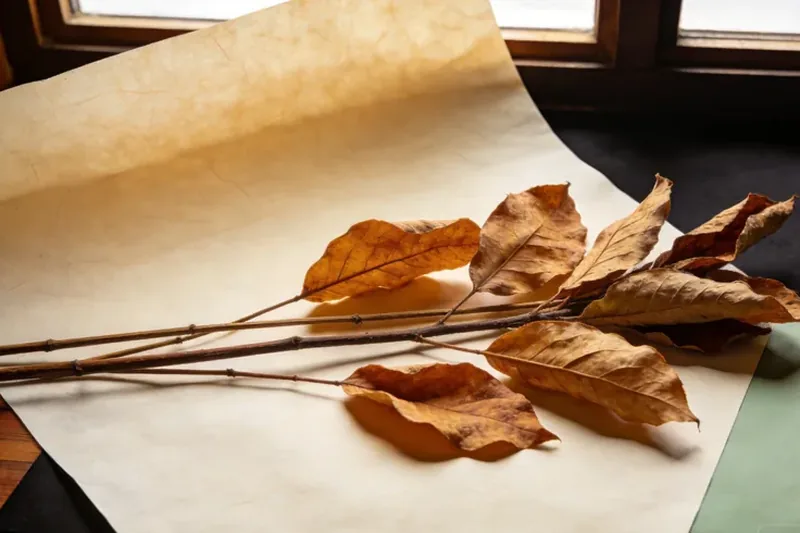
Technical answer: Mugwort — aicǎo (艾草) in Chinese — is a herb in the Artemisia genus with a distinctive herbal, bitter-green, slightly camphoraceous aroma. It is one of the most versatile herbs in Chinese tradition, used fresh or dried, for incense, purification, and (in a separate medical context) moxibustion. It is one of several Artemisia herbs on this site and must be distinguished from its close relatives 青蒿 (sweet wormwood) and 龙蒿 (tarragon).
Key facts
| Chinese | 艾草 (àicǎo), also 艾 (ài), 艾叶 (àiyè) |
| Botanical source | Artemisia species (e.g. A. argyi, A. vulgaris) |
| What it is | A dried aromatic herb (not a wood or resin) |
| Aroma | Herbal, bitter-green, slightly camphoraceous |
| Traditional role | Purification, warding insects/“negative energy”, festival use |
Aroma profile
Direct answer: Mugwort has a herbaceous, bitter-green aroma with a camphoraceous edge — quite different from sweet woods like agarwood or sandalwood. It is valued in Chinese tradition less for sweetness than for its association with cleansing and protection.
Mugwort’s aroma is herbaceous and slightly bitter-green, with a camphoraceous edge — quite different from the sweet woods (agarwood, sandalwood). It is valued in Chinese tradition less for sweetness than for its association with cleansing and protection.
Botanical identity
Direct answer: Mugwort is a herb in the Artemisia genus, family Asteraceae. Chinese mugwort is Artemisia argyi; common mugwort is Artemisia vulgaris. They are distinct species within a large genus of aromatic, bitter-green herbs.
Artemisia is a large genus in the daisy family (Asteraceae), containing many aromatic, bitter-green herbs. The two species most often meant by “mugwort” are Artemisia argyi (Chinese mugwort, 艾草) and Artemisia vulgaris (common mugwort). The genus also supplies other distinct herbs — sweet wormwood (A. annua, 青蒿) and tarragon (A. dracunculus, 龙蒿) — which share a green-herbal family character but are different species. See Artemisia argyi in Flora of China.
Chinese name and terminology
Direct answer: The names 艾草 and 艾 (ài) mean mugwort, and 艾叶 (àiyè) is “mugwort leaf.” The name overlaps with related Artemisia herbs — 青蒿 (sweet wormwood) and 龙蒿 (tarragon) — so a label that says only “艾” should be checked against species.
- 艾草 / 艾 (àicǎo / ài) — mugwort in general; the herb of purification and moxibustion.
- 艾叶 (àiyè) — “mugwort leaf,” the specific part most often used.
- Moxa (艾绒) — the dried, processed floss used in moxibustion, a separate medical application of the same herb.
Because Artemisia contains several herbs, a label that names only “艾” without a species is underspecified. See sweet wormwood (青蒿) and tarragon (龙蒿).
Where does mugwort come from?
Direct answer: Mugwort is a widespread herb; Chinese mugwort (Artemisia argyi) is native to China and East Asia, where it grows abundantly and is collected fresh or dried. It is a common, fast-growing plant, not a rare or wild-harvested material.
Artemisia argyi is native to China and East Asia, and mugwort species grow widely across the northern temperate zone. Because it is an abundant, fast-growing herb that is easy to collect and dry, mugwort is a common, economical material — quite unlike rare woods or resins. Its everyday availability is part of why it has been used so widely, from seasonal hanging to incense.
Why is mugwort used in incense?
Direct answer: Mugwort is used in incense for its cleansing, protective association and its bitter-green, slightly camphoraceous aroma. It is usually a supporting note in 合香, adding an earthy, cleansing edge to wood-and-resin blends, and it is also burned as a single herb for purification and seasonal use.
In Chinese incense, mugwort’s role follows its cultural meaning as much as its scent: it is associated with clearing a space and warding off insects and — in folk tradition — negative influence. Because its aroma is herbal rather than sweet, it is more often a supporting note in 合香 (blended incense) than a solo fragrance, adding an earthy, cleansing edge to wood-and-resin blends. It is also burned as a single herb for purification and seasonal use (端午节). See the scent guide for where herbal notes sit in a blend.
How is mugwort processed?
Direct answer: Mugwort is used fresh or, more often, dried — the leaves are cut and air-dried for incense and seasonal use. For moxibustion (a separate medical practice), the dried leaf is further processed into a soft floss (moxa/艾绒).
The basic processing is simple:
- Harvest and dry — the aerial herb or leaves are cut and air-dried; dried leaf is what is burned or hung.
- Bundle or grind — dried leaf is tied in bundles (for hanging) or ground for incense blending.
- Moxa (separate) — for moxibustion, the dried leaf is processed into a soft floss (艾绒); this is a medical application, not incense.
The drying and bundling steps are the extent of it for incense use; mugwort is not distilled into a widely traded essential oil in the way patchouli or vetiver are.
What determines mugwort quality?
Direct answer: Quality rests on leaf maturity, cleanliness, and drying — mature, well-dried leaf with a clean, bitter-green aroma grades higher than stale, musty, or over-dried material. Species (argyi vs vulgaris) is a separate identity point, not a grade.
The main quality factors:
- Leaf maturity and aroma — mature leaf with a clean, herbal, bitter-green scent.
- Drying — properly dried without mustiness or mold.
- Cleanliness — freedom from stems, soil, and contamination.
- Species — A. argyi (Chinese mugwort) vs A. vulgaris (common mugwort); a naming point, not a grade.
These are trade distinctions, not a single standardized grading system.
Common forms
Direct answer: Mugwort is sold as dried leaf, tied bundles, and ground powder. Dried leaf and bundles suit seasonal hanging and single-herb burning; powder suits blending into incense.
| Form | Typical use |
|---|---|
| Dried leaf | Burned or hung for purification |
| Tied bundles | Dragon Boat Festival (端午节) hanging |
| Ground powder | Blended into 合香 (incense compounds) |
Moxa floss (艾绒) is a further-processed form used in moxibustion — a medical application kept separate from incense use on this page. See incense powder & resin.
The Artemisia trio (mugwort vs its relatives)
Direct answer: Mugwort (Artemisia argyi / A. vulgaris) is one of three Artemisia herbs on this site. Sweet wormwood (A. annua, 青蒿) is camphoraceous and a materia-medica herb; tarragon (A. dracunculus, 龙蒿) is anise-like and a modern culinary/fragrance herb. Mugwort is the bitter-green herb of purification and moxibustion.
| Mugwort (艾草) | Sweet wormwood (青蒿) | Tarragon (龙蒿) | |
|---|---|---|---|
| Species | A. argyi / A. vulgaris | A. annua | A. dracunculus |
| Aroma | Bitter-green, camphoraceous | Camphoraceous, fresh | Anise-like, green |
| Role | Purification, moxibustion, incense | Materia-medica herb | Modern culinary/fragrance |
The three share a green-herbal family character but are different species with different aromas and roles. See sweet wormwood (青蒿) and tarragon (龙蒿).
Mugwort vs moxibustion (a distinction to keep clear)
Direct answer: Mugwort is the material for moxibustion (灸), a traditional Chinese medicine therapy that burns dried mugwort (“moxa”) on or near the body — a medical practice whose claimed benefits are not well-supported by modern evidence. This is a different domain from burning mugwort as household incense.
Mugwort is also the material for moxibustion (灸, jiǔ) — a traditional Chinese medicine therapy that burns dried mugwort (“moxa”) on or near the body.
Important: moxibustion is a medical practice whose claimed benefits are not well-supported by modern evidence (and it carries risk). This is a different domain from burning mugwort as household incense. We describe mugwort’s cultural and incense use; we do not make medical claims about moxibustion or mugwort.
Traditional use vs modern evidence
Direct answer: Mugwort’s roles — purification, insect-warding, and Dragon Boat Festival use — are documented cultural practice, not medical claims. The herb’s medicinal and moxibustion uses are traditional; their claimed benefits are not established by modern evidence.
- Traditional Use — mugwort is burned or hung to clear a space and ward off insects and, in folk tradition, negative influence.
- Historical Record — hanging mugwort at Dragon Boat Festival (端午节) is a well-documented seasonal practice around the fifth lunar month.
- Scientific Evidence — the claimed benefits of moxibustion and medicinal mugwort use are not well-supported by modern evidence.
We make no medical claims about mugwort or moxibustion.
Sustainability & sourcing
Direct answer: Mugwort is an abundant, fast-growing herb, easily collected and dried, so it carries no conservation or legal concern. Sourcing should simply confirm the species (argyi vs vulgaris) and the form.
Because mugwort is a common, fast-growing herb rather than a wild-harvested wood or resin, there is no meaningful sustainability risk. For a buyer, the practical questions are commercial: which species (A. argyi vs A. vulgaris), which form (dried leaf, bundle, or powder), and cleanliness. See the wholesale guide.
Modern commercial applications
Direct answer: Mugwort goes into incense and herbal blends, seasonal and traditional goods, and — separately — moxa for moxibustion. The incense use is aromatic; the moxa use is a medical practice this page does not evaluate.
- Incense — dried leaf and powder blended into 合香 or burned as a single herb.
- Seasonal and traditional goods — tied bundles for Dragon Boat Festival and sachets.
- Moxa (separate) — the processed floss for moxibustion, a medical application kept distinct from incense use.
What buyers should look for
Direct answer: Buyers should confirm the species (Chinese mugwort A. argyi vs common mugwort A. vulgaris), check for clean, well-dried leaf, and specify the form. Because “mugwort” can mean several Artemisia herbs, the species is the first thing to pin down.
For an incense maker or sourcing buyer:
- Species — Artemisia argyi (Chinese mugwort) vs Artemisia vulgaris (common mugwort); a real seller names which.
- Drying and cleanliness — mature, well-dried leaf without mustiness or mold.
- Form — dried leaf, bundle, or powder; each suits a different use.
- Aroma — a clean, herbal, bitter-green scent.
Safety
Like all burning plant material, mugwort smoke contains particulate matter. Burn in a well-ventilated space and avoid inhaling concentrated smoke. Keep away from children and pets.
Our Industry View
Direct answer: From a manufacturing perspective, mugwort is a strong, economical herbal accent whose value is its cleansing, bitter-green character — not a lead fragrance. The key variables are species and dosing, because a strong herbal note is easy to overuse.
Mugwort’s manufacturing role is a supporting herbal accent with a strong, recognizable character. Two points follow:
- Species changes the scent, not just the name. A. argyi, A. vulgaris, and the other Artemisia herbs read differently in the same blend, so a formula built on one will not smell the same if the source switches silently.
- Dosing is the constraint. Mugwort’s bitter-green, camphoraceous note is potent and easy to overuse; the useful range is a small proportion in a compound. The right amount depends on formulation — what it is meant to cleanse or accent — so no single figure transfers between recipes.
In our view, the commercial sweet spot is a named species in a consistent, well-dried form, used as a controlled accent rather than a lead note.
Summary
Mugwort (艾草) is a bitter-green, camphoraceous herb in the Artemisia genus, most often Artemisia argyi or A. vulgaris. It is valued in Chinese tradition for cleansing and protection, burned or hung at Dragon Boat Festival and used as a supporting note in 合香. It must be distinguished from its Artemisia relatives — sweet wormwood (青蒿) and tarragon (龙蒿) — and from moxibustion, the separate medical practice that burns the same herb. Its value rests on species and disciplined dosing; medicinal claims are traditional, not established by modern evidence.
FAQ
Is mugwort incense the same as moxibustion? No. Moxibustion is a traditional Chinese medicine therapy that burns dried mugwort, called moxa, on or near the body, and its claimed benefits are not well-supported by modern evidence. Mugwort as incense is household burning for fragrance, purification, and seasonal use — a completely different domain. The same herb appears in both, but the purpose, method, and risk profile are unrelated: moxibustion is a medical practice that carries real risk, while incense burning is a cultural and aromatic activity. This site describes mugwort’s cultural and incense use only and makes no medical claims about moxibustion or the herb itself.
What does mugwort smell like? Mugwort has a herbaceous, bitter-green aroma with a camphoraceous edge, quite different from the sweet woods like agarwood or sandalwood. It reads as green, earthy, and slightly medicinal rather than sweet or floral. In Chinese tradition this character is valued less for sweetness than for its association with cleansing and protection — mugwort is burned or hung to clear a space and, in folk tradition, to ward off insects and negative influence. Because the scent is herbal rather than sweet, mugwort is more often used as a supporting note in blended incense (合香) than burned alone for fragrance, and its edge adds an earthy, cleansing quality to wood-and-resin blends.
What is mugwort used for at Dragon Boat Festival (端午节)? Hanging mugwort around the home is a well-known seasonal practice around the fifth lunar month, tied to the Dragon Boat Festival (端午节). The herb is bundled and hung at doors or windows, a custom associated with warding off insects and — in folk tradition — negative influence, taking advantage of mugwort’s strong, pungent aroma. This is a cultural and seasonal practice, not a medical treatment. The same herb also appears in incense, where it is burned for purification, and in moxibustion, a separate traditional-medicine practice. The festival association is one of mugwort’s most visible roles in Chinese tradition, recurring every year at the start of summer.
What is the difference between mugwort and wormwood? They are close relatives in the Artemisia genus, and both names describe aromatic, bitter-green herbs, which is where much of the confusion comes from. Mugwort most often refers to Artemisia argyi (Chinese mugwort) or Artemisia vulgaris (common mugwort), while wormwood usually means Artemisia absinthium, the bitter herb historically used to flavor absinthe. They share a bitter-herbal family character and some overlap in traditional use, but they are distinct species with different aromas, habitats, and cultural roles. When a label says only “mugwort” or “wormwood” without a species, the plant is underspecified.
What is the difference between mugwort and sweet wormwood (青蒿)? They are distinct species in the same Artemisia genus. Mugwort is Artemisia argyi (and A. vulgaris), the bitter-green herb of purification and moxibustion; sweet wormwood is Artemisia annua, a camphoraceous, fresher herb recorded in classical materia medica. They share a green-herbal family character but have different aromas, habitats, and roles. See the sweet wormwood (青蒿) page.
Is mugwort safe to burn? Like all burning plant material, mugwort produces smoke and particulate matter when burned, so it should be treated with the same care as any incense. Burn it in a well-ventilated space, avoid inhaling concentrated smoke, and keep it away from children and pets. The smoke can irritate the eyes and airways, especially in poorly ventilated rooms or for anyone sensitive to airborne particles. This is general incense-safety guidance, not a claim about any specific hazard of mugwort. Mugwort is not the same as moxibustion, a separate medical practice that burns the herb near the body and carries its own risks.
See also: sweet wormwood (青蒿), tarragon (龙蒿), what Chinese incense is, rue and the full scent guide.
Evidence & Sources
Botanical identity
Source: Artemisia in Flora of China · Artemisia on GBIF. Evidence type: Established.
Traditional Chinese use
Source: this page records mugwort (艾草) for purification, insect-warding, and Dragon Boat Festival (端午节) use, distinct from moxibustion. Evidence type: Historically documented — traditional use, not modern clinical evidence.
Authenticity / adulteration
Source: the mugwort (Artemisia argyi / A. vulgaris) vs wormwood (A. absinthium) species disambiguation. Evidence type: Practical screening.
Safety
Source: like all burning plant material, mugwort smoke contains particulate matter; burn in a well-ventilated space. Evidence type: Established.
Evidence status
| Layer | Status |
|---|---|
| Botanical identity | Established |
| Traditional use | Historically documented |
| Authenticity test | Practical screening |
| Health claims | Not established |
Sources
Sources: botanical references on Artemisia and cultural accounts of mugwort’s traditional role. Moxibustion’s medical claims are treated as not established by modern evidence. This is editorial knowledge content, not medical advice.