Direct answer: Tarragon (龙蒿, lónghāo) is the herb Artemisia dracunculus, a perennial member of the Artemisia (mugwort) genus, family Asteraceae. Its leaves carry a fresh, herbal, anise-like, slightly sweet scent, familiar from French cooking and, more recently, modern fragrance. It is a modern culinary and fragrance crossover, not a classical Chinese incense ingredient, distinct from mugwort (艾草) and sweet wormwood (青蒿).
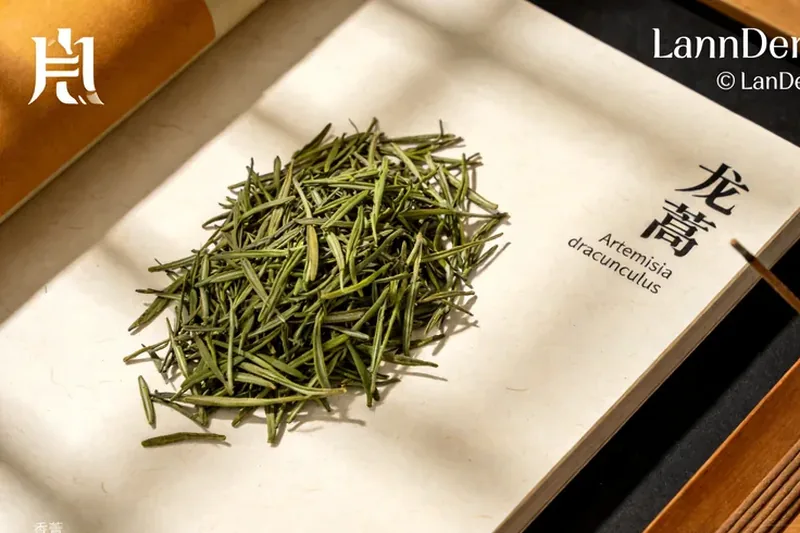
Key facts
| Chinese | 龙蒿 (lónghāo); French tarragon |
| Botanical source | Artemisia dracunculus (family Asteraceae) — the aerial herb |
| What it is | A perennial Artemisia herb, distinct from mugwort and sweet wormwood |
| Aroma | Herbal, anise-like, green, slightly sweet |
| Traditional role | None in classical Chinese incense; modern culinary/herbal |
Aroma profile
Direct answer: Tarragon is fresh, green, and herbaceous with a distinctive anise-like (licorice) sweetness over a faint bitter-green Artemisia base. Its defining aroma compound is estragole, which is why it reads as sweet-anise rather than camphoraceous or bitter — a character that separates it sharply from its mugwort and sweet-wormwood relatives.
龙蒿 (tarragon) has a fresh, green, herbaceous scent with a distinctive anise-like sweetness — the licorice-tarragon character of the culinary herb — over a faint bitter-green Artemisia base. It is lighter and sweeter than mugwort (艾草), and more anise-sweet than the camphoraceous 青蒿. The anise character comes chiefly from the compound estragole (methyl chavicol), which dominates the essential oil of the aromatic French form. This chemistry is what makes tarragon read as a sweet culinary herb rather than a medicinal or bitter aromatic, and it is the first thing a buyer should taste-test against, since the two cultivated forms differ sharply on exactly this point.
A provenance note (read this)
Direct answer: Tarragon is a modern culinary and fragrance crossover, not a classical Chinese 香材. The plant is a widely distributed northern-temperate Artemisia, but “tarragon” as a named culinary herb is a European tradition, and its fragrance use is modern. The classical Chinese canon used other Artemisia species — chiefly mugwort and sweet wormwood — not tarragon.
龙蒿 (tarragon) is a modern culinary and fragrance crossover, not a classical Chinese 香材:
- Artemisia dracunculus is a widely distributed northern-temperate species, recorded by Flora of China (including within China’s range); the plant itself is not foreign to China. But “tarragon” as a named culinary herb is a European tradition — the French-tarragon cultivar — and its use as a fragrance note is modern.
- The classical Chinese incense canon uses other Artemisia species — chiefly 艾草 (A. argyi) and 青蒿 (A. annua) — not tarragon as a distinct 香材.
- 龙蒿 is the Chinese name for the species, but it is not a lead 香材 in the classical tradition.
This page records it honestly as a modern culinary and fragrance herb — no classical Chinese incense origin is claimed, and none is fabricated.
The Artemisia trio (read this)
Direct answer: Three distinct Artemisia herbs appear in this encyclopedia and must not be confused: mugwort (艾草, A. argyi), sweet wormwood (青蒿, A. annua), and tarragon (龙蒿, A. dracunculus). They share a green-herbal family character but are different species with different aromas, chemistry, and roles — mugwort for moxibustion, sweet wormwood as a materia-medica herb, tarragon as a modern culinary herb.
The Artemisia genus supplies three distinct herbs in this encyclopedia, and they must not be confused:
- 艾草 (mugwort) — Artemisia argyi (and A. vulgaris), the perennial mugwort of moxibustion and 艾 incense. Its own entry.
- 青蒿 (sweet wormwood) — Artemisia annua, an annual with a camphoraceous scent, a classical materia-medica herb. Its own entry.
- 龙蒿 (tarragon) — Artemisia dracunculus, a perennial with an anise-like scent, a modern culinary and fragrance herb. This entry.
All three are Artemisia herbs sharing a green-herbal family character, but they are different species with different aromas and roles. The distinction matters commercially because “Artemisia herb” alone is an under-specified order: it does not tell a buyer which species, which aroma, or which chemistry they are being offered.
Botanical source and origin
Direct answer: Artemisia dracunculus is a perennial herb of the daisy family (Asteraceae), native across the northern temperate zone and recorded by Flora of China within China. Two cultivated forms exist: French tarragon (sterile, anise-sweet, propagated by cuttings) and Russian tarragon (seeded, coarser, less aromatic). The fragrance material is the French form.
Artemisia dracunculus is a perennial herb in the Asteraceae (daisy) family, native across the northern temperate zone and recorded by Flora of China within China. The fragrant part is the aerial herb — the narrow, linear leaves. Two culinary forms are distinguished: French tarragon (sterile, anise-sweet, propagated by cuttings) and Russian tarragon (seeded, coarser, less aromatic). The fragrance material is the French form.
The two-form distinction is not a botanical nicety but a sourcing fact: because French tarragon is sterile, it can only be propagated vegetatively, which is why its commercial supply is more constrained than the freely seeding Russian form. A buyer who does not specify the form can receive a herb that looks like tarragon but carries only a fraction of the estragole-sweet aroma that defines the material.
Where does tarragon come from?
Direct answer: Artemisia dracunculus ranges widely across northern-temperate Eurasia and North America; Flora of China records it within China, largely in northern and western regions. Commercial culinary tarragon, however, is overwhelmingly the French form grown in Europe and elsewhere as a garden and market herb rather than a wild harvest.
The species is one of the wider-ranging Artemisia herbs, spread across the cool-temperate zone of Eurasia and North America. Flora of China records Artemisia dracunculus within China, so the plant is not exotic to Chinese soil even though its named culinary use is European. Commercially, the material that matters — French tarragon — is a cultivated garden and market herb rather than a wild crop, and its supply is tied to vegetative propagation rather than seed. This is a herb grown close to the kitchen and the perfumer’s organ, not a commodity wild-harvested at scale.
In modern use
Direct answer: Tarragon is used as a classic French culinary herb — a component of fines herbes and béarnaise sauce — and, more recently, as a green, anise-herbal note in modern perfumery and herbal blends. It has no place in the classical Chinese 香材 canon; its named use is modern and European-influenced.
- Cooking: tarragon is a classic French culinary herb — a key component of fines herbes and béarnaise sauce.
- Fragrance: tarragon appears in modern perfumery as a green, anise-herbal note, and in modern herbal blends.
- Not classical Chinese incense: tarragon has no place in the classical 香材 canon; its named use is modern and European-influenced.
Traditional use vs modern evidence
Direct answer: Tarragon carries no classical Chinese incense record and no traditional materia-medica role in this encyclopedia’s scope; its position is entirely modern. The documented facts are botanical identity, the Asteraceae placement, and the modern culinary-and-fragrance role, plus the well-established chemistry of its estragole-dominant oil.
- Traditional Use — none in classical Chinese incense; tarragon is not a 香材, and no traditional aromatic or materia-medica role is claimed for 龙蒿 here.
- Historical Record — the botanical record places Artemisia dracunculus as a northern-temperate perennial Artemisia, recorded by Flora of China within China; the “tarragon” culinary tradition and the French/Russian cultivar distinction are documented horticultural history, not a Chinese classical record.
- Scientific Evidence — botanical identity (Asteraceae) and the estragole-dominated essential oil of the aromatic French form are established; no medical claims are made.
There is no classical Chinese incense record for 龙蒿 (tarragon) as a distinct 香材; its position is modern. We make no medical claims. The documented facts are botanical identity, the Asteraceae placement, and its modern culinary and fragrance role.
How is tarragon used in incense?
Direct answer: Tarragon is not a classical incense material, so in incense it appears only as a modern fragrance note — usually an essential oil or a synthetic accord reproducing the green, anise-herbal character — rather than as a burned herb. Its sweet-anise lift is a blending accent, not a base or a dominant note.
Because tarragon has no classical Chinese incense role, its incense use is entirely modern and borrowed from perfumery. Where it does appear, it is as a green, anise-herbal top or accent note, typically delivered as an essential oil or a fragrance accord rather than as dried herb to be burned. Its estragole-sweet character lifts fresher, greener blends — a role closer to anise or fennel than to its bitter Artemisia cousins. The practical point for a formulator is that tarragon’s charm is volatile and top-note in nature: it brightens a blend but does not anchor it, and it is easily lost under heat or buried by heavier materials.
What buyers should look for
Direct answer: A buyer should specify the form — French, not Russian, tarragon — because the two differ sharply in estragole content and therefore aroma. Confirm the material is Artemisia dracunculus and not mugwort or sweet wormwood, and for fragrance use expect an essential oil or accord rather than a burned herb.
For a formulator or sourcing buyer, the checks are:
- Form — ask for French tarragon specifically; Russian tarragon is coarser and far less aromatic, and the two are not interchangeable for fragrance work.
- Species — confirm Artemisia dracunculus and distinguish it from mugwort (Artemisia argyi) and sweet wormwood (Artemisia annua), which are different herbs with different aromas.
- Format — for fragrance, expect an essential oil (estragole-rich) or a synthetic accord; the dried culinary herb is not an incense material.
- Aroma — the tell is a sweet, anise-licorice character over a faint green base; a bitter or camphoraceous note suggests the wrong Artemisia or the wrong form.
Our Industry View
Direct answer: The real lesson of tarragon for the incense industry is about specification, not the herb itself: a genus as broad as Artemisia produces radically different aromas from species to species, so “Artemisia herb” is a meaningless order. The disciplined buyer names the species and the form — here, French A. dracunculus — because that, not the genus label, is what determines the aroma.
Tarragon is a small herb, but it carries a larger lesson for anyone sourcing botanical materials. The Artemisia genus is enormous and chemically diverse: one species reads bitter and medicinal, another camphoraceous, another sweet and anise-like. If a buyer orders “Artemisia herb” without a species, they are ordering a category, not a material — and the result could be mugwort when they wanted tarragon, or vice versa.
Three points follow:
- The genus is not a spec. In incense, plants are bought for their aroma chemistry, and that chemistry varies at the species and even the cultivar level (French vs Russian tarragon). The name of the genus is a starting point, never a finish line.
- Cultivar matters as much as species here. French and Russian tarragon are the same species but different aromatic realities, separated by estragole content and the sterility that forces vegetative propagation. This is a reminder that botanical name and commercial value are not always in lockstep.
- Modern crossover herbs fill a modern niche. Tarragon earns its place in this encyclopedia honestly — as a modern fragrance note — not by borrowing a classical pedigree. That honesty is itself the editorial position: a modern herb should be labeled a modern herb, with its provenance stated plainly rather than invented.
In our view, the useful takeaway is procedural rather than aromatic: name the species, name the form, and state the provenance, and a “minor” herb like tarragon becomes fully specifiable instead of a source of confusion.
Summary
Tarragon (龙蒿) is the perennial Artemisia herb Artemisia dracunculus, valued for a sweet, anise-like (estragole) aroma that sets it apart from mugwort (艾草) and sweet wormwood (青蒿) — its two Artemisia relatives in this encyclopedia. It is a modern culinary and fragrance crossover with no classical Chinese incense record, a provenance this page states plainly rather than fabricating. Commercially, the French and Russian forms differ sharply in aroma, so species and form — not the genus label — are the buyer’s real specification.
FAQ
What is 龙蒿 (tarragon)? The herb Artemisia dracunculus, a perennial member of the Artemisia (mugwort) genus, family Asteraceae. Its leaves carry a fresh, herbal, anise-like, slightly sweet scent, familiar from French cooking and, more recently, modern fragrance. It is a modern culinary and fragrance crossover, not a classical Chinese incense ingredient.
Is 龙蒿 the same as 艾草 (mugwort)? No — related but distinct species in the same genus (Artemisia). 龙蒿 is Artemisia dracunculus, a perennial with an anise-like scent used as a modern culinary and fragrance herb; 艾草 is Artemisia argyi (and A. vulgaris), the perennial mugwort of moxibustion and 艾 incense. They share a green-herbal family character but are different plants.
How is tarragon different from 青蒿 (sweet wormwood)? Both are Artemisia herbs, but 龙蒿 is Artemisia dracunculus — anise-like and used as a modern culinary herb — while 青蒿 is Artemisia annua — camphoraceous and a classical materia-medica herb. Different species, different aromas, different roles.
What does tarragon smell like? Fresh, green, and herbaceous, with a distinctive anise-like (licorice-tarragon) sweetness over a faint bitter-green Artemisia base. It is lighter and sweeter than mugwort and more anise-sweet than sweet wormwood. The anise character comes chiefly from estragole.
How is tarragon used? Primarily as a classic French culinary herb, and in modern perfumery as a green, anise-herbal note. It is a modern, European-influenced use, not a classical Chinese incense material, and it is usually blended rather than burned alone.
What is the difference between French and Russian tarragon? They are the same species but different cultivated forms. French tarragon is sterile, anise-sweet, and propagated by cuttings; Russian tarragon is seeded, coarser, and far less aromatic. Because the French form is the fragrant one and is sterile, its supply is more constrained — and a buyer should specify the form to avoid receiving the weak Russian herb.
See also: mugwort (艾草), sweet wormwood (青蒿), anise, fennel, and the full scent guide.
Evidence & Sources
Botanical identity
Source: Artemisia dracunculus in Flora of China · Artemisia dracunculus on GBIF. Evidence type: Established.
Modern use
Source: tarragon as a French culinary herb and modern green anise-herbal fragrance note; a modern crossover with no classical Chinese incense record. Evidence type: Modern culinary/herbal — no classical Chinese record; none claimed.
Authenticity / disambiguation
Source: 龙蒿 (Artemisia dracunculus) vs 艾草 (A. argyi) vs 青蒿 (A. annua) — distinct Artemisia species. Evidence type: Practical screening.
Safety
Source: incense combustion produces smoke and particulate matter; burn in a well-ventilated space. Evidence type: Established.
Evidence status
| Layer | Status |
|---|---|
| Botanical identity | Established |
| Traditional use | None (modern culinary/herbal) |
| Authenticity test | Practical screening |
| Health claims | Not established |
Sources
Sources: botanical references on Artemisia dracunculus and the tarragon-vs-mugwort-vs-sweet-wormwood distinction. 龙蒿 (tarragon) is a modern culinary and fragrance herb with no classical Chinese incense record; no such origin is claimed. This is editorial knowledge content, not medical advice.