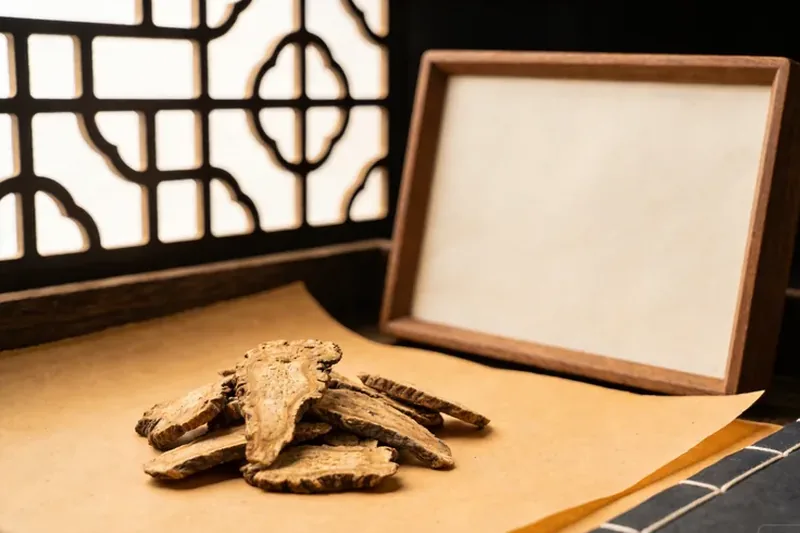
Technical answer: Angelica — báizhǐ (白芷) in Chinese — is the dried root of Angelica dahurica (family Apiaceae), an aromatic herb with a distinctive herbal, slightly sweet-bitter scent. It is a classic ingredient in Chinese 合香 (blended incense) and in traditional materia medica.
Key facts
| Chinese | 白芷 (báizhǐ) |
| Botanical source | Angelica dahurica (Apiaceae) — the dried root |
| What it is | A dried aromatic root (not a wood or resin) |
| Aroma | Herbal, aromatic, slightly sweet-bitter, subtly spicy |
| Traditional role | Incense (合香), materia medica, perfumery |
Aroma profile
Direct answer: Angelica root has a warm, herbal, aromatic scent with a slightly sweet-bitter edge and a subtle spicy undertone. It is a “root” aroma — earthy and dry rather than floral — reading more like a seasoning than a flower.
Angelica root has a warm, herbal, aromatic scent with a slightly sweet-bitter edge and a subtle spicy undertone. It is a “root” aroma — earthy and dry rather than floral — and it reads more like a seasoning than a flower.
Botanical identity
Direct answer: 白芷 is Angelica dahurica, a stout perennial herb of the carrot family (Apiaceae). Flora of China records the plant as 1–2.5 m tall, with a cylindrical brown root 3–5 cm thick that is “strongly aromatic” — the aromatic root is the part used.
Angelica dahurica is a stout perennial of the Apiaceae (carrot family). Flora of China records the plant as 1–2.5 m tall, with a cylindrical, brown root 3–5 cm thick that is “strongly aromatic” — a useful botanical anchor, because the aromatic root is exactly the material of value. It flowers July–August and fruits August–September. See Angelica dahurica in Flora of China.
The part used is the dried root — harvested, cleaned, dried, then sliced or ground. This is a root material, structurally distinct from the woods and resins it is often blended with.
Chinese name and terminology
Direct answer: 白芷 (báizhǐ) is the Chinese name for Angelica dahurica; the shared English name “angelica” also covers 当归 (dong quai, Angelica sinensis) and European angelica (Angelica archangelica) — same genus, different species, different uses.
The English name “angelica” hides a botanical split. Three distinct plants share it:
- 白芷 (báizhǐ) — Angelica dahurica, the aromatic root of Chinese 合香. This entry.
- 当归 (dāngguī, dong quai) — Angelica sinensis, the “women’s herb” of materia medica, a different species. See angelica-sinensis.
- European angelica — Angelica archangelica, used in European liqueurs and perfumery.
In an incense context, 白芷 (A. dahurica) is the relevant one.
Where does angelica come from?
Direct answer: Angelica dahurica is a north and east Asian plant; Flora of China records it in Hebei, Heilongjiang, Jilin, Liaoning, Shaanxi, and northern Taiwan, at forest margins, valley grasslands, and streamsides from 500–1,000 m, with a range into Japan, Korea, and Siberia.
Flora of China places Angelica dahurica in the forest margins, valley grasslands, and streamsides of northern and eastern China — Hebei, Heilongjiang, Jilin, Liaoning, Shaanxi, and northern Taiwan — at elevations of 500–1,000 m, extending into Japan, Korea, and Siberia. This is a cool-temperate aromatic root, not a tropical material, which is a useful distinction from the warm-climate resins and woods that dominate much of incense.
Why is it used in incense?
Direct answer: Angelica root (白芷) is used in Chinese 合香 as a classic supporting body note — its warm, herbal, earthy character adds depth and body beneath the woods and resins that anchor a formula, rather than leading with a bright or sweet top note.
白芷 is a supporting ingredient in blended incense. Its warm, herbal, earthy root character supplies body and depth — it grounds and fills out a formula from below, complementing the woods and resins rather than competing with them. This is the classic role of the aromatic roots in 合香: they give a blend its layered, herbal register, which is why 白芷 appears alongside other roots (菖蒲, 藿香, and others) as a standing member of the classical incense palette.
How is it processed?
Direct answer: Angelica root is harvested, cleaned, dried, and then sliced or ground. No extraction step is involved in the root form; only an essential oil or extract would require distillation or solvent extraction.
The root is harvested, cleaned, and dried, then either sliced (for use as root slices) or ground to powder (for blending into incense). No extraction step is involved in the dried-root form. For powder buyers, particle size and moisture are the practical variables — but the exact target depends on the formula, binder, and production line (see Our Industry View below). The grinding and forming mechanics sit within the wider how incense is made process.
What determines angelica quality?
Direct answer: Quality turns on the root’s aromatic intensity, cleanliness, and freedom from rot — a fragrant, clean, well-dried root beats a stale or woody one. The aromatic compounds concentrate in the root, so a thick, sound, aromatic root is the benchmark.
The quality factors, in rough order:
- Aromatic intensity — the root should be fragrant, herbal, and sweet-bitter when warmed; this is the decisive variable.
- Cleanliness and soundness — freedom from rot, mold, and foreign matter.
- Root thickness and maturity — a sound, mature root (recalling the botanical “strongly aromatic” root) reads richer than thin or woody material.
- For powder — consistent particle size and moisture, judged against the specific formula.
There is no standardized grading system; the buyer evaluates the physical condition and aroma of the lot.
Common forms
Direct answer: Angelica is sold as whole dried root, root slices, and ground powder. Slices and powder are the incense forms; the powder is ground from the dried root for blending.
| Form | Typical use |
|---|---|
| Whole dried root | Storage, display, materia medica |
| Root slices | Materia medica, decoction, some incense use |
| Powder | Blended into incense sticks and cones |
The distinction between slices and powder is functional, not a quality statement. See incense powder & resin for how root powder behaves in practice.
In Chinese tradition
- 合香 (blended incense): 白芷 is a classic supporting ingredient in Chinese incense formulas, contributing a warm, herbal body.
- Materia medica: 白芷 appears in traditional Chinese medicine, where it is described for various uses.
- Cultural role: it is one of many aromatic roots (alongside 菖蒲, 藿香, and others) that give classical 合香 its layered, herbal character.
Traditional use vs modern evidence
Traditional Chinese medicine describes 白芷 with a range of therapeutic uses. We treat these as traditional, not established clinical fact, and we make no medical claims. This page describes its aromatic and cultural role only.
Angelica vs dong quai (当归)
Direct answer: 白芷 (Angelica dahurica) and 当归 (Angelica sinensis, dong quai) are the same genus, different species. 白芷 is the aromatic root of incense and blended fragrance; 当归 is the materia-medica “women’s herb.” The shared English name “angelica” hides the difference.
| 白芷 (Angelica) | 当归 (Dong quai) | |
|---|---|---|
| Botanical source | Angelica dahurica | Angelica sinensis |
| Chinese name | 白芷 (báizhǐ) | 当归 (dāngguī) |
| Role | Aromatic root of 合香 (incense) | Materia medica “women’s herb”; sachet (香囊) root |
| Aroma | Warm, herbal, sweet-bitter, spicy | Warm, sweet, fuller, less sharp |
The two are complements, not substitutes, in the Chinese tradition. See angelica-sinensis and the material comparison matrix.
Adulteration & misidentification
Direct answer: The main risk is misidentification, not adulteration: “angelica” can mean 白芷, dong quai, or European angelica — three different species. The botanical name on the label resolves which is meant.
Angelica is not a heavily faked, expensive aromatic in the agarwood sense; its risk is the shared common name. A buyer who wants the warm, herbal 白芷 for incense should not unknowingly receive 当归 (dong quai) or European angelica — related plants with different aromas and roles. The botanical name on the label resolves the matter. See the incense substitution cross-reference for the general screening logic.
Sustainability & sourcing
Direct answer: Angelica dahurica is a cultivated medicinal and aromatic crop with no equivalent wild-harvest scarcity concern to spikenard or agarwood; the sourcing question is species verification and root quality rather than conservation.
白芷 is a long-cultivated aromatic and medicinal root, and there is no CITES-style or wild-harvest scarcity concern of the kind attached to spikenard or agarwood. The sourcing question is therefore identity and quality, not conservation: confirm which Angelica species is meant and evaluate the root’s aroma and soundness. See the wholesale guide for the general sourcing framework.
Modern commercial applications
Direct answer: Angelica root is used in traditional materia medica, in blended incense, and in perfumery as a warm herbal base note. Its commercial weight is led by materia medica and incense blending rather than any single flagship product.
Angelica reaches the market through distinct channels:
- Materia medica — 白芷 is a standard dried root of the Chinese herbal trade.
- Blended incense — 白芷 is a supporting body note in 合香 formulas.
- Perfumery — the warm, herbal root note is used in some fragrance blends.
The three channels value the root somewhat differently: the materia-medica trade prizes clean, intact root slices, while the incense buyer cares more about aroma on gentle heat and how the powder behaves in a formula.
What buyers should look for
Direct answer: Buyers should confirm the species (Angelica dahurica, not dong quai or European angelica), then judge the root’s aroma, soundness, and cleanliness — and, for powder, test particle size and moisture against the formula.
For an incense maker or sourcing buyer:
- Species — confirm Angelica dahurica (白芷) rather than A. sinensis (当归) or A. archangelica; a real seller names the species.
- Aroma — the root should be warm, herbal, and sweet-bitter when gently warmed.
- Soundness and cleanliness — freedom from rot, mold, and foreign matter.
- Powder consistency — confirm particle size and moisture, and test a sample against your formula.
Safety
Incense combustion produces smoke and particulate matter; burn in a well-ventilated space and avoid inhaling concentrated smoke. This is editorial knowledge content, not medical advice.
Our Industry View
Direct answer: In manufacturing, 白芷 is a supporting body note, not a lead. Its value is in grounding a blend, and that role depends on consistency — of aroma, particle size, moisture, and batch-to-batch variation — more than on any rare or premium grading.
From a manufacturing perspective, 白芷 is a body-note ingredient whose value is consistency, not rarity. It will not carry a formula the way sandalwood or agarwood can; its job is to deepen and ground a blend, which is exactly the role most vulnerable to batch-to-batch drift — a slightly stale or differently ground lot changes the blend’s character without announcing itself.
Two points follow:
- It is a supporting note, so consistency is the specification. A formula that relies on 白芷 for body needs the same warm, herbal register every batch. A single fragrant lot proves little; what matters is that the next lot smells and behaves like the last.
- Particle size and moisture affect behavior, not just aroma. In powder, particle size changes how the material packs, draws air, and burns; moisture changes how it grinds and how the finished stick dries. The right target depends on formulation — the binder, the other ingredients, and the production line — so a figure that works in one factory does not transfer to another.
In our view, the commercial sweet spot is a consistent, well-documented 白芷 with a confirmed species and a steady aromatic profile, used as a supporting body note — not a rare root, but one that must be reorderable to the same specification.
Summary
Angelica (白芷, báizhǐ) is the dried, strongly aromatic root of Angelica dahurica, a stout Apiaceae herb of northern and eastern China. It is a classic supporting body note in Chinese 合香, valued for a warm, herbal, sweet-bitter root character that grounds a blend from below. Its quality rests on aromatic intensity, soundness, and consistency rather than a formal grade, and its naming risk is confusion with dong quai (当归, Angelica sinensis) — same genus, different species. In incense it is a supporting note, not a lead; commercially, species verification and batch consistency outweigh rarity.
FAQ
Is angelica the same as dong quai? No. 白芷 (Angelica dahurica) and 当归, known as dong quai (Angelica sinensis), are different species in the same genus. 白芷 is the aromatic root used in incense and blended fragrance, with a warm, herbal, slightly sweet-bitter scent, while 当归 is a materia medica herb with a different profile and role. The shared English word “angelica” hides the difference, and a third plant, European angelica (Angelica archangelica), is used in European liqueurs and perfumery. In an incense context, 白芷 is the relevant one.
What part of angelica is used? The dried root of Angelica dahurica is the part used. The root is harvested, cleaned, dried, and then ground or sliced for use in incense and traditional practice. It is an aromatic root rather than a wood, resin, or flower, which gives it its earthy, herbal character. In Chinese 合香 (blended incense), the dried root is typically powdered and combined with other aromatics rather than burned as a whole piece.
What does angelica smell like? Angelica root has a warm, herbal, aromatic scent with a slightly sweet-bitter edge and a subtle spicy undertone. It reads as an earthy root note — dry and seasoning-like — rather than floral or woody. The aroma is closer to a culinary spice or dried herb than to a perfume flower, which is why it works as a supporting body note in blends. It contributes depth and warmth beneath woods and resins rather than leading with a bright or sweet top note.
What is angelica root used for in incense? Angelica root contributes a warm, herbal base note to Chinese blended incense. In the 合香 tradition, it is one of the classical aromatic roots that add body and depth, supporting the woods and resins that anchor a formula. It also appears in traditional materia medica, where 白芷 is described for various uses, though those are treated as traditional rather than established clinical fact. In incense, its role is aromatic and cultural, not therapeutic.
Is angelica an expensive or heavily faked material? No. Unlike agarwood, angelica root is not a rare, heavily adulterated aromatic. Its risk is misidentification, not counterfeiting: the English name “angelica” covers 白芷, dong quai (当归), and European angelica — three different species. A buyer’s main job is to confirm the botanical name (Angelica dahurica) rather than to run authenticity tests.
See also: angelica-sinensis (当归), calamus, mugwort, asarum and the full scent guide.
Evidence & Sources
Botanical identity
Source: Angelica in Flora of China · Angelica on GBIF. Evidence type: Established.
Traditional Chinese use
Source: this page records 白芷 (Angelica dahurica) as a classic supporting ingredient in 合香 (blended incense) and a materia medica herb. Evidence type: Historically documented — traditional materia-medica language, not modern clinical evidence.
Authenticity / adulteration
Source: the 白芷 / 当归 (Angelica sinensis) / European angelica (A. archangelica) disambiguation is the page’s naming note. Evidence type: Practical screening.
Safety
Source: incense combustion produces smoke and particulate matter; burn in a well-ventilated space. Evidence type: Established.
Evidence status
| Layer | Status |
|---|---|
| Botanical identity | Established |
| Traditional use | Historically documented |
| Authenticity test | Practical screening |
| Health claims | Not established |
Sources
Sources: botanical references on Angelica dahurica and the 白芷/当归 disambiguation. Medicinal uses are treated as traditional, not established clinical fact. This is editorial knowledge content, not medical advice.