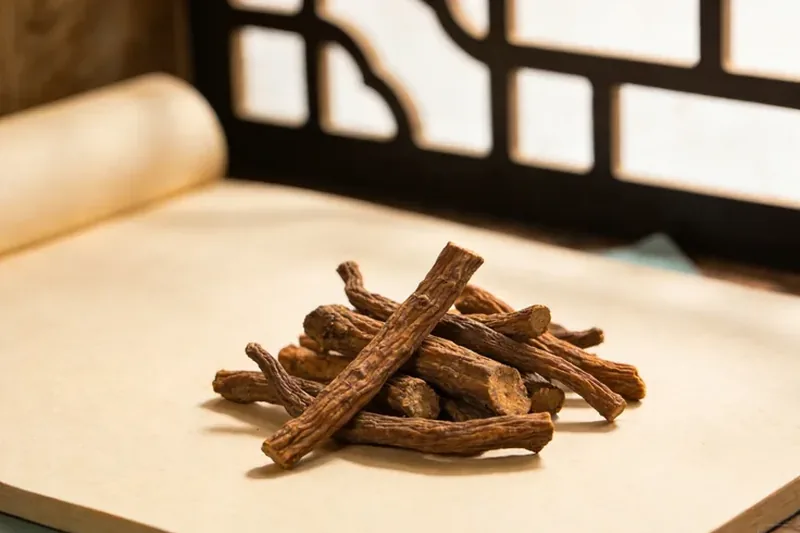
Technical answer: Spikenard — gānsōng (甘松) in Chinese — is the dried, fragrant root of Nardostachys jatamansi, a small perennial herb of the Himalayas and the mountains of western China. In Chinese incense it is a classical huxiang (合香) blending material, valued for a deep, earthy-sweet, slightly musky root note rather than for burning alone. It shares the same aromatic family as the “spikenard” (nard) of the ancient Mediterranean and Indian perfume traditions.
Key facts
| Chinese | 甘松 (gānsōng), also 甘松香 |
| Botanical source | Nardostachys jatamansi (family Caprifoliaceae) — the dried root/rhizome |
| What it is | A dried aromatic root, not a wood or resin |
| Aroma | Earthy, woody, sweet, with a musky, slightly animalic undertone |
| Traditional role | 合香 (blended incense), scenting clothes (裛衣), bath |
Aroma profile
Direct answer: Spikenard root is earthy and woody at its base, with a sweetness that is more “rooty” than floral and a musky, faintly animalic edge. It is a supporting note that deepens and grounds a blend, and its aroma develops with gentle heat.
Spikenard root is earthy and woody at its base, with a sweetness that is more “rooty” than floral and a musky, faintly animalic edge. It is a supporting note: it deepens and grounds a blend rather than leading with a bright top note. The aroma develops with gentle heat, which is why it appears repeatedly in classical huxiang formulas alongside woods and resins.
Botanical identity
Direct answer: 甘松 is Nardostachys jatamansi, a small perennial herb of the valerian family (traditionally Valerianaceae, now placed in Caprifoliaceae). Flora of China records flowering stems 5–50 cm tall, with purple-red, pink, or magenta flowers, and the fragrant root is the part used.
Nardostachys jatamansi is a small herb native to the high Himalaya. Flora of China records its flowering stems at 5–50 cm tall, with basal rosette leaves and purple-red, pink, or magenta flowers — and, crucially for incense, a fragrant rootstock, which is the material of value. The plant was traditionally placed in the valerian family (Valerianaceae) and is now treated under Caprifoliaceae in modern systems; both placements describe the same plant. See Nardostachys jatamansi in Flora of China.
The part used is the root and rhizome, which is harvested, cleaned, and dried.
Chinese name and terminology
Direct answer: The name 甘松 (gānsōng, “sweet song”) records a taste-based naming convention — 甘 means “sweet” — rather than a description of its scent. It also travels as 甘松香, and shares the English “spikenard” with the nard of Western perfume traditions.
The name 甘松 (“sweet song”) refers to its sweet taste (甘) — an older, taste-based naming convention rather than a description of its scent. The material also appears as 甘松香 (gānsōngxiāng). The English name “spikenard” links it to the nard of the ancient Mediterranean and Indian traditions — the same Nardostachys aromatic family under a different regional name.
Where does spikenard come from?
Direct answer: Nardostachys jatamansi is a high-Himalayan herb of Nepal, Bhutan, northern India, Tibet, and western Sichuan. Its high-mountain, wild-harvest habitat is the root of its scarcity and CITES monitoring.
Nardostachys jatamansi is a small herb native to the high Himalaya — Nepal, Bhutan, northern India, and into Tibet and western Sichuan. This high-mountain, wild-harvest habitat is central to its sourcing story: because the plant grows in sensitive alpine habitats and is harvested from the wild, genuine material has become scarce and its trade is monitored (see Sustainability below).
Why is it used in incense?
Direct answer: Spikenard (甘松) is used in incense as a grounding, earthy body note — it deepens a blend from below, alongside woods and resins, rather than leading with a bright top note. This is why it is a classical huxiang (合香) blending material rather than a solo burn.
Spikenard’s role follows directly from its aroma: an earthy, sweet, musky body note that grounds a formula. It works in combination, not alone — in classical huxiang (合香) it is paired with woods (sandalwood, agarwood), resins, and other roots, where it contributes a depth and warmth that the other ingredients do not supply on their own. This is why it is blended rather than burned solo for fragrance.
How is it processed?
Direct answer: Spikenard root is harvested, cleaned, and dried, then used whole, sliced, or powdered. No extraction step is involved in the root form; only a distilled oil or extract would require a further step.
The root and rhizome are harvested, cleaned, and dried, then used whole, sliced, or ground to powder for blending. No extraction step is involved in the dried-root form. For powder buyers, particle size and moisture are the practical variables — but the exact target depends on the formula, binder, and production line (see Our Industry View below). The grinding and forming mechanics sit within the wider how incense is made process.
What determines spikenard quality?
Direct answer: Quality turns on the root’s aromatic intensity and soundness — a clean, dry root with a noticeable earthy-sweet aroma when gently warmed beats a stale or woody one. Because wild sourcing is restricted, species and origin also matter.
The quality factors, in rough order:
- Aromatic intensity — the root should give a noticeable earthy-sweet, musky aroma when gently warmed; this is the decisive variable.
- Soundness and cleanliness — freedom from rot, mold, and foreign matter.
- Species and origin — because genuine wild Nardostachys is scarce and substitutes appear in commerce, confirming the species matters.
- For powder — consistent particle size and moisture, judged against the specific formula.
There is no standardized grading system; the buyer evaluates the physical condition, aroma, and provenance of the lot.
Common forms
Direct answer: Spikenard is sold as whole dried root, sliced root, and ground powder. The powder is the incense-blending form; whole and sliced root suit materia medica and storage. A separate steam-distilled “spikenard” oil is used in Western aromatherapy.
| Form | Typical use |
|---|---|
| Whole dried root / rhizome | Materia medica, storage |
| Sliced root | Materia medica, some incense use |
| Powder | Blended into incense sticks and cones |
| Spikenard oil | Western aromatherapy (a separate distilled product) |
The distinction between root forms and powder is functional, not a quality statement. See incense powder & resin for how root powder behaves in practice.
In Chinese tradition
- 合香 (blended incense): 甘松 is a classical supporting ingredient in blended incense formulas, contributing an earthy, grounding body. The Song-dynasty manual Xiangpu (香譜) records 甘松香 among the standard incense materials.
- Scenting clothes (裛衣): classical texts describe spikenard as usable to scent garments and for fragrant bathing.
- Materia medica: 甘松 appears in traditional Chinese medicine, where the Bencao Shiyi (本草拾遗) records it for various uses and notes “bathing makes the body fragrant” (浴人身令香). This is traditional materia-medica language, not modern clinical evidence.
Traditional use vs modern evidence
The classical references describe spikenard’s aromatic and cultural roles — blending, scenting, bathing — and a traditional medicinal reputation. We treat the medicinal descriptions as traditional, not established clinical fact, and make no medical claims. The documented, non-medical facts are botanical identity and the plant’s long use as a fragrant root in Chinese, Indian, and Himalayan incense traditions.
Spikenard vs related roots
Direct answer: Spikenard is an earthy, musky, sweet root note, distinct from sandalwood (a creamy, warm wood) and vetiver (a dry, smoky root). All three ground a blend, but spikenard’s musky sweetness is its own register.
| Material | Character |
|---|---|
| Spikenard (甘松) | Earthy, woody, sweet, musky — a grounding root note |
| Sandalwood | Creamy, sweet, soft — a warm, prized wood base |
| Vetiver | Dry, earthy, smoky — a rooty base with a cleaner edge |
Spikenard sits between the two in register: sweeter and more musky than vetiver, but a root rather than a wood like sandalwood. See sandalwood, vetiver, and the material comparison matrix.
Adulteration & misidentification
Direct answer: The main risks are substitution and species confusion, driven by scarcity: because wild Nardostachys is restricted and CITES-monitored, cultivated material and substitutes — including the sedge Cyperus (香附子), a traditional huxiang root — appear under the “spikenard” name. The label should specify species and form.
Spikenard’s scarcity creates its authenticity problem. Two risks recur:
- Species and form confusion — “spikenard” in Western aromatherapy is usually a steam-distilled essential oil, while Chinese 甘松 is the dried root; a label saying only “spikenard” specifies neither species nor form.
- Substitution — because wild sourcing is restricted, cultivated material and substitutes (including the unrelated sedge Cyperus, 香附子, a traditional huxiang root sometimes used in spikenard’s place) appear in commerce.
The botanical name and the form (root vs oil) resolve the matter. See the incense substitution cross-reference for the general screening logic.
Sustainability & sourcing
Direct answer: Genuine wild spikenard is increasingly scarce because Nardostachys jatamansi is harvested from sensitive Himalayan habitats and is listed under CITES Appendix II. Sourcing should confirm species, origin, and whether the material is wild or cultivated.
Wild Nardostachys is harvested from sensitive high-Himalayan habitats, and the trade is monitored under CITES Appendix II. For a buyer, the practical implication is documentation: a credible supplier should be able to name the species and origin and state whether the material is wild or cultivated, rather than offering only an unqualified “spikenard” label. See the wholesale guide for the general sourcing framework.
Modern commercial applications
Direct answer: Spikenard is used in classical-style blended incense, in traditional materia medica, and — as a distilled oil — in Western aromatherapy. The root and the oil are separate products with different price structures.
Spikenard reaches the market through distinct channels:
- Classical-style blended incense — the dried root is a grounding body note in huxiang formulas.
- Materia medica — 甘松 is a standard dried root of the Chinese herbal trade.
- Aromatherapy oil — “spikenard” oil is a steam-distilled product of the same genus, a separate market from the dried root.
The root and oil channels are distinct; a sourcing buyer should be clear which one they are buying.
What buyers should look for
Direct answer: Buyers should confirm the species and form (dried root vs oil), then judge the root’s aroma, soundness, and cleanliness — and ask whether the material is wild or cultivated, since that affects both legality and price.
For an incense maker or sourcing buyer:
- Species and form — confirm Nardostachys jatamansi and whether you are buying dried root or distilled oil; a real seller names both.
- Aroma — the root should give an earthy-sweet, musky scent when gently warmed.
- Soundness and cleanliness — freedom from rot, mold, and foreign matter.
- Wild vs cultivated — a documentation question with legal and price implications (CITES Appendix II).
- Powder consistency — for powder, confirm particle size and moisture, and test a sample against your formula.
Safety
Incense combustion produces smoke and particulate matter. Burn in a well-ventilated space, avoid inhaling concentrated smoke, and keep away from children and pets. This is editorial knowledge content, not medical advice.
Our Industry View
Direct answer: In manufacturing, spikenard’s scarcity makes documentation the real specification — species, origin, and wild-vs-cultivated status — because a “spikenard” that quietly switches species or form will change a blend’s grounding without announcing itself. Consistency matters more than any grade name.
From a manufacturing perspective, spikenard is a scarcity-driven documentation problem more than a material problem. Because genuine wild material is restricted and substitutes circulate, the nominal name “spikenard” carries less information than the species, origin, and harvest status behind it — and a formula built on one will not reproduce if the source shifts silently.
Two points follow:
- Documentation is the specification. A credible lot of 甘松 should come with species, origin, and wild-vs-cultivated status. The alternative — an unqualified “spikenard” — is exactly the situation where a substitute can enter without being noticed.
- Consistency, not grade. As a grounding body note, spikenard’s value is that the next batch smells and behaves like the last. A single fragrant lot proves little; what matters is reproducible earthy-musky character across batches.
In our view, the commercial sweet spot is a documented, consistent 甘松 with a confirmed species and origin — not a rare wild top grade that cannot be reordered to the same specification.
Summary
Spikenard (甘松, gānsōng) is the dried, fragrant root of Nardostachys jatamansi, a high-Himalayan herb. It is a classical grounding body note in Chinese 合香, valued for an earthy, sweet, musky root character, and documented in the Song-dynasty Xiangpu (香譜) and Bencao Shiyi (本草拾遗). Because wild sourcing is restricted and CITES-monitored, its risks are substitution and species/form confusion. In incense it is a supporting note, not a lead; commercially, documentation and consistency outweigh rarity.
FAQ
What does spikenard smell like? Spikenard root is earthy and woody with a sweet, slightly musky, faintly animalic undertone. It is a supporting, grounding note rather than a bright or floral one — in Chinese huxiang (blended incense) it deepens a formula from below, alongside woods and resins. The aroma is “rooty” and develops with gentle heat, which is why it is blended rather than burned alone for fragrance.
Is Chinese 甘松 the same as Western spikenard essential oil? They trace to the same plant family — Nardostachys — but the materials are not automatically identical. Chinese 甘松 is the dried root used in incense and materia medica, while “spikenard” in Western aromatherapy is usually a steam-distilled essential oil of the same genus. A label that says only “spikenard” does not specify species or form, so buyers should check what they are getting.
What part of the spikenard plant is used? The dried root and rhizome of Nardostachys jatamansi are the parts used. The plant is a small Himalayan herb; its root is harvested, cleaned, and dried, then used whole, sliced, or powdered in incense and traditional practice. The name 甘松 refers to the root’s sweet taste rather than its scent — an older, taste-based naming convention.
Why is spikenard so associated with blended incense? Because its aroma is a grounding, earthy body note rather than a self-sufficient fragrance, spikenard works best in combination. The Song-dynasty manual Xiangpu (香譜) lists 甘松香 among the standard incense materials, and classical huxiang formulas pair it with woods (sandalwood, agarwood), resins, and other roots. It contributes depth and warmth that other ingredients do not supply on their own.
Is spikenard rare? Genuine wild spikenard has become scarce because Nardostachys jatamansi is harvested from sensitive high-Himalayan habitats and its trade is monitored under CITES Appendix II. This has led to cultivated material and substitutes appearing in commerce — including the traditional huxiang root Cyperus (香附子), sometimes used in spikenard’s place. Rarity and sourcing pressure are worth checking when buying.
Is spikenard the same as vetiver? No — both are earthy root notes, but they are different plants. Spikenard is Nardostachys jatamansi, with an earthy, sweet, musky character; vetiver is Chrysopogon zizanioides, a grass whose roots give a dry, smoky, cleaner earthy note. They both ground a blend from below, but spikenard reads sweeter and more musky, while vetiver reads drier and smokier.
See also: sandalwood, vetiver, valerian and the full scent guide.
Evidence & Sources
Botanical identity
Source: Nardostachys jatamansi in Flora of China · Nardostachys jatamansi on GBIF. Evidence type: Established.
Traditional Chinese use
Source: the Song-dynasty Xiangpu (香譜, “Incense Manual,” 洪芻) records 甘松香 among standard incense materials, citing 《本草拾遺》 (“bathing makes the body fragrant,” 浴人身令香) and 《廣志》 (origin in 涼州). Evidence type: Historically documented — traditional materia-medica language, not modern clinical evidence.
Authenticity / sourcing
Source: Nardostachys jatamansi wild-harvest scarcity and CITES Appendix II monitoring; the Cyperus (香附子) substitution note. Evidence type: Practical screening.
Safety
Source: incense combustion produces smoke and particulate matter; burn in a well-ventilated space. Evidence type: Established.
Evidence status
| Layer | Status |
|---|---|
| Botanical identity | Established |
| Traditional use | Historically documented |
| Authenticity test | Practical screening |
| Health claims | Not established |
Sources
Sources: botanical references on Nardostachys jatamansi and the Song-dynasty Xiangpu (香譜) record of 甘松香. Medicinal uses are treated as traditional, not established clinical fact. Traditional-use proportions and formula quantities are recorded as historical references, not verified. This is editorial knowledge content, not medical advice.