Direct answer: Valerian (缬草, xiécǎo) is the root of Valeriana officinalis, a perennial herb of the valerian family native to Eurasia, including China. Its dried root has a strong, earthy, musky, woody scent, and it is a classical European herbal root and a modern perfumery base note. It is a native Chinese species recorded in Flora of China — but not a classical Bencao Gangmu herb.
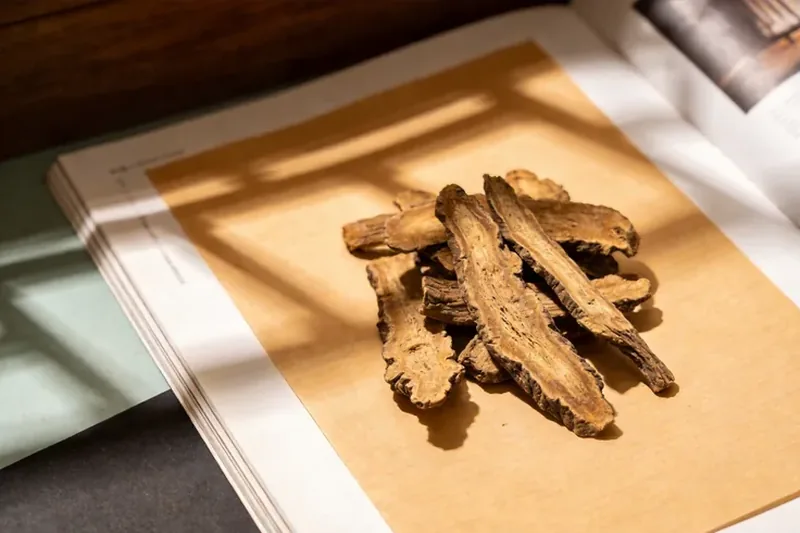
Key facts
| Chinese | 缬草 (xiécǎo); valerian root |
| Botanical source | Valeriana officinalis (family Valerianaceae / Caprifoliaceae) — the root |
| What it is | A perennial herb root, not a wood or resin |
| Aroma | Earthy, musky, woody, rooty |
| Traditional role | European herbal root; native to China but absent from the 本草纲目 canon |
Aroma profile
缬草 has a deep, earthy, musky, woody-root scent with a slightly animalic, “wet forest-floor” edge — the dense, tenacious smell of a cured root rather than a flower or leaf. In perfumery it works as a fixative and a dark base note, anchoring lighter florals and green notes. It is heavier and more rooty-musty than the soft, sweet-spicy spikenard (甘松, Nardostachys jatamansi).
A provenance note (read this)
缬草 (valerian) sits in an unusual position — native to China, but not a classical 香材:
- Valeriana officinalis is a native Chinese species; Flora of China records it under 缬草, and it grows across Eurasia.
- Its classical materia-medica record in China is thin: a search of the Bencao Gangmu (本草纲目) and its supplement (本草纲目拾遗) did not turn up 缬草 as a named entry. The plant’s documented Chinese materia-medica use is largely modern, not classical.
- Its stronghold as a fragrance and herbal root is European — valerian is a Western herbal and perfumery root, not a member of the classical Chinese 香材 canon.
This page records it honestly: a native species with a real Chinese name, but no classical Chinese incense or materia-medica origin is claimed.
Botanical source and origin
Valeriana officinalis is a tall perennial herb of the valerian family, native to Europe and temperate Asia and widespread in China; Flora of China records the species (缬草). The part used is the dried root and rhizome, which develop the characteristic earthy-musky scent as they cure and dry. The same genus (Valeriana) holds many species, and the name 缬草 is the Flora of China Chinese name for V. officinalis.
In modern use
- Perfumery: valerian root is a dark, earthy, musky base note and a natural fixative in some modern fragrances.
- Herbalism: valerian root is a long-standing European herbal; in China its materia-medica use is modern rather than classical.
- Not classical Chinese incense: valerian is absent from the 香材 canon; any Chinese use is a modern crossover.
Traditional use vs modern evidence
Valerian has no classical Chinese incense record, and its Chinese materia-medica documentation is modern rather than part of the 本草纲目 canon. We make no medical claims. The documented facts are botanical identity, the Valerianaceae placement, and its modern perfumery and herbal role.
Quality and sourcing notes
Practical points for buyers:
- 缬草 (valerian) is the dried root of Valeriana officinalis; expect a strong, earthy, musky, woody scent.
- It is a heavy base note, best blended rather than burned alone; the cured root smells earthier than the fresh one.
- Distinguish it from spikenard (甘松, Nardostachys jatamansi) and vetiver (Chrysopogon zizanioides) — all earthy roots, but different species and scents.
Safety
Incense combustion produces smoke and particulate matter. Burn in a well-ventilated space, avoid inhaling concentrated smoke, and keep away from children and pets. This is editorial knowledge content, not medical advice.
FAQ
What is 缬草 (valerian)? The dried root of Valeriana officinalis, a perennial herb of the valerian family native to Eurasia and China. It has a strong, earthy, musky, woody-root scent and is a European herbal root and modern perfumery base note, not a classical Chinese 香材.
Is 缬草 a classical Chinese incense ingredient? No. Although Valeriana officinalis is a native Chinese species recorded in Flora of China, it does not appear as a named entry in the Bencao Gangmu (本草纲目) or its supplement. Its documented Chinese use is modern, and its stronghold as a fragrance and herbal root is European.
What does valerian smell like? Deep, earthy, musky, and woody-root, with a slightly animalic, wet-forest-floor edge. It is a heavy, tenacious base note — more rooty and musty than the soft, sweet-spicy spikenard (甘松).
Is valerian the same as spikenard? No. Valerian is Valeriana officinalis (Valerianaceae); spikenard is Nardostachys jatamansi (Caprifoliaceae). Both are earthy roots, but they are different species with different scents, and spikenard has a genuine classical Chinese record while valerian does not.
How is valerian used in fragrance? As a dark, earthy, musky base note and a natural fixative in some modern perfumes, usually in small amounts to anchor lighter notes. It is a modern crossover into fragrance, not a classical incense ingredient.
See also: spikenard (甘松), vetiver, patchouli (广藿香), and the full scent guide.
Evidence & Sources
Botanical identity
Source: Valeriana officinalis in Flora of China · Valeriana officinalis on GBIF. Evidence type: Established.
Traditional use
Source: a search of the Bencao Gangmu (本草纲目) and 本草纲目拾遗 did not locate 缬草 as a named entry; the plant’s Chinese materia-medica documentation is modern rather than classical. Evidence type: Absence of classical record (defined scope) — no classical origin claimed.
Authenticity / provenance
Source: 缬草 (Valeriana officinalis) vs spikenard 甘松 (Nardostachys jatamansi) and vetiver — distinct earthy roots. Evidence type: Practical screening.
Safety
Source: incense combustion produces smoke and particulate matter; burn in a well-ventilated space. Evidence type: Established.
Evidence status
| Layer | Status |
|---|---|
| Botanical identity | Established |
| Traditional use | No classical Chinese record (modern) |
| Authenticity test | Practical screening |
| Health claims | Not established |
Sources
Sources: botanical references on Valeriana officinalis. 缬草 is a native Chinese species recorded in Flora of China, but it has no classical Chinese incense or Bencao Gangmu record; no such origin is claimed. This is editorial knowledge content, not medical advice.