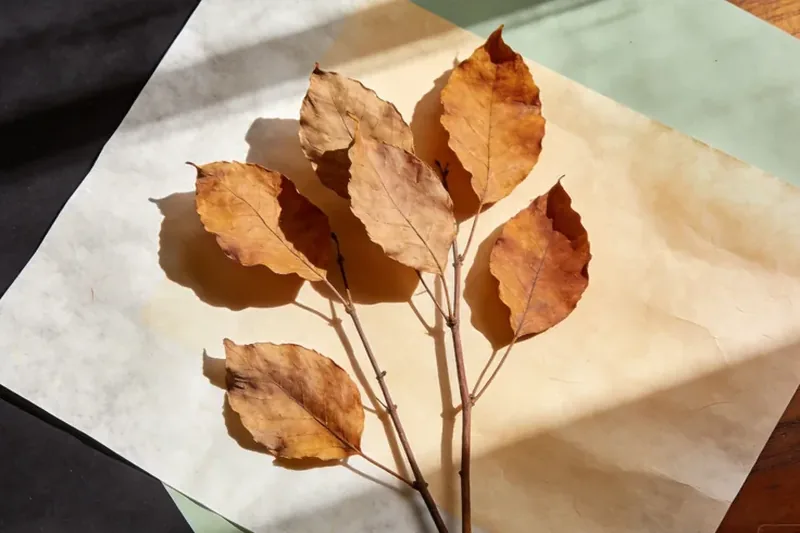
Definition: Patchouli — guǎnghuòxiāng (广藿香) in Chinese — is the dried leaf of Pogostemon cablin, a bushy mint-family herb, with a heavy, earthy, woody, balsamic aroma. It is an important ingredient in East Asian incense and a classic perfumery base note. The fragrant material is almost always the steam-distilled essential oil of the dried leaf, not the fresh leaf itself — a distinction that matters for how the material is bought and used.
Key facts
| Chinese | 广藿香 (guǎnghuòxiāng) |
| Botanical source | Pogostemon cablin (Lamiaceae — mint family) |
| What it is | Dried leaves (steam-distilled) |
| Aroma | Earthy, woody, balsamic, spicy, musty-sweet |
| Traditional role | Incense, perfume, insect repellent |
Aroma profile
Direct answer: Patchouli is a heavy, earthy, woody-balsamic base note with a musty-sweet, spicy edge. Its character is “rooted” — wet soil, dry wood, and a faint sweetness — rather than bright or floral, and it lingers, which is why a little patchouli can anchor an entire blend.
Patchouli has a heavy, earthy, woody-balsamic scent with a musty-sweet, spicy edge. It is a strong base note that lingers. Like vetiver, it tends to be a supporting/base note rather than the star.
The character is earthy and “rooted” — wet soil, dry wood, and a faint sweetness — rather than bright or floral. It is long-lasting and penetrating, which is why a little patchouli can anchor an entire blend and why it became the signature of a whole era of fragrance (the 1960s–70s association in the West).
Botanical identity
Direct answer: Patchouli is the dried leaf of Pogostemon cablin, a bushy herb in the mint family (Lamiaceae). Despite its woody, “rooted” scent, it is a leafy herb, not a wood — the aroma comes from the leaf’s essential oil, released by steam distillation.
Pogostemon cablin is a herbaceous plant in the mint family, Lamiaceae. The genus Pogostemon contains several aromatic species, but P. cablin is the one that yields commercial patchouli. The aromatic part is the leaf; when distilled, the dried leaves give the heavy, earthy essential oil that defines the material’s scent. This is a common source of confusion: patchouli reads as “woody” and “rooted,” but the botanical source is a leafy herb in the same family as mint, not a tree or a root. See Pogostemon cablin in Flora of China.
Chinese name and terminology (广藿香 vs 藿香)
Direct answer: The name 广藿香 distinguishes patchouli from 藿香 (Agastache rugosa), a different mint-family herb. 广藿香 means patchouli (the earthy incense/perfume leaf); 藿香 means Korean mint, used in medicine and cooking. English blurs the two, but in Chinese they are distinct plants.
Chinese has two “huo xiang” herbs that English blurs together:
- 广藿香 (Pogostemon cablin) — patchouli, the earthy incense/perfume material. This entry.
- 藿香 (Agastache rugosa) — Korean mint / giant hyssop, a different herb used in Chinese medicine and cooking. See agastache (藿香).
The 广 prefix marks 广藿香 as the material associated with Guangdong (the Cantonese south) — historically the point through which this traded, imported leaf reached the rest of China — setting it apart from the native 藿香, also called 土藿香 (“earth/native agastache”). They share a name and a mint-family relationship but are different plants with different aromas and uses. In an incense or perfume context, 广藿香 means patchouli.
Where does patchouli come from?
Direct answer: Patchouli is native to tropical Southeast Asia, which remains its historical and botanical home. Today the leaf is also cultivated in other tropical regions, mainly for its oil, with modern oil production concentrated in Southeast Asia — especially Indonesia.
Pogostemon cablin is a tropical plant native to Southeast Asia. The leaf has long been an ingredient in the region’s incense and perfumery, well before its 1960s–70s Western popularity. Today the crop is grown across the tropics for its essential oil, and the modern oil trade is dominated by Southeast Asian producers — Indonesia in particular is the reference supplier for the large-volume patchouli oil used in perfumery. Origin still matters for the oil’s character, but for the dried leaf used in incense, the practical question is simpler: clean, well-dried leaf with the characteristic earthy aroma.
Why is patchouli used in incense?
Direct answer: Patchouli is used in incense as an earthy, woody-balsamic base note that anchors a blend and gives it staying power. It is usually a supporting note, not a solo scent, blended with woods and resins to add depth and a musty-sweet, “rooted” weight.
In East Asian incense, patchouli is a working base note rather than a leading scent. Its heavy, persistent character lets a small amount hold a formula together and extend its dry-down, so it is blended with woods and resins rather than burned alone for fragrance. The same quality makes it a classic fixative/base in Western perfumery (chypre and oriental families). Its long folk use as an insect deterrent, especially for protecting stored textiles, is a separate, practical strand of its traditional role. See the scent guide for where patchouli sits among other base notes.
How is patchouli processed?
Direct answer: The leaf is dried — sometimes lightly fermented — then steam-distilled to extract the heavy essential oil. Drying and any fermentation step develop the oil’s earthy, musty-sweet character, and the oil is widely described as improving with age.
The route from plant to material is leaf-first, not wood-first:
- Harvest and dry — the leaves are cut and dried; in some production the leaf is lightly fermented before distillation, a step that develops the earthy, musty-sweet character.
- Distill — the dried leaf is steam-distilled to yield the essential oil, the primary commercial form.
- Age — patchouli oil is commonly described as improving with age, mellowing from a sharp green note to a deeper, smoother earthiness.
For incense, the leaf can also be used dried and whole or ground, but the oil is the dominant form in trade. Powder handling and blending mechanics sit within the wider incense powder & resin process.
What determines patchouli quality?
Direct answer: Quality rests on the leaf (cleanliness, maturity, drying) and, for the oil, on origin, distillation care, and age. A clean, well-dried leaf and an oil that is balanced and not overly sharp or “green” are the practical markers.
The main quality factors:
- Leaf quality — clean, mature, properly dried leaf without mustiness or contamination.
- Origin of the oil — different growing regions yield different profiles; Southeast Asian oils are the commercial reference.
- Distillation and age — careful distillation and aging mellow the oil from sharp-green to a smoother earthiness.
- Aroma balance — the oil should read earthy and woody-balsamic, not thin or harshly green.
There is no single standardized grading system; these are trade distinctions. For a buyer, the working checks are cleanliness and aroma rather than a nominal grade label.
Common forms
Direct answer: Patchouli reaches the market chiefly as essential oil, and to a lesser extent as dried leaf (whole or ground). The oil is the perfumery and dominant incense-blending form; the dried leaf is used directly in some traditional incense preparations.
| Form | Typical use |
|---|---|
| Essential oil | Perfumery base note; incense blending (the dominant form) |
| Dried leaf | Whole or ground, used directly in traditional incense |
| Powder | Ground leaf for blending (less common than the oil) |
The distinction is functional: the oil is a concentrated, liquid base note, while the dried leaf is a bulk botanical. They are not interchangeable in a formula. See incense powder & resin for how leaf and resin powders behave in practice.
Traditional use vs modern evidence
Direct answer: Patchouli has traditional use as an insect deterrent and in materia medica, and early laboratory research on the oil’s antimicrobial and anti-inflammatory properties exists — but this is preliminary, not established clinical fact. This page describes its aromatic and incense use only.
- Traditional Use — patchouli is used as an insect deterrent (especially for stored textiles) and appears in traditional materia medica.
- Historical Record — 广藿香 is documented as a traded Southeast Asian leaf and a long-standing East Asian incense and perfume ingredient.
- Scientific Evidence — early research on the oil’s antimicrobial and anti-inflammatory properties exists but is preliminary, not established clinical fact.
We describe its aromatic and incense use; we do not make medical claims.
Patchouli vs vetiver
Direct answer: Both are earthy base notes, but patchouli is a mint-family leaf and vetiver a grass root. Patchouli is mustier and spicier; vetiver is smokier and smoother. They are often used together to build a deep, earthy foundation.
| Patchouli (广藿香) | Vetiver (岩兰草) | |
|---|---|---|
| Plant part | Mint-family leaf (Pogostemon cablin) | Grass root (Chrysopogon zizanioides) |
| Character | Musty-sweet, spicy, woody-balsamic | Earthy, smoky-green, smooth |
| Role | Anchoring base | Grounding base |
Both are earthy base notes, but patchouli is the leaf (mint family) and vetiver the root (grass). They are often used together to build a deep, earthy foundation under woods and florals. See vetiver and the material comparison matrix.
Sustainability & sourcing
Direct answer: Patchouli is a cultivated tropical herb, not a wild-harvested or endangered material, so its supply is renewable. Sourcing for the oil should confirm origin; for the leaf, confirm cleanliness and drying rather than assuming any single origin is required.
Unlike wild-harvested woods or resins, patchouli is a farmed annual/perennial crop grown across the tropics, so its supply is renewable and not under the same conservation pressure as materials like agarwood. For a buyer, the practical questions are the same as for any botanical: which form (oil vs dried leaf), which origin for the oil, and cleanliness and drying for the leaf. See the wholesale guide for the general sourcing framework.
Modern commercial applications
Direct answer: Patchouli oil is a large-volume perfumery base note and fixative, and it also goes into incense blends, scented products, and some personal-care formulations. The dried leaf serves traditional incense uses; the oil serves fragrance.
- Perfumery — patchouli oil is a staple base note and fixative in chypre and oriental fragrance families.
- Incense — the oil (and to a lesser extent the dried leaf) is blended into sticks and cones as an earthy anchor.
- Scented products — the oil appears in soaps, candles, and aromatherapy products.
What buyers should look for
Direct answer: Buyers should specify the form — essential oil versus dried leaf — confirm the oil’s origin and age character, and check the leaf for cleanliness and a clean, earthy aroma. Because patchouli is potent, a little goes a long way, so a consistent supply matters more than volume.
For an incense maker or sourcing buyer:
- Form — decide oil versus dried leaf; they are not interchangeable in a blend.
- Origin — for oil, ask the source region, since origin shifts the profile.
- Aroma — the oil should be earthy and woody-balsamic, not thin or harshly green; the leaf should smell clean, without mustiness.
- Potency and consistency — patchouli is strong, so a repeatable, consistent lot matters more than buying large quantities of a one-off.
Safety
Incense combustion produces smoke and particulate matter. Burn in a well-ventilated space; avoid inhaling concentrated smoke. Patchouli is potent — a little goes a long way.
Our Industry View
Direct answer: From a manufacturing perspective, patchouli’s value is as a strong, consistent base note — a little anchors a whole formula. The key variables are form (oil vs leaf), origin consistency for the oil, and dosing, because an overdose of patchouli overpowers rather than supports.
Patchouli is a functional anchor, not a showcase note. Its job in a blend is to sit low, extend the dry-down, and give the formula weight, which means two things matter more than the nominal “patchouli” label:
- Form determines behavior. The essential oil and the dried leaf behave completely differently — one is a liquid base note, the other a bulk botanical. A formula built on the oil will not reproduce if the source switches to leaf, and vice versa.
- Dosing is the real skill. Because patchouli is so persistent, the useful range is narrow: too little and it does nothing, too much and it dominates the blend. The right amount depends on formulation — the other ingredients, the base it is meant to support, and the intended dry-down — so no single percentage transfers between recipes.
In our view, the commercial sweet spot is a consistent, well-documented oil (or clean dried leaf) from a stable source, used in a controlled dose, rather than chasing any particular “grade” label.
Summary
Patchouli (广藿香) is the dried, steam-distilled leaf of Pogostemon cablin, a mint-family herb, prized for a heavy, earthy, woody-balsamic base note with a musty-sweet, spicy edge. It is distinct from the similarly named 藿香 (Agastache rugosa), and it is used in East Asian incense and Western perfumery as an anchor rather than a lead. Its value rests on form (oil vs leaf), origin consistency, and disciplined dosing; scientifically, early research on its oil is preliminary, not clinical proof.
FAQ
Is patchouli a wood? No — it is the dried leaf of a mint-family herb (Pogostemon cablin). The fragrant oil is obtained by steam-distilling the dried leaves, which gives patchouli its heavy, earthy, woody-balsamic character despite being a leaf material rather than a wood. So although the aroma reads as woody and rooted, the botanical source is a leafy herb, not a tree. This distinction matters because “woody” describes the scent, not the plant part.
Is patchouli only a “hippie” scent? Its 1960s–70s Western popularity is well-known, but patchouli has a much longer history in East Asian incense and perfumery. Long before the Western association, patchouli (广藿香) was an established incense ingredient in China and Japan and a classic perfumery base note, so the “hippie” chapter is only one recent slice of its history. It also has a long folk use as an insect deterrent, especially for protecting stored textiles.
What is the difference between 广藿香 and 藿香? 广藿香 is patchouli (Pogostemon cablin); 藿香 is Korean mint (Agastache rugosa). They share a name and mint-family relationship but are different plants. In an incense or perfume context, 广藿香 means patchouli, whereas 藿香 is a different herb used in Chinese medicine and cooking. English blurs the two together, but in Chinese they are distinct materials with different aromas and uses.
What does patchouli smell like? Heavy, earthy, woody-balsamic with a musty-sweet, spicy edge — a strong base note that lingers. The character is earthy and “rooted,” like wet soil and dry wood with a faint sweetness, rather than bright or floral, which is why a little patchouli can anchor an entire blend. It is long-lasting and penetrating, so it works as a base that carries lighter top notes.
Where does patchouli come from? Southeast Asia — patchouli (Pogostemon cablin) is native to the region and has long been an ingredient in East Asian incense and perfumery, well before its 1960s–70s Western popularity. Today it is also cultivated in other tropical regions for its oil, but Southeast Asia remains its historical and botanical home. The dried leaves are what get distilled into the familiar heavy, earthy oil.
How is patchouli oil made? The dried leaves are steam-distilled. Interestingly, patchouli oil is often described as improving with age, mellowing from a sharp green note to a deeper, smoother earthiness. The leaves are typically dried, sometimes fermented, then distilled to extract the heavy, long-lasting essential oil. The fermentation and drying steps are part of what develops the oil’s characteristic earthy, musty-sweet character.
See also: vetiver and cedar, its fellow earthy/woody notes, plus the full scent guide.
Evidence & Sources
Botanical identity
Source: Pogostemon in Flora of China · Pogostemon on GBIF. Evidence type: Established.
Traditional Chinese use
Source: this page records 广藿香 (Pogostemon cablin) as an important East Asian incense ingredient and a materia medica herb. Evidence type: Historically documented — traditional materia-medica language, not modern clinical evidence.
Authenticity / adulteration
Source: the 广藿香 (Pogostemon cablin) vs 藿香 (Agastache rugosa) naming distinction. Evidence type: Practical screening.
Safety
Source: incense combustion produces smoke and particulate matter; patchouli is potent. Evidence type: Established.
Evidence status
| Layer | Status |
|---|---|
| Botanical identity | Established |
| Traditional use | Historically documented |
| Authenticity test | Practical screening |
| Laboratory confirmation | Requires analytical testing |
| Health claims | Not established |
Sources
Sources: botanical references on Pogostemon cablin (Lamiaceae, steam distillation) and accounts of its use in East Asian incense. The 广藿香/藿香 distinction is a standard Chinese-herb naming point. This is editorial knowledge content, not medical advice.