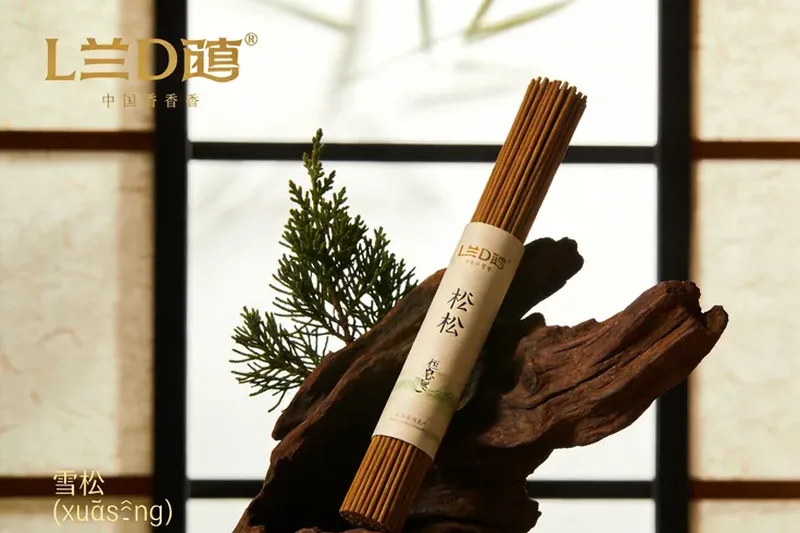
Data summary: “Cedar” in incense is a confusing common name. It can mean true cedar (Cedrus species, such as Himalayan cedar C. deodara) or — very often in “cedarwood” products — red cedar (Juniperus virginiana), a juniper, not a true cedar. Both are used for a clean, woody, slightly sweet aroma.
Key facts
| Chinese | 雪松 (xuěsōng) — “snow cedar” (true cedar) |
| Botanical source | Cedrus spp. (true cedar); “cedarwood” often Juniperus virginiana (red cedar) |
| What it is | A fragrant wood (and its essential oil) |
| Aroma | Woody, clean, slightly sweet/resinous |
| Traditional role | Incense, meditation, woodworking |
Aroma profile
Direct answer: Cedar is a dry, clean wood note — slightly sweet and resinous, without the creamy richness of sandalwood or the deep resin of agarwood. The exact character depends on which “cedar” is used: true Cedrus reads warm and balsamic, while red cedar (Juniperus virginiana) reads sharper and more pencil-like.
Cedar has a clean, woody, slightly sweet-and-resinous aroma — a “dry wood” note distinct from the creamy sweetness of sandalwood or the resinous depth of agarwood. It is a common base or blending wood. The two main “cedars” differ in register: true Cedrus is warmer and more balsamic, while Juniperus virginiana (red cedar) is brighter, sharper, and more pencil-box in character.
Botanical identity
Direct answer: “Cedar” is not one plant. True cedar is the genus Cedrus in the pine family (Pinaceae), while much commercial “cedarwood” is Juniperus virginiana, a juniper in the cypress family (Cupressaceae). The Chinese name 雪松 denotes the true Cedrus; the English common name covers at least two unrelated families.
Two plant families sit behind the word “cedar”:
- True cedars — the genus Cedrus, in the pine family (Pinaceae). The species are C. deodara (Himalayan/Deodar cedar), C. atlantica (Atlas cedar), C. libani (Lebanon cedar), and C. brevifolia (Cyprus cedar).
- “Cedarwood” in trade — frequently Juniperus virginiana (eastern redcedar), a juniper in the cypress family (Cupressaceae), and sometimes Western redcedar (Thuja plicata), also Cupressaceae.
The Chinese name 雪松 (xuěsōng, “snow cedar”) specifically denotes true Cedrus, which is why a Chinese ingredient list is more precise than an English one that simply says “cedar.” See Cedrus in Flora of China and Cedrus on GBIF.
Chinese name and terminology
Direct answer: Chinese 雪松 (xuěsōng) is the true cedar (Cedrus). It is distinct from 杜松 (dùsōng, common juniper Juniperus communis) and 崖柏 (yábǎi, Thuja sutchuenensis), two other conifers with cedar-adjacent aromas. The three are different families and parts, and Chinese names keep them separate.
雪松 (xuěsōng) is not the only Chinese conifer name a buyer will meet. Three conifers with overlapping, woody-clean aromas carry distinct names:
- 雪松 (cedar) — true Cedrus (Pinaceae). This entry.
- 杜松 (juniper) — common juniper Juniperus communis (Cupressaceae); brighter and drier than cedar. See juniper.
- 崖柏 (thuja) — Thuja sutchuenensis (Cupressaceae), a rare, protected Sichuan/Chongqing conifer with a cedar-like, faintly smoky note. See thuja.
Where English lumps several of these under “cedarwood,” the Chinese terms separate them by species, which is a useful guard against a mislabeled product.
Where does cedar come from?
Direct answer: True cedars are mountain conifers: C. deodara from the western Himalaya, C. atlantica from the Atlas Mountains of Morocco and Algeria, and C. libani from the mountains of Lebanon, Syria, and southern Turkey. Red cedar (J. virginiana) is a widespread tree of eastern North America.
The geographic origin depends entirely on which species the name “cedar” means:
- Cedrus deodara — the western Himalaya, from Afghanistan through Pakistan and northern India into Nepal and western Tibet.
- Cedrus atlantica — the Atlas Mountains of Morocco and Algeria.
- Cedrus libani — the mountains of Lebanon, Syria, and southern Turkey.
- Juniperus virginiana (red cedar) — eastern North America, a common and fast-growing tree.
True cedars are mountain conifers with a limited natural range; red cedar is an abundant lowland and upland tree. This difference in abundance matters for both price and sourcing (see Sustainability below).
The naming problem (buyer intelligence)
Direct answer: “Cedar” is among the most ambiguous names in fragrance. A label saying “cedarwood” frequently means Juniperus virginiana (a juniper), not true Cedrus. Because the species — not the word “cedar” — sets the actual aroma and price, the label should name the genus.
“Cedar” is one of the most ambiguous names in fragrance:
- True cedars (Cedrus spp.) — e.g. Himalayan cedar (C. deodara), Atlas cedar (C. atlantica), Lebanon cedar (C. libani).
- “Cedarwood oil” in commerce frequently comes from red cedar (Juniperus virginiana) — which is a juniper, not a cedar.
- Other “cedar” names (Western red cedar Thuja plicata, etc.) add further confusion.
When you see “cedar” on a label, the actual species matters for aroma and price.
In incense & tradition
Direct answer: Cedar is used in incense as a clean, dry base or background note that fills a room without dominating it. It reads “quiet and clean” rather than sweet or deep, so it is usually paired with a resin or a warmer wood rather than burned as a solo statement.
Cedar’s clean, dry wood note makes it a common background or base in incense blends, and a familiar scent in meditation and woodworking contexts. It reads “quiet and clean” rather than “sweet or deep,” which is why it is usually paired with a resin or a warmer wood rather than burned as a solo statement.
In Chinese incense the naming deserves care: 雪松 (xuěsōng) is true cedar (Cedrus), while several “cedarwood” products in commerce come from Juniperus virginiana (red cedar) or other conifers. The species — not the word “cedar” — sets the actual aroma, and the two are not interchangeable.
Where cedar sits among the woods
Direct answer: Among the main incense woods, cedar is the lightest — dry, clean, and slightly sweet-resinous — filling a room without dominating it. Sandalwood is creamy and warm, and agarwood is deep and resinous; cedar sits below both in weight.
| Wood | Character |
|---|---|
| Cedar | Dry, clean, slightly sweet-resinous — a light, “space-clearing” note |
| Sandalwood | Creamy, sweet, soft — a warm, prized base |
| Agarwood | Deep, resinous, sweet-complex — the most precious material |
Cedar is the lightest of the three: it fills a room without dominating it, which is why it works as a base or a background scent rather than a starring note.
How is cedar processed?
Direct answer: Cedar is used as wood — chips, shavings, or ground powder — or as steam-distilled cedarwood oil. The wood forms need only cutting and (for powder) grinding; the oil is a separate distilled product whose character depends on whether the source is Cedrus or Juniperus.
Cedar reaches incense in two processing paths:
- Wood — the aromatic heartwood is cut into chips or shavings for warming, or ground to powder for blending into sticks and cones. No extraction step is involved in the wood forms.
- Essential oil — “cedarwood oil” is steam-distilled from the wood; oil from Cedrus (Atlas or Himalayan) differs from oil from Juniperus virginiana, so the source species sets the oil’s character.
For powder buyers, particle size and moisture content are the practical variables, but the exact target depends on the stick formula, binder, and production line — no single figure transfers between recipes. The mechanics sit within the wider how incense is made process.
What determines cedar quality?
Direct answer: Species is the decisive variable — true Cedrus and red cedar (J. virginiana) are different materials. After species, the aromatic oil concentrates in the heartwood, so heartwood content, age, cleanliness, and (for powder) particle consistency drive quality.
The quality factors, in rough order:
- Species — true Cedrus vs red cedar (J. virginiana) vs other conifers; a different material, not a grade.
- Heartwood content — the fragrant oil concentrates in the heartwood, so a clean heartwood piece beats one mixed with pale sapwood.
- Age and oil content — denser, more resinous heartwood reads richer and longer-lasting.
- Cleanliness and form — freedom from rot and debris, and (for powder) consistent particle size.
None of these is a standardized grading system; cedar, unlike agarwood, is not graded by a formal density or origin ladder in the trade.
Common forms
Direct answer: Cedar is sold as wood chips and shavings, ground powder, and cedarwood essential oil. Chips and shavings suit warming, powder suits stick-making, and the oil is a separate distilled product that may come from Cedrus or Juniperus.
| Form | Typical use |
|---|---|
| Chips / shavings | Warmed on charcoal or an electric heater; sachet and closet use |
| Powder | Blended into incense sticks and cones |
| Cedarwood oil | Fragrance; the species (Cedrus vs Juniperus) sets the character |
The distinction between chips, shavings, and powder is functional, not a quality statement — the same wood in different physical forms. See incense powder & resin for how wood powder behaves in practice.
Traditional use vs modern evidence
Direct answer: Much “cedarwood incense” content repeats claims about relieving anxiety, insomnia, and depression. These are traditional or unverified claims, not established clinical fact. Cedar’s aromatic and woodworking use is documented; its “calming” reputation is traditional language, not clinical evidence.
Much “cedarwood incense” content repeats claims about relieving anxiety, insomnia, and depression. These are traditional or unverified claims, not established clinical fact.
- Traditional Use — cedar is burned for its clean, “space-clearing” aroma in meditation and room-freshening, and valued in woodworking for its scent and durability.
- Historical Record — true cedars (C. libani in particular) carry a long cultural record as timber and aromatic wood in the eastern Mediterranean and western Asia.
- Scientific Evidence — the wood’s essential oil is studied for its volatile chemistry, but we present no clinical or medical efficacy claims.
We describe cedar’s aromatic use; we do not make medical claims.
Adulteration & misidentification
Direct answer: The main buying risk is naming, not counterfeiting: “cedarwood” oil or wood is often Juniperus virginiana or another conifer sold without the species named. Both are legitimate aromatic woods, but they differ in aroma and price, so the label should state the genus.
Unlike agarwood, cedar is not commonly “faked” with dyed or injected material; its risk is species substitution under a shared common name. A buyer who wants the warm, balsamic note of true Cedrus should not unknowingly receive the sharper, pencil-like Juniperus virginiana — or vice versa. The two are told apart by aroma register and by the botanical name on the label; this is a labeling and identification matter, not a counterfeit-versus-genuine issue in the agarwood sense.
Sustainability & sourcing
Direct answer: Some true cedars — notably Lebanon cedar — have a long history of overharvesting and a reduced wild range, while eastern redcedar (J. virginiana) is abundant and fast-growing. Sourcing should confirm the genus, since the conservation story differs sharply between Cedrus and Juniperus.
The sustainability picture is split by genus:
- True cedars (Cedrus) are slower-growing mountain conifers; Lebanon cedar (C. libani) in particular has a documented history of overexploitation and a much-reduced natural range.
- Red cedar (Juniperus virginiana) is an abundant, fast-spreading tree across eastern North America and carries no equivalent scarcity concern.
For a buyer this is a sourcing question, not a legal one: confirm which genus the material is, because the conservation profile — and therefore the responsible-sourcing expectation — differs between the two. See the wholesale guide for the general sourcing framework.
Modern commercial applications
Direct answer: Cedar is used in incense, in cedar chests and closet liners for its aromatic (and reputed moth-repellent) character, and as cedarwood essential oil in fragrance. Red cedar also has a long industrial use, from pencil wood to pet bedding shavings.
Cedar reaches the market through several channels:
- Incense — the wood and powder are blended as a clean base note.
- Aromatic storage — cedar chests and closet liners use the wood’s scent and its long-standing (traditional, not clinically proven) reputation for deterring moths.
- Essential oil — “cedarwood oil” is a fragrance and aromatics ingredient; whether it is Cedrus or Juniperus sets the character and the price.
- Industrial uses — red cedar has historically been used for pencil wood and aromatic shavings (such as pet bedding).
What buyers should look for
Direct answer: Buyers should pin down the genus first — true Cedrus or Juniperus (or another conifer) — then the form, and, for oil, the source species. For powder, confirm particle size and moisture against the formula rather than accepting a generic “cedar” label.
For an incense maker or sourcing buyer:
- Genus — Cedrus vs Juniperus (vs another conifer); a real seller names the species.
- Form — chips, shavings, powder, or oil; each behaves differently in a blend.
- Oil source — “cedarwood oil” should state whether it is Cedrus or Juniperus virginiana, since they differ in aroma and cost.
- Powder consistency — confirm particle size and moisture, and test a sample against your formula rather than accepting a nominal “cedar.”
Safety
Incense combustion produces smoke and particulate matter. Burn in a well-ventilated space; avoid inhaling concentrated smoke.
Our Industry View
Direct answer: In manufacturing, the word “cedar” is a specification problem, not a material. Because it names two unrelated families with different aromas, the first requirement is a named genus; after that, particle size, moisture, and batch consistency follow the same logic as any wood powder — and the exact target depends on formulation.
From a manufacturing perspective, cedar’s defining issue is that the name does not identify the material. “Cedarwood” can be Cedrus or Juniperus virginiana — two plants with different aromas, densities, and prices — so a formula built on one will not reproduce if the source switches silently to the other.
Two further points follow:
- Species is a specification, not a detail. Because true cedar is warm and balsamic while red cedar is sharp and pencil-like, the choice changes the entire character of a blend. A buyer who approves a sample of one genus has not approved the other.
- Particle size and moisture affect behavior, not just aroma. In powder, particle size changes how the material packs, draws air, and burns; moisture changes how it grinds and how the finished stick dries. The right target depends on formulation — the binder, the other ingredients, and the production line — so a figure that works in one factory is not transferable to another.
In our view, the commercial sweet spot is a named genus, bought in a consistent form, used as a clean base note rather than a lead — and never accepted on the strength of the word “cedar” alone.
Summary
Cedar is a dry, clean, slightly sweet-resinous wood note that appears in incense under a confusing common name: true cedar (Cedrus, pine family) versus “cedarwood” often meaning red cedar (Juniperus virginiana, a juniper). Chinese 雪松 (xuěsōng) denotes the true Cedrus, and it is distinct from 杜松 (juniper) and 崖柏 (thuja). Its value rests on genus, heartwood content, and consistency rather than rarity, and its “calming” reputation is traditional language, not clinical evidence. In incense it is a light base or background note; commercially, naming the genus is the first requirement.
FAQ
Is “cedarwood” a true cedar? Often not. Commercial “cedarwood” oil is frequently distilled from red cedar (Juniperus virginiana), which is a juniper, not a true cedar in the genus Cedrus. True cedars include Himalayan cedar (C. deodara), Atlas cedar (C. atlantica), and Lebanon cedar (C. libani). Other plants called “cedar,” such as Western red cedar (Thuja plicata), add further confusion. Because the common name “cedar” covers several unrelated conifers, the actual species on the label determines the aroma, and it is worth checking which one you are buying.
What does cedar incense smell like? Cedar incense has a clean, woody, slightly sweet-resinous aroma — a “dry wood” note, distinct from the creamy sweetness of sandalwood or the resinous depth of agarwood. It reads “quiet and clean” rather than sweet or deep, which is why it often serves as a base or background note in blends. The scent fills a room without dominating it, so cedar is usually paired with a resin or a warmer wood rather than burned as a solo statement.
What is the difference between cedar and sandalwood? Cedar is a dry, clean, slightly sweet-resinous wood note, while sandalwood is creamy, sweet, and soft. Cedar tends to be lighter and sharper, with a “space-clearing” quality, whereas sandalwood is rounder, warmer, and more prized as a base note. Both are woody, but they sit at different weights in a blend: cedar provides a clean, airy background, and sandalwood anchors with a rich, milky sweetness. They are distinct aromas from different botanical sources.
Which cedar is used in incense? It varies. True cedars (genus Cedrus), such as Himalayan cedar (C. deodara) and Atlas cedar (C. atlantica), are one source of the woody note. But much commercial “cedarwood” oil actually comes from red cedar (Juniperus virginiana), a juniper rather than a true cedar. Because these are different plants with different aromas, the species matters for both scent and price. When a label simply says “cedar,” the actual source is worth checking before buying.
Is cedar incense safe for pets? All incense produces smoke and particulate matter, and that general caution applies to pets as well as people. Burn incense in a well-ventilated space, avoid letting smoke concentrate, and keep lit material and ash out of reach of children and pets, who may be more sensitive to airborne particles or curious about burning objects. This is general safety guidance that applies to every incense material, not a claim about any specific condition or about cedar in particular.
What is the difference between cedar, sandalwood, and agarwood? Cedar, sandalwood, and agarwood are three woods at three different weights. Cedar is dry, clean, and light — a “space-clearing” note that fills a room without dominating it. Sandalwood is creamy, sweet, and warm, a prized base note. Agarwood is deep, resinous, and sweet-complex, the most precious of the three. They come from different plants — cedar from Cedrus or juniper, sandalwood from Santalum album, and agarwood from resin-impregnated Aquilaria wood — and each fills a different role in a blend.
See also: thuja, juniper, sandalwood, and the full scent guide.
Evidence & Sources
Botanical identity
Source: Cedrus in Flora of China · Cedrus on GBIF. Evidence type: Established.
Traditional Chinese use
Source: this page records cedar’s clean, dry wood note in incense blends and meditation settings, with the 雪松 (true cedar) naming note. Evidence type: Historically documented — traditional use, not modern clinical evidence.
Authenticity / adulteration
Source: the naming problem — commercial “cedarwood” oil is often Juniperus virginiana (red cedar), not true Cedrus. Evidence type: Practical screening.
Safety
Source: incense combustion produces smoke and particulate matter; burn in a well-ventilated space. Evidence type: Established.
Evidence status
| Layer | Status |
|---|---|
| Botanical identity | Established |
| Traditional use | Historically documented |
| Authenticity test | Practical screening |
| Health claims | Not established |
Sources
Sources: botanical references on Cedrus and Juniperus virginiana, plus the observation that commercial “cedarwood” claims are widely overstated. This is editorial knowledge content, not medical advice.