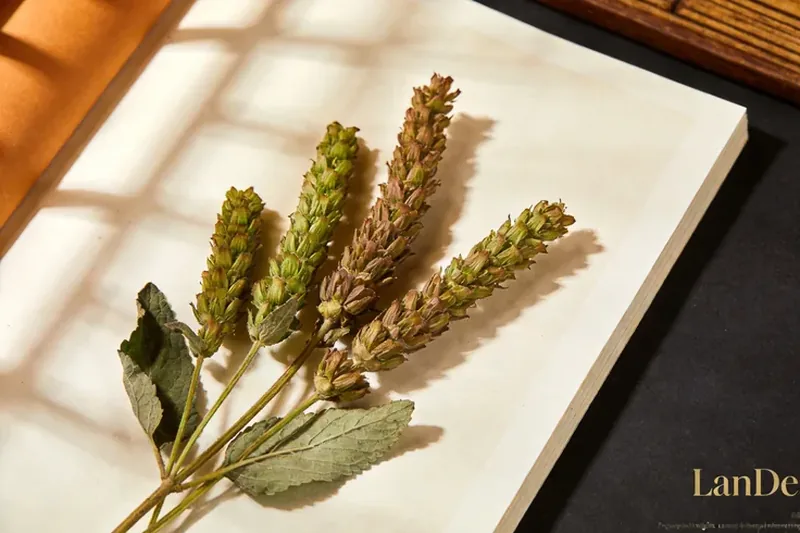
Direct answer: Agastache (藿香, huòxiāng) is the fragrant herb Agastache rugosa (Chinese giant hyssop), in the mint family. It is a classical Chinese incense and materia-medica herb with a minty, anise-like aroma. It is frequently confused with patchouli, a different plant; the two share the 藿香 name in Chinese, a standing source of error.
Key facts
| Chinese | 藿香 (huòxiāng), also 土藿香 |
| Botanical source | Agastache rugosa (family Lamiaceae) — the dried herb |
| What it is | A dried aromatic herb, not a wood or resin |
| Aroma | Minty, herbal, slightly sweet, anise-like |
| Traditional role | 合香 (blended incense), scenting clothes, materia medica |
Aroma profile
Direct answer: Agastache has a minty, herbal, slightly sweet aroma with an anise-like undertone — a fresh, green-herbal note rather than a deep or smoky one. It is a bright blender that lifts a formula with a clean minty lift, quite different from the earthy, woody-balsamic scent of patchouli (广藿香).
Agastache has a minty, herbal, slightly sweet aroma with an anise-like undertone — a fresh, green-herbal note rather than a deep or smoky one. It is a bright blender, lifting a formula with a clean minty lift, and it is also valued for scenting fabric and clothing. Its character is the clean opposite of patchouli’s: where 广藿香 is earthy, woody, and balsamic, 藿香 is fresh, green, and anise-sweet.
Botanical identity
Direct answer: Agastache rugosa is a mint-family (Lamiaceae) perennial herb, with erect stems 0.5–1.5 m tall, cordate-ovate to oblong-lanceolate leaves 4.5–11 cm long, and purplish-blue flowers from June to September. Flora of China records it as widely distributed but cultivated as a medicinal plant in China, Japan, Korea, Russia, and North America.
Agastache rugosa is a perennial herb of the mint family (Lamiaceae). Flora of China describes erect stems 0.5–1.5 m tall, heart-shaped to oblong-lanceolate leaf blades 4.5–11 × 3–6.5 cm with serrate margins, and purplish-blue flowers (June–September). It is “widely distributed, but cultivated as a medicinal plant in China,” with a range reaching Japan, Korea, Russia, and North America. The genus Agastache — the “giant hyssops” — is not the same as true hyssop (Hyssopus officinalis), another mint-family aromatic with a different character. See Agastache rugosa in Flora of China and on GBIF.
Chinese name and terminology
Direct answer: The name 藿香 is shared across two different plants, which is the whole problem: 藿香 (this page) is Agastache rugosa, the native Chinese giant hyssop, while 广藿香 is Pogostemon cablin, patchouli. The prefix 土 (native) in 土藿香 marks the local agastache against the imported patchouli.
The terminology carries real risk, because one Chinese name covers two plants:
- 藿香 / 土藿香 — Agastache rugosa, the native Chinese giant hyssop. “土” (native) marks it as the local plant. This entry.
- 广藿香 — Pogostemon cablin, patchouli, an imported, earthy, balsamic mint-family plant. See patchouli.
A label that says only “藿香” is underspecified: it could mean a fresh, anise-minty herb or an earthy, woody resin-note leaf — different plants, different scents, different uses.
The 藿香 / 广藿香 confusion (read this)
Direct answer: Two different mint-family plants share the name “藿香” in Chinese. 藿香 is Agastache rugosa (fresh, minty-anise); 广藿香 is Pogostemon cablin, patchouli (earthy, woody, balsamic). Because they were traded together and share the name, they have been conflated for centuries — a label saying only “藿香” does not identify the material.
This is the key disambiguation for this material. Two different plants share the name “藿香” in Chinese:
- 藿香 (this page) — Agastache rugosa, the native Chinese giant hyssop, a Lamiaceae herb with a minty-anise aroma.
- 广藿香 — Pogostemon cablin, patchouli, a different Lamiaceae plant with an earthy, woody, balsamic scent (treated on this site as patchouli).
The classical name 藿香 primarily meant Agastache rugosa, but because the two plants were traded together and share the name, they have been conflated for centuries. The practical consequence is the same today as it was historically: a buyer must confirm which species a “藿香” label means, because the two scents are not interchangeable.
Where does agastache come from?
Direct answer: Agastache is native to East Asia and widely distributed. Flora of China records it as “widely distributed” in China and cultivated as a medicinal plant, with a range extending to Japan, Korea, Russia, and North America. It is a common garden and medicinal herb, not a scarce or restricted material.
Agastache rugosa is a common, widely distributed herb rather than a rarity. Flora of China describes it as “widely distributed” in China and cultivated as a medicinal plant, with the species also recorded in Japan, Korea, Russia, and North America. This ubiquity matters commercially: unlike patchouli — which is a specific cultivated leaf crop with its own supply chain — agastache is an easily grown herb with no scarcity premium, which is part of why it functions as a fresh, everyday blender rather than a costly pillar note.
Why is it used in incense?
Direct answer: Agastache is a classical fresh-herb ingredient in 合香 (blended incense), contributing a minty, green lift to a formula. It is also recorded for scenting clothing. Its role is that of a bright top-note herb — a clean, fresh lift — rather than a deep base or a solo fragrance.
Agastache’s role in incense is as a fresh, minty-herbal blender. In 合香 it lifts a formula with a clean, green, anise-sweet note, and classical sources also describe putting it in clothing to scent the fabric. It is a bright top note — not a deep or smoky base — and it is almost always blended rather than burned alone. Its Buddhist-sutra names (below) are a record of how central this fresh herb was to the incense traditions that entered China with Buddhism, which is a stronger claim to importance than its modest scent profile alone would suggest.
How is it processed?
Direct answer: Agastache is used as the dried aerial herb — stems and leaves — harvested at flowering, cleaned, and dried whole, then kept as loose herb or ground to powder for blending. No extraction step is needed for the incense herb; it is a dried-leaf material, not a resin or oil.
The part used is the dried aerial herb — stems, leaves, and flowering tops — gathered and dried. Processing is simple:
- Dried herb — whole or lightly crushed, for loose blends and clothing-sachets.
- Powder — ground herb for blending into sticks and cones; particle size and moisture affect how the powder packs and burns.
The mechanics of grinding and forming sit within the wider how incense is made process, and the powder-handling behavior is covered in incense powder & resin.
What determines agastache quality?
Direct answer: Quality turns on freshness and scent retention: the dried herb should smell clean and minty-anise, without mustiness or a faded, brown appearance. The decisive commercial question is species identity — confirming it is Agastache rugosa (藿香), not patchouli (Pogostemon cablin, 广藿香), since the two are different materials.
The practical quality points, in rough order:
- Species identity — 藿香 (Agastache rugosa) vs 广藿香 (Pogostemon cablin, patchouli); a different plant, not a grade. Confirm which a label specifies.
- Freshness and aroma — the dried herb should smell clean, minty, and anise-like, without mustiness.
- Cleanliness — freedom from stems, soil, and foreign material.
- Color and condition — a green, intact herb beats a brown, faded, or shattered one.
Agastache carries no standardized grading ladder — it is an abundant herb, not a graded resin or wood — so quality means freshness, cleanliness, and correct species.
Common forms
Direct answer: Agastache is sold as dried whole herb, crushed herb, and ground powder. The forms are the same herb in different physical states — leaf for blends and sachets, powder for stick-making — and none is a quality statement in itself.
| Form | Typical use |
|---|---|
| Dried herb | Loose blends, clothing-sachets |
| Crushed herb | Blends, potpourri |
| Powder | Incense sticks and cones |
In Chinese tradition
- 合香 (blended incense): 藿香 is a classical fresh-herb ingredient in blended incense, contributing a minty, green lift.
- Scenting clothes: classical sources describe putting 藿香 in clothing to scent it — 可着衣服中.
- Buddhist naming: 藿香 carries several Buddhist-sutra names — 多摩羅跋香 (tāmalapatra), 兜娄婆香, 钵怛罗香, 迦筭香 — a sign of its importance in Buddhist incense practice.
- Materia medica: 藿香 is a major traditional-medicine herb, classically described for “transforming dampness” (化湿) and related uses. This is traditional materia-medica language, not modern clinical evidence.
Traditional use vs modern evidence
Direct answer: Agastache’s aromatic and cultural roles — incense, clothing-scenting, and its Buddhist-sutra names — are well documented. Its medicinal uses are traditional, not established clinical fact, and this page makes no medical claims. The documented non-medical facts are its botanical identity and its long use as a fresh, minty incense herb.
- Traditional Use — 藿香 is a classical fresh-herb ingredient in 合香 and a clothing-scenting herb.
- Historical Record — the Song-dynasty Xiangpu (香譜) records 藿香 under the Buddhist name 多摩羅跋香; the Ming Xiangcheng (香乘) records the sutra names and the clothing-scenting use (可着衣服中).
- Scientific Evidence — the essential oil’s chemistry is characterized, but we present no clinical or medical efficacy claims.
The aromatic and cultural roles are well documented. The medicinal uses are traditional, not established clinical fact, and we make no medical claims.
What buyers should look for
Direct answer: Buyers should first confirm species — 藿香 (Agastache rugosa) vs 广藿香 (Pogostemon cablin, patchouli) — then check that the dried herb is clean, fresh, and minty rather than musty. For powder, confirm particle size and moisture against the formula rather than accepting a generic “藿香” label.
For an incense maker or sourcing buyer:
- Species — 藿香 (agastache) vs 广藿香 (patchouli); ask, because the label often does not say, and the two scents are not interchangeable.
- Freshness — the herb should smell clean and minty-anise, not musty or faded.
- Cleanliness — freedom from stems and foreign material.
- Powder consistency — confirm particle size and moisture, and test a sample against your formula.
Our Industry View
Direct answer: The commercial issue with 藿香 is not quality but identity: the name covers two unrelated-scented plants, so the first requirement is a named species. After that, agastache behaves as a fresh, abundant top-note herb — buy it for freshness and consistency, not rarity.
From a manufacturing perspective, agastache’s defining problem is that the name 藿香 does not identify the material. It can mean the fresh, anise-minty Agastache rugosa or the earthy, balsamic patchouli Pogostemon cablin — two plants a buyer would never substitute for one another if they could smell the difference. Two points follow:
- Species is a specification, not a detail. A formula built on the fresh minty lift of 藿香 will not reproduce if the supply switches silently to the earthy depth of 广藿香. A buyer who approves a sample of one has not approved the other.
- It is an abundant herb, so consistency is the real value. Unlike patchouli, which has its own crop-and-distillation supply chain, agastache is a common garden herb with no scarcity premium. The buyer’s leverage is in freshness and batch-to-batch consistency — a steady, clean, correctly named leaf beats a rare-sounding label.
In our view, the commercial sweet spot is a named species bought fresh and consistent, used as a bright top-note blender — and never accepted on the strength of the shared name “藿香” alone.
Summary
Agastache (藿香) is Agastache rugosa, a mint-family perennial native to East Asia and widely cultivated, used in Chinese incense as a fresh, minty-anise blender and for scenting clothes. Its defining commercial risk is naming: it shares the 藿香 name with patchouli (Pogostemon cablin, 广藿香), a different plant with an earthy, balsamic scent. Its value rests on freshness and correct species rather than rarity, its Buddhist-sutra names attest to its historical importance, and its medicinal uses are traditional language, not clinical evidence.
FAQ
Is 藿香 the same as patchouli? No. 藿香 (Agastache rugosa) is the native Chinese giant hyssop with a minty, anise-like aroma; patchouli is Pogostemon cablin (广藿香), a different mint-family plant with an earthy, woody, balsamic scent. They share the “藿香” name in Chinese, which is why they have been conflated for centuries, but they are different plants with different scents — see our patchouli page.
What does agastache smell like? Agastache (藿香) has a minty, herbal, slightly sweet aroma with an anise-like undertone — a fresh, green-herbal note. It is a bright blender, lifting a formula with a clean minty lift, and it is also used to scent fabric. It is quite different from the earthy, woody scent of patchouli.
What is 土藿香? 土藿香 (“earth/native agastache”) is another name for Agastache rugosa, the native Chinese agastache, used to distinguish it from 广藿香 (Pogostemon cablin, patchouli). The “土” (native) prefix marks it as the local plant rather than the imported patchouli. The two are different species despite sharing the “藿香” name.
How is agastache used in incense? Agastache is a classical fresh-herb ingredient in 合香 (blended incense), contributing a minty, green lift. Classical sources also describe placing it in clothing to scent the fabric (可着衣服中). It carries several Buddhist-sutra names — 多摩羅跋香 (tāmalapatra) and others — reflecting its role in Buddhist incense practice.
Why does agastache have so many Buddhist names? Because it was a valued aromatic in Buddhist incense practice, and the sutras recorded it under several transliterated names — 多摩羅跋香 (tāmalapatra, from the Sanskrit for a fragrant leaf), 兜娄婆香, 钵怛罗香, and 迦筭香. The proliferation of names is a record of the herb’s importance across the incense traditions that entered China with Buddhism, not a sign of confusion about the plant itself.
Is agastache the same as hyssop? No. Agastache is Agastache rugosa, sometimes called “Chinese giant hyssop,” but it is not the same as true hyssop (Hyssopus officinalis), a different mint-family plant. The shared English common name “hyssop” is a loose convenience, not a botanical identity — the two are distinct genera with different aromas and uses.
See also: patchouli, mugwort, elsholtzia, paicao and the full scent guide.
Evidence & Sources
Botanical identity
Source: Agastache rugosa in Flora of China · Agastache rugosa on GBIF. Evidence type: Established.
Traditional Chinese use
Source: the Song-dynasty Xiangpu (香譜) records 藿香 under the Buddhist name 多摩羅跋香 (《釋氏會要》); the Ming Xiangcheng (香乘) records the sutra names (法华经 多摩罗跋香, 楞严经 兜娄婆香, etc.) and the clothing-scenting use (可着衣服中). Evidence type: Historically documented — traditional, not modern clinical evidence.
Authenticity / disambiguation
Source: the 藿香 (Agastache rugosa) vs 广藿香 (Pogostemon cablin, patchouli) distinction. Evidence type: Practical screening.
Safety
Source: incense combustion produces smoke and particulate matter; burn in a well-ventilated space. Evidence type: Established.
Evidence status
| Layer | Status |
|---|---|
| Botanical identity | Established |
| Traditional use | Historically documented |
| Authenticity test | Practical screening |
| Health claims | Not established |
Sources
Sources: botanical references on Agastache rugosa and the Song-dynasty Xiangpu (香譜) / Ming Xiangcheng (香乘) records of 藿香. The 藿香 / 广藿香 (patchouli) distinction is recorded as practical screening. Medicinal uses are treated as traditional, not established clinical fact. This is editorial knowledge content, not medical advice.