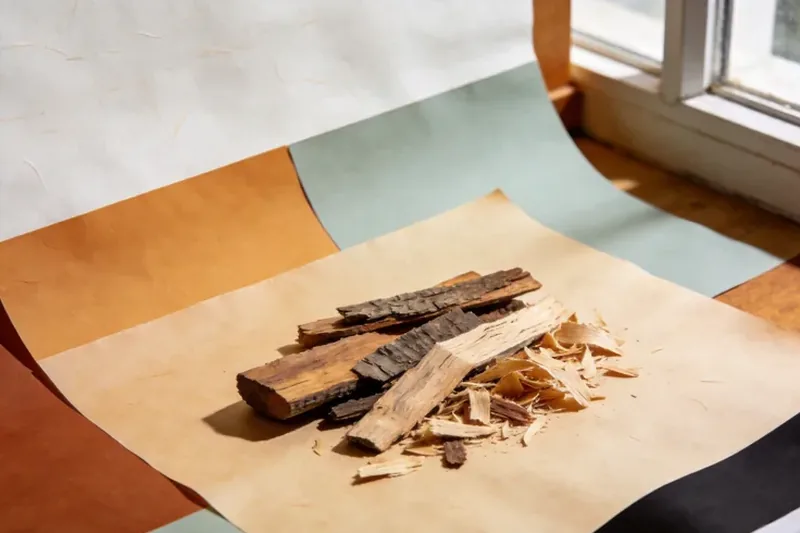
Direct answer: Red sandalwood (紫檀, zǐtán) is the dense, deep crimson heartwood of Pterocarpus santalinus, a leguminous tree of southern India. It is a hard, heavy dye-and-carving wood whose dark-red pigment (santalin) has been prized for centuries, and whose finely-ground wood is used in Chinese incense as a sweet, softly spicy fragrant wood. It is not the same material as sandalwood (檀香, Santalum album).
Key facts
| Chinese | 紫檀 (zǐtán), also 紫檀木 / 紫檀香 |
| Botanical source | Pterocarpus santalinus (family Fabaceae) — the heartwood |
| What it is | A dense red heartwood, used as wood, powder, and dye |
| Aroma | Woody, sweet, faintly rosy and spicy when heated |
| Traditional role | Fragrant wood, carving wood, red dye; classical incense material |
Aroma profile
Direct answer: Red sandalwood is woody and sweet rather than resinous or sharp — a soft, slightly rosy, gently spicy note that develops on gentle heating. It is a subtle supporting wood, not a loud top note, and its defining trait is the vivid red heartwood that doubles as dye.
Red sandalwood’s scent is woody and sweet rather than resinous or sharp — a soft, slightly rosy, gently spicy note that develops on gentle heating. The wood is dense and burns slowly. The vivid red color is its signature: the heartwood yields the red dye santalin, and this pigment is why the wood has been cut, carved, and traded as much for its color as for its scent. This is the rare case where the appearance of an incense ingredient is nearly as important as its aroma — a fact that shapes everything from grading to adulteration.
Botanical identity
Direct answer: Pterocarpus santalinus is a small to medium leguminous tree (Fabaceae) native to the dry deciduous forests of southern India. The part used is the dark, extraordinarily dense heartwood; the pale outer sapwood is of little value. It is unrelated to true sandalwood (Santalum album, Santalaceae).
Pterocarpus santalinus is a small to medium tree native to the dry deciduous forests of southern India, chiefly the Eastern Ghats. The part used is the dark heartwood, which is extraordinarily dense and hard. The tree is a legume (Fabaceae), unrelated to the true sandalwood Santalum album (檀香, Santalaceae) — a distinction that matters because the two are frequently confused in English. See Pterocarpus santalinus on GBIF.
Chinese name and terminology
Direct answer: The name 紫檀 means “purple/violet sandalwood” — 紫 (deep red-purple) + 檀 (the aromatic wood register) — but the “檀” is honorific, not botanical: 紫檀 and 檀香 are unrelated plants. The shared character is the source of the English confusion.
The Chinese name 紫檀 (zǐtán) is literal: 紫 “deep red-purple” + 檀, the character that names a whole class of prized aromatic woods. The point to hold onto is that 檀 is a category of honor, not a family: 檀香 (true sandalwood, Santalum album) and 紫檀 (red sandalwood, Pterocarpus santalinus) and 降真香 (jiangzhenxiang) are all “檀”-class fragrant woods in the classical register, but they are unrelated plants. The English word “sandalwood,” which merges 檀香 and 紫檀, is where the confusion lives — and it is a genuine trap for a buyer who assumes “red sandalwood” is a colored form of sandalwood.
紫檀 as a naming problem (read this)
Direct answer: 紫檀 in Chinese has never reliably named a single species. Historically it covered several dark, dense rosewoods; in modern commerce, cheaper red woods are passed off under the name. The practical lesson is that “紫檀” names a color-and-density profile more than a botanical identity — so species and origin must be pinned down separately.
Here is the deep problem with 紫檀, and it is a naming problem, not a chemistry problem:
- The historical looseness. In classical Chinese usage, 紫檀 did not always name Pterocarpus santalinus alone. The term functioned as a premium category for dark, dense, red-purple hardwood — so different rosewoods and dark tropical hardwoods could all travel as “紫檀.” A classical text that says 紫檀 may be pointing at a class of material, not a specific tree.
- The modern substitution. Because genuine Pterocarpus santalinus is scarce and CITES-regulated, commerce substitutes other red or dyed woods — dyed Dalbergia rosewoods, bloodwood, and other reddish tropical timbers — under the name 紫檀. The red color is easy to imitate; the density and provenance are not.
- The “sandalwood” false friend. In English, “red sandalwood” sits misleadingly beside “sandalwood,” suggesting a relationship that does not exist. The two are different families, different continents, and different materials: one is bought for its fragrant oil, the other largely for its color and hardness.
This page describes 紫檀 = Pterocarpus santalinus. The practical consequence for a buyer is to treat 紫檀 as a claim that must be verified against species and origin — exactly the discipline the incense authentication database walks through.
Where does red sandalwood come from?
Direct answer: Red sandalwood comes from the dry deciduous forests of southern India, chiefly the Eastern Ghats, where Pterocarpus santalinus grows wild. It is a slow-growing tree with a limited natural range, which — combined with centuries of demand for its dye and timber — is why the species is scarce and trade-restricted.
Pterocarpus santalinus is native to a restricted zone of southern India, the dry deciduous forests of the Eastern Ghats in Andhra Pradesh and adjacent areas. It grows slowly and is harvested for the dark heartwood that accumulates over decades. This narrow wild range and slow growth are the root of its conservation status: over-harvesting for the valuable red timber and dye led to the species being listed under CITES Appendix II in 2019, so international trade is now monitored and permitted rather than free.
Why is it used in incense?
Direct answer: Red sandalwood is used in incense as a dense, sweetly woody supporting wood that burns slowly and lends a soft rosy-spicy warmth to a blend. It is also, unusually, a visual ingredient — the red powder colors a formula — which gives it a dual role most aromatic woods do not have.
In Chinese incense, 紫檀 reads as a dense, sweetly woody supporting wood: it anchors a blend with a slow-burning, gently spicy warmth rather than a bright top note. Its role is partly structural — a heavy, slow, steady wood — and partly aromatic. But it carries a second, often-overlooked function: because the heartwood is vividly red, ground 紫檀 colors the powder it is mixed into. This dual identity (fragrance + pigment) is why 紫檀 sits in both the fragrant-wood and the dye-and-lacquer traditions, and why its powder grade is judged on color as much as on scent. See incense powder & resin.
How is it processed?
Direct answer: Red sandalwood is processed by separating the dark heartwood from the pale sapwood, then either cutting the heartwood for carving or grinding it to powder. For incense, the powder is the working form; for dye and lacquer, the pigment is extracted by soaking or boiling the shavings.
The pale, nearly worthless sapwood is discarded, and the dark heartwood is the material of use. From there it branches:
- Carving and furniture — the hard, dense heartwood is cut into fine furniture, seals, beads, and Buddhist implements.
- Powder — the heartwood is ground for incense; particle size affects how the dense wood packs and burns.
- Dye and pigment — the red santalin is extracted from shavings by soaking or boiling, yielding a dye and a pigment for lacquer and textiles.
For the incense maker, the practical point is that this is a hard wood: it grinds slowly, produces a heavy powder, and burns more slowly than a soft conifer or herb — so in a stick formula it behaves more like a dense base than a quick-burning filler.
What determines red sandalwood quality?
Direct answer: Quality turns on the depth and evenness of the red color, the density of the heartwood, and the confirmation of species. A deep, even crimson, heavy, slow-burning heartwood of genuine Pterocarpus santalinus is the benchmark; pale, light, or substituted wood fails the color and identity tests.
The quality factors, in rough order:
- Color — a deep, even crimson-red heartwood is the first signal; pale or patchy color means immature wood, sapwood contamination, or substitution.
- Density — genuine heartwood is heavy and hard; lighter wood is a warning sign.
- Species identity — confirmation that the material is Pterocarpus santalinus, not a dyed or related red wood.
- Condition — clean, dry heartwood free of sapwood, mold, and contamination.
- Aroma — a faint, sweet, rosy-spicy note on gentle warming; though for 紫檀, color and density outrank scent as grading signals.
Note the unusual ordering: for most incense woods, aroma leads; for 紫檀, color and density are the primary specifications, because the material’s value was historically as much in its red pigment and hardness as in its scent.
Common forms
Direct answer: Red sandalwood is sold as whole heartwood pieces for carving, cut wood for implements, powder for incense and paste, and extracted dye/pigment. Chips and powder serve warming and blending respectively; the dye is a separate extracted product.
| Form | Typical use |
|---|---|
| Whole / cut heartwood | Carving, furniture, seals, beads, Buddhist implements |
| Chips / shavings | Warming; pigment extraction |
| Powder | Incense blending (colors as well as scents a formula) |
| Dye / pigment | Lacquer, textile dye, traditional coloring |
In Chinese tradition
- Fragrant wood (Traditional Use): 紫檀 appears in classical incense contexts as a dense fragrant wood, often listed among the precious woods alongside 檀香 and 降真香.
- Carving and furniture (Historical Record): the hardness and deep color made 紫檀 the classic material of fine furniture, seals, beads, and Buddhist implements — a documented, durable use.
- Dye (Historical Record): the heartwood’s red pigment was extracted as a dye and a pigment for lacquer and textiles.
- Materia medica (Traditional Use): 紫檀 is recorded in traditional Chinese medicine for cooling, astringent uses. This is traditional materia-medica language, not modern clinical evidence.
Traditional use vs modern evidence
Direct answer: The botanical identity and the wood’s long use as a fragrant, colored, carving material are established. Medicinal descriptions are traditional, not clinical fact, and this page makes no medical claims. The two unambiguous facts are the Pterocarpus santalinus identity and the dye-and-timber tradition.
- Traditional Use — 紫檀 as a fragrant wood and its traditional materia-medica descriptions (cooling, astringent). This is traditional language, not modern clinical evidence.
- Historical Record — the documented, durable uses as carving/furniture timber and as a red dye/pigment for lacquer and textiles; and the classical listing of 紫檀 among precious fragrant woods.
- Scientific Evidence — the botanical identity of Pterocarpus santalinus (Fabaceae) and the heartwood pigment (santalin) are documented; the CITES Appendix II (2019) listing is an established regulatory fact. We present no clinical or medical efficacy claims.
What buyers should look for
Direct answer: Buyers should confirm species and origin first — genuine Pterocarpus santalinus is scarce and CITES-listed, and other red woods are commonly substituted — then judge the depth and evenness of the red color and the density of the heartwood. For powder, ask about color, particle size, and provenance rather than accepting a nominal “紫檀” label.
For an incense maker or sourcing buyer:
- Species and origin — ask whether the material is genuinely Pterocarpus santalinus and where it comes from; a real seller can answer and document it.
- Color and density — a deep, even crimson, heavy heartwood; pale or light wood is a warning.
- Legality — the species is CITES Appendix II; confirm permitted, documented trade.
- Form — for powder, confirm particle size and color consistency against your formula rather than accepting a grade on the label’s word.
Safety
Incense combustion produces smoke and particulate matter. Burn in a well-ventilated space, avoid inhaling concentrated smoke, and keep away from children and pets. This is editorial knowledge content, not medical advice.
Red sandalwood vs sandalwood vs 降真香
Direct answer: These are three unrelated “檀”-class fragrant woods. Red sandalwood (Pterocarpus santalinus) is a legume bought for its red dye-and-timber heartwood; sandalwood (Santalum album) is the creamy, milky-woody fragrant oil wood; 降真香 (jiangzhenxiang) is a third aromatic wood in the classical precious-wood register. The shared 檀 character is honorific, not botanical.
| Red sandalwood (紫檀) | Sandalwood (檀香) | 降真香 (jiàngzhēnxiāng) | |
|---|---|---|---|
| Botanical source | Pterocarpus santalinus (Fabaceae) | Santalum album (Santalaceae) | a distinct aromatic wood (see its own entry) |
| What it is valued for | Dense red heartwood — dye, carving, and a soft sweet scent | Creamy, milky-woody fragrant oil | A precious fragrant wood in the classical register |
| Aroma | Woody, sweet, faintly rosy-spicy | Creamy, sweet, soft, woody | Its own profile |
| Key buying risk | Substitution with other red woods | Species substitution (non-album “sandalwood”) | Source ambiguity |
The three are complements in the classical precious-wood canon, not substitutes. See sandalwood, jiangzhenxiang, and the material comparison matrix.
Our Industry View
Direct answer: 紫檀 is the incense ingredient where color and density, not scent, are the specification. A manufacturer should treat the red pigment as a functional requirement — it colors the powder — and verify species and legal origin before anything else, because the name “紫檀” is a category claim, not an identity guarantee.
From a manufacturing perspective, red sandalwood is the clearest case in the aromatic canon of a material bought for appearance and identity over aroma:
- Color is a functional specification, not a bonus. Ground 紫檀 visibly tints a formula, so the redness is part of what the buyer is paying for. A batch whose color is off — pale, brown, or dyed rather than a natural deep crimson — is a failed batch even if it smells roughly right, because the visual function is gone.
- The name is a category, not a species. “紫檀” historically covered several dark rosewoods, and modern commerce adds substitutes. A buyer who accepts “紫檀” as a self-identifying species label is assuming more than the name guarantees. The disciplined move is to demand species (Pterocarpus santalinus), origin, and documentation — the same discipline as for agarwood or sandalwood.
- Legal origin is a cost and availability question. With CITES Appendix II listing, permitted 紫檀 is a documented, slower-moving material. A supply of “cheap, abundant 紫檀” is usually a red flag for substitution.
In our view, the commercial sweet spot is a documented, legally sourced, genuinely deep-red Pterocarpus santalinus heartwood, bought by species and color spec rather than by the ambiguous name — and priced accordingly, since the scarcity and regulation are real.
Summary
Red sandalwood (紫檀) is the dense crimson heartwood of Pterocarpus santalinus, a legume of southern India, valued for centuries as much for its red santalin dye and hard carving timber as for its soft, sweetly woody scent. It is unrelated to true sandalwood (Santalum album), the shared 檀 character being honorific rather than botanical, and the historical looseness of the name — plus modern substitution with other red woods — makes species and origin the buyer’s first check. Listed under CITES Appendix II since 2019, it is a documented, color-and-density-driven material whose red pigment is a functional part of its incense value, not an incidental feature.
FAQ
What is the difference between red sandalwood and sandalwood? They are unrelated plants. Red sandalwood is Pterocarpus santalinus, a legume (Fabaceae) native to southern India, valued for its dense crimson heartwood, dye, and a soft woody-sweet scent. Sandalwood (檀香) is Santalum album (Santalaceae), prized for its creamy, milky-woody fragrance oil. The English word “sandalwood” lumps them together, but they are different families, different geographies, and different materials with different uses and scents.
What does red sandalwood smell like? Woody and sweet, with a faintly rosy, gently spicy character that emerges on gentle heating — softer and less resinous than a classic “sandalwood” note. Because the wood is dense and slow-burning, it is usually blended or heated rather than burned alone for fragrance. The color is as central as the scent: the heartwood’s red santalin pigment has been traded as a dye for centuries.
Why is red sandalwood regulated? Pterocarpus santalinus is a slow-growing tree harvested from a restricted natural range in the dry forests of southern India, and over-harvesting for its valuable heartwood led to it being listed under CITES Appendix II in 2019. The listing means international trade in the wood is monitored and permitted. The scarcity also drives substitution — other red woods are sometimes sold as 紫檀 — so species and origin should be confirmed when buying.
Is 紫檀 a Chinese incense material? Yes, historically. 紫檀 is recorded among the precious fragrant woods of classical Chinese incense, alongside 檀香 and 降真香, and it was also the classic material of fine furniture, seals, and Buddhist implements. In incense it reads as a dense, sweetly woody supporting wood. The term is also historically loose — 紫檀 could name several dark rosewoods — so a label should be read with that ambiguity in mind.
What part of red sandalwood is used? The dark heartwood. It is used whole for carving and beads, cut for furniture and implements, ground to powder for incense and paste, and extracted for its red pigment. The outer sapwood is pale and of little value; the deep crimson heartwood is the material of trade.
Why is color so important for 紫檀? Because the red pigment is a functional part of the material, not a cosmetic extra. The heartwood’s santalin colors incense powder, lacquer, and textiles, so a buyer specifies color the way a perfumer specifies an aroma. A batch with off color is a failed batch even if the scent is acceptable — which is why color and density, more than aroma, are the primary grading signals for this wood.
See also: sandalwood, jiangzhenxiang, and the full scent guide.
Evidence & Sources
Botanical identity
Source: Pterocarpus santalinus on GBIF · Pterocarpus santalinus on the CITES checklist. Evidence type: Established.
Traditional Chinese use
Source: 紫檀 recorded as a fragrant and carving wood in classical Chinese incense and furniture contexts; medicinal uses in the Bencao Gangmu (本草纲目) tradition. Evidence type: Historically documented — traditional materia-medica language, not modern clinical evidence.
Authenticity / sourcing
Source: Pterocarpus santalinus scarcity, CITES Appendix II listing (2019), and the common substitution of other red woods. Evidence type: Practical screening.
Safety
Source: incense combustion produces smoke and particulate matter; burn in a well-ventilated space. Evidence type: Established.
Evidence status
| Layer | Status |
|---|---|
| Botanical identity | Established |
| Traditional use | Historically documented |
| Authenticity test | Practical screening |
| Health claims | Not established |
Sources
Sources: botanical references on Pterocarpus santalinus and its CITES Appendix II listing. Red sandalwood (紫檀) is recorded as a fragrant and carving wood; medicinal uses are treated as traditional, not established clinical fact. This is editorial knowledge content, not medical advice.