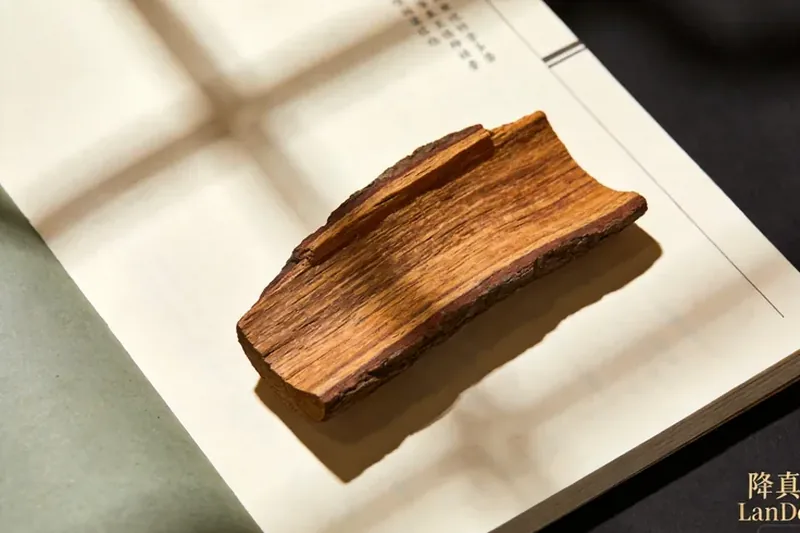
Direct answer: Jiangzhenxiang (降真香, jiàngzhēnxiāng) is a fragrant, resinous heartwood best known as the incense of Daoist ritual, burned so that its smoke “rises straight” to summon the immortals. Its botanical identity is genuinely contested: classical texts point to Acronychia pedunculata (山油柑, the citrus family), while modern trade conflates it with Dalbergia odorifera (降香黄檀, fragrant rosewood).
Key facts
| Chinese | 降真香 (jiàngzhēnxiāng); classical aliases 紫藤香 / 鸡骨香 |
| Botanical source | Acronychia pedunculata (classical); cf. Dalbergia odorifera (modern) |
| What it is | A fragrant, resinous heartwood, not a bark or root |
| Aroma | Woody, sweet, resinous; subtle alone, powerful when blended |
| Traditional role | Daoist ritual incense, 合香 blending, materia medica |
Aroma profile
Direct answer: 降真香 is described classically as subtle on its own — 烧之初不甚香 (not very fragrant at first burning) — but excellent in blends, where 得诸香和之则特美 (it becomes especially fine mixed with other aromatics). Its smoke was prized as “powerful and far-reaching” (焚之气劲而远). The wood is resinous and dense, closer to the character of a fragrant heartwood than to a bright or floral note.
降真香 is described classically as subtle on its own — 烧之初不甚香 (not very fragrant at first burning) — but excellent in blends, where 得诸香和之则特美 (it becomes especially fine mixed with other aromatics). Its smoke was prized as “powerful and far-reaching” (焚之气劲而远). The wood is resinous and dense, closer to the character of a fragrant heartwood than to a bright or floral note. This is the defining paradox of 降真香: its reputation rests not on a bright solo fragrance but on its blending behavior and its ritual role — two qualities that are harder to buy or verify than a simple aromatic note.
Botanical identity: a standing dispute
Direct answer: Two different plants are sold under the name 降真香. The classical material is the resinous heartwood of Acronychia pedunculata (山油柑), a citrus-family (Rutaceae) tree; the modern conflation is Dalbergia odorifera (降香黄檀, “scented rosewood”), a legume. The two are different plants from different families, and the label alone does not say which is meant.
This is the core buyer-intelligence point for 降真香. Two different plants are sold under the name:
- 降真香 (classical) — Acronychia pedunculata (山油柑), a citrus-family (Rutaceae) tree of southern China and Southeast Asia, whose resinous heartwood is the material described in the classical manuals.
- 降香 (modern conflation) — Dalbergia odorifera (降香黄檀, “scented rosewood”), a legume whose fragrant wood is the 降香 of the modern Chinese pharmacopoeia, and which has increasingly replaced the classical material in trade.
The classical Xiangcheng (香乘) describes 降真香 as a tree’s heartwood (树心也) with a thick white outer bark (外白皮厚八九寸) — a description that fits Acronychia pedunculata. But in modern commerce the name frequently refers to Dalbergia odorifera. The two are different plants from different families; buyers should confirm which is meant.
Botanical source and origin
Direct answer: Acronychia pedunculata (山油柑) is a shrub or tree to 28 m tall of the rue family (Rutaceae), with elliptic leaf blades and a subglobose fruit 0.5–1.5 cm. It is recorded by Flora of China, native to southern China and Southeast Asia. It is the classical botanical source of 降真香’s heartwood.
Acronychia pedunculata, the classical botanical source of 降真香, is a shrub or small-to-large tree of the rue family (Rutaceae). Flora of China records it as a shrub or small-to-large tree, to 28 m tall, with elliptic to obovate leaf blades 3.5–24.5 × 2–8.5 cm and a subglobose fruit 0.5–1.5 cm in diameter. It is native to southern China and Southeast Asia. The material of value is its resinous heartwood, the part the classical manuals describe. The modern conflation Dalbergia odorifera (降香黄檀) is a legume — a different family entirely — whose fragrant wood has increasingly replaced the classical material in commerce. See Acronychia pedunculata in Flora of China.
Chinese name and terminology
Direct answer: 降真香 (jiàngzhēnxiāng) means roughly “the incense that summons the true (immortals)” — 降 “to descend” + 真 “the true/immortals” + 香 “incense” — a ritual name, not a botanical one. The classical aliases 紫藤香 and 鸡骨香 are descriptive. The name’s very meaning points to its ritual role rather than to a species.
The name 降真香 is a ritual name, not a botanical one: 降 (jiàng, “to descend”) + 真 (zhēn, “the true/immortals”) + 香 (xiāng, “incense”) — “the incense that summons the true (immortals).” The classical aliases 紫藤香 (“purple-vine incense”) and 鸡骨香 (“chicken-bone incense”) are descriptive of its appearance. This matters because the name points at a function — summoning the immortals in Daoist ritual — rather than at a plant, which is precisely why the botanical identity can drift while the name stays attached to the ritual role.
In Chinese tradition
- Daoist ritual (Historical Record): 降真香’s name means roughly “the incense that summons the true (immortals).” Classical sources describe burning it so the smoke rises straight, invoking cranes and stars in altar rites — 伴和诸香烧烟直上感引鹤降醮星辰烧此香妙为第一.
- 合香 (blended incense) (Historical Record): 降真香 is prized in blends rather than alone — it “becomes especially fine mixed with other aromatics.”
- Folk fumigation (Traditional Use): 降真香 was also burned against “seasonal qi” and household disturbances (主天行时气宅舍怪异) — folk custom, not modern evidence.
- Materia medica (Traditional Use): 降真香 / 降香 appear in traditional medicine. We treat such use as traditional, not established clinical fact.
Traditional use vs modern evidence
Direct answer: The classical descriptions — subtle alone, fine in blends, straight-rising smoke in Daoist ritual — are historical and observational. The medicinal and folk-fumigation uses are traditional, not established clinical fact. The key documented point for modern readers is the botanical dispute between Acronychia pedunculata and Dalbergia odorifera.
- Traditional Use — 降真香 / 降香 in traditional medicine; folk fumigation against “seasonal qi” and household disturbances. Traditional, not established clinical fact.
- Historical Record — the Song-dynasty Xiangpu (香譜) and Ming Xiangcheng (香乘) records of 降真香: its aliases, its blending behavior, and its Daoist-ritual smoke description.
- Scientific Evidence — the botanical identity of Acronychia pedunculata (Rutaceae) is established (classical identification); the Dalbergia odorifera conflation is recorded as modern trade practice. We present no clinical or medical efficacy claims.
The classical descriptions are historical and observational. The medicinal and folk-fumigation uses are traditional, not established clinical fact, and we make no medical claims.
The straight-smoke ritual claim (a critical note)
Direct answer: 降真香’s most famous attribute is its “straight-rising smoke” in Daoist ritual — 烧烟直上感引鹤降 — but this is a ritual-observational description, not a measurable material property. The claim is cultural and historical; it should not be read as a physical specification of the wood.
The “straight-rising smoke” is 降真香’s signature attribute, and it deserves a careful framing:
- The classical sources describe burning 降真香 so its smoke rises straight, invoking cranes and stars (伴和诸香烧烟直上感引鹤降醮星辰).
- This is a ritual-observational claim — part of the incense’s Daoist meaning — not a measurable physical property. Smoke behavior depends on material, burn method, airflow, and the blend, not on a mystical property of one wood.
The point for this encyclopedia: the “straight-rising smoke” is cultural history, not material science. It records 降真香’s ritual role faithfully, but a buyer should not treat it as a verifiable specification of the wood itself.
Why is it used in incense?
Direct answer: 降真香 is used for its role in Daoist ritual and for its behavior in 合香 blends — subtle alone, but “especially fine mixed with other aromatics.” Its value is ritual significance and blending behavior, not a bright solo note, which makes it a wood bought for context and role rather than for a simple aroma.
降真香’s incense use is inseparable from its ritual role and its blending behavior:
- Daoist ritual: it is the incense of 降真 — burned so its smoke rises straight to summon the immortals. This religious-cultural role is its most famous use.
- 合香 blending: it is prized in blends rather than alone — “得诸香和之则特美” (it becomes especially fine mixed with other aromatics).
This makes 降真香 a wood bought for context and role — ritual significance and blending behavior — rather than for a bright, simple aroma. A buyer who evaluates it only on solo fragrance will miss the point of the material.
How is it processed?
Direct answer: 降真香 is processed by taking the resinous heartwood and cutting, shaping, or grinding it for burning and blending. There is no extraction step in the wood form; the material is the resin-saturated heartwood itself, and processing is a cutting-and-drying matter.
The processing of 降真香 is wood-processing:
- Select heartwood — the resinous heartwood is separated from the outer bark (which the Xiangcheng describes as thick and white).
- Cut / shape / grind — the heartwood is cut into pieces or ground for burning and blending.
There is no extraction or distillation step in the wood form; the material is the resin-saturated heartwood itself. As with other fragrant woods, particle size and moisture affect how the powder packs and burns, and the right target depends on formulation.
What determines quality?
Direct answer: Genuine 降真香 is resinous and dense, and its classical value was its behavior in blends and its straight-rising smoke. Given the substitution risk — the same name can mean Acronychia pedunculata or Dalbergia odorifera — the single most important “quality” check is confirming the species and family.
The quality factors, in rough order:
- Identity — which plant is it? Acronychia pedunculata (classical) or Dalbergia odorifera (modern conflation)? Different families, different woods.
- Resin content and density — genuine material is resinous and dense.
- Aroma behavior — subtle alone, fine in blends, per the classical record.
There is no standardized grading ladder for 降真香; identity is the decisive check, and the species-and-family confirmation is what prevents a substitution.
Common forms
Direct answer: 降真香 is sold as resinous heartwood pieces, chips, and powder. The wood is burned or blended whole; it is not typically an oil or a flowing resin like frankincense — it is a resinous heartwood, not an exuded resin.
| Form | Typical use |
|---|---|
| Heartwood pieces / chips | Ritual burning; warming |
| Powder | Blended into 合香 incense |
The material is a resinous heartwood — the fragrant, resin-saturated inner wood — not a flowing resin like frankincense or a bark. This is a key distinction for a buyer: 降真香 is a wood, not an exudate.
What buyers should look for
Direct answer: Buyers should recognize that 降真香 / 降香 can mean Acronychia pedunculata (classical heartwood) or Dalbergia odorifera (scented rosewood) — different woods from different families — and confirm the species and family. Genuine material is resinous and dense, and its value is ritual role and blending behavior, not a bright solo note.
For a sourcing buyer:
- Identity — confirm which plant is meant: Acronychia pedunculata (classical 降真香) or Dalbergia odorifera (modern 降香). They are different woods from different families.
- Resin and density — genuine material is resinous and dense.
- Role — understand its value is ritual significance and blending behavior, not a simple solo aroma.
- Form — heartwood pieces/chips or powder, depending on the use.
Safety
Incense combustion produces smoke and particulate matter. Burn in a well-ventilated space, avoid inhaling concentrated smoke, and keep away from children and pets. This is editorial knowledge content, not medical advice.
降真香 vs agarwood vs sandalwood
Direct answer: 降真香, agarwood, and sandalwood are all fragrant woods, but they differ in formation and identity. Agarwood is injury-induced resin wood (Aquilaria); sandalwood is fragrant heartwood (Santalum); 降真香 is a resinous heartwood whose very species is contested (Acronychia pedunculata vs Dalbergia odorifera). They are not interchangeable.
| 降真香 | Agarwood (沉香) | Sandalwood (檀香) | |
|---|---|---|---|
| What it is | Resinous heartwood (species contested) | Resin wood formed by injury | Fragrant heartwood |
| Botanical source | Acronychia pedunculata / cf. Dalbergia odorifera | Aquilaria spp. | Santalum album |
| Key risk | Species substitution | Heavy adulteration | Species substitution |
All three are fragrant woods, but 降真香’s defining issue is a species-level identity dispute, unlike agarwood’s adulteration problem or sandalwood’s substitution problem. See agarwood (沉香) and sandalwood (檀香).
Our Industry View
Direct answer: 降真香 is a case where the market has silently substituted one plant for another while the label stayed the same. The classical heartwood (Acronychia pedunculata) has been displaced in trade by Dalbergia odorifera — a different family — so “降真香” now names a role and a history, not a single species. For a buyer, the label is the risk, and the scientific name is the only reliable specification.
From a sourcing perspective, 降真香 is the strongest example in this encyclopedia of name-family substitution — where a culturally loaded name has detached from its original plant:
- The label did not change; the plant did. Classical 降真香 was the resinous heartwood of Acronychia pedunculata (Rutaceae). Modern trade increasingly fills the name with Dalbergia odorifera (a legume). The label “降真香/降香” stayed the same while the material underneath shifted families — a substitution that is economic, not botanical.
- The name names a role, not a species. “降真香” means “the incense that summons the immortals” — a ritual function. A name that points at a function can drift across plants while the function stays stable, which is exactly what happened. A buyer who specifies only “降真香” is specifying a role, not a material.
- The ritual attribute is history, not physics. The famous “straight-rising smoke” is a ritual-observational claim, not a measurable property of one wood. It should be understood as cultural record, not as a purchase specification.
In our view, the commercial sweet spot for 降真香 is a species-confirmed, family-stated material — where the seller can name Acronychia pedunculata versus Dalbergia odorifera — rather than a label whose prestige has outlived its botanical anchor.
Summary
降真香 (jiàngzhēnxiāng) is a fragrant, resinous heartwood best known as the Daoist ritual incense burned so its smoke “rises straight” to summon the immortals — a ritual name (“the incense that summons the true”) rather than a botanical one. Its identity is genuinely contested: classical texts point to Acronychia pedunculata (山油柑, Rutaceae), while modern trade conflates it with Dalbergia odorifera (降香黄檀, a legume). Its classical value was blending behavior (subtle alone, “especially fine mixed with other aromatics”) and ritual significance, not a bright solo note — so its “straight-rising smoke” is cultural history, not a physical specification. For a buyer, the label is the risk, and the scientific name is the only reliable specification.
FAQ
What is 降真香? 降真香 is a fragrant, resinous heartwood best known as the incense of Daoist ritual — its name means roughly “the incense that summons the true (immortals),” and classical sources describe burning it so its smoke rises straight to invoke the spirits. It is subtle burned alone and prized in blends. Its botanical identity is contested, however: classical texts point to Acronychia pedunculata, while modern trade often uses Dalbergia odorifera.
What is the difference between 降真香 and 降香? In classical terms, 降真香 is the resinous heartwood of Acronychia pedunculata (山油柑), a citrus-family tree. In modern trade and the pharmacopoeia, 降香 most often refers to Dalbergia odorifera (降香黄檀, scented rosewood), a legume. The two are different woods from different families, but the names have been conflated, so the same label can mean either — a key point to check when buying.
Why is 降真香 associated with Daoism? Because of its ritual role. The name 降真 means “descending the true/immortals,” and classical sources describe burning 降真香 in altar rites so the smoke rises straight to summon cranes and stars — 伴和诸香烧烟直上感引鹤降醮星辰. Its “straight-rising smoke” made it the classic Daoist ritual incense, which is why it carries a strong religious and cultural association beyond its scent.
What does 降真香 smell like? Classical sources describe it as subtle on its own — 烧之初不甚香 (not very fragrant at first burning) — but excellent when blended, where it “becomes especially fine mixed with other aromatics” (得诸香和之则特美). Its smoke was prized as powerful and far-reaching (焚之气劲而远). So its reputation rests on blending behavior and ritual use rather than a bright solo fragrance.
Is 降真香 a wood or a resin? It is a resinous heartwood — the fragrant, resin-saturated inner wood of the tree, not a flowing resin like frankincense or a bark. The classical Xiangcheng (香乘) describes it as the tree’s heartwood (树心也) beneath a thick white outer bark. This distinguishes it from resins (which are exuded) and from simple aromatic woods without the resinous character.
Is the “straight-rising smoke” a real property? It is a ritual-observational claim from the classical record, not a measurable physical property. Smoke behavior depends on material, burn method, airflow, and the blend — so the “straight-rising smoke” is best understood as 降真香’s cultural and ritual meaning, faithfully recorded, rather than as a verifiable specification of one wood.
See also: agarwood (沉香), sandalwood (檀香), and the full scent guide.
Evidence & Sources
Botanical identity
Source: Acronychia pedunculata in Flora of China · Acronychia pedunculata on GBIF. Evidence type: Established (classical identification); the Dalbergia odorifera (降香黄檀) conflation is noted as modern trade practice.
Traditional Chinese use
Source: the Song-dynasty Xiangpu (香譜) records 降真香 (卷二, citing 《南州記》 and 《海藥本草》); the Ming Xiangcheng (香乘) records the aliases 紫藤香 / 鸡骨香, the blending behavior, and the Daoist-ritual smoke description. Evidence type: Historically documented — traditional, not modern clinical evidence.
Authenticity / disambiguation
Source: the 降真香 (Acronychia pedunculata) vs 降香 (Dalbergia odorifera) substitution risk. Evidence type: Practical screening.
Safety
Source: incense combustion produces smoke and particulate matter; burn in a well-ventilated space. Evidence type: Established.
Evidence status
| Layer | Status |
|---|---|
| Botanical identity | Established (classical); contested in modern trade |
| Traditional use | Historically documented |
| Authenticity test | Practical screening |
| Health claims | Not established |
Sources
Sources: botanical references on Acronychia pedunculata and the Song-dynasty Xiangpu (香譜) / Ming Xiangcheng (香乘) records of 降真香. The 降真香 / 降香 (Dalbergia odorifera) conflation is recorded as modern trade practice. Medicinal and folk-fumigation uses are treated as traditional, not established clinical fact. This is editorial knowledge content, not medical advice.