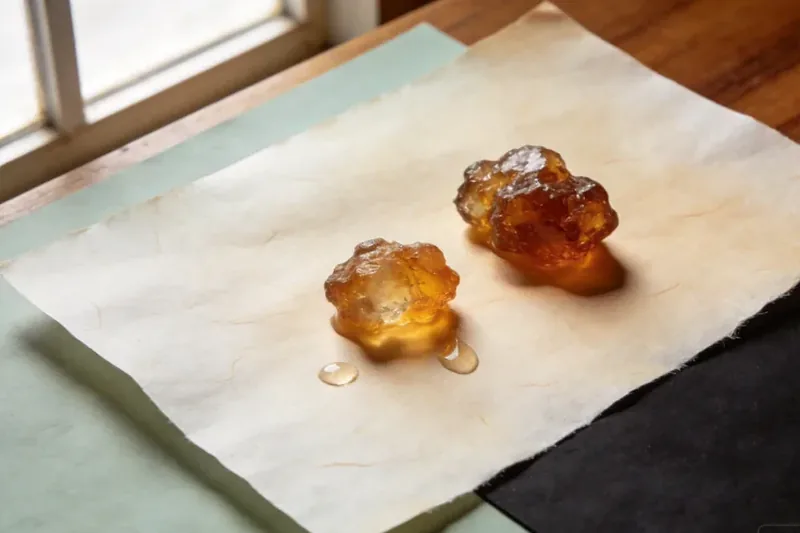
Direct answer: Galbanum (白松香, báisōngxiāng) is the gum-resin of Ferula gummosa (and related Ferula species), a giant fennel of the carrot family (Apiaceae) native to Iran and Central Asia. It is a green, balsamic, sharp resin used since antiquity in Western and Middle-Eastern incense and perfumery; its closest relative here is asafoetida (阿魏), another Ferula resin. It is not attested in the Chinese compendium 香乘.
Key facts
| Chinese | 白松香 (báisōngxiāng); also 格蓬 / 波斯树脂 |
| Botanical source | Ferula gummosa (family Apiaceae) — the gum-resin |
| What it is | A plant gum-resin, from a giant fennel |
| Aroma | Green, balsamic, earthy, sharp |
| Traditional role | Western/Middle-Eastern incense resin; perfumery |
Aroma profile
Direct answer: Galbanum is green and sharp at the top, with a bitter, earthy, balsamic depth beneath — the archetypal “green” note of classical perfumery, smelling of crushed stems, pine, and wet earth with a resinous backbone. It is more vegetal and astringent than frankincense, and less sulfurous than its relative asafoetida.
Galbanum is green and sharp at the top, with a bitter, earthy, balsamic depth beneath — the archetypal “green” note of classical perfumery, smelling of crushed stems, pine, and wet earth with a resinous backbone. It is more vegetal and astringent than frankincense, and less sulfurous than its relative asafoetida. In a blend it reads as a green, bracing resin, adding a fresh, sappy lift that few resins provide — a green note delivered by a resin, not by a leaf or stem.
Botanical identity
Direct answer: Ferula gummosa is a large perennial herb of the carrot family (Apiaceae), native to the mountains of Iran and Central Asia. The gum-resin is tapped from the root and lower stem, hardening into the “tears” traded since antiquity. Unlike most entries here, it has no Flora of China treatment — its identity is anchored in GBIF and Western classical sources.
Ferula gummosa is a large perennial herb of the carrot family (Apiaceae), native to the mountains of Iran and Central Asia. The gum-resin is tapped from the root and lower stem, hardening into the “tears” traded since antiquity. Unlike most entries here, it is not a Chinese native and has no Flora of China treatment — its identity is anchored in GBIF and Western classical sources (where galbanum is documented from Dioscorides and Pliny onward). See Ferula gummosa on GBIF.
Chinese name and terminology
Direct answer: The name 白松香 (báisōngxiāng) means “white pine fragrance” — a descriptive, translated name rather than a classical term. Its alternates 格蓬 (géfēng, a transliteration of “galbanum”) and 波斯树脂 (“Persian resin”) both mark it as a foreign, translated import, not a native Chinese material.
The terminology marks the material’s origin at every turn:
- 白松香 (báisōngxiāng) — “white pine fragrance,” a descriptive name.
- 格蓬 (géfēng) — a transliteration of “galbanum.”
- 波斯树脂 (bōsī shùzhī) — “Persian resin,” naming its geographic origin.
The name 白松香 (and 格蓬) enters Chinese via translated Western materia-medica and perfumery vocabulary, reflecting galbanum’s Mediterranean and Middle-Eastern origin. There is no classical 香谱/香乘 term for it, which is the honest position recorded below.
The 白松香 / 阿魏 family note (read this)
Direct answer: Two Ferula gum-resins from the same region are easily related but distinct: 白松香 (galbanum, Ferula gummosa) is green, balsamic, and sharp, while 阿魏 (asafoetida, Ferula assa-foetida / F. foetida) is far more sulfurous and pungent. Both are giant fennel resins from Iran and Central Asia, but their scent characters differ sharply, and the Chinese names are not interchangeable.
Two Ferula gum-resins from the same region are easily related but distinct:
- 白松香 (galbanum) — Ferula gummosa and relatives; green, balsamic, sharp. This entry.
- 阿魏 (asafoetida) — Ferula assa-foetida / F. foetida; far more sulfurous and pungent. Its own entry (see asafoetida).
Both are giant fennel resins from Iran and Central Asia in the same genus, but their scent characters differ sharply — galbanum is green and balsamic, asafoetida is sulfurous and pungent — and the Chinese names are not interchangeable. A buyer should not substitute one for the other on the strength of the shared genus.
The absence-from-香乘 note (read this)
Direct answer: 白松香 does not appear in the classical incense compendium 香乘. This encyclopedia could not verify a classical Chinese incense-canon entry for galbanum, and records that honestly rather than asserting one. Its documented heritage is Western and Middle-Eastern, entering Chinese only via translated vocabulary.
This is a case where the absence of a record is itself the honest finding:
- Not a 香乘 ingredient — 白松香 does not appear in the classical compendium 香乘. We could not verify a classical Chinese incense-canon entry for galbanum, and we record that honestly rather than asserting one.
- Translated Western knowledge — the name 白松香 (and 格蓬) enters Chinese via translated Western materia-medica and perfumery vocabulary, reflecting galbanum’s Mediterranean/Middle-Eastern origin.
- Western classical incense — galbanum is a documented ingredient of Western and Middle-Eastern incense and perfumery from antiquity.
The practical consequence for a buyer: any “classical Chinese” provenance claim for galbanum should be treated with care, because the documented heritage is Western and Middle-Eastern, not Chinese-canonical.
Where does galbanum come from?
Direct answer: Galbanum comes from Ferula gummosa, a giant fennel of the carrot family native to the mountains of Iran and Central Asia. The gum-resin is tapped from the root and lower stem and hardens into tears. It is not a Chinese native, and has no Flora of China treatment.
Ferula gummosa grows in the mountains of Iran and Central Asia, and the gum-resin is tapped from the root and lower stem, hardening into the tears traded since antiquity. Galbanum is documented in Western classical sources (Dioscorides, Pliny) as an incense and perfumery resin of the Mediterranean and Middle-Eastern world. Its absence from the Chinese 香乘 canon and its lack of a Flora of China treatment both point to the same fact: this is a Western and Middle-Eastern material that reached Chinese-language sources only through translation.
Why is it used in incense?
Direct answer: Galbanum is used as a green, bracing resin note — a fresh, sappy lift that few resins provide, and one of the classic “green” notes of Western and Middle-Eastern incense and perfumery. It is documented from antiquity in those traditions, though it has no classical Chinese incense-canon role.
Galbanum’s role is as a green, bracing resin: a fresh, sappy, vegetal lift delivered by a resin rather than a leaf, one of the archetypal green notes of Western and Middle-Eastern incense and perfumery. It is documented in those traditions from antiquity. In the Chinese context, it is a translated Western material — useful for a modern buyer or formulator who wants a green resin note, but not a classical Chinese 香材, and this page records that distinction explicitly.
How is it processed?
Direct answer: Galbanum is a gum-resin tapped from the root and lower stem of the giant fennel, hardening into tears, and then sold as resin tears or refined into an oil or extract. The resin-tear form is the traditional incense material; the oil serves perfumery.
Galbanum is obtained by tapping: the gum-resin is tapped from the root and lower stem of Ferula gummosa, hardening into the “tears” traded since antiquity. From there it is sold as resin tears for incense, or refined into an essential oil or extract for perfumery. The green, sharp top note is volatile, so freshness and handling affect how much of the sappy lift survives; the resin-tear form is the traditional incense material, while the oil serves fine perfumery.
What determines galbanum quality?
Direct answer: Quality turns on the green, sappy, balsamic character: genuine galbanum is bitter-green rather than sweet or citrus, with a sharp top and a balsamic base. Because it is not a Chinese-canon material, provenance and identity — Ferula gummosa, not the sulfurous asafoetida — are the first checks.
The quality factors, in rough order:
- Identity — Ferula gummosa (galbanum), not Ferula assa-foetida (asafoetida); the scent characters differ sharply.
- Aroma — green, sappy, balsamic; bitter-green rather than sweet or citrus, with a sharp top.
- Freshness — the green top note is volatile.
- Provenance — a Western/Middle-Eastern resin; treat any “classical Chinese” provenance claim with care.
There is no single standardized ladder, but “green, correctly identified, and honestly sourced” is the durable signal.
Common forms
Direct answer: Galbanum is sold as resin tears for incense and as an essential oil or extract for perfumery. The resin-tear form is the traditional incense material; the oil delivers the green note in fine perfumery.
| Form | Typical use |
|---|---|
| Resin tears | Incense blending |
| Essential oil / extract | Perfumery (green note) |
In Chinese tradition
- Not a 香乘 ingredient (Historical Record): 白松香 does not appear in the classical incense compendium 香乘. We could not verify a classical Chinese incense-canon entry, and record that honestly.
- Translated Western knowledge (Historical Record): the name 白松香 (and 格蓬) enters Chinese via translated Western materia-medica and perfumery vocabulary.
- Western classical incense (Traditional Use): galbanum is a documented ingredient of Western and Middle-Eastern incense and perfumery from antiquity.
Traditional use vs modern evidence
Direct answer: The incense and perfumery use is documented in Western classical sources. Medicinal uses, where they appear, are traditional, not established clinical fact, and this page makes no medical claims. The documented facts are botanical identity, the Apiaceae placement, the green balsamic aromatic use, and the honest absence from 香乘.
- Traditional Use — galbanum as a Western/Middle-Eastern incense and perfumery resin.
- Historical Record — galbanum documented from Dioscorides and Pliny onward; its absence from the Chinese 香乘 canon recorded honestly.
- Scientific Evidence — the botanical identity of Ferula gummosa (Apiaceae) and the resin’s chemistry are documented; we present no clinical or medical efficacy claims.
The incense and perfumery use is documented in Western classical sources. Medicinal uses, where they appear, are traditional, not established clinical fact, and we make no medical claims.
What buyers should look for
Direct answer: Buyers should confirm identity — 白松香 is galbanum (Ferula gummosa), a green, sharp resin, distinct from 阿魏 (asafoetida), its sulfurous relative. Expect a green, sappy, balsamic character. And because it is not a Chinese-canon material, treat any “classical Chinese” provenance claim with care.
For a buyer:
- Identity — Ferula gummosa (galbanum), not asafoetida (Ferula assa-foetida); the scent characters differ sharply.
- Aroma — green, sappy, balsamic; bitter-green rather than sweet or citrus.
- Provenance — its documented heritage is Western and Middle-Eastern; treat any “classical Chinese” provenance claim with care.
Our Industry View
Direct answer: Galbanum’s commercial lesson is that a green note can come from a resin — and that honest provenance matters as much as aroma. It is a Western/Middle-Eastern resin with no 香乘 entry, so a buyer should specify it by its actual heritage and its Ferula identity, not by a fabricated Chinese-canon pedigree or a name shared with asafoetida.
From a manufacturing perspective, galbanum makes two points worth carrying forward:
- A green note can come from a resin. Most green notes come from leaves and stems; galbanum delivers a green, sappy, bracing lift from a gum-resin, which is precisely its value — a fresh vegetal top note with a resin’s tenacity. A formulator who wants a “green” that lasts can reach for galbanum where a leaf note would fade.
- Honest provenance is part of the specification. Galbanum has no 香乘 entry, and its documented heritage is Western and Middle-Eastern. A buyer should specify it on those terms — Ferula gummosa, Western/Middle-Eastern origin — rather than accept a “classical Chinese” framing that the record does not support. The same honesty principle applies to its relationship with asafoetida: same genus, sharply different scent, names not interchangeable.
In our view, galbanum is a distinctive green balsamic resin — buy it by species name (Ferula gummosa), expect a bitter-green sappy character, keep it separate from asafoetida, and record its Western/Middle-Eastern heritage honestly.
Summary
Galbanum (白松香) is the gum-resin of Ferula gummosa, a giant fennel (Apiaceae) of Iran and Central Asia, whose green, sharp, balsamic character made it an archetypal green note of Western and Middle-Eastern incense and perfumery from antiquity. It is not a Chinese native and has no Flora of China treatment, and it is not attested in the Chinese 香乘 canon — a fact this page records honestly. It is distinct from its sulfurous relative asafoetida (阿魏). No medical claims are made.
FAQ
What is 白松香 (galbanum)? The gum-resin of Ferula gummosa (and related Ferula species), a giant fennel of the carrot family (Apiaceae) native to Iran and Central Asia. It is a green, balsamic, sharp resin used since antiquity in Western and Middle-Eastern incense and perfumery. It is closely related to 阿魏 (asafoetida), another Ferula resin.
Is galbanum the same as asafoetida? No. Both are Ferula gum-resins from Iran and Central Asia, but distinct species with different characters. Galbanum (白松香, Ferula gummosa) is green, balsamic, and sharp; asafoetida (阿魏, Ferula assa-foetida) is far more sulfurous and pungent. The Chinese names are not interchangeable, and each has its own entry.
Is 白松香 in the Chinese incense canon? We could not verify it. 白松香 does not appear in the classical compendium 香乘, and we record that honestly rather than asserting a classical entry. The name enters Chinese via translated Western materia-medica and perfumery vocabulary, reflecting galbanum’s Mediterranean and Middle-Eastern origin.
What does galbanum smell like? Green and sharp at the top, with a bitter, earthy, balsamic depth beneath — the archetypal “green” note of classical perfumery, smelling of crushed stems, pine, and wet earth over a resinous backbone. It is more vegetal and astringent than frankincense, and less sulfurous than asafoetida. In a blend it reads as a green, bracing resin.
Where does galbanum come from? From Ferula gummosa, a large perennial herb of the carrot family (Apiaceae) native to the mountains of Iran and Central Asia. The gum-resin is tapped from the root and lower stem and hardens into the tears traded since antiquity. It is not a Chinese native and has no Flora of China treatment, so its identity rests on GBIF and Western classical sources.
Why does galbanum have no Chinese name in the classical canon? Because it never entered the classical Chinese incense tradition — it is a Western and Middle-Eastern resin. The Chinese names 白松香 (“white pine fragrance”) and 格蓬 (a transliteration of “galbanum”) are modern, translated terms that reflect this foreign origin, not classical 香谱/香乘 vocabulary. We record this absence honestly rather than inventing a classical pedigree.
See also: asafoetida, frankincense, and the full scent guide.
Evidence & Sources
Botanical identity
Source: Ferula gummosa on GBIF. Evidence type: Established.
Traditional Chinese use
Source: 白松香 (galbanum) — not attested in 香乘; a Western/Middle-Eastern resin entering Chinese via translated vocabulary. Evidence type: Historically documented (Western classical); absence in 香乘 recorded honestly.
Authenticity / disambiguation
Source: 白松香 (Ferula gummosa) vs 阿魏 (Ferula assa-foetida) — distinct Ferula resins. Evidence type: Practical screening.
Safety
Source: incense combustion produces smoke and particulate matter; burn in a well-ventilated space. Evidence type: Established.
Evidence status
| Layer | Status |
|---|---|
| Botanical identity | Established |
| Traditional use | Historically documented (Western) |
| Authenticity test | Practical screening |
| Health claims | Not established |
Sources
Sources: botanical reference on Ferula gummosa and the galbanum-vs-asafoetida distinction. Galbanum’s incense use is documented in Western classical sources; its absence from 香乘 is recorded honestly, and no medical claims are made. This is editorial knowledge content, not medical advice.