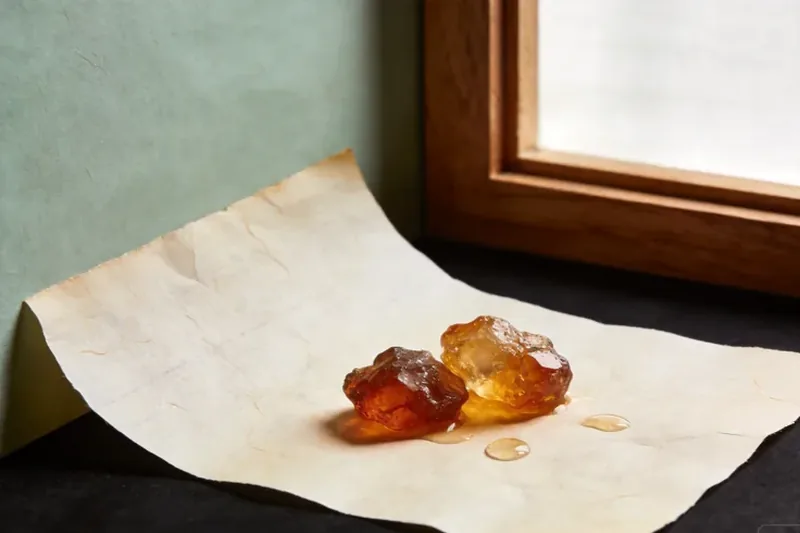
Direct answer: Asafoetida (阿魏, āwèi) is the dried resin of Ferula assa-foetida, a giant perennial herb of the carrot family (Apiaceae) native to Central Asia and the Iranian plateau. It is a fiercely pungent, sulfurous resin whose raw garlic-onion odor mellows on heating into a savory, allium-like depth — one of the “foreign aromatics” that entered China via the Silk Road.
Key facts
| Chinese | 阿魏 (āwèi) — a loanword from Central Asian languages |
| Botanical source | Ferula assa-foetida (family Apiaceae) — the dried resin |
| What it is | A plant resin, from a giant Central Asian herb |
| Aroma | Pungent, sulfurous, garlic-onion (raw); savory, allium-like (cooked) |
| Traditional role | Classical pungent resin; incense and materia medica |
Aroma profile
Raw asafoetida is famously pungent — a sharp, sulfurous, garlic-onion smell from its sulfur compounds (notably ferulic acid derivatives and disulfides). The defining trait is its transformation: when heated or cooked, the harsh raw odor mellows into a deep, savory, allium-like warmth. In a blend this makes it a pungent accent — used in tiny amounts to add an umami-like, savory depth that is entirely unlike sweet woods and resins.
Botanical source and origin
Ferula assa-foetida is a massive perennial herb of the carrot family (Apiaceae), native to the dry steppes and mountains of Central Asia, Iran, and Afghanistan. The resin is tapped from the living root and lower stem and hardens into a dark, strong-smelling gum. The Chinese name 阿魏 is a phonetic loanword reflecting the material’s foreign origin; Chinese materia medica also recognizes a native relative, 新疆阿魏 (Ferula sinkiangensis), as a regional source.
A naming caution: 阿魏 (Ferula assa-foetida, the imported classical resin) and 新疆阿魏 (Ferula sinkiangensis, the Xinjiang native) are closely related Ferula species. This page describes the classical imported 阿魏 = Ferula assa-foetida, while noting the native relative as a regional variant.
In Chinese tradition
- Classical 香药: 阿魏 is one of the “foreign aromatics” (香药) of classical Chinese incense, entering through the Silk Road and appearing in 合香 contexts for its pungent, fixative character.
- Incense and medicine: 阿魏 is recorded in both incense and traditional medicine, valued for its penetrating, warming quality.
- Materia medica: 阿魏 is recorded in traditional Chinese medicine (本草綱目, 木部) with described uses. This is traditional materia-medica language, not modern clinical evidence.
Traditional use vs modern evidence
The aromatic use is documented in classical records. Medicinal uses are traditional, not established clinical fact, and we make no medical claims. The documented, non-medical facts are botanical identity, the Ferula genus placement, and the pungent aromatic use.
Quality and sourcing notes
Practical points for buyers:
- Asafoetida is extremely pungent; store sealed and handle with care, as the smell is pervasive.
- Distinguish 阿魏 (Ferula assa-foetida) from the native 新疆阿魏 (Ferula sinkiangensis) — related Ferula resins.
- In incense, asafoetida is a trace pungent accent; too much is overpowering.
Safety
Incense combustion produces smoke and particulate matter. Burn in a well-ventilated space, avoid inhaling concentrated smoke, and keep away from children and pets. Asafoetida’s raw odor is intense; use in tiny amounts. This is editorial knowledge content, not medical advice.
FAQ
What is 阿魏 (asafoetida)? The dried resin of Ferula assa-foetida, a giant perennial herb of the carrot family (Apiaceae) native to Central Asia and the Iranian plateau. It is a fiercely pungent, sulfurous resin famous for its raw garlic-onion odor, which mellows dramatically on heating into a savory, allium-like depth. In classical Chinese incense and medicine it is a pungent aromatic resin that entered China through the Silk Road.
Why does asafoetida smell so strong? Because of its sulfur compounds — including disulfides and ferulic acid derivatives — which give the raw resin its sharp, garlic-onion, sulfurous odor. The defining trait is transformation: when heated or cooked, the harsh raw smell mellows into a deep, savory, allium-like warmth. This is why it is used in tiny amounts as a pungent accent rather than a base.
Is 阿魏 the same as 新疆阿魏? Closely related, but distinct. 阿魏 is the imported classical resin of Ferula assa-foetida; 新疆阿魏 is Ferula sinkiangensis, a native Xinjiang relative recognized in Chinese materia medica as a regional source. They are both Ferula resins with a pungent character, but this page describes the classical imported 阿魏 = Ferula assa-foetida.
What does asafoetida smell like after heating? It transforms from a sharp, sulfurous, garlic-onion raw odor into a deep, savory, allium-like warmth — the same transformation that makes it a prized culinary ingredient in Indian and Middle Eastern cooking. In a blend this makes it a pungent accent that adds an umami-like, savory depth entirely unlike sweet woods and resins.
How is 阿魏 used in Chinese tradition? As one of the “foreign aromatics” (香药) of classical Chinese incense, entering through the Silk Road and appearing in 合香 contexts for its pungent, fixative character, and in traditional medicine for its penetrating, warming quality. The medicinal uses are traditional language, not modern clinical evidence, and this encyclopedia makes no medical claims.
See also: galangal, frankincense, costus, galbanum and the full scent guide.
Evidence & Sources
Botanical identity
Source: Ferula assa-foetida on GBIF · Ferula sinkiangensis (新疆阿魏) on GBIF. Evidence type: Established.
Traditional Chinese use
Source: 阿魏 as a classical 香药 (foreign aromatic) entering via the Silk Road, recorded in the 本草綱目 木部. Evidence type: Historically documented — aromatic use; medicinal uses are traditional, not modern clinical evidence.
Authenticity / disambiguation
Source: 阿魏 (Ferula assa-foetida) vs 新疆阿魏 (Ferula sinkiangensis) — related Ferula resins. Evidence type: Practical screening.
Safety
Source: incense combustion produces smoke and particulate matter; burn in a well-ventilated space. Evidence type: Established.
Evidence status
| Layer | Status |
|---|---|
| Botanical identity | Established |
| Traditional use | Historically documented |
| Authenticity test | Practical screening |
| Health claims | Not established |
Sources
Sources: botanical references on Ferula assa-foetida and the native Ferula sinkiangensis variant. Asafoetida is recorded as a classical 香药; medicinal uses are treated as traditional, not established clinical fact. This is editorial knowledge content, not medical advice.