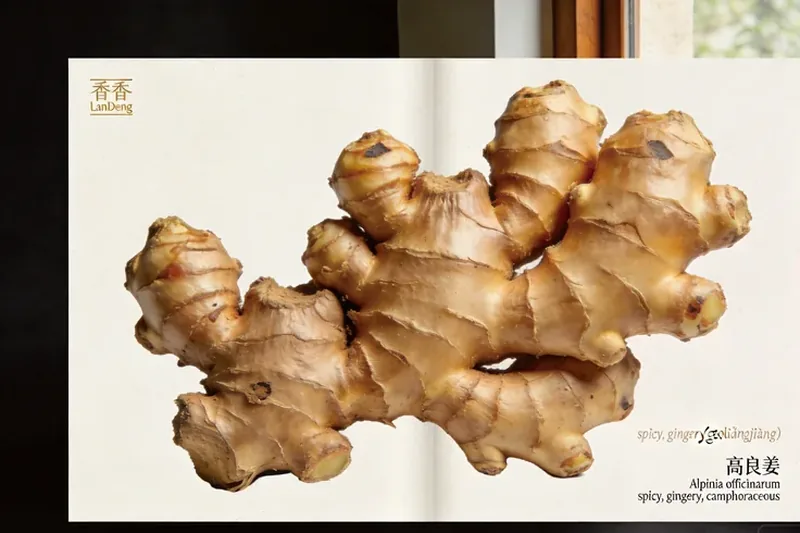
Technical answer: Galangal — gāoliángjiāng (高良姜) in Chinese — is the dried rhizome of Alpinia officinarum, a perennial herb of the ginger family (Zingiberaceae) native to southern China and Hainan. It is a warm, gingery spice with a sharp, slightly camphoraceous, woody bite, used in Chinese incense as a warming spice accent in some 合香 (blended incense) contexts. It is the “lesser galangal,” distinct from the larger “greater galangal” (Alpinia galanga).
Key facts
| Chinese | 高良姜 (gāoliángjiāng) |
| Botanical source | Alpinia officinarum (family Zingiberaceae) — the rhizome |
| What it is | A dried spice root/rhizome, not a wood or resin |
| Aroma | Spicy, gingery, camphoraceous, woody |
| Traditional role | Culinary spice, materia medica, warming incense accent |
What is galangal?
Direct answer: Galangal (高良姜, gāoliángjiāng) is the dried rhizome of Alpinia officinarum, a ginger-family (Zingiberaceae) perennial native to southern China and Hainan. It is a warm, gingery spice with a sharp, camphoraceous, woody bite, used in cooking, in traditional materia medica, and as a warming spice accent in some 合香 blends. It is the “lesser galangal,” distinct from the larger Alpinia galanga.
Galangal is best understood as a ginger-family spice with a sharper, drier character than common ginger. The part used is the rhizome — a knobby, reddish-brown underground stem — not a root in the strict botanical sense, and certainly not a wood or resin. Its name 高良姜 places it squarely in the ginger family (姜), and its “lesser” qualifier distinguishes it from a larger, milder cousin used more in cooking.
Botanical identity
Direct answer: Alpinia officinarum is a perennial herb of the Zingiberaceae (ginger) family. Flora of China records pseudostems 40–110 cm, sessile linear leaf blades 20–30 × 1.2–2.5 cm, erect racemes 6–10 cm, and a labellum white with red streaks; the fruit is a red globose capsule about 1 cm. The aromatic part is the elongate rhizome.
Flora of China records Alpinia officinarum as a perennial with pseudostems 40–110 cm and sessile, linear leaf blades 20–30 × 1.2–2.5 cm. The inflorescence is an erect raceme 6–10 cm, and the showy labellum is white with red streaks; the fruit is a red, globose capsule about 1 cm in diameter. It flowers April–September and fruits May–November. The aromatic part is the elongate, terete rhizome. See Alpinia officinarum in Flora of China and Alpinia officinarum on GBIF.
Chinese name and terminology
Direct answer: 高良姜 (gāoliángjiāng) names the “lesser galangal,” Alpinia officinarum. The qualifier 小 (small/lesser) is implicit in trade usage, distinguishing it from 大高良姜 (dà gāoliángjiāng), the “greater galangal” Alpinia galanga — a larger, milder, more culinary species. The 姜 element places both in the ginger family.
The naming task here is the lesser-vs-greater split, which is a real species difference, not a grade:
- 高良姜 (gāoliángjiāng) — lesser galangal, Alpinia officinarum; smaller, more intensely aromatic, and the one recorded in Chinese materia medica.
- 大高良姜 (dà gāoliángjiāng) — greater galangal, Alpinia galanga; larger, milder, used more in Southeast Asian cooking.
Both are ginger-family (Alpinia) rhizomes, but they are different species, and 高良姜 in Chinese incense refers to the lesser galangal. The 姜 element also links galangal to common ginger (Zingiber officinale) and sand ginger (Kaempferia galanga) — distinct species in the same family. See ginger and sand ginger.
Where does galangal come from?
Direct answer: Alpinia officinarum is native to southern China — Flora of China records it in Guangdong, Guangxi, and Hainan — and is now cultivated across Southeast Asia. Its supply follows the spice-herb trade rather than a dedicated incense-material industry.
Alpinia officinarum is native to southern China: Flora of China records it in Guangdong, Guangxi, and Hainan, and it is now cultivated across Southeast Asia. Like its ginger relatives, galangal enters the incense trade as a culinary spice with an incense sideline — priced and graded like a spice, not like a specialty aromatic wood or resin.
Aroma profile
Direct answer: Galangal is spicy and gingery at its base, with a sharp, slightly camphoraceous, woody edge and a drier, more penetrating character than common ginger. It is a spice accent rather than a base note, adding a warm, piquant bite that cuts through heavier woods and resins.
Galangal is spicy and gingery at its base, with a sharp, slightly camphoraceous, woody edge and a drier, more penetrating character than common ginger. In the ginger family it sits alongside cardamom and sand ginger, but with its own sharper, camphor-like profile: where ginger reads warm and citrusy and cardamom reads sweet and aromatic, galangal reads dry, sharp, and penetrating — a note that cuts through rather than blends into the background.
Why is it used in incense?
Direct answer: Galangal is used in incense as a warming spice accent in some 合香 blends, where its sharp, camphoraceous heat lifts and brightens heavier woods and resins. It is a supporting spice, not a classical defining material or a base.
Galangal’s incense role is a spice accent, not a lead:
- 合香 warming accent: galangal appears as a warming spice note in some blended-incense contexts, alongside other spices, where its dry, penetrating heat cuts through heavier woods and resins.
- Never a base: it is a supporting character that sharpens and brightens, not a material burned alone as a self-sufficient fragrance.
How is it processed?
Direct answer: Galangal is processed by harvesting the rhizome, cleaning it, and drying it — whole, sliced, or ground to powder. There is no extraction step in the whole/ground form; for incense blending it is ground, with particle size and moisture depending on the formula.
The essential step is simple: the rhizome is dug, cleaned, and dried to a stable, storable form, then used whole, sliced, or ground. For powder buyers, the same practical variables as any root or rhizome powder apply: particle size and moisture affect how the material packs, burns, and releases aroma, and the right target depends on the formula — the binder, other ingredients, and the production line. The grinding mechanics sit within the wider how incense is made process, and rhizome-powder behavior is covered in incense powder & resin.
What determines galangal quality?
Direct answer: Quality turns on a hard, dense, strongly gingery-aromatic rhizome with a clean camphor-like edge. Stale, soft, or woody-fibrous rhizomes lose their aromatic heat. There is no standardized numerical grading; the buyer evaluates the physical condition of the lot.
The practical quality factors, in rough order:
- Aroma — a strong, gingery, camphoraceous scent; the primary indicator.
- Density and hardness — a hard, dense rhizome holds its volatile aromatics better than a soft, spongy one.
- Cleanliness — freedom from soil, mold, and foreign root material.
- For powder — consistent particle size and moisture, judged against the specific formula.
Common forms
Direct answer: Galangal is sold as whole dried rhizomes, cut slices, and ground powder. Whole rhizomes and slices serve culinary and traditional use and inspection; powder serves incense blending — the same material in different physical forms, not a quality distinction.
| Form | Typical use |
|---|---|
| Whole dried rhizome | Culinary spice, traditional use, inspection |
| Cut slices | Culinary use, inspection |
| Powder | Blended into incense sticks and cones |
The distinction is functional, not a quality statement. See incense powder & resin for how rhizome powder behaves in practice.
In Chinese tradition
- Culinary spice: galangal is a warm, gingery spice used in cooking and spice blends. Historical Record — documented culinary use.
- Materia medica: 高良姜 is recorded in traditional Chinese medicine (本草綱目, 草部) as a warming aromatic. Traditional Use — traditional materia-medica language, not modern clinical evidence.
- Incense context: galangal appears as a warming spice accent in some 合香 blends, alongside other spices, rather than as a classical defining material. Historical Record — documented formula use.
Traditional use vs modern evidence
The culinary role is well documented. Medicinal uses are traditional, not established clinical fact, and we make no medical claims. The documented, non-medical facts are botanical identity, the lesser-vs-greater distinction, and the warm, gingery aromatic use.
Galangal vs related gingers
Direct answer: Galangal, ginger, and sand ginger are distinct species of the ginger family (Zingiberaceae) that share a warm, camphoraceous family character. Galangal (Alpinia officinarum) is sharp and camphoraceous; ginger (Zingiber officinale) is warm and citrusy; sand ginger (Kaempferia galanga) is milder and more aromatic. Lesser and greater galangal are themselves two different species.
| Ginger | Botanical source | Aroma |
|---|---|---|
| Galangal 高良姜 (lesser) | Alpinia officinarum, Zingiberaceae | Sharp, camphoraceous, woody |
| Greater galangal 大高良姜 | Alpinia galanga, Zingiberaceae | Larger, milder, culinary |
| Ginger 干姜 | Zingiber officinale, Zingiberaceae | Warm, pungent, slightly citrusy |
| Sand ginger 山柰 | Kaempferia galanga, Zingiberaceae | Milder, more aromatic |
They are distinct species in one family. See ginger, sand ginger, and the material comparison matrix for the general logic.
Adulteration & misidentification
Direct answer: Galangal is not a heavily faked aromatic; its main risk is the lesser-vs-greater species confusion — 高良姜 (lesser, Alpinia officinarum) vs 大高良姜 (greater, Alpinia galanga), two different species. The scientific name on the label resolves it.
Galangal is an inexpensive spice, so adulteration is not the same concern as with agarwood. The real risk is species confusion: lesser galangal (Alpinia officinarum) and greater galangal (Alpinia galanga) are different species, and a label that says only “galangal” or 高良姜 could be ambiguous. Specifying Alpinia officinarum resolves it.
What buyers should look for
Direct answer: Buyers should confirm the species (Alpinia officinarum, lesser galangal), the form, and the physical condition — a hard, dense, strongly gingery-aromatic rhizome with a camphor-like edge and no mold. For powder, test particle size and moisture against the formula.
For an incense maker or sourcing buyer:
- Species — confirm Alpinia officinarum (lesser galangal); the lesser-vs-greater split makes this the first check.
- Form — whole rhizome, slices, or powder; each behaves differently in a blend.
- Physical condition — hard, dense, strongly gingery-aromatic rhizome with a camphor-like edge, no mold or debris.
- Powder consistency — confirm particle size and moisture, and test a sample against your formula.
Safety
Incense combustion produces smoke and particulate matter. Burn in a well-ventilated space, avoid inhaling concentrated smoke, and keep away from children and pets. This is editorial knowledge content, not medical advice.
Our Industry View
Direct answer: In manufacturing, galangal is a sharp spice accent, not a base. Its value is a dry, camphoraceous heat that cuts through heavier woods and resins — but because it is a volatile-spice note, storage and dose matter more than the nominal name.
From a manufacturing perspective, galangal’s defining traits are sharpness and penetration. It supplies a dry, camphoraceous heat that cuts through heavier woods and resins, but its aromatics are volatile, so the material fades if stored poorly.
Two points follow:
- It is an accent, not a base. Galangal sharpens and brightens a blend but will not carry it. A buyer who expects it to lead a fragrance will be disappointed, while one who doses it as a spice accent gets real value.
- Penetration is the formulation variable. Because its heat is sharp, the practical dose and particle-size targets depend on formulation, so a figure that works in one factory does not transfer to another.
In our view, galangal’s commercial value lies in its role as a correctly identified, hard, dense lesser-galangal rhizome used as a measured spice accent — a supporting ginger whose real value is its sharp aromatic heat, not its price.
Summary
Galangal (高良姜) is the dried rhizome of Alpinia officinarum, a Zingiberaceae perennial Flora of China records with pseudostems 40–110 cm and a white-with-red-streaks labellum, native to Guangdong, Guangxi, and Hainan. It is the “lesser galangal,” distinct from the larger, milder greater galangal (Alpinia galanga), and in the ginger family it sits alongside common ginger and sand ginger. In Chinese tradition it is a culinary spice and a materia-medica warming aromatic, and in incense a sharp, camphoraceous warming accent. Its main identification risk is the lesser-vs-greater species split; commercially, correct identification and dense, fresh rhizome condition outweigh price.
FAQ
What is galangal root? The dried rhizome of Alpinia officinarum, a perennial herb of the ginger family (Zingiberaceae) native to southern China and Hainan. It is a warm, gingery spice with a sharp, camphoraceous, woody bite, used in cooking and as a warming accent in some incense. It is the “lesser galangal,” distinct from the larger “greater galangal” (Alpinia galanga).
How does galangal differ from ginger? Galangal is a relative of common ginger, not the same plant. It belongs to the same family (Zingiberaceae) but the genus Alpinia rather than Zingiber. Its rhizome is drier, sharper, and more camphoraceous than common ginger, with a more penetrating, woody bite. It is used as a spice and in materia medica, and it is the source of a distinct warming accent in incense.
What is the difference between lesser and greater galangal? Lesser galangal is Alpinia officinarum (高良姜) — smaller, more intensely aromatic, and the one recorded in Chinese materia medica; greater galangal is Alpinia galanga (大高良姜) — larger, milder, and used more in Southeast Asian cooking. They are different species of the same ginger-family genus, and 高良姜 in Chinese incense refers to the lesser galangal.
What does galangal smell like? Spicy and gingery at its base, with a sharp, slightly camphoraceous, woody edge and a drier, more penetrating character than common ginger. In incense it acts as a warming spice accent that cuts through heavier woods and resins, rather than serving as a base note.
Where does galangal come from? From Alpinia officinarum, a perennial herb of the ginger family native to southern China — Flora of China records it in Guangdong, Guangxi, and Hainan — now cultivated across Southeast Asia. The dried rhizome is the part used, and it has been recorded in Chinese materia medica as a warming aromatic. The lesser galangal is the species that matters for Chinese incense.
Is galangal the same as sand ginger? No. Galangal is Alpinia officinarum (高良姜), while sand ginger is Kaempferia galanga (山柰) — different genera in the same ginger family (Zingiberaceae). Both are warm, aromatic rhizomes, but galangal is sharper and more camphoraceous, while sand ginger is milder and more aromatic. They are distinct species with their own entries in this encyclopedia.
See also: sand-ginger, cardamom, ginger, sharp-leaf galangal and the full scent guide.
Evidence & Sources
Botanical identity
Source: Alpinia officinarum in Flora of China · Alpinia officinarum on GBIF. Evidence type: Established.
Traditional Chinese use
Source: 高良姜 as a culinary spice and materia-medica warming aromatic, recorded in the 本草綱目 草部. Evidence type: Historically documented — culinary use; medicinal uses are traditional, not modern clinical evidence.
Authenticity / disambiguation
Source: lesser galangal (Alpinia officinarum) vs greater galangal (Alpinia galanga); vs ginger (Zingiber officinale) and sand ginger (Kaempferia galanga). Evidence type: Practical screening.
Safety
Source: incense combustion produces smoke and particulate matter; burn in a well-ventilated space. Evidence type: Established.
Evidence status
| Layer | Status |
|---|---|
| Botanical identity | Established |
| Traditional use | Historically documented (culinary) |
| Authenticity test | Practical screening |
| Health claims | Not established |
Sources
Sources: botanical references on Alpinia officinarum and the lesser-vs-greater-galangal distinction. Galangal is recorded as a culinary spice; medicinal uses are treated as traditional, not established clinical fact. This is editorial knowledge content, not medical advice.