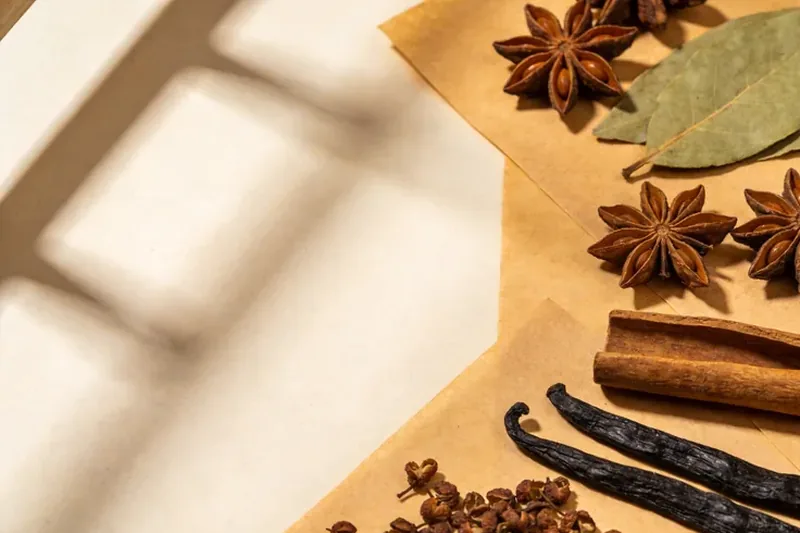
Technical answer: White cardamom — báidòukòu (白豆蔻) in Chinese — is the dried fruit of Amomum kravanh, a ginger-family (Zingiberaceae) plant of Southeast Asia. It is a warm, camphoraceous spice used in Chinese cooking, traditional medicine, and — as the classical texts specify — as a blending ingredient in incense (和香), not a burning material in its own right.
Key facts
| Chinese | 白豆蔻 (báidòukòu); “cardamom” also 豆蔻 |
| Botanical source | Amomum kravanh (family Zingiberaceae) — the dried fruit/seed |
| What it is | A dried spice fruit, not a wood or resin |
| Aroma | Camphoraceous, spicy, eucalyptus-like, warm |
| Traditional role | 合香 blending, cooking, materia medica |
Aroma profile
Direct answer: White cardamom has a warm, camphoraceous, slightly eucalyptus-like aroma — more “medicinal-spicy” than sweet. It is one of a cluster of ginger-family spice scents, and in Chinese incense it adds a warm, pungent lift rather than a sweet one.
White cardamom has a warm, camphoraceous, slightly eucalyptus-like aroma — more “medicinal-spicy” than sweet. It is one of a cluster of ginger-family spice aromas, and in Chinese incense it is used to add a warm, pungent lift. The classical manuals specify that its role is blending: the Ming-dynasty Xiangcheng (香乘) notes that cardamom “is not a burning incense material — its seed and root are pungent and can only be used for blending” (豆蔻非焚爇香具…止可用以和香).
Botanical identity
Direct answer: 白豆蔻 is Amomum kravanh, a ginger-family (Zingiberaceae) plant of Southeast Asia; the dried fruit and its seed are the parts used. A closely related Java white cardamom, Amomum compactum (爪哇白豆蔻), is recorded by Flora of China as 1–1.5 m tall, native to Java and cultivated in Hainan and southern Yunnan.
White cardamom belongs to the ginger family, Zingiberaceae. Two names carry the botanical story:
- Amomum kravanh — the white/round cardamom, the Southeast Asian ginger-family spice that is 白豆蔻 in Chinese.
- Amomum compactum — the related Java white cardamom (爪哇白豆蔻), which Flora of China records as 1–1.5 m tall, native to Java (Indonesia), and cultivated in Hainan and southern Yunnan, with medicinal use. See Amomum compactum in Flora of China.
The part used is the dried fruit, whose seeds carry the aroma. This is a spice fruit, structurally distinct from the woods, resins, and roots it is often blended with.
Chinese name and terminology
Direct answer: The name 豆蔻 (cardamom) is underspecified — it covers several different plants. 白豆蔻 (white cardamom) is Amomum kravanh; 草豆蔻 (katsumadai) is Alpinia katsumadae; 肉豆蔻 is nutmeg (Myristica fragrans); green cardamom is Elettaria cardamomum. The 豆蔻 name alone does not identify the plant.
The word “豆蔻” (cardamom) covers several different spice plants, which is a standing source of confusion:
- 白豆蔻 (this page) — Amomum kravanh, white/round cardamom, the Southeast Asian ginger-family spice.
- 草豆蔻 (katsumadai) — Alpinia katsumadae (and relatives), a different ginger-family seed used in materia medica. See katsumadai.
- 肉豆蔻 (nutmeg) — Myristica fragrans, a completely different plant and family, not a cardamom at all despite the shared 豆蔻 name.
- Green cardamom — Elettaria cardamomum, the familiar “cardamom” of Indian and Middle Eastern cooking, called 小豆蔻 in Chinese.
A label that says only “cardamom” or “豆蔻” is underspecified — these are different plants with different scents and uses.
Where does cardamom come from?
Direct answer: Amomum kravanh is a Southeast Asian ginger-family plant; the related Amomum compactum is native to Java and cultivated in Hainan and southern Yunnan. The spice is a tropical Southeast Asian crop, not a temperate or temperate-Chinese material.
White cardamom is a Southeast Asian spice. Amomum kravanh is native to mainland Southeast Asia, and the related Java white cardamom (Amomum compactum, 爪哇白豆蔻) is native to Java (Indonesia), cultivated in Hainan and southern Yunnan per Flora of China. This tropical Southeast Asian origin distinguishes it from the temperate and montane roots (such as angelica and ligusticum) that also appear in Chinese incense.
Why is it used in incense?
Direct answer: White cardamom (白豆蔻) is used in incense as a blending spice — it adds a warm, pungent lift to a formula, but the classical manuals specify it is not burned alone. Its role is 和香 (blending), not a solo burn.
Cardamom’s incense role is explicitly a blending one. The Ming-dynasty Xiangcheng (香乘) is specific: cardamom “is not a burning incense material — its seed and root are pungent and can only be used for blending” (豆蔻非焚爇香具…止可用以和香). So it appears in huxiang (合香) formulas as a warm, pungent supporting note — its warmth supports a formula rather than carrying one alone.
How is it processed?
Direct answer: Cardamom is used as the dried whole fruit, whose seeds carry the aroma; the seeds are separated and ground for blending. No extraction step is involved in the fruit or seed form; only an essential oil would require distillation.
The fruit is harvested and dried; the aroma is carried in the seeds, which are separated from the husk and ground for blending. No extraction step is involved in the dried-fruit or seed form. For powder buyers, particle size and moisture are the practical variables — but the exact target depends on the formula, binder, and production line (see Our Industry View below). The grinding and forming mechanics sit within the wider how incense is made process.
What determines cardamom quality?
Direct answer: Quality turns on the fruit’s fullness and the seed’s aromatic intensity — a well-filled, intact fruit with fragrant, camphoraceous seeds beats a shrunken or stale one. Because the seeds carry the scent, seed fullness and freshness are the decisive variables.
The quality factors, in rough order:
- Seed fullness and aromatic intensity — the seeds carry the aroma; well-filled, fragrant, camphoraceous seeds are the benchmark.
- Fruit intactness — whole, sound fruits beat broken or shrunken ones.
- Freshness — the volatile camphoraceous character fades with age.
- For powder — consistent particle size and moisture, judged against the specific formula.
There is no standardized grading system; the buyer evaluates the physical condition and aroma of the lot.
Common forms
Direct answer: Cardamom is sold as whole dried fruits, separated seeds, and ground seed powder. The powder is the incense-blending form; whole fruits and seeds suit cooking and materia medica.
| Form | Typical use |
|---|---|
| Whole dried fruits | Cooking, storage, materia medica |
| Separated seeds | Cooking, some incense use |
| Seed powder | Blended into incense sticks and cones |
The distinction between whole fruit, seed, and powder is functional, not a quality statement. See incense powder & resin for how spice powder behaves in practice.
In Chinese tradition
- 合香 (blended incense): 白豆蔻 is a classical blending spice in incense formulas, contributing a warm, pungent lift — but specifically as a 和香 ingredient, not a solo burn.
- Culinary: 白豆蔻 is a warming spice in Chinese cooking and spiced-broth traditions.
- Materia medica: 白豆蔻 is a traditional-medicine herb, classically described for “transforming dampness and moving qi” (化湿行气) and related uses. This is traditional materia-medica language, not modern clinical evidence.
Traditional use vs modern evidence
The classical records are specific about cardamom’s blending role in incense, which is a useful and well-documented point. The medicinal uses are traditional, not established clinical fact, and we make no medical claims. The documented, non-medical facts are botanical identity and the blending-only role in classical incense.
Cardamom vs related ginger-family spices
Direct answer: 白豆蔻 (Amomum kravanh) is one of several ginger-family “cardamom” spices. 草豆蔻 (Alpinia katsumadae) is a more medicinal seed; 草果 (Amomum tsao-ko) is the smoky “black cardamom”; nutmeg (肉豆蔻) is an unrelated plant. They share the 豆蔻 or ginger-family name but are distinct.
| Spice | Botanical source | Character |
|---|---|---|
| 白豆蔻 (white cardamom) | Amomum kravanh | Warm, camphoraceous, eucalyptus-like |
| 草豆蔻 (katsumadai) | Alpinia katsumadae | Warm, camphoraceous, more bitter |
| 草果 (tsaoko) | Amomum tsao-ko | Smoky, spicy, “black cardamom” |
| 肉豆蔻 (nutmeg) | Myristica fragrans | Sweet, warm, an unrelated family |
The 豆蔻 name and the ginger family both hide real botanical differences. See katsumadai, tsao-ko, and the material comparison matrix.
Adulteration & misidentification
Direct answer: The main risk is misidentification under the shared 豆蔻 name: 白豆蔻, 草豆蔻, 肉豆蔻 (nutmeg), and green cardamom are different plants. The Chinese name and botanical name on the label resolve which is meant.
Cardamom is not a heavily faked, expensive aromatic; its risk is the shared 豆蔻 name. A buyer who wants the white cardamom (Amomum kravanh) should not unknowingly receive 草豆蔻 (Alpinia), nutmeg (肉豆蔻, Myristica fragrans), or green cardamom (Elettaria) — all different plants with different scents and uses. The Chinese name (白豆蔻 vs 草豆蔻 vs 肉豆蔻) or the botanical name resolves the matter. See the incense substitution cross-reference for the general screening logic.
Sustainability & sourcing
Direct answer: Cardamom is a cultivated Southeast Asian spice with no equivalent wild-harvest scarcity concern to spikenard or agarwood; the sourcing question is species verification and seed quality rather than conservation.
White cardamom is a cultivated spice, and the related Java white cardamom is grown in cultivation (Hainan, southern Yunnan). There is no CITES-style or wild-harvest scarcity concern of the kind attached to spikenard or agarwood. The sourcing question is therefore identity and quality, not conservation: confirm which “cardamom” is meant and evaluate seed fullness and aroma. See the wholesale guide for the general sourcing framework.
Modern commercial applications
Direct answer: Cardamom is used in Chinese cooking and spiced-broth traditions, in traditional materia medica, and as a blending spice in classical-style incense. Its commercial weight is led by the culinary and materia-medica channels; incense is a smaller, specialist use.
Cardamom reaches the market through distinct channels:
- Culinary — 白豆蔻 is a warming spice in Chinese cooking and spiced-broth traditions.
- Materia medica — 白豆蔻 is a standard dried fruit of the Chinese herbal trade.
- Blended incense — 白豆蔻 is a classical blending spice in huxiang formulas.
The culinary and materia-medica channels dominate its commercial weight; incense is a smaller, specialist application.
What buyers should look for
Direct answer: Buyers should confirm which “cardamom” is meant (白豆蔻 vs 草豆蔻 vs nutmeg), then judge seed fullness, aroma, and freshness — and, for powder, test particle size and moisture against the formula.
For an incense maker or sourcing buyer:
- Identity — confirm 白豆蔻 (Amomum kravanh) rather than 草豆蔻 (Alpinia), nutmeg (肉豆蔻), or green cardamom (Elettaria); a real seller names the Chinese or botanical name.
- Seed fullness — well-filled, fragrant, camphoraceous seeds are the benchmark.
- Freshness — the camphoraceous character fades with age.
- Powder consistency — for powder, confirm particle size and moisture, and test a sample against your formula.
Safety
Incense combustion produces smoke and particulate matter. Burn in a well-ventilated space, avoid inhaling concentrated smoke, and keep away from children and pets. This is editorial knowledge content, not medical advice.
Our Industry View
Direct answer: In manufacturing, white cardamom’s defining constraint is its classical role: it is a blender, not a burn. Its warm pungency supports a formula but can dominate or vanish depending on dosage and batch, so consistency — of aroma, particle size, moisture, and identity — matters more than any grade name.
From a manufacturing perspective, 白豆蔻 is a blender whose value is warm pungency, not volume. The classical manuals are explicit that it is a 和香 ingredient, not a burning material — which means its role in a modern formula is a supporting accent whose character must stay reproducible, and whose identity must not slip between the several “cardamoms.”
Two points follow:
- Identity is a specification, not a detail. 白豆蔻, 草豆蔻, and nutmeg are different plants sharing a name; a formula built on one will not reproduce if the source switches silently to another. The Chinese name or botanical name is part of the specification.
- Particle size and moisture affect behavior, not just aroma. In powder, particle size changes how the material packs, draws air, and burns; moisture changes how it grinds and how the finished stick dries. The right target depends on formulation — the binder, the other ingredients, and the production line — so a figure that works in one factory does not transfer to another.
In our view, the commercial sweet spot is a correctly identified, consistently full-seeded 白豆蔻 used as a measured blending accent — not a rare spice, but one that must be reorderable to the same specification.
Summary
White cardamom (白豆蔻, báidòukòu) is the dried fruit of Amomum kravanh, a ginger-family (Zingiberaceae) spice of Southeast Asia. It is valued for a warm, camphoraceous, eucalyptus-like aroma, and the classical Xiangcheng (香乘) specifies its incense role as a blending spice (和香), not a solo burn. Its quality rests on seed fullness, aroma, and freshness rather than a formal grade, and its naming risk is confusion with 草豆蔻 (katsumadai), nutmeg (肉豆蔻), and green cardamom — all different plants. In incense it is a blending accent, not a lead; commercially, identity and batch consistency outweigh volume.
FAQ
Is cardamom the same as nutmeg? No. The Chinese name 豆蔻 covers both, which is the source of the confusion, but they are different plants and families. 白豆蔻 (white cardamom) is Amomum kravanh, a ginger-family spice; 肉豆蔻 (“meat 豆蔻”) is Myristica fragrans, nutmeg, a completely different plant. The shared 豆蔻 name hides the difference, so a label should specify which is meant.
What does white cardamom smell like? White cardamom has a warm, camphoraceous, slightly eucalyptus-like aroma — more “medicinal-spicy” than sweet. It belongs to a cluster of ginger-family spice scents. In Chinese incense it adds a warm, pungent lift, and the classical manuals specify that this is a blending role rather than a solo fragrance.
Is cardamom used in Chinese incense? Yes, but as a blender. The Ming-dynasty Xiangcheng (香乘) is explicit that cardamom “is not a burning incense material — its seed and root are pungent and can only be used for blending” (豆蔻非焚爇香具…止可用以和香). So it appears in huxiang (合香) formulas as a warm, pungent supporting note, not as a material burned alone.
What is the difference between 白豆蔻 and 草豆蔻? They are different ginger-family (Zingiberaceae) seeds. 白豆蔻 is Amomum kravanh (white/round cardamom), the Southeast Asian spice; 草豆蔻 is Alpinia katsumadae (and relatives), used in materia medica. They share the 豆蔻 name and a general warm-spice character but are distinct plants with different aromas and uses.
What is green cardamom? Green cardamom is Elettaria cardamomum, the familiar “cardamom” of Indian and Middle Eastern cooking, called 小豆蔻 in Chinese. It is yet another distinct plant — not 白豆蔻 (Amomum kravanh), 草豆蔻 (Alpinia), or nutmeg (肉豆蔻). The English word “cardamom” usually means the green one, while 白豆蔻 is the white/round variety, which is a useful distinction to keep straight.
Is 白豆蔻 the same as 草果 (tsaoko)? No. 白豆蔻 is Amomum kravanh (white/round cardamom); 草果 is Amomum tsao-ko, the smoky “black cardamom” of southwestern Chinese cooking. They are both ginger-family (Zingiberaceae) spices in the Amomum group, but distinct species with different aromas — white cardamom is warm and camphoraceous, while tsaoko is smoky and earthy.
See also: katsumadai (草豆蔻), tsao-ko (草果), clove, cinnamon, nutmeg and the full scent guide.
Evidence & Sources
Botanical identity
Source: Amomum kravanh on GBIF · Amomum compactum (related white cardamom) in Flora of China. Evidence type: Established.
Traditional Chinese use
Source: the Ming-dynasty Xiangcheng (香乘) records 豆蔻香 and specifies cardamom’s blending-only role (豆蔻非焚爇香具…止可用以和香). Evidence type: Historically documented — traditional, not modern clinical evidence.
Authenticity / disambiguation
Source: the 白豆蔻 (Amomum kravanh) vs 草豆蔻 (Alpinia) vs 肉豆蔻 (Myristica fragrans, nutmeg) vs green cardamom (Elettaria) distinction. Evidence type: Practical screening.
Safety
Source: incense combustion produces smoke and particulate matter; burn in a well-ventilated space. Evidence type: Established.
Evidence status
| Layer | Status |
|---|---|
| Botanical identity | Established |
| Traditional use | Historically documented |
| Authenticity test | Practical screening |
| Health claims | Not established |
Sources
Sources: botanical references on Amomum kravanh (white cardamom) and the Ming-dynasty Xiangcheng (香乘) record of 豆蔻香. The 白豆蔻 / 草豆蔻 / 肉豆蔻 (nutmeg) / green-cardamom disambiguation is recorded as practical screening. Medicinal uses are treated as traditional, not established clinical fact. This is editorial knowledge content, not medical advice.