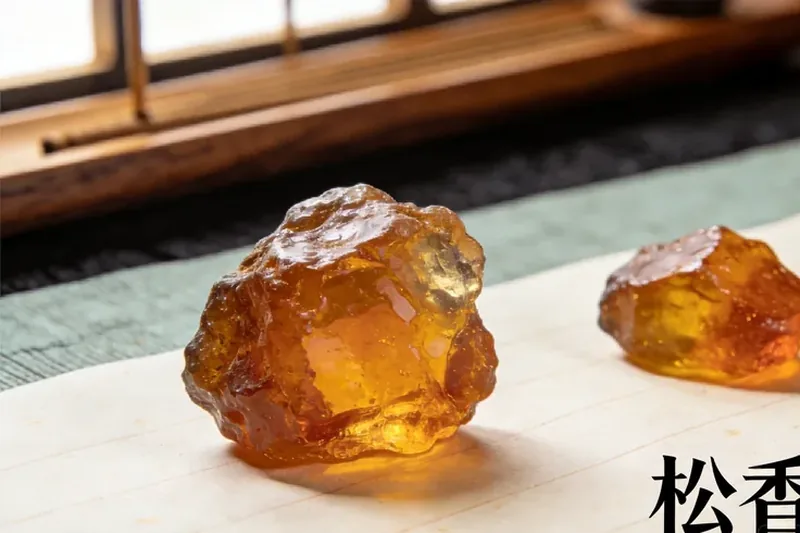
Direct answer: Pine resin — sōngxiāng (松香) in Chinese — is the hardened oleoresin of pine trees (Pinus spp.), the same material that, refined, is known as rosin or colophony. It has a fresh, piney, woody-balsamic aroma and is used in incense, varnish, and as a traditional aromatic and adhesive. It comes from the very same tree as pine needles (松针) — same species, different part — and the two must be kept distinct.
Key facts
| Chinese | 松香 (sōngxiāng); raw resin = 松脂 (sōngzhī) |
| Botanical source | Pinus species (Pinaceae) — pine oleoresin |
| What it is | A hardened tree resin (oleoresin) |
| Aroma | Piney, woody, balsamic, slightly resinous |
| Traditional role | Incense, adhesives, varnish, traditional use |
Aroma profile
Direct answer: Pine resin has a fresh, forest-like pine aroma over a warm, woody-balsamic base — brighter and more “green” than sweet resins like benzoin, and less deep than agarwood. It is the scent of conifer woods, clean and outdoorsy rather than heavy.
Pine resin has a fresh, forest-like pine aroma over a warm, woody-balsamic base — brighter and more “green” than the sweet resins like benzoin, and less deep than agarwood. It is the scent of conifer woods, and it reads clean and outdoorsy rather than heavy. Compared with the sharp, green scent of crushed pine needles (松针), the resin is warmer and more balsamic — the tree’s base note rather than its bright top.
Botanical identity
Direct answer: Pine resin is an oleoresin from pine trees in the family Pinaceae. The genus Pinus supplies the resin; in China, masson pine (Pinus massoniana) is a common source of both the resin and the aromatic needles.
Pinus is a large genus of evergreen conifers in the family Pinaceae, and the resin is the oleoresin the tree exudes when its bark is cut — a mixture of resin acids and the volatile turpentine fraction. In China, masson pine (Pinus massoniana) is a common source of both the resin and the aromatic needles, which is why the resin and the needle share the same tree but are separate materials. See Pinus massoniana in Flora of China.
Chinese name and terminology (松香 vs 松脂)
Direct answer: Chinese distinguishes 松脂 (the raw oleoresin as it comes from the tree) from 松香 (the refined rosin/colophony left after the turpentine is removed). Both come from the pine (松); the difference is the stage of the same material.
- 松脂 (sōngzhī) — the raw pine oleoresin, the sticky gum as collected.
- 松香 (sōngxiāng) — literally “pine fragrance,” the refined solid rosin/colophony after the volatile turpentine is distilled off.
Both are stages of the same pine oleoresin. The pine tree (松) itself is a classical emblem of longevity and steadfastness, evergreen through winter — a symbolism that attaches to the tree as a whole, not specifically to its resin. See pine needles (松针) for the tree’s other aromatic part.
What it is (rosin vs raw resin)
Direct answer: Pine resin is the sticky oleoresin that exudes when pine bark is cut. It can be used raw, or refined into rosin/colophony — the solid left after the volatile turpentine fraction is distilled off. In incense, “pine resin” usually means the raw aromatic gum; “rosin” means the refined solid.
Pine resin is the sticky oleoresin that exudes when pine bark is cut. It can be used raw, or refined:
- Raw resin — the hardened, semi-translucent gum as collected.
- Rosin / colophony — the refined solid left after the volatile turpentine fraction is distilled off. It is the familiar amber solid used in violin bows, varnish, and some incense.
In incense, the term “pine resin” usually points at the raw aromatic gum; “rosin” points at the refined solid. The two are stages of the same material.
Where does pine resin come from?
Direct answer: Pine resin comes from Pinus trees across the Northern Hemisphere. In China, masson pine (Pinus massoniana) is a traditional source of the tapped resin, and tapping is a renewable, managed practice rather than wild collection.
Pines are native across the Northern Hemisphere, and many species in China yield resin. The classic Chinese source is masson pine (Pinus massoniana), tapped for its oleoresin in southern China — the same species that supplies the aromatic needles. Because the trees are abundant and re-tapped rather than cut down, pine resin is a renewable, managed material, quite different from wild-harvested resins like agarwood or frankincense.
Why is pine resin used in incense?
Direct answer: Pine resin is used in incense for its fresh, woody-balsamic conifer note — a brightener alongside deeper, sweeter resins — and it also serves as a traditional binder or adhesive in some preparations. It is usually a supporting note, not a solo scent.
In Chinese 合香, pine resin adds a fresh, woody-resinous note and can also serve a functional role as a traditional binder or adhesive in some preparations. It reads clean and outdoorsy rather than heavy, which makes it a useful brightener alongside deeper, sweeter resins. Its role is closer to a conifer accent and a working binder than to a lead fragrance.
How is pine resin processed?
Direct answer: Pine resin is harvested by tapping — cutting the bark to let the oleoresin run — then the raw resin is either used as-is or refined by distilling off the volatile turpentine fraction to leave solid rosin/colophony.
The processing is a two-stage matter:
- Tapping — the bark is cut so the tree exudes its sticky oleoresin, which is collected.
- Refining (optional) — the volatile turpentine fraction is distilled off, leaving the solid rosin/colophony; this is the familiar amber solid of varnish and violin bows.
Whether a buyer wants the raw resin or the refined rosin depends on the use — raw gum for incense aroma, refined rosin for binder and industrial roles.
What determines pine resin quality?
Direct answer: Quality rests on clarity, color, and purity — clean, pale, well-formed resin grades higher than dark or bark-contaminated material — plus the refinement stage (raw resin vs rosin). These are trade distinctions, not a single standardized system.
The main quality factors:
- Clarity and color — clean, pale, translucent resin generally ranks higher than dark or cloudy material.
- Purity — freedom from bark debris and contamination.
- Refinement stage — raw resin versus rosin/colophony; a different product, not just a different grade.
- Aroma freshness — a clean, piney, woody-balsamic scent with no stale off-notes.
These are trade distinctions, not a single standardized grading system.
Common forms
Direct answer: Pine resin is sold as raw resin lumps, refined rosin (solid), and ground powder. Raw resin suits incense heating; rosin suits binder and industrial roles; powder suits blending.
| Form | Typical use |
|---|---|
| Raw resin (lumps) | Warmed for incense aroma |
| Rosin / colophony (solid) | Binder, varnish, industrial use |
| Powder | Blended into incense and pastes |
The distinction between raw resin and rosin is a refinement stage, not a quality statement — the same oleoresin in different forms. See incense powder & resin.
Pine resin vs pine needles
Direct answer: Pine resin and pine needles come from the same pine tree but are different parts with different scents. The resin is woody-balsamic and resinous — the base note; the needles are greener and conifer-fresh — the top note.
| Pine resin (松香) | Pine needles (松针) | |
|---|---|---|
| Plant part | The tree’s oleoresin | The tree’s evergreen leaves |
| Aroma | Woody-balsamic, resinous | Conifer-fresh, green |
| Role | Base note, binder | Top note, sachet herb |
The two are easily told apart: the resin is the warm, balsamic base of the tree, the needles the sharp, green top. They are used differently in blends. See pine needles (松针).
Traditional use vs modern evidence
Direct answer: Pine resin appears in traditional uses across cultures, and its refined form (rosin) is a common industrial material. We describe its aromatic and practical roles; we do not make medical claims.
- Traditional Use — pine resin is a traditional aromatic in Chinese 合香 and a long-standing adhesive and sealant.
- Historical Record — the pine (松) is a classical Chinese emblem of longevity, and its resin is a documented aromatic and practical material.
- Scientific Evidence — refined rosin is a common industrial material, which is a matter of chemistry, not health benefit.
We describe its aromatic and practical roles; we do not make medical claims.
Sustainability & sourcing
Direct answer: Pine resin is tapped from abundant, widely distributed pine trees and is renewable — trees are re-tapped rather than felled. This makes it one of the least conservation-sensitive aromatics, unlike wild-harvested woods and resins.
Unlike wild-harvested agarwood or frankincense, pine resin is tapped from abundant, managed pine forests, and the trees are re-tapped rather than cut down. There is no CITES listing or meaningful conservation pressure on the material. For a buyer, the practical questions are commercial — raw resin or rosin, which species, and what purity — rather than legal or sustainability risk. See the wholesale guide.
Modern commercial applications
Direct answer: Pine resin serves two distinct markets: refined rosin is a large-volume industrial material (varnish, adhesives, fluxes, violin bows), while the raw aromatic gum serves incense. The two are stages of the same oleoresin with very different uses.
- Incense — the raw aromatic gum as a fresh, woody-resinous note and traditional binder.
- Industry — refined rosin is a workhorse in varnish, adhesives, paper sizing, and soldering fluxes.
- Musical use — rosin is the familiar friction material on violin, viola, and cello bows.
What buyers should look for
Direct answer: Buyers should specify raw resin versus refined rosin, check clarity and purity, and confirm the form. Because the two stages have different uses, the first question is which material is actually wanted.
For an incense maker or sourcing buyer:
- Refinement stage — raw resin for aroma, rosin/colophony for binder and industrial roles; they are not interchangeable.
- Clarity and purity — clean, pale resin without bark debris.
- Form — lumps, solid, or powder; each behaves differently.
- Aroma — a fresh, piney, woody-balsamic scent with no stale off-notes.
Safety
Incense combustion produces smoke and particulate matter; burn in a well-ventilated space and avoid inhaling concentrated smoke. Pine resin is flammable — store it away from flame and heat. This is editorial knowledge content, not medical advice.
Our Industry View
Direct answer: From a manufacturing perspective, pine resin’s real value is dual — an inexpensive conifer note and a functional binder — so the working variables are the refinement stage (raw resin vs rosin) and consistency. Rosin is heat-sensitive and behaves differently from wood powder.
Pine resin is unusual among aromatics because it sits in two markets at once: a cheap, fresh conifer note, and an industrial binder (as rosin). Two points follow for anyone working with it:
- Stage matters more than “grade.” Raw resin and refined rosin are the same chemistry but behave completely differently — the gum melts and smokes like a resin, while rosin is a harder, higher-melting solid with strong adhesive properties. A formula that uses one will not behave the same with the other.
- Resin burns differently from wood powder. Resinous material is sticky and heat-sensitive, so particle size, moisture, and how it is combined with a binder all affect burn — and the right settings depend on formulation. There is no universal figure; a buyer should sample against their own production.
In our view, the commercial sweet spot is a clearly specified material — raw resin or rosin, named species, consistent purity — rather than an ambiguous “pine resin” label.
Summary
Pine resin (松香) is the hardened oleoresin of Pinus trees, the same material that refines into rosin/colophony. It has a fresh, piney, woody-balsamic aroma and serves incense as a conifer note and traditional binder, while its refined form is a large-volume industrial material. It is distinct from pine needles (松针), the same tree’s green top note, and it is among the most renewable, least conservation-sensitive aromatics.
FAQ
Is pine resin the same as rosin? Rosin (colophony) is refined pine resin — the solid left after the volatile turpentine fraction is removed. They are stages of the same oleoresin, not different materials. The raw resin is the sticky, semi-translucent gum as collected from the tree; when the volatile turpentine is distilled off, the solid amber residue left behind is what we call rosin or colophony, the familiar material used on violin bows and in varnishes.
Does pine resin smell like pine needles? Related but not identical — pine resin is woody-balsamic and resinous, while “pine needle” scent is greener and more conifer-fresh. The resin is the base note; the needles give the brighter top. In a blend, pine resin adds a warm, woody-balsamic depth rather than the sharp, clean freshness of crushed needles, so the two are related but sit at different points of the pine scent. See the pine needles (松针) page.
What is pine resin used for in incense? It adds a fresh, woody-balsamic, conifer note to blends, and is also used as a traditional binder/adhesive in some preparations. It is usually a supporting note, not a solo scent. The resin reads clean and outdoorsy rather than heavy, which makes it a useful brightener alongside the deeper, sweeter resins. Beyond incense, rosin is a common industrial material used in varnish and on violin bows.
Is pine resin the same as frankincense? No. Pine resin comes from Pinus trees (Pinaceae) and is piney and woody-balsamic; frankincense comes from Boswellia trees (Burseraceae) and is citrus-resinous. Different plants, different resins. Pine resin reads fresh, green, and conifer-like, while frankincense reads bright, citrus, and creamy, so they are easily told apart and used for different effects in incense. In a blend, pine resin adds an outdoorsy conifer edge, whereas frankincense lends a warmer, citrus-resinous brightness.
How do you burn pine resin? Like other resins — on a lit charcoal disc (in sand or ash on a heatproof surface) or more gently on an electric incense heater. Use small pieces; it melts and releases fragrant smoke. The charcoal method is hotter and produces more smoke, while the electric heater is slower, lower in smoke, and often preferred indoors. Keep it in a ventilated space and store unused resin away from flame, since it is flammable.
What is the difference between 松香 and 松脂? Both are pine resin at different stages. 松脂 (sōngzhī) is the raw oleoresin as it comes from the tree — the sticky gum. 松香 (sōngxiāng) is the refined rosin/colophony left after the volatile turpentine is distilled off. They are the same material, raw versus refined, and they serve different uses — the raw gum for incense aroma, the refined solid for binder and industrial roles.
See also: pine needles (松针), cedar, borneol, amber and the full scent guide.
Evidence & Sources
Botanical identity
Source: Pinus in Flora of China · Pinus on GBIF. Evidence type: Established.
Traditional Chinese use
Source: this page records pine resin (松香) as a traditional aromatic in Chinese 合香 and pine (松) as a longevity symbol. Evidence type: Historically documented — traditional use, not modern clinical evidence.
Commercial grading
Source: the raw resin vs rosin/colophony distinction (volatile turpentine fraction removed). Evidence type: Trade terminology.
Safety
Source: incense combustion produces smoke and particulate matter; pine resin is flammable — store away from flame and heat. Evidence type: Established.
Evidence status
| Layer | Status |
|---|---|
| Botanical identity | Established |
| Traditional use | Historically documented |
| Commercial grading | Trade terminology |
| Health claims | Not established |
Sources
Sources: botanical references on Pinus oleoresin and the rosin/colophony refinement. This is editorial knowledge content, not medical advice.