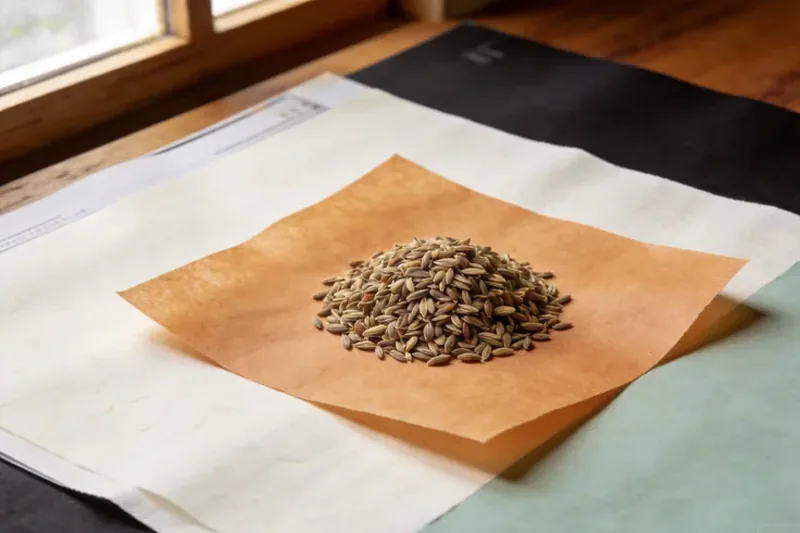
Direct answer: Apricot kernel (杏仁, xìngrén) is the kernel of the apricot, Prunus armeniaca, a stone fruit of the rose family (Rosaceae) long cultivated in China and Central Asia. The kernel has a sweet, nutty, almond-like scent and a bitter undertone from its amygdalin content. The Bencao Gangmu records 杏 in its fruit section, with 杏仁 as the material of value.
Key facts
| Chinese | 杏仁 (xìngrén); the fruit 杏, classical name 甜梅 |
| Botanical source | Prunus armeniaca (family Rosaceae) — the kernel |
| What it is | A stone-fruit kernel with a sweet-bitter nutty scent |
| Aroma | Sweet, nutty, almondy, bitter |
| Traditional role | 杏仁 in materia medica; a food and fragrance seed |
Aroma profile
Direct answer: Apricot kernel is sweet and nutty, with a marzipan-like almondy character and a clean bitter edge — the scent family shared by bitter almonds, cherry laurel, and other Prunus kernels. The bitterness reflects the kernel’s amygdalin, which releases benzaldehyde — the source of the almond note — when the kernel is crushed or moistened.
Apricot kernel is sweet and nutty, with a marzipan-like almondy character and a clean bitter edge — the scent family shared by bitter almonds, cherry laurel, and other Prunus kernels. The bitterness reflects the kernel’s amygdalin (a cyanogenic glycoside), which releases benzaldehyde — the source of the almond note — when the kernel is crushed or moistened. It is a food-adjacent scent, used in fragrance as a soft, sweet, marzipan nuance rather than a lead note. The key point is that the “almond” smell is a chemistry phenomenon — a molecule (benzaldehyde) released by several Prunus kernels — not a statement that apricot and almond are the same plant.
A provenance note (read this)
Direct answer: 杏仁 is recorded as a food and materia-medica seed, but its classical use is not primarily as a burned incense material. The Bencao Gangmu records it as food and medicine; it does not appear as a lead 香乘 ingredient. This page records it honestly — a documented food and materia-medica seed, positioned as such rather than invented as an incense staple.
杏仁 is recorded as a food and materia-medica seed, but its classical use is not primarily as a burned incense material:
- The Bencao Gangmu (本草纲目), fruit section (果之一), records 杏 with the kernel 杏仁 and the classical name 甜梅 (“sweet plum”), describing the fruit and kernel as food and medicine.
- It does not appear as a lead ingredient in the 香乘 (Xiang Cheng) incense canon; where the kernel’s sweet-bitter note is used, it is a supporting food or fragrance nuance, not a classical 香材 staple.
This page records 杏仁 honestly: a documented food and materia-medica seed with a genuine classical record, positioned as such rather than invented as an incense staple.
Botanical source and origin
Direct answer: Prunus armeniaca, the apricot, is a small tree of the rose family (Rosaceae), 5–8 (to 12) m tall, with flowers that open before the leaves and a drupe that is white, yellow, or orange, often tinged red. It is native to Central and East Asia and cultivated since antiquity across China and westward; the kernel inside the stone is the material of value.
Prunus armeniaca, the apricot, is a small tree of the rose family (Rosaceae). Flora of China records it (within Armeniaca) as a tree 5–8 (to 12) m tall, with a spherical crown, broad-ovate leaves, and flowers that open before the leaves, 2–4.5 cm in diameter, with white, pink, or red-tinged petals, followed by a drupe that is white, yellow, or orange, often tinged red. It is native to Central and East Asia and cultivated since antiquity across China and westward. The material of value is the kernel (杏仁) inside the stone, prized for its oil, its sweet-bitter nutty flavor, and its marzipan-like scent. See Armeniaca vulgaris (apricot) in Flora of China.
Chinese name and terminology
Direct answer: 杏仁 (xìngrén) means “apricot kernel” — 杏 “apricot” + 仁 “kernel/seed” — and the Bencao Gangmu records the fruit under the classical name 甜梅 (“sweet plum”). The 仁 in the name is the important precision: it names the kernel inside the stone, not the fruit flesh.
The Chinese term is part-precise: 杏 (xìng) is the apricot, and 仁 (rén) is the kernel or seed, so 杏仁 names the kernel inside the stone, not the fruit flesh. This matters because the apricot’s edible flesh and its aromatic, cyanogenic kernel are completely different materials with different safety profiles. The Bencao Gangmu records the fruit under 杏 with the classical name 甜梅 (“sweet plum”) — a name that, like many Chinese plant names, emphasizes the fruit’s sweetness while the kernel carries the distinctive marzipan-and-bitter chemistry.
The almond-note chemistry (read this)
Direct answer: The “almond” scent of apricot kernel is a molecule, not a plant identity. Apricot, bitter almond, and cherry laurel are all Prunus kernels whose amygdalin releases benzaldehyde when crushed or moistened — and benzaldehyde is the almond note. So “almond-smelling” spans several species sharing one chemistry.
The almond note deserves a precise framing, because it is the source of the most common confusion around 杏仁:
- Amygdalin is a cyanogenic glycoside present in many Prunus kernels — apricot, bitter almond, cherry laurel, peach.
- When crushed or moistened, amygdalin is acted on by enzymes to release benzaldehyde (the marzipan-like almond aroma) and hydrogen cyanide (the toxicity concern).
- The almond note is benzaldehyde, so several different kernels “smell of almond” because they share the same chemistry, not because they are the same plant.
This is why apricot kernel can stand in for almond in fragrance contexts — the shared benzaldehyde — and why bitter kernels carry a documented safety concern that sweet kernels carry in lesser degree.
In Chinese tradition
- Food and materia medica (Historical Record): 杏仁 is a long-documented food and medicine — the Bencao Gangmu (本草纲目) records it under 杏 with the name 甜梅.
- Fragrance nuance (Traditional Use): the sweet-bitter marzipan note of the kernel is used in perfumery and some edible preparations, not as a classical incense staple.
- Cyanogenic caution (Scientific Evidence): apricot kernels contain amygdalin, which can release cyanide; bitter kernels in particular are a documented safety concern. This is a safety fact, not a medical claim.
Traditional use vs modern evidence
Direct answer: The food and materia-medica record is documented; the medicinal uses are traditional, not established clinical fact. The documented, non-medical facts are botanical identity, the Rosaceae placement, the kernel’s food-and-fragrance role, and its established chemistry (amygdalin → benzaldehyde).
- Traditional Use — 杏仁 in the Bencao Gangmu as food and medicine. Traditional materia-medica language, not modern clinical evidence.
- Historical Record — the record of 杏/杏仁/甜梅 in the Bencao Gangmu 果之一.
- Scientific Evidence — the botanical identity of Prunus armeniaca (Rosaceae) and the chemistry of amygdalin (releasing benzaldehyde and cyanide) are established. We present no clinical or medical efficacy claims.
The food and materia-medica record is documented. Medicinal uses are traditional, not established clinical fact, and we make no medical claims.
How is it processed?
Direct answer: Apricot kernel is processed by removing the stone and shelling the kernel, then used whole, ground, or pressed for oil. There is no classical incense-processing record; processing is culinary or oil-pressing, and the sweet-bitter note is released by crushing, which is also when the cyanogenic chemistry becomes relevant.
The processing of 杏仁 is culinary and oil-oriented:
- Shelling — the stone is cracked to extract the kernel.
- Use whole / ground / pressed — the kernel is used whole, ground, or cold-pressed for its oil.
There is no classical incense-processing record for 杏仁; it is a food and oil seed. The practical point is that crushing or moistening releases the benzaldehyde note — and simultaneously activates the cyanogenic chemistry — which is why bitter kernels are handled as a safety matter, not a casual flavoring.
What determines quality?
Direct answer: Quality turns on kernel soundness and the sweet-versus-bitter distinction — sweet kernels are the food-grade material, while bitter kernels are higher in amygdalin and treated as a safety concern. There is no incense-grading standard, because it is not an incense material.
The quality factors, in rough order:
- Sweet vs bitter — sweet kernels are the food-grade material; bitter kernels are higher in amygdalin (a cyanide precursor).
- Soundness — clean, well-filled kernels without rancidity or insect damage.
- Aroma — a sweet, nutty, marzipan-like character for the food-grade kernel.
The sweet-versus-bitter distinction is the decisive quality and safety axis, not a fragrance-grading ladder.
Common forms
Direct answer: Apricot kernel is sold whole, ground, and as pressed oil. Whole and ground kernels serve food and traditional use; the oil serves culinary and cosmetic use. It is not sold as an incense material in the classical sense.
| Form | Typical use |
|---|---|
| Whole kernel | Food; traditional use |
| Ground kernel | Food; some fragrance preparations |
| Apricot kernel oil | Culinary and cosmetic use |
The forms are culinary and oil-oriented, reinforcing that 杏仁 is a food and materia-medica seed rather than a 香材.
What buyers should look for
Direct answer: Buyers should know the sweet-versus-bitter distinction — sweet kernels are the food-grade material, bitter kernels are higher in amygdalin (a cyanide precursor) and are a documented safety concern. 杏仁 is a food and materia-medica seed, not a classical incense staple; use it as a supporting sweet-nutty nuance, not a lead 香材.
For a food, fragrance, or sourcing buyer:
- Sweet vs bitter — confirm which kernel is being offered; bitter kernels are higher in amygdalin and not for casual consumption.
- Identity — confirm Prunus armeniaca (杏仁), distinct from bitter almond and other Prunus kernels that share the benzaldehyde note.
- Role — understand it is a food and materia-medica seed, not a classical incense staple.
- Condition — clean, sound kernels with a sweet, nutty, marzipan-like aroma and no rancidity.
Safety
Incense combustion produces smoke and particulate matter. Burn in a well-ventilated space, avoid inhaling concentrated smoke, and keep away from children and pets. Bitter apricot kernels contain amygdalin, a cyanide precursor, and are not for casual consumption. This is editorial knowledge content, not medical advice.
Apricot kernel vs bitter almond
Direct answer: Apricot kernel (杏仁) and bitter almond are different Prunus kernels that share the same almond-note chemistry. Both contain amygdalin, which releases benzaldehyde (the almond scent) and cyanide; bitter almond is the higher-amygdalin, more intensely bitter kernel, while apricot kernel exists in sweet and bitter forms. The “almond” smell is the shared molecule, not a shared species.
| Apricot kernel (杏仁) | Bitter almond | |
|---|---|---|
| Botanical source | Prunus armeniaca | Prunus amygdalus var. amara (and other Prunus) |
| Character | Sweet-bitter, nutty, marzipan | Intensely bitter, marzipan |
| Chemistry | Amygdalin → benzaldehyde + cyanide | Amygdalin → benzaldehyde + cyanide (higher) |
Both are Prunus kernels converging on benzaldehyde, which is why they smell alike despite being different plants. The safety logic is shared: amygdalin is a cyanide precursor, and bitter forms carry the higher concern.
Our Industry View
Direct answer: Apricot kernel’s lesson is that a scent can be a molecule, not a plant — and that the almond note is chemistry (benzaldehyde) shared across several Prunus kernels. For a buyer, this means the note is reproducible and the real specification is the kernel’s sweet-versus-bitter profile and its cyanogenic safety, not the species name alone.
From a manufacturing and sourcing perspective, 杏仁 illustrates how a fragrance note can be decoupled from the plant that carries it:
- The note is a molecule. The “almond” scent is benzaldehyde, released when Prunus kernels’ amygdalin is crushed or moistened. Because several species share the chemistry, “almond-smelling” is not a species specification — and a formulator can often reach the same note by other means. This is the opposite of a material like agarwood, whose value is tied to a specific wood.
- Sweet versus bitter is the real spec. The practical distinction is not apricot-versus-almond but sweet versus bitter kernel — because that axis determines both aroma and the cyanogenic safety profile. A buyer who specifies only “杏仁” has not specified the safety-relevant variable.
- Safety drives sourcing discipline here. Amygdalin’s cyanide release means bitter kernels are a genuine handling concern, not a flavor nuance. This is a rare case where the chemistry that produces the aroma is also the chemistry that produces the risk, so the sourcing spec and the safety spec are the same question.
In our view, the useful takeaway is procedural: specify the kernel (sweet or bitter), understand the note as benzaldehyde chemistry, and treat the cyanogenic safety boundary as part of the specification — rather than treating 杏仁 as a simple “almond-scented seed.”
Summary
Apricot kernel (杏仁) is the kernel of the apricot, Prunus armeniaca, a Rosaceae stone fruit of Central and East Asia long cultivated in China. Its sweet, nutty, marzipan-like scent comes from amygdalin, which releases benzaldehyde — the almond note — and cyanide when the kernel is crushed; that shared chemistry is why several Prunus kernels smell alike. The Bencao Gangmu records 杏/杏仁 under the name 甜梅 as food and medicine, and 杏仁 is honestly positioned here as a food and materia-medica seed with a fragrance nuance, not a classical incense staple. The sweet-versus-bitter distinction is the decisive quality and safety axis.
FAQ
What is 杏仁 (apricot kernel)? The kernel of the apricot, Prunus armeniaca, a stone fruit of the rose family (Rosaceae) long cultivated in China and Central Asia. It has a sweet, nutty, almondy scent with a bitter edge, and it is recorded as a food and materia-medica seed rather than a classical incense staple.
Does 杏仁 appear in the Bencao Gangmu? Yes. The Bencao Gangmu (本草纲目), fruit section (果之一), records 杏 with the kernel 杏仁 and the classical alternative name 甜梅 (“sweet plum”), describing the fruit and kernel as food and medicine. Its classical role is food and materia medica, not a lead incense ingredient.
Why does apricot kernel smell of almond? Because both are Prunus kernels sharing a common chemistry. The kernel’s amygdalin, a cyanogenic glycoside, releases benzaldehyde when the kernel is crushed or moistened, and benzaldehyde is the compound behind the marzipan-like almond note. The bitter edge reflects the kernel’s amygdalin content.
Are bitter apricot kernels safe? They are a documented safety concern, not a casual food. Bitter kernels are higher in amygdalin than sweet ones, and amygdalin can release cyanide in the body. This is a safety fact about the kernel’s chemistry, not a medical claim, and bitter kernels are not recommended for consumption.
Is 杏仁 a classical incense ingredient? Not as a lead material. 杏仁 is a documented food and materia-medica seed with a genuine classical record (甜梅 in the Bencao Gangmu), but it is not a staple of the 香乘 incense canon. Its sweet-bitter marzipan note is used as a supporting nuance rather than a lead 香材.
What is the difference between sweet and bitter apricot kernels? They are two forms of the same kernel distinguished by amygdalin content. Sweet kernels are the food-grade material with a milder marzipan note; bitter kernels are higher in amygdalin — the cyanide precursor — and are treated as a safety concern rather than a casual food. The distinction matters for both aroma and safety.
See also: plum blossom (梅花), peony (芍药), licorice (甘草), and the full scent guide.
Evidence & Sources
Botanical identity
Source: Armeniaca vulgaris (apricot) in Flora of China · Prunus armeniaca on GBIF. Evidence type: Established.
Traditional Chinese use
Source: the Bencao Gangmu (本草纲目), 果之一, records 杏 with the kernel 杏仁 and the name 甜梅, as food and medicine. Evidence type: Historically documented — food and materia medica; medicinal uses are traditional, not modern clinical evidence.
Authenticity / safety
Source: apricot kernels contain amygdalin, a cyanogenic glycoside; bitter kernels are a documented safety concern. Evidence type: Established (chemistry).
Safety
Source: incense combustion produces smoke and particulate matter; bitter kernels are not for casual consumption. Evidence type: Established.
Evidence status
| Layer | Status |
|---|---|
| Botanical identity | Established |
| Traditional use | Historically documented (food, materia medica) |
| Authenticity test | Practical screening |
| Health claims | Not established |
Sources
Sources: botanical references on Prunus armeniaca and the Bencao Gangmu (本草纲目) 果之一 record of 杏/杏仁. 杏仁 is documented as a food and materia-medica seed; medicinal uses are treated as traditional, not established clinical fact. This is editorial knowledge content, not medical advice.