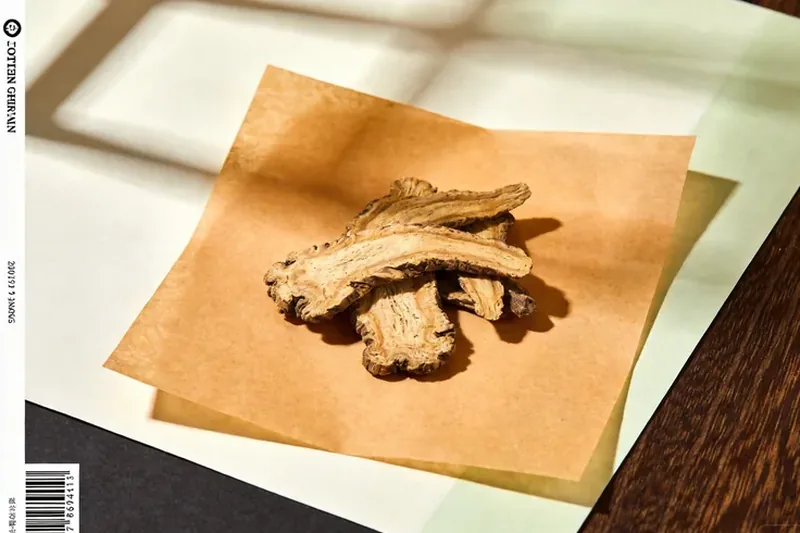
Direct answer: Licorice (甘草, gāncǎo) is the dried root and rhizome of Glycyrrhiza uralensis, a leguminous perennial of the pea family (Fabaceae) native to northern China, Mongolia, and Siberia. It is a deeply sweet root — its glycyrrhizin is many times sweeter than sugar — and in Chinese incense its role is not to be burned for a dominant scent but to act as a sweetening, harmonizing binder in 合香 formulas.
Key facts
| Chinese | 甘草 (gāncǎo) — “sweet herb” |
| Botanical source | Glycyrrhiza uralensis (family Fabaceae) — the dried root/rhizome |
| What it is | A dried root, not a wood or resin |
| Aroma | Sweet, woody, earthy, slightly bitter |
| Traditional role | 合香 sweetener and harmonizer; materia medica |
Aroma profile
Licorice root is sweet and woody, with an earthy, slightly bitter undertone — more a deep, dry sweetness than a sugary one. Its defining trait is the intense sweetness of glycyrrhizin, which persists long after the root has dried. In incense it does not lead: it reads as a softening, harmonizing note that rounds sharp or pungent aromatics and lends a smooth, mellow finish. Burnt alone it is unremarkable; blended in small proportion it is a quiet workhorse of classical formulas.
A role of sweetness, not scent (read this)
甘草 enters classical incense not for its own fragrance but for what it does to a formula. The Ming-dynasty Xiangcheng (香乘) treats 甘草 as one of the routine preparation ingredients alongside 藿香 (agastache) and 零陵香 — its sections on material preparation instruct that ingredients “such as 藿香, 甘草, 零陵香” (凡藿香甘草零陵之類) be picked clean of stems and weeds, sun-dried, and crumbled before use. Formulas in the same text list 甘草末 (powdered licorice) in small measured amounts — often a few qian against liang of the principal aromatics — confirming its role as a minor sweetening addition, not a principal scent.
Botanical source and origin
Glycyrrhiza uralensis is a leguminous perennial of the pea family (Fabaceae), native to the steppes and semi-arid regions of northern China, Mongolia, and Siberia. The part used is the dried root and rhizome, which concentrates glycyrrhizin — the compound responsible for the characteristic sweetness. It is one of several licorice species; Glycyrrhiza uralensis is the Chinese licorice, distinct from the Mediterranean Glycyrrhiza glabra, though the two share the sweetening principle.
In Chinese tradition
- 合香 harmonizer: 甘草 is a classical sweetener and harmonizer in blended incense, added in small amounts to round and soften sharper aromatics.
- Materia medica: 甘草 is one of the most-used herbs in traditional Chinese medicine, classically described for “harmonizing the hundred herbs” (调和诸药) — a harmonizing role that carries over into its incense use. This is traditional materia-medica language, not modern clinical evidence.
- Not a solo incense material: 甘草 is not burned alone for fragrance; it appears in formulas as a supporting ingredient.
Traditional use vs modern evidence
The sweetening and harmonizing use in incense is documented in the classical manuals. Medicinal uses are traditional, not established clinical fact, and we make no medical claims. The documented, non-medical facts are botanical identity, the Fabaceae placement, and the root’s long use as a minor sweetening binder in 合香.
Quality and sourcing notes
Practical points for buyers:
- 甘草 is Glycyrrhiza uralensis, the Chinese licorice; distinguish it from the Mediterranean Glycyrrhiza glabra — different species, same sweetening principle.
- Expect a deep, dry sweetness rather than a floral or spicy scent; the root is a supporting ingredient, not a principal aromatic.
- In incense it is used in small, measured amounts — a sweetening harmonizer, not a base to build a formula around.
Safety
Incense combustion produces smoke and particulate matter. Burn in a well-ventilated space, avoid inhaling concentrated smoke, and keep away from children and pets. This is editorial knowledge content, not medical advice.
FAQ
What is 甘草 (licorice)? The dried root and rhizome of Glycyrrhiza uralensis, a leguminous perennial of the pea family (Fabaceae) native to northern China, Mongolia, and Siberia. It is a deeply sweet root whose glycyrrhizin is many times sweeter than sugar, used in Chinese incense as a sweetening, harmonizing binder in 合香 formulas rather than as a dominant scent.
Is licorice burned alone as incense? No. 甘草 is not a solo incense material; its role is to sweeten and harmonize. In the Ming-dynasty Xiangcheng (香乘) it appears in small measured amounts — often a few qian against liang of the principal aromatics — rounding and softening sharper notes rather than leading the fragrance.
What does licorice root smell like? Sweet and woody, with an earthy, slightly bitter undertone — more a deep, dry sweetness than a sugary one, from the compound glycyrrhizin. In incense it reads as a softening, harmonizing note that lends a smooth, mellow finish to sharper aromatics.
What is the difference between Chinese and Mediterranean licorice? They are different species of the same genus. Chinese licorice is Glycyrrhiza uralensis; Mediterranean licorice is Glycyrrhiza glabra. Both contain the sweetening principle glycyrrhizin, but they are distinct plants with different native ranges — the former from northern Asia, the latter from the Mediterranean region.
Is licorice used in traditional Chinese medicine? Yes — 甘草 is among the most-used herbs in traditional Chinese medicine, classically described for “harmonizing the hundred herbs” (调和诸药). This harmonizing role carries over into its incense use, but this is traditional materia-medica language, not modern clinical evidence, and no medical claims are made here.
See also: spikenard-nardostachys, galangal, schisandra and the full scent guide.
Evidence & Sources
Botanical identity
Source: Glycyrrhiza uralensis in Flora of China · Glycyrrhiza uralensis on GBIF. Evidence type: Established.
Traditional Chinese use
Source: the Ming-dynasty Xiangcheng (香乘) lists 甘草 among routine preparation ingredients (凡藿香甘草零陵之類) and records 甘草末 in small measured amounts in formulas. Evidence type: Historically documented — aromatic/harmonizing use; medicinal uses are traditional, not modern clinical evidence.
Authenticity / disambiguation
Source: 甘草 (Glycyrrhiza uralensis, Chinese licorice) vs Glycyrrhiza glabra (Mediterranean licorice). Evidence type: Practical screening.
Safety
Source: incense combustion produces smoke and particulate matter; burn in a well-ventilated space. Evidence type: Established.
Evidence status
| Layer | Status |
|---|---|
| Botanical identity | Established |
| Traditional use | Historically documented |
| Authenticity test | Practical screening |
| Health claims | Not established |
Sources
Sources: botanical references on Glycyrrhiza uralensis and the Ming-dynasty Xiangcheng (香乘) record of 甘草 as a sweetening, harmonizing preparation ingredient. Licorice’s harmonizing use is documented; medicinal uses are treated as traditional, not established clinical fact. This is editorial knowledge content, not medical advice.