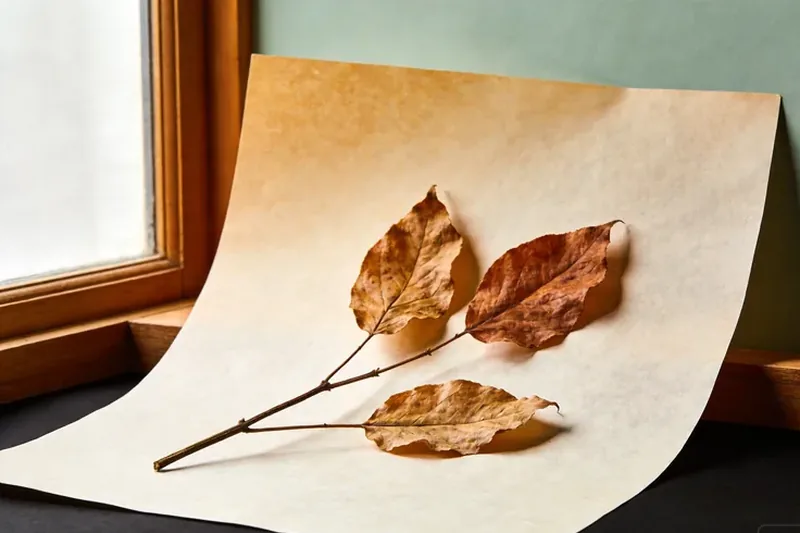
Direct answer: Perilla (紫苏, zǐsū) is the aerial herb of Perilla frutescens, an annual of the mint family (Lamiaceae) native to East Asia. It is a fragrant, minty-basil herb with a sweet, anise-like character from its essential oil, used in Chinese incense as a green herbal note and as a culinary herb. The name 紫苏 refers to the purple-leaved form; the green-leaved form is called 白苏.
Key facts
| Chinese | 紫苏 (zǐsū) — “purple perilla”; green form = 白苏 (báisū) |
| Botanical source | Perilla frutescens (family Lamiaceae) — the aerial herb |
| What it is | A fragrant culinary and aromatic herb, not a wood |
| Aroma | Herbal, minty, sweet, anise-like |
| Traditional role | Green herbal note; culinary herb |
Aroma profile
Direct answer: Perilla is herbal and minty, with a sweet, anise-like warmth and a faint basil edge — a fresh, green-sweet scent typical of the aromatic mint family. It is lighter and sweeter than true mint, and warmer than a plain green herb; in a blend it reads as a green herbal top note, adding freshness without mint’s sharpness.
Perilla is herbal and minty, with a sweet, anise-like warmth and a faint basil edge — a fresh, green-sweet scent typical of the aromatic mint family. It is lighter and sweeter than true mint, and warmer than a plain green herb. In a blend it reads as a green herbal note, adding freshness and a soft, anise-sweet lift without the sharpness of mint.
Botanical identity
Direct answer: Perilla frutescens is an erect annual herb of the mint family (Lamiaceae), with stems 0.3–2 m tall, green or purple, and broadly ovate to round leaves 4.5–13 cm long that may be green, purplish, or purple-black. Its flowers open August–November. The species is native to East Asia and grown from southern China through Japan and Korea.
Perilla frutescens is an erect annual herb of the mint family (Lamiaceae). Flora of China describes stems 0.3–2 m tall — green or purple, finely pilose or densely villous — with broadly ovate to circular leaf blades 4.5–13 × 2.8–10 cm, serrate at the margin, and colored green, purplish, or purple-black. The small flowers open August–November. Two color forms are recognized in Chinese usage — the purple-leaved 紫苏 (zǐsū) and the green-leaved 白苏 (báisū) — but they are one species, two color forms, not two plants. See Perilla frutescens in Flora of China and on GBIF.
Chinese name and terminology
Direct answer: 紫苏 means “purple perilla” and 白苏 “white perilla,” naming the two leaf-color forms of one species. Across East Asia the same plant is shiso (紫苏/青紫苏) in Japan and deulkkae/kkaennip in Korea. The color form is a labeling point, not a botanical difference — and neither is true mint (薄荷) or agastache (藿香).
The name 紫苏 (“purple perilla”) contrasts with 白苏 (“white/green perilla”), recording the leaf-pigment difference within one species. The same plant travels under regional names across East Asia — shiso in Japan and deulkkae (with kkaennip for the leaf) in Korea — which is why an ingredient list may say “perilla,” “shiso,” or “beefsteak plant” for the same material. This matters for buying because the name does not tell you which color form you are getting, and neither 紫苏 nor 白苏 is the same as true mint (薄荷, Mentha haplocalyx) or agastache (藿香, Agastache rugosa), two other mint-family herbs with their own entries.
Where does perilla come from?
Direct answer: Perilla is native to East Asia and widely cultivated. Flora of China records it across Fujian, Guangdong, Guangxi, Guizhou, Hebei, Hubei, Jiangsu, Jiangxi, Shanxi, Sichuan, Taiwan, Xizang, Yunnan, and Zhejiang, and beyond China in Bhutan, Cambodia, India, Indonesia, Japan, Korea, Laos, and Vietnam — it grows in waste areas and gardens.
Perilla frutescens is a common, easily grown annual across warm-temperate and subtropical East Asia. It is documented in waste areas and gardens from the Chinese provinces listed in Flora of China (Fujian, Guangdong, Guangxi, Guizhou, Hebei, Hubei, Jiangsu, Jiangxi, Shanxi, Sichuan, Taiwan, Xizang, Yunnan, Zhejiang) and more widely through Japan, Korea, the Himalayan foothills, and mainland Southeast Asia. Its abundance and easy cultivation are part of why it is a kitchen herb first and an incense material second — unlike a scarce resin or a slow-growing wood, perilla carries no rarity premium.
Why is it used in incense?
Direct answer: Perilla is used in incense as a light, green herbal top note that adds freshness and a soft anise-sweet lift to a blend. It is a culinary herb crossing into incense, not a classical pillar material, so it usually appears as a supporting accent rather than a lead note or a solo burn.
Perilla’s role in incense is that of a fresh, green-herbal accent. Its anise-sweet, minty lift brightens a formula without the cooling sharpness of true mint, which makes it useful where a blend needs “green” character that stays soft. Because it is primarily a culinary and aromatic herb rather than a resin or wood, perilla is almost always blended — it is too light and leafy to anchor a stick on its own, and it burns quickly, releasing its top note early. Its incense use is best understood as a modern crossover from its culinary and fragrance role, not as a continuation of a core 香道 recipe canon.
How is it processed?
Direct answer: Perilla is used as the dried aerial herb — leaves and flowering tops — harvested, cleaned, and dried whole, then either kept as loose leaf or ground to powder for blending. No extraction step is needed for the incense leaf; an essential oil is a separate product from the leaf material.
The part used is the aerial herb — leaves and flowering tops — cut and dried. From there it branches by end use:
- Dried leaf — kept whole or lightly crushed for sachets and loose blends.
- Powder — ground leaf for blending into sticks and cones; as with any leafy powder, particle size and moisture affect how it packs and burns.
- Essential oil — a separate steam-distilled product with a stronger, more concentrated anise-mint character; not the same as the leaf.
For powder buyers, particle size and moisture are the practical variables, but the exact target depends on the formula and production line — no single figure transfers between recipes. The mechanics sit within the wider how incense is made process.
What determines perilla quality?
Direct answer: For the dried herb, quality is about freshness and scent retention: the leaf should be clean, whole, and still carry a sweet, anise-minty aroma, without mustiness or brown, faded color. Leaf color is a form difference, not a grade — purple and green perilla are the same species, not two quality tiers.
The practical quality points, in rough order:
- Freshness and aroma — a good dried perilla still smells sweet-anise and green; stale or overdried leaf loses this and reads flat or dusty.
- Cleanliness — freedom from stems, soil, and foreign leaf.
- Leaf integrity — whole leaf beats heavily shattered or powdered-down material for aromatic retention.
- Color — purple vs green is a form (紫苏 vs 白苏), not a grade; both are legitimate, but a buyer should know which they are receiving because the label often does not say.
Perilla carries no standardized commercial grading ladder — it is an abundant herb, not a graded resin — so “quality” here means freshness and cleanliness rather than origin or density.
Common forms
Direct answer: Perilla is sold as dried whole leaf, crushed leaf, ground powder, and (separately) essential oil. Leaf and powder suit blending and sachets; the oil is a distinct, more concentrated product. None of the leaf forms is a quality statement — they are the same herb in different physical forms.
| Form | Typical use |
|---|---|
| Dried leaf | Sachets, loose blends, tea |
| Crushed leaf | Blends, potpourri |
| Powder | Incense sticks and cones |
| Essential oil | Fragrance; a separate, concentrated product |
紫苏 vs 白苏: a labeling problem (read this)
Direct answer: 紫苏 (purple) and 白苏 (green) are the same species, Perilla frutescens, in two leaf-color forms — not different plants. A label that says only “perilla” does not tell you the color form, and color matters less than freshness. Both forms are distinct from mint (薄荷) and agastache (藿香).
This is the key disambiguation for the material:
- 紫苏 (zǐsū) — the purple-leaved form; the classical culinary and aromatic name.
- 白苏 (báisū) — the green-leaved form; the same species, different pigment.
The two are one species in two color forms, a labeling point rather than two materials. In Japan the same plant is called shiso (紫苏 / 青紫苏 for the green form), and in Korea deulkkae — so “perilla,” “shiso,” and “beefsteak plant” can all name the same herb. The genuinely different plants nearby are true mint (薄荷, Mentha haplocalyx — see mint) and agastache (藿香, Agastache rugosa — see agastache-rugosa), both mint-family herbs with their own scents.
In Chinese tradition
- Culinary herb: perilla is a staple culinary herb across East Asia, used fresh and dried in cooking, pickling, and tea — and as a wrapper for grilled and fermented foods in Korean and Japanese cooking.
- Incense: 紫苏 is used as a light, green herbal note in incense, adding freshness and a soft anise-sweet lift.
- Materia medica: 紫苏 is recorded in traditional Chinese medicine (本草綱目, 草部) with described uses. This is traditional materia-medica language, not modern clinical evidence.
Traditional use vs modern evidence
Direct answer: Perilla’s culinary and aromatic use is well documented, but its medicinal uses are traditional, not established clinical fact. The documented non-medical facts are its botanical identity, its mint-family placement, and its green-herbal aromatic use — and this page makes no medical claims.
- Traditional Use — perilla is a staple culinary herb and a light green-herbal incense note across East Asia.
- Historical Record — 紫苏 is recorded in the 本草綱目 (草部) as a culinary and materia-medica herb; the 紫苏/白苏 color-form naming is established usage.
- Scientific Evidence — the essential oil’s chemistry (notably perillaldehyde) is characterized, but we present no clinical or medical efficacy claims.
The culinary and aromatic use is well documented. Medicinal uses are traditional, not established clinical fact, and we make no medical claims.
What buyers should look for
Direct answer: Buyers should confirm which leaf form they are receiving (紫苏 purple vs 白苏 green) and — more importantly — that the dried herb is clean, whole, and still fragrant rather than stale. For powder, confirm particle size and moisture against the formula rather than accepting a generic “perilla” label.
For an incense maker or sourcing buyer:
- Form — purple (紫苏) or green (白苏); ask, because the label often does not say.
- Freshness — the dried leaf should smell sweet-anise and green, not flat or musty.
- Cleanliness and integrity — whole, clean leaf beats shattered or stem-heavy material.
- Powder consistency — confirm particle size and moisture, and test a sample against your formula.
Our Industry View
Direct answer: Perilla’s incense value is as a fresh top note, not a rarity — it is an abundant culinary herb crossing into fragrance. The buyer’s real question is consistency of leaf quality and scent retention, not origin or grade, since purple and green perilla are one species and neither carries a rarity premium.
From a manufacturing perspective, perilla is instructive because it is a culinary herb doing secondary duty as a fragrance. Unlike agarwood or sandalwood, where origin, age, and resin content dominate the buying decision, perilla’s value turns on freshness and aroma retention — the same qualities a chef looks for in the kitchen. Two points follow:
- The color form is not a grade. 紫苏 and 白苏 are one species, and a supplier switching silently between purple and green leaf has not necessarily changed the material’s botanical identity — but the aroma character can shift slightly with variety and harvest, so a buyer who approves a sample of one should confirm the next batch matches.
- It is a top note, so it behaves like one. Leafy green herbs burn fast and release their scent early; they need a base to carry them. Expect perilla to contribute a bright opening rather than a long dry-down, and dose it accordingly.
In our view, perilla is a cheap, reliable green accent — buy it for freshness and consistency, not for prestige, and treat the purple/green question as a labeling detail rather than a quality signal.
Summary
Perilla (紫苏) is the aerial herb of Perilla frutescens, a mint-family annual native to East Asia and grown from southern China to Japan and Korea. Its two leaf-color forms — purple 紫苏 and green 白苏 — are one species, not two plants, and the same herb travels as shiso in Japan and deulkkae in Korea. It is a fresh, anise-sweet green herbal note used in incense as a top-note accent, a culinary herb first and a fragrance second. Its value rests on freshness and consistency rather than rarity, and its medicinal uses are traditional language, not clinical evidence.
FAQ
What is 紫苏 (perilla)? The aerial herb of Perilla frutescens, an annual of the mint family (Lamiaceae) native to East Asia and long cultivated across China, Japan, and Korea. It is a fragrant, minty-basil herb with a sweet, anise-like character, used in Chinese incense as a green herbal note and as a culinary herb. The name 紫苏 refers to the purple-leaved form.
What is the difference between 紫苏 and 白苏? They are the same species, Perilla frutescens, in two color forms: 紫苏 (zǐsū) is the purple-leaved form and 白苏 (báisū) is the green-leaved form. They differ in leaf pigment but are botanically one species — a labeling point, not two different plants. Both are distinct from true mint and agastache.
What does perilla smell like? Herbal and minty, with a sweet, anise-like warmth and a faint basil edge — a fresh, green-sweet scent typical of the aromatic mint family. It is lighter and sweeter than true mint, and warmer than a plain green herb. In a blend it reads as a green herbal note, adding freshness and a soft, anise-sweet lift.
Is perilla the same as shiso? Yes — shiso is the Japanese name for the same species, Perilla frutescens. The purple form is 紫苏 (shiso / zǐsū) and the green form is 白苏 (green shiso / báisū). In Korea the same plant is called deulkkae, with kkaennip naming the leaf. They are one species cultivated across East Asia under different regional names, not different plants.
How is 紫苏 used in Chinese tradition? Primarily as a staple culinary herb — used fresh and dried in cooking, pickling, and tea — and as a light, green herbal note in incense. It is also recorded in traditional Chinese medicine (本草綱目, 草部). The medicinal uses are traditional language, not modern clinical evidence, and this encyclopedia makes no medical claims.
Is perilla a wood or a resin? Neither — it is a leafy aerial herb, the dried leaves and flowering tops of Perilla frutescens. As a leafy herb it behaves differently from woods and resins in incense: it is light, burns quickly, and releases its green top note early, so it is usually blended as an accent rather than burned alone or used as a base.
See also: mint, agastache-rugosa, mugwort, elsholtzia and the full scent guide.
Evidence & Sources
Botanical identity
Source: Perilla frutescens in Flora of China · Perilla frutescens on GBIF. Evidence type: Established.
Traditional Chinese use
Source: 紫苏 as a culinary herb and green herbal note, recorded in the 本草綱目 草部. Evidence type: Historically documented — aromatic and culinary use; medicinal uses are traditional, not modern clinical evidence.
Authenticity / disambiguation
Source: 紫苏 vs 白苏 as two color forms of one species; distinct from 薄荷 (mint) and 藿香 (agastache). Evidence type: Practical screening.
Safety
Source: incense combustion produces smoke and particulate matter; burn in a well-ventilated space. Evidence type: Established.
Evidence status
| Layer | Status |
|---|---|
| Botanical identity | Established |
| Traditional use | Historically documented |
| Authenticity test | Practical screening |
| Health claims | Not established |
Sources
Sources: botanical references on Perilla frutescens and the purple-vs-green form distinction. Perilla is recorded as a culinary and aromatic herb; medicinal uses are treated as traditional, not established clinical fact. This is editorial knowledge content, not medical advice.