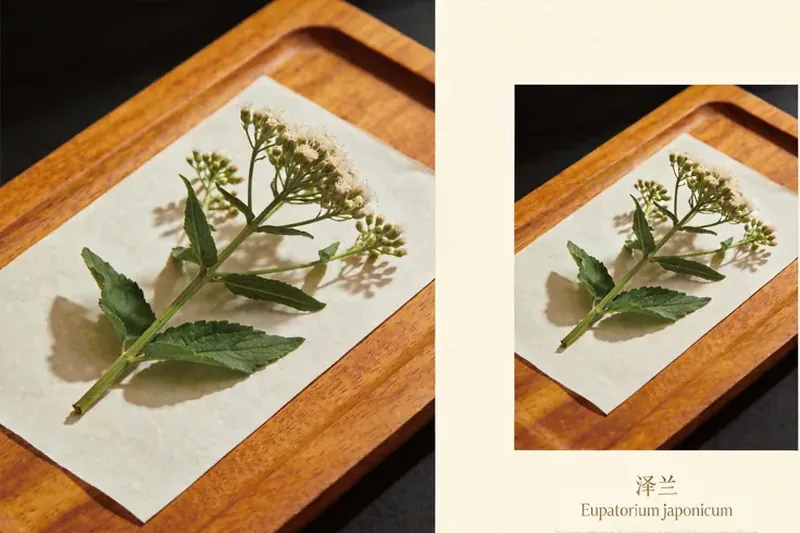
Direct answer: Zelan (泽兰, zélán) is the aromatic herb Eupatorium japonicum, a daisy-family (Asteraceae) perennial native to East Asia. It is a same-genus relative of, and must be distinguished from, 佩兰 (Eupatorium fortunei). The name 泽兰 is contested in Chinese materia medica, and that naming tangle is set out plainly rather than papered over.
Key facts
| Chinese | 泽兰 (zélán); Flora of China name 白头婆 (báitóupó) |
| Botanical source | Eupatorium japonicum (family Asteraceae) — the aerial herb |
| What it is | A daisy-family aromatic herb, same genus as 佩兰 |
| Aroma | Herbal, aromatic, fresh, slightly sweet |
| Traditional role | A contested 泽兰 name; distinguished from 佩兰 |
A naming caution (read this)
Direct answer: 泽兰 is a contested name, and the honesty matters. The Bencao Gangmu records a 泽兰 with “square stem, purple nodes” (方莖紫節) that modern botanists identify as the mint-family Lycopus lucidus, not a Eupatorium — while Eupatorium japonicum (Flora of China name 白头婆) is also called 泽兰 in some usage. This page describes 泽兰 = Eupatorium japonicum, the daisy-family herb.
泽兰 is a contested name, and the honesty matters:
- Classical 泽兰: the Bencao Gangmu (本草纲目), 草之三, records 泽兰 as a plant with “方莖紫節” (square stem, purple nodes) growing by water — which modern botanists identify as the mint-family herb Lycopus lucidus (地笋), not a Eupatorium.
- This entry — 泽兰 as Eupatorium japonicum: the daisy-family (Asteraceae) herb that Flora of China gives the Chinese name 白头婆, and which is also called 泽兰/山泽兰 in some regional usage. It is the same genus as 佩兰 (Eupatorium fortunei) — a distinct species, not the mint-family 泽兰.
The Bencao Gangmu itself flags the 泽兰/兰草 (佩兰) confusion — “其與蘭草為一物二種” — showing how old the naming tangle is. This page describes 泽兰 = Eupatorium japonicum, the daisy-family herb, not Lycopus lucidus.
Aroma profile
Direct answer: 泽兰 has a fresh, herbaceous, lightly aromatic scent with a gentle sweetness — the clean “green” character of the Eupatorium herbs, close to but a touch less sweet than 佩兰. It reads as a fresh herbal note, useful as a light accent rather than a dominant incense smell.
泽兰 has a fresh, herbaceous, lightly aromatic scent with a gentle sweetness — the clean “green” character of the Eupatorium herbs, close to but a touch less sweet than 佩兰. It reads as a fresh herbal note, useful as a light accent rather than a dominant incense smell. The scent is mild and green — a supporting character, not a lead, and this quietness is exactly what makes the botanical naming question the material’s real story rather than its aroma.
Botanical source and origin
Direct answer: Eupatorium japonicum is a herbaceous perennial 50–200 cm tall of the daisy family (Asteraceae), with erect, purplish-red stems and opposite leaves 6–20 × 2–6.5 cm. Flora of China records it under the Chinese name 白头婆; it is native to China, Japan, and Korea, where it grows in open and semi-shaded places.
Eupatorium japonicum is a herbaceous perennial of the daisy family (Asteraceae), native to China, Japan, and Korea, where it grows in open and semi-shaded places. Flora of China records it as a perennial herb 50–200 cm tall, with short rhizomes, erect, purplish-red stems, and opposite leaves — median stem leaves elliptic, narrowly elliptic, ovate-elliptic, or lanceolate, 6–20 × 2–6.5 cm — with pinnate venation and yellow glandular dots. Flora of China gives the species the Chinese name 白头婆 (báitóupó). The part used is the aerial herb. See Eupatorium japonicum in Flora of China.
The 泽兰 / 佩兰 distinction (read this)
Direct answer: 泽兰 and 佩兰 are closely related but distinct species in the same genus Eupatorium: 泽兰 is Eupatorium japonicum (Flora of China name 白头婆), while 佩兰 is Eupatorium fortunei, the classical “worn-orchid” fragrant herb. Both are fresh, herbaceous Asteraceae aromatics, but they are distinct species that must be kept separate in sourcing.
泽兰 and 佩兰 are closely related but distinct species in the same genus (Eupatorium):
- 泽兰 (this entry) — Eupatorium japonicum, the daisy-family herb; Flora of China names it 白头婆.
- 佩兰 — Eupatorium fortunei, the classical “worn-orchid” fragrant herb, its own entry.
Both are Asteraceae herbs with fresh, herbaceous scents; they differ as species within Eupatorium. The two must be kept distinct in sourcing, and both must be kept apart from the classical materia-medica 泽兰, which is the mint-family Lycopus lucidus — a third plant caught in the same naming tangle.
In Chinese tradition
- Materia medica (Traditional Use): the Bencao Gangmu (本草纲目), 草之三, has a 泽兰 entry, but the plant described (square stem, purple nodes) is the mint-family Lycopus lucidus, not Eupatorium japonicum. This is traditional materia-medica language, not modern clinical evidence.
- Fragrant herb (Historical Record): as an aromatic Eupatorium, it belongs to the same fresh, herbaceous family of scented herbs as 佩兰.
- Naming (Historical Record): the 泽兰/兰草 (佩兰) confusion is ancient, recorded in the Bencao Gangmu itself.
Traditional use vs modern evidence
Direct answer: The materia-medica record is traditional, not established clinical fact. The documented facts are botanical identity, the Asteraceae placement, the 佩兰 distinction, and the 泽兰 naming conflict — a documented case of a classical name not mapping cleanly to a modern species.
- Traditional Use — the 泽兰 materia-medica record in the Bencao Gangmu 草之三. Traditional materia-medica language, not modern clinical evidence.
- Historical Record — the Bencao Gangmu record of a 泽兰 with square stems and purple nodes (identified today as Lycopus lucidus), and its own note on the 泽兰/兰草 (佩兰) confusion.
- Scientific Evidence — the botanical identity of Eupatorium japonicum (Asteraceae) is established. We present no clinical or medical efficacy claims.
The materia-medica record is traditional, not established clinical fact, and we make no medical claims.
Why is 泽兰 catalogued here? (a framing note)
Direct answer: 泽兰 is catalogued here because it is a real aromatic herb with a documented, contested name — a worked example of how classical Chinese plant names do not map one-to-one onto modern species. Its value is not a strong aroma but a naming lesson: 泽兰 has named at least two different plants across history, and that ambiguity is itself the information.
泽兰 earns its place in this encyclopedia not for a strong fragrance but for a naming lesson:
- It is a genuine aromatic herb — the fresh, herbaceous Eupatorium japonicum.
- Its name is contested — classical 泽兰 (square stem, purple nodes) is the mint-family Lycopus lucidus, while Eupatorium japonicum is also called 泽兰 in some usage.
- The Bencao Gangmu itself records the 泽兰/兰草 (佩兰) confusion.
This makes 泽兰 a clean, documented example of a broader problem: classical Chinese plant names often named a role or a description, not a single species, and a modern buyer or researcher must pin the name to a scientific species rather than trusting the label.
How is it processed?
Direct answer: 泽兰 is processed by harvesting the aerial herb and drying it — whole or cut — and, for blending, grinding it to powder. There is no distillation or extraction step; the whole dried herb is the traditional material, and particle size and moisture depend on the formula.
The processing of 泽兰 is herb-drying, like 佩兰 and other leafy herbs:
- Harvest — the aerial herb (leaves and stems) is harvested.
- Dry — the herb is dried to a stable, storable form, whole or cut.
- Grind (optional) — for blending, the dried herb is ground to powder.
There is no distillation or extraction step. As with other leafy herbs, particle size and moisture affect how the material packs, burns, and releases aroma, and the right target depends on formulation.
What determines quality?
Direct answer: Quality turns on cleanliness, colour, and aroma — dried 泽兰 should be clean and green with a fresh, herbaceous scent when rubbed. The decisive “quality” issue, however, is identity: confirming Eupatorium japonicum, given the name’s contested history.
The quality factors:
- Identity — confirm Eupatorium japonicum; the name 泽兰 is contested with Lycopus lucidus and adjacent to Eupatorium fortunei (佩兰).
- Cleanliness — freedom from stems, soil, and foreign herb material.
- Colour and freshness — clean green material, not browned or musty.
- Aroma — a fresh, herbaceous scent when rubbed.
There is no standardized grading ladder; identity is the decisive check, followed by physical condition.
What buyers should look for
Direct answer: Buyers should confirm the species — Eupatorium japonicum — and be alert that “泽兰” in classical texts often means the mint-family Lycopus lucidus instead. Then judge condition: clean, green, fresh-smelling herb. Specify the scientific name when sourcing.
For a sourcing buyer:
- Species — specify Eupatorium japonicum; distinguish it from 佩兰 (Eupatorium fortunei) and from the mint-family Lycopus lucidus.
- Naming awareness — “泽兰” is contested; the scientific name, not the label, must carry the specification.
- Condition — clean, green, fresh-smelling herb with no mustiness.
- Form — whole/cut herb or powder, depending on the use.
Safety
Incense combustion produces smoke and particulate matter. Burn in a well-ventilated space, avoid inhaling concentrated smoke, and keep away from children and pets. This is editorial knowledge content, not medical advice.
泽兰 vs 佩兰 vs classical 泽兰
Direct answer: Three plants sit under the 泽兰 name: Eupatorium japonicum (this entry, Flora of China name 白头婆), Eupatorium fortunei (佩兰, a same-genus but distinct species), and the classical 泽兰 identified today as Lycopus lucidus (a mint-family herb). The name has covered at least two of them, and the scientific name is the only reliable key.
| Plant | Botanical source | Note |
|---|---|---|
| 泽兰 (this entry) | Eupatorium japonicum (Asteraceae) | Flora of China name 白头婆 |
| 佩兰 | Eupatorium fortunei (Asteraceae) | The classical “worn-orchid” herb |
| Classical 泽兰 | Lycopus lucidus (Lamiaceae) | The 本草纲目 “square stem, purple nodes” plant |
The same name 泽兰 has pointed at different plants across history, and the Bencao Gangmu itself records the confusion. See eupatorium (佩兰) for the same-genus herb and the full disambiguation.
Our Industry View
Direct answer: 泽兰 is a template for how to handle a contested classical name: pin the scientific species, state the conflict plainly, and treat the name as a role-description rather than a one-to-one species label. For sourcing, a drifting name is a supply-chain risk — “泽兰” without a species is a role, not a material.
From an editorial and sourcing perspective, 泽兰 is the clearest worked example of a recurring problem in Chinese botanical sourcing: the name and the plant do not map one-to-one.
Three points follow:
- A classical name often names a description, not a species. The Bencao Gangmu’s 泽兰 is described by morphology — square stem, purple nodes, growing by water — and modern botanists read that description as Lycopus lucidus, a mint-family herb. Meanwhile Eupatorium japonicum is also called 泽兰. The name named a character, and two different plants fit it across different eras.
- The conflict is documented, not invented. The Bencao Gangmu itself notes the 泽兰/兰草 (佩兰) confusion — “其與蘭草為一物二種” — so this is not a modern over-interpretation but an ancient, acknowledged ambiguity. Stating it plainly is the honest editorial position.
- For sourcing, the species carries the specification. A buyer who orders “泽兰” without a scientific name is ordering a role, not a material, and will receive whatever the seller’s region calls 泽兰. The fix is procedural: pin Eupatorium japonicum (or E. fortunei, or Lycopus lucidus) and confirm it against the description.
In our view, 泽兰’s value is its naming discipline — a documented, contested name handled by pinning the species and stating the conflict — which is exactly the kind of transparency that builds a credible botanical-incense knowledge base.
Summary
泽兰 (zélán) is the aromatic herb Eupatorium japonicum, an Asteraceae perennial 50–200 cm tall native to East Asia, which Flora of China records under the name 白头婆. It is a same-genus relative of 佩兰 (Eupatorium fortunei), a distinct species, and its name is genuinely contested: the classical 泽兰 of the Bencao Gangmu (square stem, purple nodes) is identified today as the mint-family Lycopus lucidus, while Eupatorium japonicum is also called 泽兰. The Bencao Gangmu itself records the 泽兰/兰草 confusion, making this a documented case of a classical name that does not map cleanly to a modern species — and the scientific name, not the label, is the only reliable key for sourcing.
FAQ
What is 泽兰 (zelan)? This entry describes Eupatorium japonicum, a daisy-family (Asteraceae) aromatic herb native to East Asia — the same genus as 佩兰 (Eupatorium fortunei), a distinct species. Flora of China gives E. japonicum the Chinese name 白头婆, though it is also called 泽兰/山泽兰 in some usage.
Is 泽兰 the same as 佩兰? No — same genus (Eupatorium), different species. 泽兰 here is Eupatorium japonicum; 佩兰 is Eupatorium fortunei, the classical “worn-orchid” fragrant herb. Both are fresh, herbaceous Asteraceae herbs, but they are distinct species.
Why is the name 泽兰 contested? The Bencao Gangmu (本草纲目), 草之三, records a 泽兰 with “方莖紫節” (square stem, purple nodes) growing by water — which modern botanists identify as the mint-family Lycopus lucidus (地笋), not a Eupatorium. Meanwhile Eupatorium japonicum is also called 泽兰. The Bencao Gangmu itself notes the ancient 泽兰/兰草 (佩兰) confusion.
What does 泽兰 smell like? Fresh, herbaceous, and lightly aromatic, with a gentle sweetness — the clean “green” character of the Eupatorium herbs, close to 佩兰 but a touch less sweet. It works as a light, fresh accent rather than a dominant incense note.
How do I tell 泽兰 and 佩兰 apart when sourcing? They are different species of Eupatorium, similar in scent but distinct plants. Specify the scientific name — Eupatorium japonicum for 泽兰, Eupatorium fortunei for 佩兰 — and be alert that “泽兰” in classical texts often means the mint-family Lycopus lucidus instead.
What does the Bencao Gangmu actually say about 泽兰? It records a 泽兰 with “方莖紫節” (square stem, purple nodes) growing by water — a description modern botanists read as the mint-family Lycopus lucidus, not a Eupatorium. It also flags the 泽兰/兰草 (佩兰) confusion directly, showing that the name has been ambiguous since the classical period.
See also: eupatorium (佩兰), agastache-rugosa (藿香), mugwort (艾草), and the full scent guide.
Evidence & Sources
Botanical identity
Source: Eupatorium japonicum in Flora of China · Eupatorium japonicum on GBIF. Evidence type: Established (Flora of China names the species 白头婆).
Traditional Chinese use / naming
Source: the Bencao Gangmu (本草纲目), 草之三, records a 泽兰 with square stems and purple nodes (方莖紫節), identified by modern botanists as Lycopus lucidus; the text also notes the 泽兰/兰草 (佩兰) confusion. Evidence type: Historically documented — naming conflict; medicinal uses are traditional, not modern clinical evidence.
Authenticity / disambiguation
Source: 泽兰 (Eupatorium japonicum) vs 佩兰 (Eupatorium fortunei) — same genus, different species; vs the mint-family 泽兰 (Lycopus lucidus). Evidence type: Practical screening.
Safety
Source: incense combustion produces smoke and particulate matter; burn in a well-ventilated space. Evidence type: Established.
Evidence status
| Layer | Status |
|---|---|
| Botanical identity | Established |
| Traditional use | Historically documented (naming conflict) |
| Authenticity test | Practical screening |
| Health claims | Not established |
Sources
Sources: botanical references on Eupatorium japonicum and the Bencao Gangmu (本草纲目) 草之三 record of 泽兰. The name 泽兰 is contested between the mint-family Lycopus lucidus and the daisy-family Eupatorium japonicum; this page follows the Eupatorium japonicum identification and keeps the 佩兰 distinction. Medicinal uses are treated as traditional, not established clinical fact. This is editorial knowledge content, not medical advice.