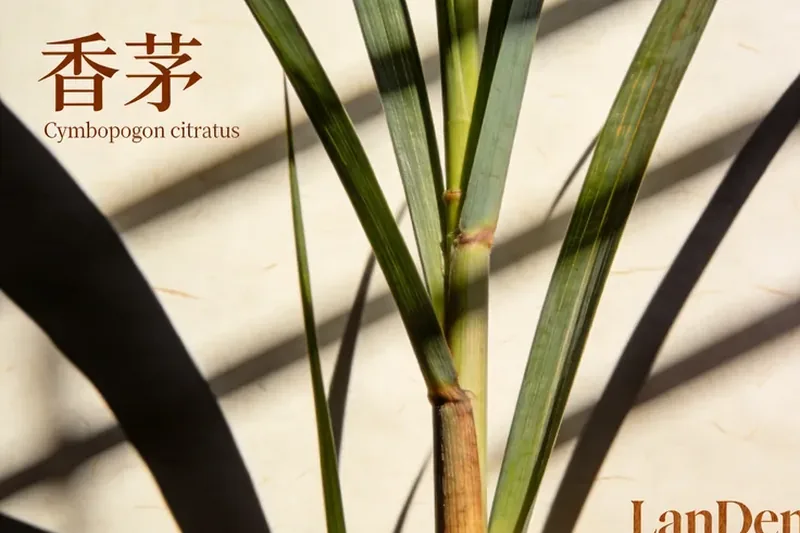
Technical answer: Citronella — xiāngmáo (香茅) in Chinese — is the fragrant leaf of Cymbopogon citratus, a tropical grass of the Poaceae family, better known in English as lemongrass. It is a bright, citrusy, lemony aromatic used across Southeast Asian cooking, and it appears in incense as a fresh, clean top note and as a traditional insect-repelling scent. Strictly, the essential oil sold as “citronella oil” often comes from a close relative (Cymbopogon nardus or C. winterianus), while Cymbopogon citratus is the lemongrass of the kitchen — a distinction worth noting.
Key facts
| Chinese | 香茅 (xiāngmáo), “fragrant grass”; also 柠檬香茅 |
| Botanical source | Cymbopogon citratus (family Poaceae) — the leaf |
| What it is | A fragrant tropical grass, used fresh or dried |
| Aroma | Citrusy, lemony, fresh, green-grassy |
| Traditional role | Fresh top note, insect-repelling scent, culinary herb |
Aroma profile
Direct answer: Lemongrass is bright and citrusy — a clean, lemony, slightly green-grassy scent driven by the aromatic citral. It is a top note: the fresh, lively lift that arrives first and fades fastest in a blend.
Lemongrass is bright and citrusy — a clean, lemony, slightly green-grassy scent driven by the aromatic citral. It is a top note, the kind of fresh, lively scent that lifts a blend immediately but fades fastest. In incense it adds a clean, zesty brightness; it is more at home in fresh, modern, and mosquito-repelling incense than in heavy classical wood-and-resin blends. Where lemon peel reads sharply citrus and lemon balm reads softly herbal, lemongrass sits between them — lemony but green, a grass note rather than a fruit note.
Botanical identity
Direct answer: Citronella/lemongrass is Cymbopogon citratus, a perennial, shortly rhizomatous grass of the Poaceae (grass) family, recorded by Flora of China with robust tufted culms up to 2 m tall and glaucous leaf blades 30–90 cm long. The fragrant part is the leaf, packed with citral-rich essential oil.
Cymbopogon citratus is a perennial, shortly rhizomatous grass of the Poaceae family. Flora of China records it with robust, tufted culms up to 2 m tall and glaucous (blue-green) leaf blades 30–90 cm long. It is the leaf that is used — packed with essential oil rich in citral, the aldehyde behind the lemony scent. This matters for a buyer: citronella is a leafy grass material, not a wood, resin, root, or flower, and its fragrance is concentrated in the fresh leaf rather than in a dense heartwood. See Cymbopogon citratus in Flora of China and Cymbopogon citratus on GBIF.
Chinese name and terminology
Direct answer: 香茅 (xiāngmáo, “fragrant grass”) is the standard name for lemongrass, also written 柠檬香茅. The name overlaps with — but is not identical to — “citronella”: 香茅 is the culinary grass Cymbopogon citratus, while “citronella oil” for insect repellent is more often distilled from C. nardus or C. winterianus.
A naming caution worth keeping straight:
- 香茅 (xiāngmáo) / 柠檬香茅 — Cymbopogon citratus, lemongrass, the culinary grass.
- “Citronella oil” — more often distilled from Cymbopogon nardus or C. winterianus, the “citronella grasses” of the insect-repellent trade.
“Citronella” and “lemongrass” overlap but are not identical: both are fragrant Cymbopogon grasses with a citrus character, but the species and the product differ.
Where does citronella come from?
Direct answer: Cymbopogon citratus is a clumping tropical grass native to Southeast Asia, now cultivated throughout the tropics and subtropics. It is the “lemongrass” of Thai and Vietnamese cooking, grown for its citral-rich leaves.
Cymbopogon citratus is a clumping tropical grass native to Southeast Asia, now cultivated throughout the tropics and subtropics. It is the “lemongrass” of Thai and Vietnamese cooking, grown as a culinary and aromatic crop for its citral-rich leaves. Unlike the wild-harvested woods of the incense canon, lemongrass is an easily grown grass whose supply follows ordinary aromatic-crop agriculture.
Why is it used in incense?
Direct answer: Lemongrass is used in incense as a fresh, clean, citrussy top note — a bright, modern lift and a traditional insect-repelling scent. It is more at home in fresh and mosquito-repelling incense than in heavy classical 合香 blends of woods and resins.
香茅’s incense role follows from its aroma behavior: as a top note it lifts a blend immediately, so it suits fresh, clean, and modern formulas and the insect-repelling incense that draws on citronella’s practical reputation. It is less at home in the heavy wood-and-resin blends of classical 合香, where a zesty grass note would read as out of place. Its identity is fundamentally a fresh aromatic, not a deep base. See the citrus incense guide and its citrus relatives lemon and lemon balm.
How is it processed?
Direct answer: Lemongrass leaves are used fresh, dried, or distilled for their citral-rich oil. For incense, the leaves are typically dried and ground to powder, with particle size and moisture affecting how the material packs, burns, and releases aroma.
The leaf is the part used, and it branches by end use:
- Fresh — the culinary and traditional aromatic form.
- Dried — the stable form for storage and grinding.
- Distilled oil — “lemongrass oil” or “citronella oil,” a separate product from the leaf itself.
For powder buyers, the same practical variables as any leafy powder apply: particle size and moisture affect how the material packs, burns, and releases aroma, and the right target depends on the formula — the binder, the other ingredients, and the production line (see Our Industry View below). The drying and grinding mechanics sit within the wider how incense is made process.
What determines citronella quality?
Direct answer: The strength of the lemony aroma is the main quality indicator — fresh or dried leaves should smell strongly of citral. Beyond that, buyers must distinguish 香茅 (C. citratus) from the other citronella grasses (C. nardus, C. winterianus), related but different species and products.
The practical quality factors:
- Aroma strength — a strong, clean lemony-citral scent; the scent is the main quality indicator.
- Species — 香茅 (C. citratus, lemongrass) versus the citronella grasses (C. nardus, C. winterianus).
- Freshness — leaves should be green and aromatic, not browned or stale.
- For powder — consistent particle size and moisture, judged against the specific formula.
There is no standardized numerical grading system; the buyer evaluates the lot by scent and species.
Common forms
Direct answer: Lemongrass is sold fresh, dried (whole or cut), ground to powder, and as distilled oil. Fresh and dried serve cooking and traditional use; powder serves incense blending; the oil is a separate distilled product, not ground leaf.
| Form | Typical use |
|---|---|
| Fresh leaf | Cooking, traditional aromatic use |
| Dried leaf | Storage, tea, incense |
| Powder | Blended into incense sticks and cones |
| Distilled oil | Insect repellent, fragrance, perfumery |
The distinction between leaf and oil is functional, not a quality statement — the same plant in different physical forms. See incense powder & resin for how leaf powder behaves in practice.
In Chinese tradition
- Fresh aromatic and insect repellent: 香茅’s lemony scent is used to freshen spaces and to repel insects — a practical aromatic role shared with other citronella grasses. Historical Record — documented practical use.
- Culinary: lemongrass is a defining herb of Southeast Asian cuisine, and its use in southern Chinese and diaspora cooking is well established. Historical Record — documented culinary use.
- Incense context: 香茅 appears in incense as a fresh, clean, citrussy top note, most common in modern and insect-repelling incense rather than classical 合香 formulas. Modern Industry Practice.
- Materia medica: 香茅 has traditional aromatic uses. Traditional Use — this is traditional materia-medica language, not modern clinical evidence.
Traditional use vs modern evidence
The culinary and insect-repelling roles are well documented. Any medicinal use is traditional, not established clinical fact, and we make no medical claims. The documented, non-medical facts are botanical identity, the citral-rich leaf, and its use as a fresh, clean fragrance.
Citronella vs related citrus aromatics
Direct answer: Citronella (lemongrass) is a grassy, citral-driven lemon scent, distinct from lemon peel (a sharp, bright fruit-citrus from Citrus × limon) and from lemon balm (a soft, herbal-minty lemon from Melissa officinalis). The three share a lemon character but come from different plants and sit at different weights.
| Aromatic | Plant | Character |
|---|---|---|
| Citronella / lemongrass (香茅) | Cymbopogon citratus | Green, grassy lemon — a top note |
| Lemon (柠檬) | Citrus × limon | Sharp, bright fruit-citrus from the peel |
| Lemon balm (香蜂草) | Melissa officinalis | Soft, herbal, minty lemon |
All three belong to a loose “lemon-scented” family, but they are different plants with different aromas and uses. See lemon, lemon balm, and the citrus incense guide.
Adulteration & misidentification
Direct answer: The main risk is misidentification, not adulteration: 香茅 (C. citratus, lemongrass) is easily conflated with the citronella grasses (C. nardus, C. winterianus) and, in loose usage, with “citronella oil” — related but different species and products. The botanical name on the label resolves the matter.
Citronella is not an expensive, heavily faked aromatic; its risk is a naming matter. The word “citronella” slides between the culinary grass and the insect-repellent oil grasses, and the species name is the only reliable way to pin down which is meant. See the substitution cross-reference for the general screening logic.
Modern commercial applications
Direct answer: Lemongrass reaches the market through three channels — culinary herb, insect-repellent oil (the “citronella” of mosquito products), and a fresh incense/fragrance top note. The culinary and repellent channels dominate its commercial weight; incense use is a smaller, modern crossover.
Lemongrass’ commercial life is led by cooking and by the insect-repellent oil distilled from the citronella grasses. Its incense role is a smaller, modern crossover — a fresh, zesty top note in contemporary and mosquito-repelling formulas. For a sourcing buyer, this split matters because the culinary, repellent, and incense markets value the grass differently: culinary buyers prize fresh, strongly aromatic leaves; oil buyers prize citral yield; incense buyers care about how the dried powder behaves in a formula.
What buyers should look for
Direct answer: Buyers should confirm the species (C. citratus vs the citronella grasses), judge the strength of the lemony aroma, and confirm the form — fresh, dried, powder, or oil. For powder, test particle size and moisture against the formula.
For an incense maker or sourcing buyer:
- Species — confirm Cymbopogon citratus; a real seller can state it and distinguish it from the citronella grasses.
- Aroma strength — a strong, clean lemony-citral scent is the main quality indicator.
- Form — fresh leaf, dried leaf, powder, or oil; each behaves differently in a blend.
- Powder consistency — confirm particle size and moisture, and test a sample against your formula.
Safety
Incense combustion produces smoke and particulate matter. Burn in a well-ventilated space, avoid inhaling concentrated smoke, and keep away from children and pets. This is editorial knowledge content, not medical advice.
Our Industry View
Direct answer: In manufacturing, lemongrass is a precision top note, not a base. Its value is a bright, citral-driven lift that arrives first — but top notes fade fastest, so dosage, particle size, and batch consistency matter more than the variety name, and the material must be treated as a fresh aromatic rather than a durable base.
From a manufacturing perspective, lemongrass’ defining trait is brightness — which is both its value and its constraint. It supplies a clean, zesty lift that no wood or resin can match, but top notes are, by definition, the first to fade, so the brightness must be dosed and blended deliberately rather than relied on to carry a formula.
Two points follow:
- It is a top note, not a base. Lemongrass lifts a blend but will not anchor it. Its role is to brighten the opening; a buyer who expects it to provide a lasting body will be disappointed, while one who uses it as a measured top-note accent gets real value.
- Particle size and moisture affect behavior, not just aroma. As a leafy powder, lemongrass is sensitive to the same grinding and drying variables as any powder; the right target depends on formulation — the binder, the other ingredients, and the production line — so a figure that works in one factory does not transfer to another.
In our view, the commercial sweet spot is a clean, strongly aromatic, correctly identified lemongrass leaf used as a measured top-note accent — not a rare or expensive ingredient, but one that rewards precision and an honest understanding of how quickly top notes fade.
Summary
Citronella (香茅) is the citral-rich leaf of Cymbopogon citratus — lemongrass — a perennial Poaceae grass recorded by Flora of China at up to 2 m tall, valued as a culinary herb, an insect-repelling aromatic, and a fresh, lemony top note in modern incense. It is distinct from the citronella grasses (C. nardus, C. winterianus) that supply “citronella oil,” and it sits alongside lemon and lemon balm in a loose lemon-scented family of unrelated plants. In incense it is a bright top note, not a base; commercially, species confirmation, aroma strength, and consistency outweigh the variety name.
FAQ
Is citronella the same as lemongrass? Related but not identical. Lemongrass is Cymbopogon citratus (香茅), the culinary grass of Southeast Asian cooking. “Citronella oil” for insect repellent is more often distilled from Cymbopogon nardus or C. winterianus. All are fragrant citrus-scented grasses of the same genus, but the species — and therefore the product — differ, and the two names are worth distinguishing.
What does lemongrass smell like? Bright, clean, and lemony — a citrusy, slightly green-grassy scent driven by the aromatic citral. It is a top note: the fresh, lively lift that arrives first and fades fastest in a blend. In incense it adds a zesty, modern brightness rather than a heavy classical wood or resin character.
Is 香茅 a Chinese incense ingredient? It is used in incense as a fresh, clean, citrussy top note, most common in modern and insect-repelling incense rather than the heavy classical 合香 blends of woods and resins. Its defining identity is culinary — lemongrass is a staple of Southeast Asian cooking — and its incense use is a fresh, modern crossover of that bright lemony character.
Why is lemongrass used to repel insects? Because of its strong citral-rich lemony scent, which is why citronella grasses are distilled into insect-repelling oils. Lemongrass (Cymbopogon citratus) shares this practical role with the citronella grasses (C. nardus, C. winterianus) used for citronella oil. The repellent role is a practical aromatic use, not a medical claim.
What part of the plant is used? The leaf. Lemongrass leaves are packed with essential oil rich in citral, which gives the lemony scent. The leaves are used fresh in cooking, dried, or distilled for oil. The quality indicator is the strength of the lemony aroma, and in incense the material is a bright, sparingly-used top note.
What is the difference between lemongrass and lemon? They are different plants with a shared lemon character. Lemongrass (Cymbopogon citratus) is a grass whose leaves carry a green, grassy lemon scent from citral; lemon (Citrus × limon) is a tree whose peel carries a sharp, bright fruit-citrus scent. One is a leafy top note, the other a fruit-peel citrus; they are not interchangeable in a formula.
See also: lemon, lemon balm, patchouli, the citrus incense guide, rue and the full scent guide.
Evidence & Sources
Botanical identity
Source: Cymbopogon citratus in Flora of China · Cymbopogon citratus on GBIF. Evidence type: Established.
Traditional Chinese use
Source: 香茅 as a fresh aromatic, insect-repelling scent, and culinary herb. Evidence type: Historically documented — aromatic and culinary use, not medical.
Authenticity / disambiguation
Source: lemongrass (Cymbopogon citratus) vs citronella grasses (C. nardus, C. winterianus). Evidence type: Practical screening.
Safety
Source: incense combustion produces smoke and particulate matter; burn in a well-ventilated space. Evidence type: Established.
Evidence status
| Layer | Status |
|---|---|
| Botanical identity | Established |
| Traditional use | Historically documented |
| Authenticity test | Practical screening |
| Health claims | Not established |
Sources
Sources: botanical references on Cymbopogon citratus and the lemongrass-vs-citronella distinction. Lemongrass is recorded as a culinary and insect-repelling aromatic; any medicinal use is treated as traditional, not established clinical fact. This is editorial knowledge content, not medical advice.