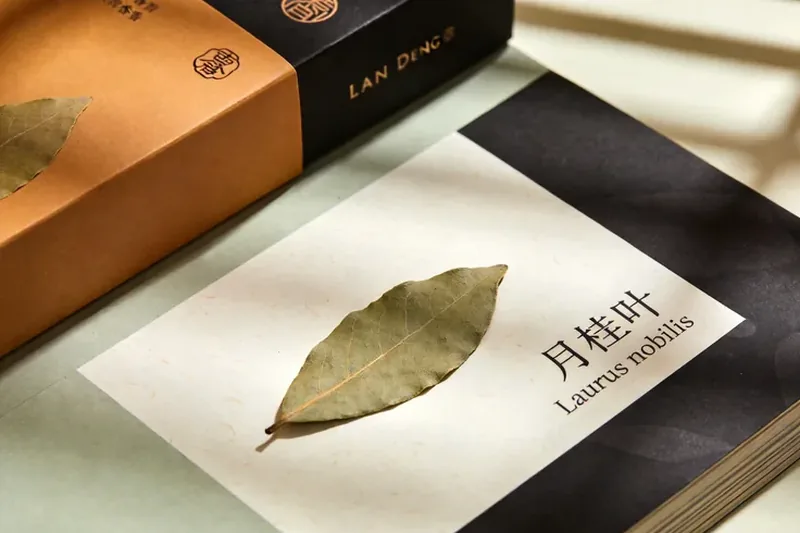
Direct answer: Bay leaf (月桂叶, yuèguì yè) is the leaf of Laurus nobilis, the bay laurel or sweet bay, an evergreen tree of the laurel family (Lauraceae) native to the Mediterranean. It is a herbal, camphoraceous, slightly sweet culinary and fragrance herb, used in Chinese incense as a herbal accent and, more commonly, as a modern crossover rather than a classical ingredient. In classical Chinese, 月桂 usually refers to the osmanthus.
Key facts
| Chinese | 月桂叶 (yuèguì yè) — “bay laurel leaf” |
| Botanical source | Laurus nobilis (family Lauraceae) — the leaves |
| What it is | A leaf, not a wood or resin |
| Aroma | Herbal, camphoraceous, fresh, slightly sweet |
| Traditional role | Western culinary herb; modern herbal note |
Aroma profile
Direct answer: Bay leaf is herbal and camphoraceous, with a fresh, slightly sweet and eucalyptus-like character that intensifies when the leaf is bruised or gently heated. It is more aromatic and green than a true spice, sitting between mint and clove in register, and in a blend it reads as a dry herbal accent adding a clean aromatic lift.
Bay leaf is herbal and camphoraceous, with a fresh, slightly sweet and eucalyptus-like character that intensifies when the leaf is bruised or gently heated. It is more aromatic and “green” than a true spice, sitting between mint and clove in register. In a blend it reads as a dry herbal accent, adding a clean, aromatic lift rather than sweetness or depth.
Botanical identity
Direct answer: Laurus nobilis is an evergreen tree or large shrub of the laurel family (Lauraceae), native to the Mediterranean. Its aromatic leaves are the bay leaves of Western cooking, and its leaves and berries supplied the laurel wreaths of classical antiquity. It is not a Chinese native and has no Flora of China treatment.
Laurus nobilis is an evergreen tree or large shrub of the laurel family (Lauraceae), native to the Mediterranean region. Its aromatic leaves are the bay leaves of Western cooking, and its leaves and berries supplied the laurel wreaths of classical antiquity — the origin of “laureate.” It is not a Chinese native and has no Flora of China treatment; its identity is anchored in GBIF and Western botanical sources. The Lauraceae family also contains cinnamon (桂皮, Cinnamomum cassia), which is why the shared 桂 character invites confusion — same family, different parts and different aromas. See Laurus nobilis on GBIF.
Chinese name and terminology
Direct answer: The Chinese name 月桂叶 means “bay laurel leaf.” But the shared 月桂 name connects unrelated plants: 月桂叶 is Laurus nobilis (bay laurel), while 月桂/桂花 is Osmanthus fragrans (sweet osmanthus), and 桂皮 is Cinnamomum cassia (cinnamon bark). The 桂 character is the trap.
The Chinese name 月桂叶 (“bay laurel leaf”) is precise, but the 桂 character it shares with other aromatics is a standing source of confusion:
- 月桂叶 (bay leaf) — Laurus nobilis (Lauraceae), the Mediterranean bay laurel. This entry.
- 月桂 / 桂花 (osmanthus) — Osmanthus fragrans (Oleaceae), the sweet osmanthus. See osmanthus.
- 桂皮 (cinnamon) — Cinnamomum cassia (Lauraceae), a bark. See cinnamon.
The shared 桂 is a Chinese-character coincidence, not a botanical relationship — bay leaf and osmanthus are in different families entirely.
The 月桂 naming caution (read this)
Direct answer: In classical Chinese, 月桂 usually means the osmanthus (Osmanthus fragrans), not the bay laurel (Laurus nobilis). When a classical source says 月桂 or 月桂子, it is describing osmanthus and its fruit — a fact that matters when reading old incense and materia-medica texts.
The Chinese name 月桂 is shared across unrelated plants, which is a real source of confusion:
- 月桂叶 (bay leaf) — Laurus nobilis (Lauraceae), the Mediterranean bay laurel. This entry.
- 月桂 / 桂花 (osmanthus) — Osmanthus fragrans (Oleaceae), the sweet osmanthus, which classical Chinese texts sometimes call 月桂 (and whose fruit, 月桂子, appears in 香乘). Its own entry.
- 桂皮 (cinnamon) — Cinnamomum cassia (Lauraceae), a different laurel-family bark. Its own entry.
This page describes 月桂叶 = Laurus nobilis = bay leaf. When a classical source says 月桂 or 月桂子, it is usually describing osmanthus, not the bay laurel. This is a reading discipline, not a botanical subtlety: an English-speaking reader who sees “月桂” and reaches for the bay leaf will misread the classical record.
Where does bay leaf come from?
Direct answer: Bay laurel is native to the Mediterranean region, where it has been cultivated since antiquity for its aromatic leaves. It is not a Chinese native — its presence in Chinese kitchens and incense is a modern import, not a continuation of a classical Chinese material.
Laurus nobilis is native to the Mediterranean basin, where it has been grown for culinary and ceremonial use since classical antiquity. It has no native range in China and no Flora of China treatment. This provenance matters for how it is framed: bay leaf is a modern crossover into Chinese incense and cooking — an imported Western herb — not a classical 香道 or materia-medica material. Its identity is anchored in Western botanical and culinary tradition.
Why is it used in incense?
Direct answer: Bay leaf is used in incense as a dry, herbal accent — a fresh, camphoraceous lift — and in sachets. Its use is a modern crossover from Western cooking and fragrance rather than a classical Chinese incense role, so it usually appears as a supporting herbal note, not a lead or a solo burn.
Bay leaf’s role in incense is as a dry, camphoraceous herbal accent. Its fresh, slightly sweet eucalyptus-like lift suits blends and sachets where a clean, aromatic “green” note is wanted without the cool sweetness of mint. It is not a classical Chinese incense ingredient — 月桂叶 does not appear in the 香乘, and where 香乘 mentions 月桂子 it means the osmanthus fruit — so its incense use is best understood as a modern crossover from its Western culinary and fragrance role. It is usually blended rather than burned alone, functioning as a supporting note.
How is it processed?
Direct answer: Bay leaf is used as the dried leaf, harvested and air-dried whole, then kept whole for slow release or ground to powder for blending. The leaves are also steam-distilled for bay leaf essential oil, a separate, more concentrated product.
The part used is the dried leaf. Processing is simple:
- Dried whole leaf — the classic culinary and sachet form; slow-releasing when gently heated.
- Crushed or ground leaf — for blending into incense; particle size and moisture affect how the powder packs and burns.
- Essential oil — steam-distilled bay leaf oil, a distinct, concentrated product with a stronger camphoraceous-eucalyptus character.
The grinding and forming mechanics sit within the wider how incense is made process.
What determines bay leaf quality?
Direct answer: Quality turns on freshness and oil content: a good bay leaf is intact, green, and strongly aromatic when bruised, with a clean camphoraceous-eucalyptus lift. Old, faded, or broken leaves have lost much of their essential oil and read flat. Correct species is assumed — bay leaf is Laurus nobilis, not the unrelated “bay” names in other plants.
The practical quality points, in rough order:
- Freshness and oil content — a good leaf releases a strong camphoraceous aroma when bruised or warmed; old leaves fade and flatten.
- Leaf integrity — whole, unbroken leaves retain aroma better than shattered ones.
- Color — green, unblemished leaf beats brown or faded leaf.
- Cleanliness — freedom from stems, dust, and foreign leaf.
Bay leaf carries no standardized grading ladder — it is an abundant culinary herb — so quality means freshness, oil content, and integrity.
Common forms
Direct answer: Bay leaf is sold as dried whole leaves, crushed leaf, ground powder, and essential oil. Whole leaves suit slow release and sachets; powder suits stick-making; the oil is a separate concentrated product. The forms are the same leaf in different physical states.
| Form | Typical use |
|---|---|
| Dried whole leaf | Culinary; sachets; slow release |
| Crushed leaf | Blends, potpourri |
| Powder | Incense sticks and cones |
| Essential oil | Fragrance; a separate concentrated product |
In Chinese tradition
- Not a classical incense ingredient: 月桂叶 does not appear in the classical incense compendium 香乘; where 香乘 mentions 月桂子, it refers to the fruit of osmanthus, not bay laurel.
- Western culinary herb: bay leaf is a staple of Mediterranean and European cooking, and its use in Chinese kitchens and incense is a modern crossover.
- Aromatic accent: its camphoraceous leaves are used for their fresh, herbal scent in blends and sachets.
Traditional use vs modern evidence
Direct answer: Bay leaf’s culinary and aromatic use is documented in Western sources; its use in Chinese incense is a modern crossover, not a classical record. We make no medical claims. The documented non-medical facts are its botanical identity, Lauraceae placement, and camphoraceous aromatic use.
- Traditional Use — bay leaf is a staple Western culinary and fragrance herb, used for its camphoraceous, slightly sweet aroma.
- Historical Record — its use in Chinese kitchens and incense is a modern crossover; 月桂叶 is absent from the 香乘, where 月桂子 means the osmanthus fruit.
- Scientific Evidence — the leaf’s essential oil (notably 1,8-cineole) is characterized, but we present no clinical or medical efficacy claims.
The culinary and aromatic use is documented in Western sources. We make no medical claims.
What buyers should look for
Direct answer: Buyers should confirm they are getting Laurus nobilis leaf, then check freshness and oil content — an intact, green, strongly aromatic leaf. For powder, confirm particle size and moisture against the formula. And keep the 桂 disambiguation in mind: bay leaf is not osmanthus or cinnamon.
For an incense maker or sourcing buyer:
- Species — bay leaf is Laurus nobilis; distinguish it from osmanthus (桂花) and cinnamon (桂皮), which share the 桂 character.
- Freshness and oil content — the leaf should be green, intact, and strongly aromatic when bruised.
- Form — whole leaf, crushed, powder, or oil; each behaves differently in a blend.
- Powder consistency — confirm particle size and moisture, and test a sample against your formula.
Our Industry View
Direct answer: Bay leaf’s commercial interest is as a clean, cheap herbal accent, but its real lesson is provenance: it is a modern Western crossover wearing a Chinese name. The 月桂/桂花/桂皮 confusion is a labeling risk that a buyer resolves by naming the species, not by trusting the 桂 character.
From a manufacturing perspective, bay leaf is a minor but instructive material. Its aromatic value — a dry, camphoraceous, eucalyptus-like lift — is modest and easily sourced, which makes it a cheap accent rather than a pillar. Two points follow:
- Provenance is part of the specification. Bay leaf is a Western herb imported into Chinese incense, not a classical material; treating it as a 香道 heritage ingredient would misstate its history. For content and labeling, the honest framing is “modern crossover,” which is also what a buyer should understand before paying any premium for a “月桂” label.
- The 桂 character is a trap, not a clue. 月桂叶 (bay), 桂花 (osmanthus), and 桂皮 (cinnamon) are unrelated aromatics sharing one character. In sourcing, the only reliable identifier is the Latin species name — Laurus nobilis — because the Chinese characters will not keep the three apart.
In our view, bay leaf is a clean, low-cost herbal accent worth having for its fresh lift — but buy it by species name, and do not let the shared 桂 character blur the difference between a Mediterranean leaf, a sweet Chinese flower, and a warm bark.
Summary
Bay leaf (月桂叶) is the leaf of Laurus nobilis, a Mediterranean laurel-family evergreen, used as a camphoraceous, slightly sweet herbal accent in incense and sachets. It is a modern Western crossover, not a classical Chinese incense ingredient — in classical Chinese, 月桂 usually means the osmanthus, not the bay laurel, and the shared 桂 character also reaches cinnamon. Its value rests on freshness and oil content rather than rarity, and its medicinal uses are not claimed.
FAQ
What is 月桂叶 (bay leaf)? The leaf of Laurus nobilis, the bay laurel or sweet bay, an evergreen tree of the laurel family (Lauraceae) native to the Mediterranean. It is a herbal, camphoraceous, slightly sweet culinary and fragrance herb — the “bay leaf” of Western kitchens — used in Chinese incense as a herbal accent and as a modern crossover.
Is 月桂叶 the same as osmanthus (桂花)? No. 月桂叶 is the leaf of Laurus nobilis (Lauraceae), the Mediterranean bay laurel. But in classical Chinese, 月桂 usually refers to the osmanthus (Osmanthus fragrans, Oleaceae) — whose fruit, 月桂子, appears in 香乘. The shared 月桂 name connects unrelated plants, and each has its own entry here.
What does bay leaf smell like? Herbal and camphoraceous, with a fresh, slightly sweet, eucalyptus-like character that intensifies when the leaf is bruised or gently heated. It is more aromatic and green than a true spice, sitting between mint and clove in register. In a blend it reads as a dry herbal accent, adding a clean aromatic lift.
Is bay leaf in the classical Chinese incense record? Not as bay laurel. 月桂叶 does not appear in the classical incense compendium 香乘; where 香乘 mentions 月桂子, it refers to the fruit of osmanthus, not the bay laurel. Bay leaf’s use in Chinese kitchens and incense is a modern crossover from its Western culinary and aromatic role.
Is bay leaf the same as cinnamon (桂皮)? No. Bay leaf is Laurus nobilis (a leaf), while cinnamon (桂皮) is Cinnamomum cassia (a bark). Both are in the laurel family (Lauraceae) but are different species used for different parts, with different characters — bay leaf is herbal and camphoraceous, cinnamon is warm and sweet-spicy. Each has its own entry.
Is bay leaf the same as osmanthus fruit (月桂子)? No. 月桂子 (“月桂 fruit”) is the fruit of the osmanthus (Osmanthus fragrans), not a product of the bay laurel (Laurus nobilis). When classical texts record 月桂子, they mean the osmanthus fruit — a different plant from the bay leaf, despite the shared 月桂 name.
See also: cinnamon, rosemary, osmanthus, and the full scent guide.
Evidence & Sources
Botanical identity
Source: Laurus nobilis on GBIF. Evidence type: Established.
Traditional Chinese use
Source: 月桂叶 (bay leaf) — not a 香乘 ingredient; the 月桂 name in classical Chinese usually denotes osmanthus, not bay laurel. Evidence type: Historically documented (Western culinary); name disambiguation recorded honestly.
Authenticity / disambiguation
Source: 月桂叶 (Laurus nobilis) vs 月桂/桂花 (Osmanthus fragrans) vs 桂皮 (Cinnamomum cassia). Evidence type: Practical screening.
Safety
Source: incense combustion produces smoke and particulate matter; burn in a well-ventilated space. Evidence type: Established.
Evidence status
| Layer | Status |
|---|---|
| Botanical identity | Established |
| Traditional use | Historically documented (Western) |
| Authenticity test | Practical screening |
| Health claims | Not established |
Sources
Sources: botanical reference on Laurus nobilis and the bay-vs-osmanthus-vs-cinnamon naming distinction. Bay leaf’s culinary and aromatic use is documented in Western sources; no medical claims are made. This is editorial knowledge content, not medical advice.