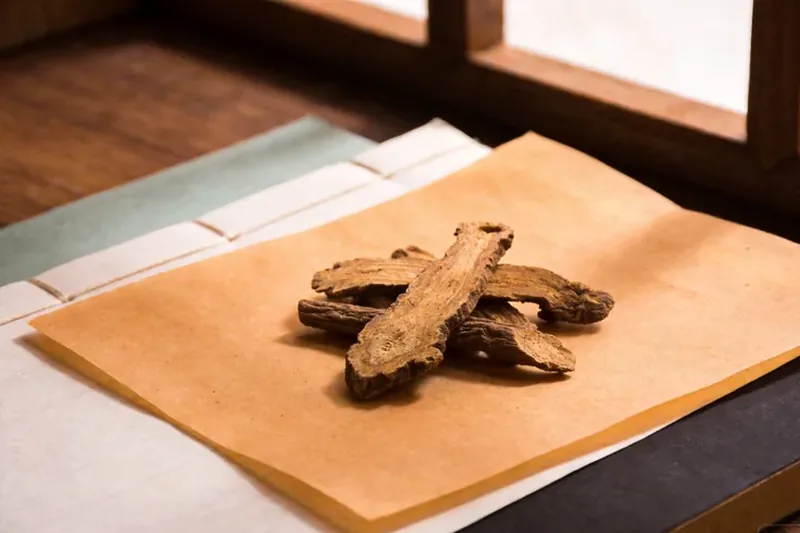
Technical answer: Atractylodes — cāngzhú (苍术) in Chinese — is the dried rhizome of Atractylodes lancea, an aromatic herb in the daisy family (Asteraceae). It is a major herb of Chinese materia medica and a traditional fumigation material — burned with mugwort to “clear” a space — but it is not one of the classical fragrance ingredients of huxiang (合香). This page records that distinction precisely.
Key facts
| Chinese | 苍术 (cāngzhú), also 茅苍术 / 南苍术 |
| Botanical source | Atractylodes lancea (Asteraceae) — the dried rhizome |
| What it is | A dried aromatic root/rhizome, not a wood or resin |
| Aroma | Herbal, woody, pungent, earthy |
| Traditional role | Materia medica; fumigation (烟熏) with mugwort |
Aroma profile
Direct answer: Atractylodes rhizome has a pungent, dry, medicinal scent — herbal and woody with an earthy undertone, nothing sweet or floral. Its strong, sharp aroma is precisely why it was burned for fumigation rather than blended into fragrance-forward incense.
Atractylodes rhizome has a pungent, herbal, woody scent — dry and medicinal rather than sweet or floral. It is not a “perfume” material in the classical sense. Its aroma is why it has been used in smoking traditions (fumigation) rather than in fragrance-forward huxiang blends. Where agarwood rewards gentle warming and sandalwood reads creamy and soft, atractylodes is rough and penetrating — an aromatic built to announce itself in smoke, not to unfold in layers.
Botanical identity
Direct answer: Atractylodes is the rhizome of Atractylodes lancea, a perennial herb of the Asteraceae (daisy) family recorded by Flora of China at (15–)30–100 cm tall with a thick, horizontal or ascending rhizome — the part used. It is a root material, structurally unlike the woods and resins of the classical incense canon.
Atractylodes lancea is a perennial herb of the daisy family, Asteraceae. Flora of China records the plant at (15–)30–100 cm tall, with a thick, horizontal or ascending rhizome and stems that are solitary or tufted; the leaves are papery and pinnately divided. It is the rhizome — the underground stem — that is harvested, dried, and used. This matters for a buyer: atractylodes is a root material, a different category from the woods, resins, and flowers it is sometimes grouped with. See Atractylodes lancea in Flora of China and Atractylodes lancea on GBIF.
Chinese name and terminology
Direct answer: 苍术 (cāngzhú) is the standard name, with regional forms recorded as 茅苍术 / 南苍术. The name is a species label, not a grade — and the shared English word “atractylodes” hides a split between 苍术 (A. lancea) and the very different 白术 (A. macrocephala), which must be pinned down.
The name 苍术 is specific, but the English catch-all “atractylodes” is not. Two terms a buyer must keep separate:
- 苍术 (cāngzhú) — Atractylodes lancea, the pungent “brown” atractylodes, the fumigation and materia-medica herb this page describes. Regional names 茅苍术 / 南苍术 point to the same material.
- 白术 (báizhú) — Atractylodes macrocephala, the “white” atractylodes, a different species with a milder profile and a different medicinal role.
A label that says only “atractylodes” is underspecified; the species name resolves it (see Atractylodes vs bai zhu below).
Where does atractylodes come from?
Direct answer: Atractylodes lancea is native to East Asia, found across central and southern China and the Korean peninsula. It is a wild and semi-cultivated herb of temperate hills and mountains rather than a plantation crop on the scale of sandalwood or agarwood.
Atractylodes lancea is a perennial herb native to East Asia, found across central and southern China and the Korean peninsula. It grows in temperate and montane habitats, and the rhizome is collected and dried as a materia-medica staple. Unlike the tropical woods and resins of the incense trade, atractylodes is a temperate herb whose supply follows the patterns of medicinal-herb agriculture and wild collection rather than a dedicated aromatic-plantation industry.
Why is it used in incense?
Direct answer: Atractylodes is not a classical incense fragrance material. Its burning role is fumigation (烟熏) — burned, often together with mugwort, as a folk and seasonal practice for clearing a space and warding off “impure qi” (辟秽) — a different tradition from the fragrance art of 合香.
This is the central distinction the page exists to record. Atractylodes appears in the context of burning, but not as a fragrance:
- Fumigation (烟熏): 苍术 has long been burned, often together with mugwort (艾草), as a traditional fumigation practice associated with clearing a space and warding off “impure qi” (辟秽) — a folk-custom and seasonal practice rather than a fragrance art.
- Not a 合香 material: unlike 甘松, 藿香, or 零陵香, 苍术 does not appear in the classical incense manuals (香乘 / 香譜) as a huxiang fragrance material.
Conflating the two is the most common error around this herb — and the reason buyers should understand which kind of “incense ingredient” they are being offered. See mugwort, its fumigation partner, and the blending system for how 合香 actually works.
How is it processed?
Direct answer: Atractylodes is processed by harvesting the rhizome, cleaning it, and drying it — whole, sliced, or ground to powder. The drying method and the resulting moisture and particle size depend on the producer and the intended use, so no single specification applies across the trade.
The essential step is simple: the rhizome is dug, cleaned, and dried to a stable, storable form. From there it branches by end use — whole dried rhizomes and slices for materia medica and fumigation, or ground powder for blending into incense. For powder buyers, the same practical variables as any root powder apply: particle size and moisture affect how the material packs, burns, and releases aroma, and the right target depends on the formula — the binder, the other ingredients, and the production line (see Our Industry View below). The drying and grinding mechanics sit within the wider how incense is made process.
What determines atractylodes quality?
Direct answer: The first determinant is species — 苍术 (A. lancea) versus 白术 (A. macrocephala) — because the two are different materials with different aromas and uses. After that, quality turns on cleanliness, dryness, and the strength of the characteristic pungent aroma.
The practical quality factors, in rough order:
- Species — 苍术 vs 白术 is a material difference, not a grade difference; confirm A. lancea.
- Cleanliness — freedom from soil, foreign roots, and mold.
- Dryness and storage — a properly dried rhizome keeps its pungent aroma rather than turning musty.
- Aroma — a strong, clean herbal-pungent scent, not stale or faded.
- For powder — consistent particle size and moisture, judged against the specific formula.
There is no standardized numerical grading system for atractylodes in the way there is a “sinking” test for agarwood; the buyer evaluates the physical condition of the lot.
Common forms
Direct answer: Atractylodes is sold as whole dried rhizomes, slices, and ground powder. Whole rhizomes and slices serve materia medica and fumigation; powder serves incense blending — the same material in different physical forms, not a quality distinction.
| Form | Typical use |
|---|---|
| Whole dried rhizome | Materia medica, fumigation |
| Slices | Decoction, inspection, fumigation |
| Powder | Blended into incense sticks and cones |
The distinction is functional, not a quality statement. See incense powder & resin for how root powder behaves in practice.
In Chinese tradition
- Materia medica: 苍术 is a major herb in traditional Chinese medicine, classically described for “drying dampness and strengthening the spleen” (燥湿健脾) and related uses. Traditional Use — this is traditional materia-medica language, not modern clinical evidence.
- Fumigation (烟熏): 苍术 has long been burned, often together with mugwort (艾草), as a traditional fumigation practice associated with clearing a space and warding off “impure qi” (辟秽) — a folk-custom and seasonal practice rather than a fragrance art. Historical Record — documented folk practice.
- Incense context: unlike 甘松, 藿香, or 零陵香, 苍术 does not appear in the classical incense manuals (香乘 / 香譜) as a huxiang fragrance material. Its “burning” role is fumigation, a different tradition. Historical Record — documented by its absence from the fragrance manuals.
Traditional use vs modern evidence
苍术’s medicinal reputation is extensive in the classical literature, but it is traditional, not established clinical fact, and we make no medical claims. The well-documented, non-medical facts are its botanical identity and its long folk use as a fumigation herb burned with mugwort. Its absence from the classical fragrance manuals is the key editorial distinction this page preserves. We do not present any claim that burning atractylodes — alone or with mugwort — has a medical or antimicrobial effect; that framing belongs to traditional belief, not to established evidence.
Atractylodes vs bai zhu (白术)
Direct answer: 苍术 and 白术 are two closely related medicinal roots in the same genus but distinct species with different profiles and roles. 苍术 (A. lancea) is the pungent, fumigation-oriented root; 白术 (A. macrocephala) is the milder “white” medicinal root. The shared English word hides a real difference.
| 苍术 (Atractylodes) | 白术 (Bai zhu) | |
|---|---|---|
| Species | Atractylodes lancea | Atractylodes macrocephala |
| Character | Pungent, dry, “brown” atractylodes | Milder, “white” atractylodes |
| Traditional role | Fumigation; “drying dampness” | A major, widely used materia-medica root |
| Incense relevance | Burned as fumigation (not 合香) | Not an incense material |
The two share a genus but are distinct species with different profiles and roles, and a buyer should check which species a label specifies. The disambiguation logic is the same one described in the substitution cross-reference.
Adulteration & misidentification
Direct answer: The main risk is misidentification, not adulteration: because both are sold as “atractylodes,” 苍术 (A. lancea) and 白术 (A. macrocephala) can be conflated. The two have different aromas and uses, so the botanical name on the label resolves the matter.
Atractylodes is not an expensive, heavily faked aromatic in the way agarwood is; its risk is a naming and identification matter. The principal confusion is between the two Atractylodes species, which share the English name but serve different purposes. A label that names the species — A. lancea versus A. macrocephala — resolves it.
Modern commercial applications
Direct answer: Atractylodes reaches the market mainly as a materia-medica herb and a fumigation material, with a small secondary role in herbal-incense blends that draw on its smoky, clearing character. The materia-medica channel dominates its commercial weight.
Atractylodes’ commercial life is led by traditional medicine — the dried rhizome is a staple materia-medica item, sold whole, sliced, and powdered. Its incense-adjacent role is smaller and specific: it appears in herbal or “clearing”-themed blends and in fumigation products rather than in fragrance-forward 合香. For a sourcing buyer, this split matters because the materia-medica and incense markets value the root differently — medicinal buyers prize species authenticity and cleanliness, while incense buyers care about aroma on combustion and how the powder behaves in a formula.
What buyers should look for
Direct answer: Buyers should confirm the species (A. lancea vs A. macrocephala), the form, and the physical condition — clean, dry, strongly aromatic rhizome with no mold or foreign matter. For powder, test particle size and moisture against the formula rather than accepting a nominal grade.
For an incense maker or sourcing buyer:
- Species — confirm Atractylodes lancea; a real seller can state it and distinguish it from 白术.
- Form — whole rhizome, slices, or powder; each behaves differently in a blend.
- Physical condition — clean, dry, intact rhizome with a strong pungent aroma and no mold or debris.
- Powder consistency — confirm particle size and moisture, and test a sample against your formula.
Safety
Burning plant material produces smoke and particulate matter. Fumigation with 苍术 and mugwort produces dense smoke, so it should be done in a well-ventilated space, and concentrated smoke should not be inhaled. Keep away from children and pets. This is editorial knowledge content, not medical advice.
Our Industry View
Direct answer: In manufacturing, atractylodes is a fumigation and “clearing”-theme material, not a fragrance base. Its value is a dry, penetrating herbal-smoke note — but the same intensity means it can overwhelm a delicate formula, so dosage, particle size, and batch consistency matter more than the variety name.
From a manufacturing perspective, atractylodes’ defining trait is intensity — which is both its value and its constraint. It supplies a dry, penetrating herbal note that nothing else in the canon quite matches, but that very intensity means it must be dosed deliberately: a little goes a long way, and an unmeasured addition can flatten a blend’s finer florals and woods.
Two points follow:
- It is a fumigation material, not a 合香 base. Atractylodes will not anchor a fragrance the way sandalwood or agarwood can, and it was never a classical huxiang ingredient. Its proper role is a smoky, clearing character in herbal and “purifying”-themed blends — a buyer who expects it to behave like a perfume wood will be disappointed; one who uses it deliberately gets real value.
- Particle size and moisture affect behavior, not just aroma. As a root powder, atractylodes is sensitive to the same grinding and drying variables as any powder; the right target depends on formulation — the binder, the other ingredients, and the production line — so a figure that works in one factory does not transfer to another.
In our view, the commercial sweet spot is a clean, correctly identified, consistently dried A. lancea rhizome used as a measured smoky-herbal accent — not a rare or expensive ingredient, but one that rewards precision and a clear understanding of its fumigation tradition.
Summary
Atractylodes (苍术) is the dried rhizome of Atractylodes lancea, an Asteraceae perennial recorded by Flora of China at 30–100 cm tall, valued in Chinese tradition as a materia-medica herb and — distinctively — as a fumigation material burned with mugwort to clear a space. It is not a classical huxiang fragrance ingredient, a distinction that separates it from the woods and resins of the incense canon. Its main identification risk is confusion with 白术 (A. macrocephala), a different species with a different role. In incense it is a smoky, “clearing” accent, not a base; commercially, species confirmation and consistency outweigh the variety name.
FAQ
Is atractylodes an incense ingredient? Not in the classical sense. 苍术 does not appear in the Song- and Ming-dynasty incense manuals (香譜 / 香乘) as a huxiang (blended-fragrance) material. Its burning role is fumigation — burning it, often with mugwort, as a folk custom for clearing a space and warding off “impure qi” (辟秽). That is a different tradition from fragrance-forward incense, and the two should not be conflated.
What is the difference between 苍术 and 白术? They are two closely related medicinal roots in the same genus. 苍术 (Atractylodes lancea) is the pungent “brown” atractylodes used in fumigation and described for “drying dampness”; 白术 (Atractylodes macrocephala) is the milder “white” atractylodes, a different and widely used materia-medica root. The shared English word “atractylodes” hides the difference, so buyers should check which species a label specifies.
What does atractylodes smell like? Atractylodes rhizome has a pungent, herbal, woody scent that reads as dry and medicinal rather than sweet or floral. It is not a perfume note in the classical sense. Its strong aroma is precisely why it has been used for fumigation rather than for blending into fragrance-forward incense.
What is atractylodes used for in Chinese tradition? 苍术 is a major traditional-medicine herb, classically described for “drying dampness and strengthening the spleen” (燥湿健脾) and related uses — traditional materia-medica language, not modern clinical evidence. Separately, it has a long folk use as a fumigation herb, burned together with mugwort (艾草) as a seasonal practice for clearing a space. This page records both roles while making no medical claims.
Is atractylodes the same as mugwort? No. Mugwort (艾草) is an Artemisia herb, while atractylodes (苍术) is an Atractylodes rhizome — different plants and families. They appear together in one specific context: the traditional fumigation practice of burning 苍术 and mugwort together to “clear” a space. That shared fumigation role is the reason they are linked, not a botanical relationship.
What part of the plant is used? The rhizome — the thick, horizontal or ascending underground stem — not the leaves or flowers. Flora of China records Atractylodes lancea as a perennial herb 30–100 cm tall with a thick rhizome, and it is that rhizome which is harvested, dried, and used whole, sliced, or ground to powder.
See also: mugwort, angelica, the blending system, and the full scent guide.
Evidence & Sources
Botanical identity
Source: Atractylodes lancea in Flora of China · Atractylodes lancea on GBIF. Evidence type: Established.
Traditional Chinese use
Source: 苍术 as a materia-medica herb (燥湿健脾) and its fumigation use with mugwort (艾草) for 辟秽. Evidence type: Historically documented — traditional materia-medica language, not modern clinical evidence. Note: 苍术 is absent from the classical fragrance manuals 香乘 / 香譜; its burning role is fumigation, not huxiang.
Authenticity / disambiguation
Source: the 苍术 (Atractylodes lancea) vs 白术 (A. macrocephala) species distinction. Evidence type: Practical screening.
Safety
Source: burning plant material (incl. 苍术-mugwort fumigation) produces smoke and particulate matter; ventilate and avoid inhaling concentrated smoke. Evidence type: Established.
Evidence status
| Layer | Status |
|---|---|
| Botanical identity | Established |
| Traditional use | Historically documented |
| Authenticity test | Practical screening |
| Health claims | Not established |
Sources
Sources: botanical references on Atractylodes lancea and the 苍术 / 白术 disambiguation. Medicinal uses are treated as traditional, not established clinical fact; 苍术’s fumigation role is recorded as folk custom, distinct from the classical fragrance manuals. This is editorial knowledge content, not medical advice.