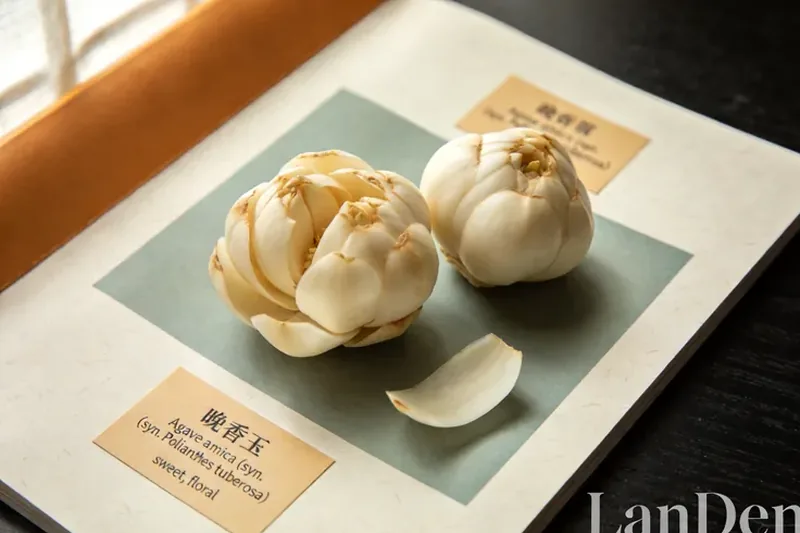
Direct answer: Tuberose (晚香玉, wǎnxiāngyù) is the flower of Agave amica (long known as Polianthes tuberosa), a bulbous perennial of the asparagus family (Asparagaceae) native to Mexico. Its name means “night-fragrant jade.” It is a Western-perfumery flower adopted into modern Chinese floristry and fragrance, prized for a rich, sweet, creamy, heady white-floral scent that deepens at night — not a plant of the classical Chinese canon.
Key facts
| Chinese | 晚香玉 (wǎnxiāngyù) — “night-fragrant jade” |
| Botanical source | Agave amica (syn. Polianthes tuberosa), family Asparagaceae — the flower |
| What it is | A bulbous perennial flower, a modern crossover into Chinese floristry |
| Aroma | Sweet, floral, creamy, heady |
| Traditional role | None in classical Chinese incense; modern floral note |
Aroma profile
Direct answer: Tuberose is one of the most powerful white florals in perfumery — sweet and creamy, with a rich, almost fruity headiness that intensifies after dusk. It reads as dense and narcotic rather than fresh or green, which is the signature that made it a prized enfleurage flower in Western perfumery.
Tuberose is one of the most powerful white florals in perfumery — sweet and creamy, with a rich, almost fruity headiness that intensifies after dusk. In a room it reads as dense and narcotic rather than fresh or green. This is the signature that made it a prized enfleurage flower in Western perfumery, and it is this Western profile, not any Chinese classical record, that brings 晚香玉 into modern Chinese floral fragrance. The night-intensification is not poetic license: the flower’s scent genuinely strengthens in the evening, which is why its name — in Chinese and in its perfume reputation — centers on night.
A provenance note (read this)
Direct answer: 晚香玉 is a modern crossover, not a classical Chinese incense material. The plant is native to Mexico and entered global cultivation through Western horticulture; the name 晚香玉 (“night-fragrant jade”) is a descriptive modern coinage, not a term from 香乘 or the Bencao Gangmu. No classical Chinese origin is claimed.
晚香玉 is a modern crossover, not a classical Chinese incense material:
- The plant is native to Mexico and entered global cultivation through Western horticulture.
- The Chinese name 晚香玉 (“night-fragrant jade”) is a descriptive modern coinage, not a term from 香乘 (Xiang Cheng) or the Bencao Gangmu (本草纲目).
- It does not appear in the classical 香材 canon; its use in Chinese contexts is modern floristry, garden fragrance, and Western-style perfumery.
This page records it honestly as a modern floral note — no classical Chinese origin is claimed, and none is fabricated.
Botanical source and origin
Direct answer: Agave amica (formerly Polianthes tuberosa) is a bulbous perennial of the asparagus family, native to Mexico and long cultivated for its powerfully fragrant white flowers. Recent taxonomy has returned it from its own genus Polianthes to Agave; both names are in use, with Polianthes tuberosa the more familiar in perfumery literature.
Agave amica (formerly Polianthes tuberosa) is a bulbous perennial of the asparagus family, native to Mexico and long cultivated for its powerfully fragrant white flowers. Recent taxonomic work has returned the tuberose from its own genus Polianthes to Agave; both names are in active use, with Polianthes tuberosa the more familiar in perfumery literature. It is grown in China today as a floristry and garden plant; it is not a native species and has no Flora of China entry.
The taxonomic detail is worth noting for buyers because it means the same flower can be listed under two different scientific names — Agave amica or Polianthes tuberosa — and a source that uses the older name is not necessarily wrong, just using the perfumery-traditional label.
Where does tuberose come from?
Direct answer: Tuberose is native to Mexico and was spread worldwide through Western horticulture as a prized fragrant cut flower and perfume crop. It is now grown in warmer regions, including modern China, but it is not a native Chinese plant and has no Flora of China entry.
The tuberose is a Mexican native that became a global horticultural and perfume crop through Western cultivation. Its powerfully fragrant white flowers made it valuable enough to be moved across warm regions worldwide, and it is now grown in modern China as a floristry and garden bulb. It is important to keep this straight: the plant is not native to China, has no Flora of China entry, and arrived through the Western floristry-and-perfumery channel — which is exactly why it is a modern crossover rather than a classical 香材.
In modern use
Direct answer: 晚香玉 is grown as a fragrant cut flower and garden bulb in modern China, and tuberose absolute is a classic Western white-floral note in fine fragrance, extracted by solvent or enfleurage. It has no role in 合香 or the classical 香材 canon.
- Floristry and garden: 晚香玉 is grown as a fragrant cut flower and garden bulb in modern China.
- Perfumery: tuberose absolute is a classic Western white-floral note, used in fine fragrance; the scent is extracted by solvent or enfleurage.
- Not a classical incense material: it has no role in 合香 (blended incense) or the classical 香材 canon.
Traditional use vs modern evidence
Direct answer: There is no classical Chinese incense record for 晚香玉; its position is entirely modern. The documented facts are botanical identity, the Asparagaceae placement, the Mexican origin, and the flower’s modern floristry-and-perfumery role — no classical origin is claimed.
- Traditional Use — none in classical Chinese incense; tuberose has no traditional 香材 or materia-medica role in this encyclopedia’s scope, and no classical use is claimed.
- Historical Record — the botanical record places Agave amica (syn. Polianthes tuberosa) as a Mexican native in the asparagus family, spread worldwide by Western horticulture; the name 晚香玉 is a modern descriptive coinage, not a classical Chinese term.
- Scientific Evidence — botanical identity (Asparagaceae) and the recent taxonomic return from Polianthes to Agave are established; the flower’s night-fragrance behavior is documented. No medical claims are made.
There is no classical Chinese incense record for 晚香玉; its position is entirely modern. We make no medical claims. The documented facts are botanical identity, the Asparagaceae placement, and the flower’s modern floristry-and-perfumery role.
How is tuberose used in fragrance?
Direct answer: Tuberose is used as a white-floral note extracted from the flowers — historically by enfleurage, now usually by solvent extraction into an absolute, or reproduced as a synthetic accord. The living flower’s scent is not carried into burning incense, which is why 晚香玉 is a perfumery and floristry material rather than a classical 香材.
Tuberose’s fragrance role is in extraction, not burning. The flower’s powerful scent is captured historically by enfleurage — pressing the blossoms into fat to absorb their fragrance — and now usually by solvent extraction into an absolute, or by reproducing the profile as a synthetic accord. The critical practical point is that this is a cold-extraction flower: its scent is delicate enough that it does not survive combustion, which is why tuberose appears in perfume and floristry, not as a burned incense material. The living flower’s evening fragrance and the perfumer’s absolute are two different things, and neither is a classical 香材.
What buyers should look for
Direct answer: A buyer should recognize 晚香玉 as a modern crossover flower — a floristry and perfumery material, not a classical 香材 and not a burned incense ingredient. For fragrance, expect a tuberose absolute or a synthetic accord; the living flower’s scent does not carry into burning incense.
For a formulator or sourcing buyer, the checks are:
- Provenance — recognize tuberose as a Mexican-native, Western-horticulture flower with no classical Chinese incense record; treat any “classical 香材” claim with care.
- Name — the flower may be listed as Agave amica or Polianthes tuberosa; both refer to the same plant, the latter being the perfumery-traditional label.
- Format — for fragrance, expect a tuberose absolute or a synthetic accord; the fresh flower is a floristry item, not an incense material.
- Aroma — expect a sweet, creamy, heady white-floral that intensifies at night; this dense, narcotic character is its signature.
Our Industry View
Direct answer: Tuberose’s lesson is about extraction economics: it is a flower whose scent is powerful in life but destroyed by combustion, so its entire commercial value is tied to cold extraction — enfleurage or solvent — and to the modern perfumery channel that brought it to China. It is a modern crossover that should be labeled as such, not draped in a borrowed classical pedigree.
Tuberose is the clearest example in this encyclopedia of a material whose value depends entirely on how its scent is captured:
- Combustion destroys what extraction preserves. The flower is intensely fragrant in the evening air, yet its delicate scent does not survive burning. This is a real material-science boundary: some aromatics are heat-stable and suit incense, while others — like tuberose — are cold-extraction materials. Recognizing which is which is basic formulator competence.
- The channel shapes the identity. Tuberose reached China through Western horticulture and perfumery, not through the classical 香材 canon, and its Chinese name 晚香玉 is a modern descriptive coinage. That channel is part of its identity and should be stated, not hidden.
- Taxonomic drift is a sourcing detail. The move from Polianthes to Agave means the same flower carries two scientific names; a buyer who sees either is looking at the same material. Knowing this prevents false “wrong species” alarms.
In our view, tuberose is a legitimate modern floral note whose value is extraction-bound: the disciplined buyer specifies “tuberose absolute or accord,” knows it is not a burned material, and keeps its modern, Mexican-origin provenance clearly on the record.
Summary
Tuberose (晚香玉, “night-fragrant jade”) is the flower of Agave amica (syn. Polianthes tuberosa), a Mexican-native, asparagus-family bulb whose sweet, creamy, heady white-floral scent intensifies at night. It is a Western-perfumery flower that entered modern Chinese floristry and fragrance as a crossover, with no classical Chinese incense record — stated plainly rather than fabricated. Because its scent is destroyed by combustion, its value is extraction-bound (enfleurage, solvent, or accord), making it a perfumery material rather than a burned 香材.
FAQ
What is 晚香玉 (tuberose)? The tuberose, Agave amica (long known as Polianthes tuberosa), a bulbous perennial of the asparagus family (Asparagaceae) native to Mexico. Its Chinese name means “night-fragrant jade,” and it is prized for a rich, sweet, creamy, heady white-floral scent that deepens after dark.
Is 晚香玉 a classical Chinese incense ingredient? No. The tuberose is native to Mexico and entered Chinese use through Western horticulture; the name 晚香玉 is a modern descriptive coinage. It does not appear in the classical 香材 canon, the 香乘, or the Bencao Gangmu (本草纲目). Its position in Chinese contexts is modern floristry, garden fragrance, and Western-style perfumery — no classical origin is claimed.
What does tuberose smell like? Sweet, creamy, and intensely heady — one of the most powerful white florals in perfumery, with a rich, almost fruity density that intensifies at night. It reads as narcotic and dense rather than fresh or green, which is why it became a prized enfleurage flower in Western fine fragrance.
Why is the scientific name changing from Polianthes tuberosa? Taxonomic revision has moved the tuberose from its own genus Polianthes into Agave, giving the accepted name Agave amica. Both names remain in use, with Polianthes tuberosa still common in perfumery literature, but the accepted botanical name is now Agave amica.
How is tuberose used in fragrance? As a white-floral note extracted from the flowers — historically by enfleurage, now usually by solvent extraction into an absolute, or reproduced as a synthetic accord. The living flower’s scent is not carried into burning incense, which is one reason 晚香玉 is a perfumery and floristry material rather than a classical 香材.
Why is tuberose called “night-fragrant”? Because the flower’s scent genuinely strengthens in the evening — a real biological behavior, not just poetic language. The name 晚香玉 (“night-fragrant jade”) records this, and it is why tuberose is associated with evening and night fragrance in perfumery.
See also: jasmine, Spanish jasmine, osmanthus, ylang-ylang and the full scent guide.
Evidence & Sources
Botanical identity
Source: Agave amica on GBIF · Polianthes tuberosa (synonym) on GBIF. Evidence type: Established.
Modern use
Source: tuberose as a Western perfumery white-floral and a modern Chinese floristry/garden flower. Evidence type: Modern floristry and perfumery — no classical Chinese record; none claimed.
Authenticity / provenance
Source: 晚香玉 is a modern crossover (Mexican origin, Asparagaceae); it is not in the classical 香材 canon. Evidence type: Practical screening.
Safety
Source: incense combustion produces smoke and particulate matter; burn in a well-ventilated space. Evidence type: Established.
Evidence status
| Layer | Status |
|---|---|
| Botanical identity | Established |
| Traditional use | None (modern crossover) |
| Authenticity test | Practical screening |
| Health claims | Not established |
Sources
Sources: botanical references on Agave amica (syn. Polianthes tuberosa). 晚香玉 is a modern crossover flower with no classical Chinese incense record; no such origin is claimed. This is editorial knowledge content, not medical advice.