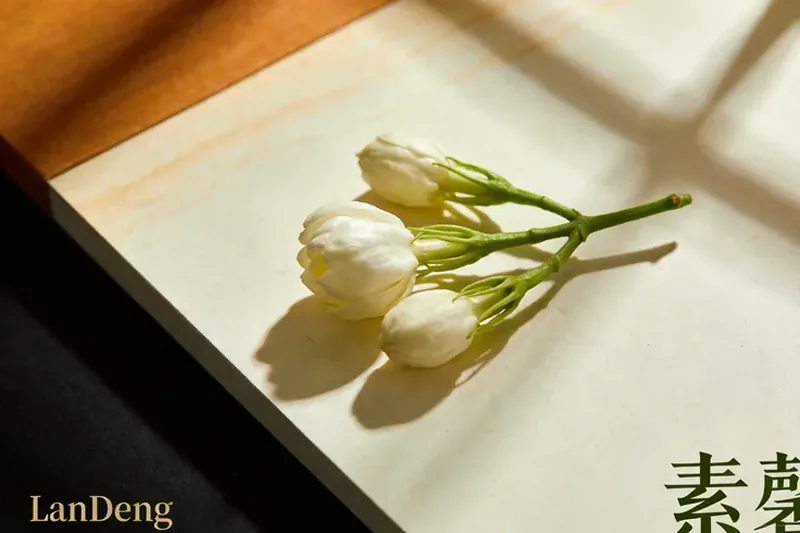
Direct answer: Jasmine grandiflorum (素馨, sùxīn) is the flower of Jasminum grandiflorum, the Spanish or royal jasmine, a climbing shrub of the olive family (Oleaceae) with large, intensely fragrant white flowers. It is the classic Western perfumery jasmine — the source of much jasmine absolute — and is recorded in the Chinese compendium 香乘 alongside its close relative 茉莉 (Jasminum sambac). The two jasmines are distinct species.
Key facts
| Chinese | 素馨 (sùxīn) — also 素馨花 |
| Botanical source | Jasminum grandiflorum (family Oleaceae) — the flowers |
| What it is | A flower, not a wood or resin |
| Aroma | Sweet, floral, heady, green |
| Traditional role | Perfumery jasmine; incense flower (香乘) |
Aroma profile
素馨 is intensely sweet and white-floral, with a heady, almost indolic depth that is richer than 茉莉’s tea-like sweetness. In natural absolute form it carries a warm, animalic undercurrent beneath the green-floral top; commercial jasmine notes are usually rendered cleaner and brighter. In a blend it pushes the scent toward opulent and romantic, where 茉莉 reads fresher and more delicate.
The 素馨 / 茉莉 distinction (read this)
Two Jasminum species sit at the centre of Chinese and global jasmine:
- 素馨 (Jasminum grandiflorum) — the “Spanish/Poet’s/royal jasmine,” larger flowers, the classic Western perfumery jasmine and jasmine-absolute source. This entry.
- 茉莉 (Jasminum sambac) — the tea-scented jasmine, the classic Chinese tea-and-fragrance jasmine. Its own entry.
Both appear together in the classical record — 香乘 lists 素馨 and 茉莉 as distinct flowers (for example, in 心字香 and in the ten-flower recipe 逗情香). This page describes 素馨 = Jasminum grandiflorum. When a source means 茉莉, it is describing Jasminum sambac.
Botanical source and origin
Jasminum grandiflorum is a scrambling evergreen shrub of the olive family (Oleaceae), native to South Asia and long cultivated across warm regions, including southern China. Its flowers are larger than those of J. sambac, white, and powerfully fragrant, opening at night. It is the principal source of commercial jasmine absolute and concrete for Western perfumery, and Flora of China records it among the cultivated Jasminum species.
In Chinese tradition
- Incense flower: 素馨 is recorded in 香乘 as a flower for incense and scenting — for example, in 心字香 (番禺人作心字香 用素馨茉莉半开者) and in the ten-flower 逗情香 recipe.
- Scenting method: classical sources describe steaming 素馨 and other fragrant flowers to capture their scent (蒸香).
- Perfumery: globally, 素馨 is the archetypal jasmine of fine fragrance, distinct from the tea jasmine.
Traditional use vs modern evidence
The aromatic and incense use is documented in classical and modern perfumery records. We make no medical claims. The documented, non-medical facts are botanical identity, the Oleaceae placement, and the sweet heady floral use.
Quality and sourcing notes
Practical points for buyers:
- Distinguish 素馨 (Jasminum grandiflorum) from 茉莉 (Jasminum sambac) — different jasmines with different scent character, and a label saying only “jasmine” is underspecified.
- True jasmine absolute is costly and delicate; in incense the scent is often carried as an accord over a wood or resin base.
- Expect a headier, more opulent white-floral character from 素馨 than from the tea-fresh 茉莉.
Safety
Incense combustion produces smoke and particulate matter. Burn in a well-ventilated space, avoid inhaling concentrated smoke, and keep away from children and pets. This is editorial knowledge content, not medical advice.
FAQ
What is 素馨 (suxin)? The flower of Jasminum grandiflorum, the Spanish or royal jasmine, a climbing shrub of the olive family (Oleaceae) with large, intensely fragrant white flowers. It is the classic Western perfumery jasmine and a principal source of jasmine absolute. It is recorded in the Chinese incense compendium 香乘 alongside its close relative 茉莉 (Jasminum sambac).
How does 素馨 differ from 茉莉 (jasmine)? Both are Jasminum species, but distinct. 素馨 is Jasminum grandiflorum — larger flowers, headier and more opulent, the classic perfumery jasmine. 茉莉 is Jasminum sambac — the tea-scented jasmine used for jasmine tea. 香乘 lists them as separate flowers (for example, in 心字香 and 逗情香), and each has its own entry here.
What does 素馨 smell like? Intensely sweet and white-floral, with a heady, almost indolic depth richer than 茉莉’s tea-like sweetness. In natural absolute form it carries a warm, animalic undercurrent beneath a green-floral top; commercial jasmine notes are usually rendered cleaner and brighter. In a blend it reads opulent and romantic.
Is 素馨 used in perfumery? Yes — it is the archetypal jasmine of Western fine fragrance and the principal source of commercial jasmine absolute and concrete. Its large, night-opening white flowers are picked for their intense scent and processed into absolute and concrete. In Chinese incense it appears as a flower material in 香乘, often paired with 茉莉.
What does the name 素馨 refer to? The flower of Jasminum grandiflorum (also 素馨花). It is distinct from 茉莉 (Jasminum sambac), the tea jasmine. Both are olive-family (Jasminum) climbers with sweet white flowers, but 素馨 is the headier, larger-flowered perfumery species, while 茉莉 is the fresher tea-scented species.
See also: jasmine, osmanthus, and the full scent guide.
Evidence & Sources
Botanical identity
Source: Jasminum grandiflorum in Flora of China · Jasminum grandiflorum on GBIF. Evidence type: Established.
Traditional Chinese use
Source: 素馨 as an incense and scenting flower in 香乘 (心字香, 逗情香). Evidence type: Historically documented — classical incense record.
Authenticity / disambiguation
Source: 素馨 (Jasminum grandiflorum) vs 茉莉 (Jasminum sambac) — distinct jasmines, listed separately in 香乘. Evidence type: Practical screening.
Safety
Source: incense combustion produces smoke and particulate matter; burn in a well-ventilated space. Evidence type: Established.
Evidence status
| Layer | Status |
|---|---|
| Botanical identity | Established |
| Traditional use | Historically documented |
| Authenticity test | Practical screening |
| Health claims | Not established |
Sources
Sources: botanical references on Jasminum grandiflorum and the suxin-vs-moli distinction. 素馨 is recorded as an incense flower in 香乘; no medical claims are made. This is editorial knowledge content, not medical advice.