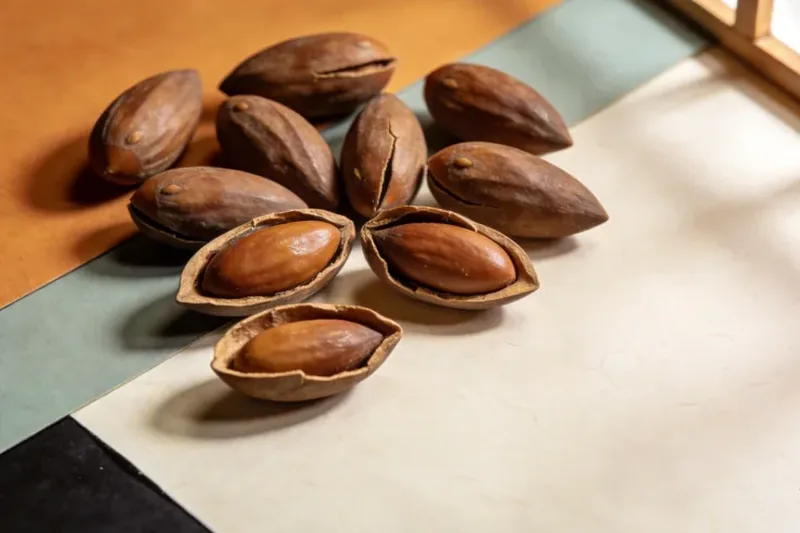
Direct answer: Torreya (香榧, xiāngfěi) is the nut of the Chinese torreya, Torreya grandis, an evergreen conifer of the yew family (Taxaceae) native to eastern China. The large, aromatic seed is a prized Chinese nut, and the Bencao Gangmu records it under 榧实 with the classical name 玉山果 (“jade-mountain fruit”), echoed in a poem by Su Dongpo.
Key facts
| Chinese | 香榧 (xiāngfěi); classical 榧实, 玉山果 |
| Botanical source | Torreya grandis (family Taxaceae) — the seed |
| What it is | A large aromatic nut/seed, a conifer product |
| Aroma | Nutty, woody, resinous, roasted |
| Traditional role | Culinary nut; 榧实 in materia medica |
Aroma profile
Direct answer: 香榧 is nutty and woody, with a resinous, slightly roasted, faintly sweet character — the scent of a rich, oily conifer nut. It is subtle and food-adjacent rather than floral or spicy, and its primary role is culinary rather than aromatic.
香榧 is nutty and woody, with a resinous, slightly roasted, faintly sweet character — the scent of a rich, oily conifer nut. It is subtle and food-adjacent rather than floral or spicy. Its primary role is culinary (the seed is eaten), and in aromatics the wood and seed contribute a quiet, warm, conifer-nut undertone rather than a lead fragrance. This is the honest framing: torreya’s aroma exists, but it is a food scent, not an incense note in the classical sense.
Botanical source and origin
Direct answer: Torreya grandis is an evergreen tree to 25 m tall of the yew family (Taxaceae), with an ellipsoid-to-ovoid seed 2–4.5 × 1.2–2.5 cm. It is native to the mountains of eastern China — southern Anhui, northern Fujian, Zhejiang, and adjacent provinces — at 200–1,400 m, and has long been cultivated for its large, edible, aromatic seeds.
Torreya grandis is an evergreen tree of the yew family (Taxaceae). Flora of China records it as a tree to 25 m tall, with linear-lanceolate leaves and an ellipsoid to ovoid seed 2–4.5 × 1.2–2.5 cm, the seed maturing in the second year (pollination April, seed maturity September–November of the second year). It grows in mountains, open valleys, and by streams at 200–1,400 m, native to southern Anhui, northern Fujian, northeastern Guizhou, western Hunan, southern Jiangsu, northern Jiangxi, and Zhejiang. The seed — commonly called 香榧 — is the material of value, with a hard shell enclosing an oily, aromatic kernel. See Torreya grandis in Flora of China.
The 玉山果 (yu shan guo) name (read this)
Direct answer: The Bencao Gangmu records the torreya under 榧实 with the classical name 玉山果 (“jade-mountain fruit”), and quotes Su Dongpo’s praise. Li Shizhen explains the name through the tree’s handsome grain — 文木 (“patterned wood”) — and names Yushan county as the finest source.
The Bencao Gangmu (本草纲目), in its fruit section (果之三), records the torreya under 榧实 with the classical name 玉山果 (“jade-mountain fruit”), and quotes the poet Su Dongpo (苏轼):
“彼美玉山果,粲为金盘实。” — “That lovely jade-mountain fruit, gleaming as a dish of gold.”
Li Shizhen explains the name: “榧亦作棐,其木名文木,斐然章采,故谓之榧。信州玉山县者為佳” — the tree is called 文木 (patterned wood) for its handsome grain, hence 榧, and the finest come from Yushan county in Xinzhou. The point for this encyclopedia: 香榧 is a valued Chinese nut with a genuine classical record — a culinary and materia-medica seed, not a burned incense material.
In Chinese tradition
- Culinary nut (Historical Record): 香榧 is a prized Chinese nut, eaten roasted for its rich, aromatic kernel — the documented primary use.
- 玉山果 (Historical Record): the Bencao Gangmu (本草纲目) records the classical name 玉山果, quoting Su Dongpo’s praise and Li Shizhen’s etymology.
- Materia medica (Traditional Use): 榧实 appears in traditional Chinese medicine. This is traditional materia-medica language, not modern clinical evidence.
Traditional use vs modern evidence
Direct answer: The culinary use is unambiguous and well documented; the medicinal uses are traditional, not established clinical fact. The documented, non-medical facts are botanical identity, the Taxaceae placement, and the culinary nut record.
- Traditional Use — 榧实 in traditional Chinese medicine. Traditional materia-medica language, not modern clinical evidence.
- Historical Record — the Bencao Gangmu record of 榧实/玉山果, with Su Dongpo’s poem and Li Shizhen’s etymology; the long cultivation of the torreya in eastern China for its edible seed.
- Scientific Evidence — the botanical identity of Torreya grandis (Taxaceae) is established. We present no clinical or medical efficacy claims.
The culinary use is unambiguous and well documented. Medicinal uses are traditional, not established clinical fact, and we make no medical claims.
Why is torreya catalogued here? (a framing note)
Direct answer: Torreya appears in this encyclopedia as a seed entity with a genuine classical record, positioned honestly as a culinary and materia-medica nut rather than invented as an incense staple. It is catalogued for its 榧实/玉山果 record and its conifer-seed identity, not for a classical burned-incense role it does not have.
香榧 is not a burned incense material, and this page does not claim otherwise. It is catalogued because:
- It is a named seed with a real classical record (榧实 / 玉山果 in the Bencao Gangmu), which the encyclopedia’s seed coverage should include.
- It is a conifer seed, which makes it a useful point of comparison with other conifer seeds and woods in the database.
- Its honest position — a culinary nut, not a 香材 — is itself part of the editorial discipline: a material is catalogued for what it genuinely is, not for an invented aromatic pedigree.
This is the same discipline applied to ginkgo and other food seeds: record the real identity and role, and say plainly when there is no incense use.
How is it processed?
Direct answer: Torreya is processed by harvesting the mature seed, removing the outer covering, and roasting the kernel for eating. There is no incense-processing tradition for the seed; its processing is culinary, and the aromatic note is a food scent rather than a prepared incense material.
The processing of 香榧 is culinary, not incense:
- Harvest — the mature seed is collected in autumn of the second year.
- Dehusk / shell — the outer covering and the hard shell are removed to reach the kernel.
- Roast — the kernel is roasted, which develops its rich, nutty, faintly sweet aroma.
There is no classical incense-processing record for torreya; it is prepared for eating, and its aroma is a byproduct of that culinary preparation.
What determines quality?
Direct answer: For the culinary nut, quality is a large, sound, well-filled kernel with a rich, oily, faintly sweet aroma. There is no incense-grading standard for torreya, because it is not an incense material; quality is judged as a nut, not as a 香材.
The quality factors are culinary:
- Kernel fullness — a large, well-filled kernel rather than a hollow or shriveled one.
- Aroma — a rich, oily, faintly sweet, roasted-nut character.
- Soundness — freedom from rancidity, mold, and insect damage.
Because torreya is a food seed, it is graded as a nut, not as an aromatic — a point that reinforces its honest positioning in this encyclopedia.
What buyers should look for
Direct answer: Buyers should understand that 香榧 is a culinary nut (Torreya grandis), not a burned incense material, and distinguish it from cypress seed (柏子, Platycladus orientalis) — a different conifer seed, different family, used in incense. Expect a nutty, woody, resinous, roasted character, and buy it as a food seed.
For a sourcing or culinary buyer:
- Identity — confirm Torreya grandis (香榧, Taxaceae), the Chinese torreya nut.
- Role — understand it is a culinary and materia-medica seed, not a burned incense material.
- Disambiguation — distinguish it from cypress seed (柏子, Platycladus orientalis), another conifer seed used in incense — different family (Cupressaceae vs Taxaceae), different use.
- Condition — large, sound, well-filled kernels with a rich, oily aroma and no rancidity.
Safety
Incense combustion produces smoke and particulate matter. Burn in a well-ventilated space, avoid inhaling concentrated smoke, and keep away from children and pets. This is editorial knowledge content, not medical advice.
Torreya vs cypress seed
Direct answer: Both are conifer seeds, but torreya (香榧, Torreya grandis) is a yew-family (Taxaceae) culinary nut, while cypress seed (柏子, Platycladus orientalis) is a cypress-family (Cupressaceae) seed used in incense. Different families, different uses — food versus incense.
| Torreya (香榧) | Cypress seed (柏子) | |
|---|---|---|
| Botanical source | Torreya grandis (Taxaceae) | Platycladus orientalis (Cupressaceae) |
| Character | Nutty, woody, resinous, roasted | Roasted, nutty, woody, softly resinous |
| Role | Culinary nut; 榧实 in materia medica | The incense material of 柏子香 |
Both are conifer seeds with a nutty, roasted character, but they belong to different conifer families and serve opposite roles — food versus incense. See cypress seed (柏子) and ginkgo nut (银杏) for the wider seed context.
Our Industry View
Direct answer: Torreya’s lesson is about honesty in cataloguing, not about aroma: a seed with a famous classical name (玉山果) and a genuine literary record is still a food, not an incense material — and a credible knowledge base records that distinction rather than inflating the material into something it is not. That honesty is what protects the encyclopedia’s authority.
From an editorial and sourcing perspective, torreya illustrates a discipline that matters more than any single ingredient: a famous name does not make a material an incense ingredient.
Three points follow:
- The record is real; the incense role is not. Torreya has a genuine classical record — 榧实/玉山果 in the Bencao Gangmu, Su Dongpo’s poem, Li Shizhen’s etymology. But that record is culinary and materia-medica, not aromatic. A credible knowledge base records the real role and states plainly that there is no classical burned-incense use, rather than inventing one to fill a template.
- Conifer seeds are a useful category, even when they are not incense. Cataloguing torreya alongside cypress seed (柏子, a genuine incense seed) and ginkgo (a food seed) lets the reader see the boundary clearly: same morphological category (seed), different families, different uses. That contrast is itself information.
- For buyers, the value is disambiguation. A buyer who encounters “香榧” or “榧实” should know they are looking at a food nut, not a 香材 — and should not confuse it with the incense seed 柏子. The honest label prevents a category error.
In our view, torreya’s commercial and editorial value is precisely its honesty — a named, sourced, correctly positioned culinary seed whose inclusion strengthens the encyclopedia’s credibility rather than diluting it.
Summary
Torreya (香榧) is the large, edible, aromatic seed of the Chinese torreya, Torreya grandis, an evergreen yew-family (Taxaceae) tree to 25 m tall native to the mountains of eastern China. It is a prized culinary nut with a genuine classical record — the Bencao Gangmu records 榧实 with the name 玉山果 (“jade-mountain fruit”), quoting Su Dongpo — but it is a food and materia-medica seed, not a burned incense material. It is distinguished from cypress seed (柏子, Platycladus orientalis, Cupressaceae), the conifer seed that is an incense material, by both family and use. Its inclusion here is an act of honest cataloguing, not a claim of aromatic pedigree.
FAQ
What is 香榧 (torreya)? The nut of the Chinese torreya, Torreya grandis, an evergreen conifer of the yew family (Taxaceae) native to eastern China. Its large, aromatic seed is a prized Chinese nut, and the Bencao Gangmu (本草纲目) records it under 榧实 with the classical name 玉山果.
Why is torreya called 玉山果 (jade-mountain fruit)? The name reflects the tree’s fine wood and a famous growing region. The Bencao Gangmu (本草纲目) records 玉山果 as a classical name and quotes Su Dongpo: “彼美玉山果,粲为金盘实” (that lovely jade-mountain fruit, gleaming as a dish of gold). Li Shizhen explains that the tree is called 文木 (patterned wood) for its handsome grain, and that the finest come from Yushan county.
What does torreya smell like? Nutty and woody, with a resinous, slightly roasted, faintly sweet character — the scent of a rich, oily conifer nut. It is subtle and food-adjacent rather than floral or spicy, and its primary role is culinary rather than aromatic.
Is 香榧 a burned incense material? Not in the classical tradition. Torreya is a culinary nut with a materia-medica record (榧实); it is not a burned incense ingredient. Its aromatic value is quiet — a warm conifer-nut undertone — rather than a lead fragrance. This page records it honestly as such rather than inventing an incense role.
What is the difference between torreya and cypress seed? Both are conifer seeds, but torreya (香榧, Torreya grandis) is a yew-family (Taxaceae) culinary nut, while cypress seed (柏子, Platycladus orientalis) is a cypress-family (Cupressaceae) seed used in incense. Different families and different uses — food versus incense.
Where does the Chinese torreya grow? In the mountains of eastern China — southern Anhui, northern Fujian, Zhejiang, and adjacent provinces, at 200–1,400 m — where it is long cultivated for its large, edible, aromatic seeds. The seed matures in the autumn of its second year, and the finest are traditionally associated with Yushan county.
See also: cypress-seed (柏子), pine-resin (松香), ginkgo nut (银杏), and the full scent guide.
Evidence & Sources
Botanical identity
Source: Torreya grandis in Flora of China · Torreya grandis on GBIF. Evidence type: Established.
Traditional Chinese use
Source: the Bencao Gangmu (本草纲目), 果之三, records 榧实 with the classical name 玉山果, quoting Su Dongpo (“彼美玉山果,粲为金盘实”). Evidence type: Historically documented — culinary nut; medicinal uses are traditional, not modern clinical evidence.
Authenticity / disambiguation
Source: 香榧 (Torreya grandis, Taxaceae) vs 柏子 (cypress seed, Platycladus orientalis, Cupressaceae). Evidence type: Practical screening.
Safety
Source: incense combustion produces smoke and particulate matter; burn in a well-ventilated space. Evidence type: Established.
Evidence status
| Layer | Status |
|---|---|
| Botanical identity | Established |
| Traditional use | Historically documented (culinary) |
| Authenticity test | Practical screening |
| Health claims | Not established |
Sources
Sources: botanical references on Torreya grandis and the Bencao Gangmu (本草纲目) 果之三 record of 榧实/玉山果. 香榧 is documented as a culinary nut; medicinal uses are treated as traditional, not established clinical fact. This is editorial knowledge content, not medical advice.